
What does a worldview reveal about how people understand life, relationships, and their place in the world? The phrase “African worldview” can sound abstract, and it may suggest that people across a vast, diverse continent share one way of seeing life. They don’t. Still, some African philosophical and spiritual traditions offer useful themes to explore, including community, nature, ancestors, and continuity across generations.
If you’re unsure where philosophy ends, spirituality begins, or religion fits in, start by looking at the context. These ideas take shape within particular histories, languages, communities, and living practices. This article explains the term, considers themes found in some traditions, and offers practical ways to learn without treating distinct traditions as interchangeable.
We’ll look at how relationships can connect the living, the natural world, and those who came before, while keeping differences between traditions in view. Approach ancestral wisdom through context, listening, and gradual study, rather than expecting a quick, universal answer.
Key Takeaways
- Use “African worldview” as a broad comparative term, not a label for one shared set of beliefs.
- Explore relationship and continuity as useful themes while staying attentive to differences among traditions and communities.
- When comparing examples, identify the people, place, language, and historical period behind each teaching.
- Begin with an open question, then consider whose knowledge is being shared and in what context.
- Structured digital study can support a gradual exploration of African culture, spirituality, and tradition.
What Does African Worldview Mean? Begin with a Careful Definition
A worldview is a set of assumptions and values through which people interpret life, understand their place in the world, and make sense of their responsibilities to others. It can shape what a community considers meaningful, how knowledge is passed on, and how people understand relationships between human beings and the wider world.
“An African worldview is a broad way of discussing how particular African communities make meaning of life, shaped by their own histories, places, languages, and traditions, rather than a single belief system shared across the continent.”
This distinction matters. The phrase can help frame comparisons, but it becomes misleading when it turns many intellectual and spiritual traditions into one doctrine. African philosophy offers a wider introduction to philosophical thought expressed through ideas, practices, and beliefs. Treat broad overviews as starting points, then look for sources that explain a specific community and its context.
Why There Is No Single African Worldview
Africa encompasses many cultures and languages, shaped by distinct environments, migrations, political histories, and forms of community life. Those differences do not produce one shared answer to life’s questions. They shape particular perspectives, which can also change across generations and within communities.
Lineage, place, and lived experience may all matter, but their meanings differ from one tradition to another. A teaching connected to one community cannot automatically explain another. When you encounter a claim about “African belief,” ask: whose tradition is being described, where, and in what historical setting? If the source doesn’t answer those questions, treat its claim as broad or incomplete rather than applying it to the continent as a whole.
Worldview, Spirituality, and Religion: How the Terms Relate
These terms overlap, but they aren’t interchangeable. A worldview is a broad interpretive lens. Philosophy involves reflection and reasoning about questions such as knowledge, ethics, and reality. Spirituality may describe ways people seek meaning or understand relationships with what they consider sacred. Religion often refers to shared teachings, practices, institutions, or forms of devotion. In daily life, these boundaries can be porous: a community’s assumptions about life may inform both spiritual practice and religious expression.
That overlap doesn’t mean every African community holds the same spiritual beliefs, or that every person relates to inherited traditions in the same way. For a closer look at spiritual traditions and ancestral themes, continue with this guide to African spirituality and ancestral wisdom. Pay attention to the tradition and context each source names.
How Relationships and Continuity Shape Some African Worldviews
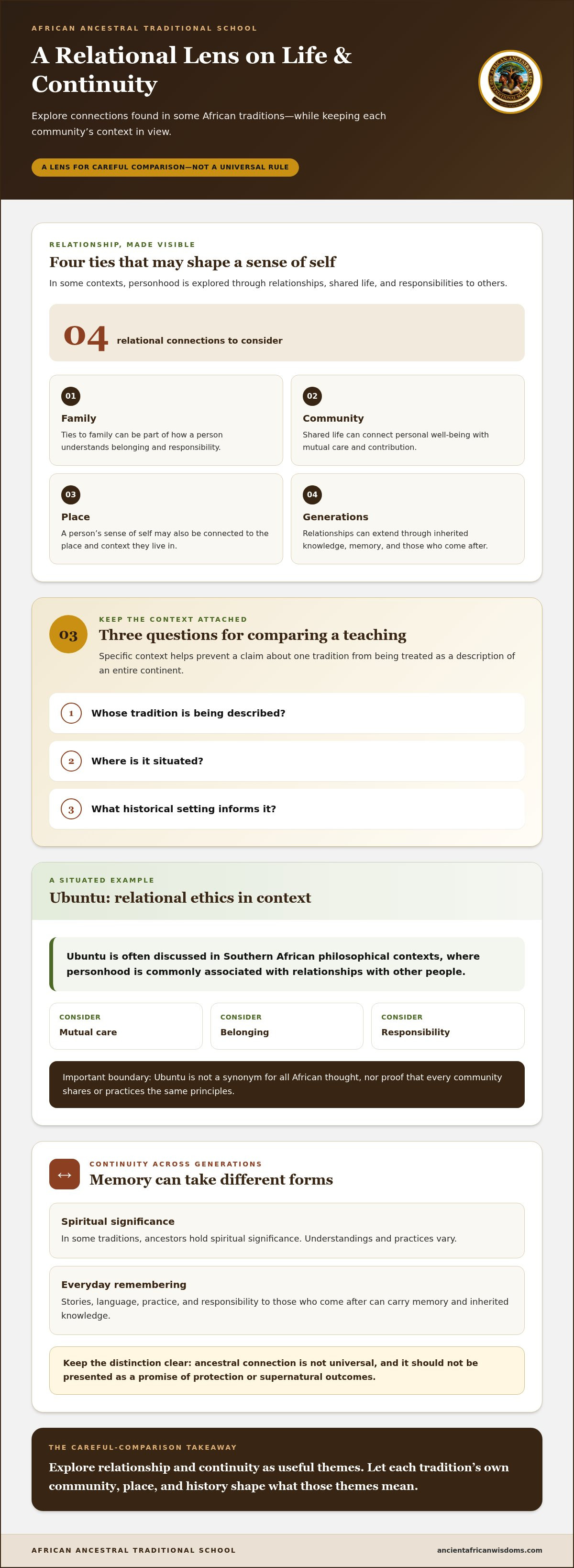
Relationship is one useful way to explore some African traditions, but it is not a rule that explains every community. In particular contexts, a person’s sense of self may be understood through ties to family, community, place, and generations. These connections can involve responsibilities as well as belonging. People may be understood not only as individuals, but also through their relationships and contributions to shared life.
In some African philosophical traditions, ideas about personhood and the good life are explored through relationships with others, though their meanings vary by community and context. Use this as a lens for careful comparison, not as a claim of continent-wide agreement. The African Studies Centre Leiden’s discussion of African philosophies and contemporary challenges offers one perspective on how such ideas can remain relevant to present-day questions.
Personhood, Community, and Mutual Responsibility
Ubuntu is one situated example of relational ethics, often discussed in Southern African philosophical contexts. It is commonly associated with the idea that personhood is shaped through relations with other people. In this context, it can prompt questions about mutual care, belonging, and responsibility: how might one person’s well-being connect with the well-being of others?
Ubuntu shouldn’t be used as a synonym for all African thought, or as proof that every community puts its principles into practice in the same way. It is a philosophical concept with its own contexts and interpretations. Other traditions may describe responsibility, community, and personhood through different ideas and histories. Keep those distinctions visible so that a specific teaching can be understood on its own terms.
Ancestors, Memory, and Continuity Across Generations
Continuity can connect present lives with family memory, inherited knowledge, and those who came before. In some traditions, ancestors hold spiritual significance; in others, lineage and memory may be discussed in different terms. Practices and understandings vary. Don’t present ancestral connection as universal or as a promise of protection or other supernatural outcomes.
Continuity can also be understood through the everyday work of remembering: stories shared across generations, knowledge carried through language and practice, and responsibility to those who will come after. These forms of memory can shape identity without requiring everyone to interpret them in the same spiritual way. For a more focused exploration, read about ancestral veneration in the African diaspora.
Let the tradition and its context guide your questions as you continue learning. Structured digital study in African culture, spirituality, and tradition can help you deepen that inquiry through African ancestral learning.
African Worldview in Context: Compare Themes Without Flattening Traditions
Comparison can reveal questions worth exploring, but it shouldn’t make distinct traditions seem interchangeable. Start by asking how a specific source describes a theme, such as community, land, or cultural memory, within its own setting. The table below offers questions for responsible comparison, not fixed descriptions of entire peoples.
| Tradition named in a source | Theme to explore | Context to establish |
|---|---|---|
| Yoruba | How a particular source discusses community or continuity | Which community, place, period, and meaning of the terms it describes |
| Igbo | How a particular source discusses belonging or cultural memory | Whether it addresses a specific community and historical setting |
| Akan | How a particular source discusses land, lineage, or shared life | Which interpretation and practices are documented, and for whom |
These names point to broad cultural contexts, not single, unchanging systems of belief. The table doesn’t claim that a theme means the same thing across Yoruba, Igbo, and Akan communities. It highlights what to establish before drawing a comparison.
What a Responsible Cultural Comparison Looks Like
Choose sources that name the community and explain the concepts they discuss. Then compare like with like: for example, a teaching from a particular place and period with another teaching whose context is equally clear. Similar-sounding words or practices don’t automatically have identical meanings. Look for differences in terminology, interpretation, and how knowledge is shared or practiced. If a source leaves those details unclear, treat its claims as limited instead of filling gaps with assumptions.
This approach also helps prevent ranking traditions as more ancient, authentic, or complete than others. Comparison is not a contest. It can help you notice meaningful connections and distinctions without asking one community’s history to stand in for another’s.
Why History and Cultural Memory Matter
Knowledge is carried through people, language, teaching, and memory, and what survives or is shared can be shaped by historical change. A documented account, a community’s interpretation of its past, and a present-day spiritual reflection may speak to one another, but they aren’t the same kind of evidence. Keep those layers distinct as you read. For more on how knowledge and memory connect, explore African indigenous knowledge and cultural memory.
A worldview is a starting point for careful questions, not a shortcut to sweeping conclusions. As you read, note which tradition a source represents and keep its particular history in view.
How to Explore an African Worldview with Respect and Reflection
Move from curiosity to context before drawing conclusions. Rather than deciding in advance what a tradition must teach, begin with a question and make room for answers that may differ across communities. Then connect ideas to the setting a source describes, such as its understanding of responsibility to family, place, or generations.
Questions to Bring to Your Reading
Before interpreting a source, identify who is speaking and what their account covers. These questions can help you read with care:
- What am I hoping to understand? Begin with an open question, rather than a predetermined spiritual conclusion.
- Whose tradition and perspective are represented? Identify the community, place, language, and historical period the source addresses.
- What shapes this account? Consider how family, local history, land, or diaspora experience may inform the perspective.
- What kind of statement am I reading? Separate what the source documents from what it interprets or presents as personal belief or reflection.
Before generalizing about a worldview, check which community, place, language, and historical period the source actually describes. Keep these details beside your notes, especially when comparing accounts. If a source doesn’t provide enough context, limit your conclusion to what it does say instead of filling in the blanks yourself.
Learning Without Treating Traditions as Interchangeable
Choose community-grounded sources that explain their scope, and let each voice represent the experience it actually addresses. A single author, text, or teaching can offer meaningful insight without speaking for every community. If two sources use similar terms, compare how each defines them before assuming they mean the same thing.
Approach sacred knowledge with humility, too. Not every teaching is intended for public sharing, and reading about a practice doesn’t automatically make it appropriate to reproduce. You can learn, reflect, and ask thoughtful questions without prescribing rituals or claiming authority over a tradition. A patient pace leaves room for cultural distinctions and for the possibility that some answers belong within community contexts.
To continue your learning, explore structured digital courses in African culture, spirituality, and tradition through African ancestral study. Step by step, study can deepen understanding while keeping reflection grounded in context.
Continue Your Study Through Structured African Ancestral Learning
The central lesson is simple: themes such as relationship, community, and continuity can open a path into study, but they aren’t a universal formula for understanding African traditions. Each teaching belongs to particular histories and communities. Keep asking whose knowledge you’re learning, and let context guide what you take from it.
What Structured Digital Learning Can Offer
Complex teachings often take time to understand. Structured digital courses in African culture, spirituality, and tradition let learners approach ideas progressively and return to questions as their knowledge grows. Tiered online learning provides a pathway through different levels of study, while community access gives learners space to connect and share thoughtful discussion.
Learning alongside others can support reflection, but it doesn’t make every participant’s experience the same. An online course also doesn’t replace community-specific teaching or the lived relationships through which cultural knowledge may be carried. Treat it as one way to deepen your study while staying attentive to the distinct sources, people, and traditions you encounter.
Choose a Thoughtful Next Step
Let your questions shape what you explore next. You might want to learn about a specific spiritual teaching, cultural tradition, or approach to ancestral knowledge. Focusing on one topic can help you continue at a steady pace without expecting one course or source to explain every African community. For a related starting point, read this guide to African ancestral spirituality courses.
As your understanding develops, the meaning of a worldview can become clearer through careful study and reflection, rather than through one sweeping definition. Explore African ancestral learning when you’re ready, and follow the questions that feel meaningful to you. Learning can unfold one thoughtful step at a time.
Carry Your Learning Forward with Care
Understanding an African worldview begins with recognizing that no single account can represent the continent’s many traditions. Relational themes such as community, ancestry, and continuity can offer thoughtful entry points, but their meanings belong to particular cultural and historical contexts. Read closely, ask whose perspective a source represents, and let differences remain visible rather than forcing them into one explanation.
Learning can continue gradually. The African Ancestral Traditional School offers online education in African spirituality, culture, and tradition, with structured learning levels and community access to support ongoing study. Its digital courses give you a way to explore these subjects progressively and return to questions as your understanding develops.
Ready to continue exploring? Explore African ancestral learning at your own pace through the African Ancestral Traditional School’s digital courses and structured learning levels.
Frequently Asked Questions
What is an African worldview?
An African worldview is a broad way to describe how particular African communities understand life, meaning, relationships, and people’s place in the world. It isn’t one doctrine shared across the continent. Its ideas take shape through distinct histories, languages, communities, and spiritual traditions. For a grounded explanation, look for the specific people and context a source discusses, rather than assuming one account can represent every African culture.
Is there one African worldview?
No. There isn’t one worldview that represents every African culture or community. The phrase can introduce questions about community, nature, spirituality, or continuity, but the answers vary across traditions and historical settings. Similarities can be meaningful, yet they don’t erase differences in belief, language, or practice. As you read, notice which community a source describes and whose knowledge or perspective informs its account.
How does African worldview differ from Western worldview?
Neither “African worldview” nor “Western worldview” describes one uniform perspective, so the difference depends on which traditions are being compared. Some African philosophical or spiritual traditions emphasize relationships among people, community, land, and generations; particular Western traditions may frame these connections differently. These are broad possibilities, not fixed opposites. A fair comparison identifies the specific thinkers, communities, and histories involved instead of generalizing about all Africans or all Westerners.
What role does community play in African worldviews?
In some African philosophical traditions, community helps shape ideas about belonging, responsibility, and personhood. Ubuntu, often discussed in Southern African philosophical contexts, is one example of relational ethics, not a summary of all African thought. Its interpretations and applications can vary, as can communal values across societies. To understand a particular account, consider who is explaining the concept, the context they describe, and how their perspective relates to community life.
Do all African traditions believe in ancestors?
No. Beliefs and practices concerning ancestors differ among African communities and aren’t universal to every tradition or individual. Where ancestral relationships are significant, their meaning and forms of engagement also vary. Avoid treating one description as representative of everyone, or assuming that ancestral belief guarantees a particular outcome. Look for sources that name the tradition and distinguish cultural explanation from personal interpretation, especially when learning about sacred practices or community-specific teachings.
How can I learn about African worldviews respectfully?
Begin with a specific question, then identify the community, tradition, language, place, and historical period a source addresses. Seek perspectives grounded in the communities being discussed, and distinguish documented information from interpretation or personal belief. Be cautious of accounts that present one practice as universal or assume all sacred knowledge is public. Taking time to understand a source’s scope helps you recognize shared themes while respecting cultural differences.
What is the difference between African worldview and African spirituality?
A worldview describes the assumptions and values through which people interpret existence and their place in it. Spirituality refers to ways people understand or engage with sacred, spiritual, or transcendent dimensions of life. The ideas can overlap, but the terms aren’t interchangeable. Both cover diverse traditions, so a clear explanation should identify its cultural context. Avoid treating either term as one unified system shared by every African community.


