
What if understanding your ancestors means more than tracing a family tree? For many people, ancestry begins with names, stories, and kinship. In some African spiritual traditions, ancestors also hold a sacred place in how communities understand memory, responsibility, and the living world.
If these meanings seem difficult to separate, you’re not alone. The word “ancestor” can refer to biological forebears, people remembered through cultural tradition, or spiritual beings. Its meaning depends on the community and context. African traditions are not interchangeable, and relationships with ancestors are not all understood as worship.
This guide distinguishes lineage from cultural memory and spiritual understandings, and explores why ancestors matter in particular traditions. It also offers a respectful starting point for further learning: study each teaching in context, listen carefully, and avoid assuming that one community speaks for all. Patient, grounded study can deepen your understanding of ancestry and the wisdom carried across generations.
Key Takeaways
- Separate biological descent, family memory, and spiritual meaning when considering who your ancestors are.
- Use stories, names, and records to explore lineage, while recognizing that a family tree alone doesn’t establish spiritual significance.
- Approach terms such as veneration and worship with care. Their meanings and associated practices vary across traditions.
- Start your research with a clear question, gather family accounts, and note what is known, uncertain, or passed down.
- Build cultural context through patient, structured learning, including online courses and community access focused on African spirituality, culture, and tradition.
What Does Ancestor Mean? Understanding Family, Lineage, and Spiritual Meaning
An ancestor is a person in an earlier generation from whom someone is descended. Ancestry is the broader history of descent and heritage. These words can also carry family memories and spiritual meanings, but those layers are related, not identical. A record may establish a relationship without explaining the place that person holds in a family’s stories or spiritual life.
“Ancestors are people remembered through descent, while the meanings attached to them belong to particular families and cultural traditions.” This distinction matters because no single definition or practice is shared by every African community. The meaning of an ancestor depends on the people, history, and tradition being discussed.
Ancestor, ancestry, and lineage: what is the difference?
An ancestor is an individual in a preceding generation. Ancestry refers to the descent or heritage connecting someone with earlier generations, while lineage describes how relationships may be traced and understood within a family or community. Depending on the context, lineage can shape identity, belonging, or inheritance.
Different sources preserve different parts of this history. A family record might document a name, date, or relationship. An oral account may preserve memories, explanations, and details missing from written documents. Record both, noting where accounts agree, differ, or leave questions open.
Why does the meaning of ancestors depend on cultural context?
Families and spiritual traditions interpret relationships with the dead in different ways. In some settings, “ancestor” may refer mainly to deceased relatives. In others, the word carries spiritual significance shaped by particular teachings and practices. Don’t infer these meanings from genealogy alone or generalize across a continent with diverse histories and traditions.
Terms such as “veneration” and “worship” also need context. They can describe different ideas, and neither should be applied automatically to every relationship with the dead. For a broad comparative overview, see Ancestor Veneration in African Cultures, then look for sources grounded in the particular community or tradition you’re studying. You can also explore African spirituality and ancestral wisdom for broader context. As you read, ask whose understanding is being described and what history gives it meaning.
How Ancestors Relate to Lineage, Memory, and Community
Lineage is carried through more than a list of names. Family stories, records, and shared customs can each preserve part of a community’s understanding of where people came from and how relationships connect across generations. Together, these sources offer clues, though they may not tell the same story or answer every question.
Ancestry may trace family history, while the spiritual meaning of ancestors depends on the traditions and communities that interpret it. A family tree can help document relationships, but it can’t establish by itself what spiritual significance a person holds. That meaning belongs to a particular cultural context, not to genealogy alone.
What can oral history and family records tell us?
An oral account might preserve a relative’s name, a place of origin, a migration, or a story connected to a family practice. Treat it as meaningful testimony to document and contextualize, rather than as automatically verified fact. Record who shared the account, when you heard it, and whether another source supports or differs from it.
As you gather material, note names, places, relationships, dates when known, and the source of each detail. Written records can confirm some connections, while family testimony may preserve memories those records don’t capture. Displacement, enslavement, migration, and missing or inaccessible records can make research difficult. Gaps don’t make a family’s history less worthy of care. They call for patience and clear notes about what remains uncertain.
How can cultural memory carry ancestral knowledge forward?
Memory also lives in shared practices. Stories passed across generations, language, values, and community customs can carry knowledge about belonging and history, even when an individual family line is difficult to document. These forms of cultural memory may be communal rather than a record of one direct line of descent.
That distinction matters. Learning a story or inherited practice can connect you with a community’s past, but it isn’t the same as claiming direct personal contact with the dead. Interpretations of spiritual relationships vary, so let the tradition and the people who carry it shape your understanding. For a deeper discussion, read about cultural memory and Indigenous knowledge.
To keep your research grounded, separate what you’ve documented from what you’ve heard, and mark unanswered questions without rushing to fill them. If you want to study how African spirituality, culture, and tradition shape these ideas, explore structured African learning at your own pace.
Ancestor Veneration, Worship, and Other Spiritual Relationships
Words such as “veneration” and “worship” can carry different meanings depending on who uses them. Veneration often describes showing honor or reverence; worship can suggest devotion understood as religious worship. These are working distinctions, not fixed labels accepted by every community. Some writers use the terms differently, and some people may use neither to describe their own tradition.
There isn’t one African approach to relationships with the dead. Beliefs and practices vary among communities, families, and spiritual traditions, and broad statements can flatten those differences. A gesture of remembrance, a spiritual teaching, and a community ritual shouldn’t be treated as interchangeable or assumed to have the same meaning everywhere.
Is ancestor veneration the same as worship?
Not necessarily. The answer depends on how a community defines the relationship and how a particular source uses its terms. Rather than deciding based on an outside label, ask what the practice means to the people who hold it: What is being expressed? Who is addressed? How does the tradition describe the relationship? For focused discussion of African-diasporic perspectives, read about ancestor veneration in the African diaspora.
How should readers understand tradition-specific beliefs?
Look for the specific community, tradition, or speaker behind a claim. Separate a documented teaching from an author’s interpretation, and distinguish both from your own assumptions. Sacred knowledge isn’t a universal checklist. Details may belong to a particular context and may not be appropriate to generalize.
The comparison below offers questions for reading, not a universal classification. Ground each term’s meaning in the source using it.
| Term | Possible meaning in a source | Respectful question to ask |
|---|---|---|
| Veneration | Honor or reverence, as the source defines it | How does this community describe the act and its purpose? |
| Worship | Devotion described in religious terms | Is this the community’s own word, or an outside label? |
| Remembrance | Keeping a person or history present through memory | Is the source describing cultural memory, spiritual practice, or both? |
Read with care and let each source speak within its own setting. This helps you learn about ancestors without mistaking one interpretation for a shared belief across African peoples.
How to Explore Your Ancestral Roots with Care and Curiosity
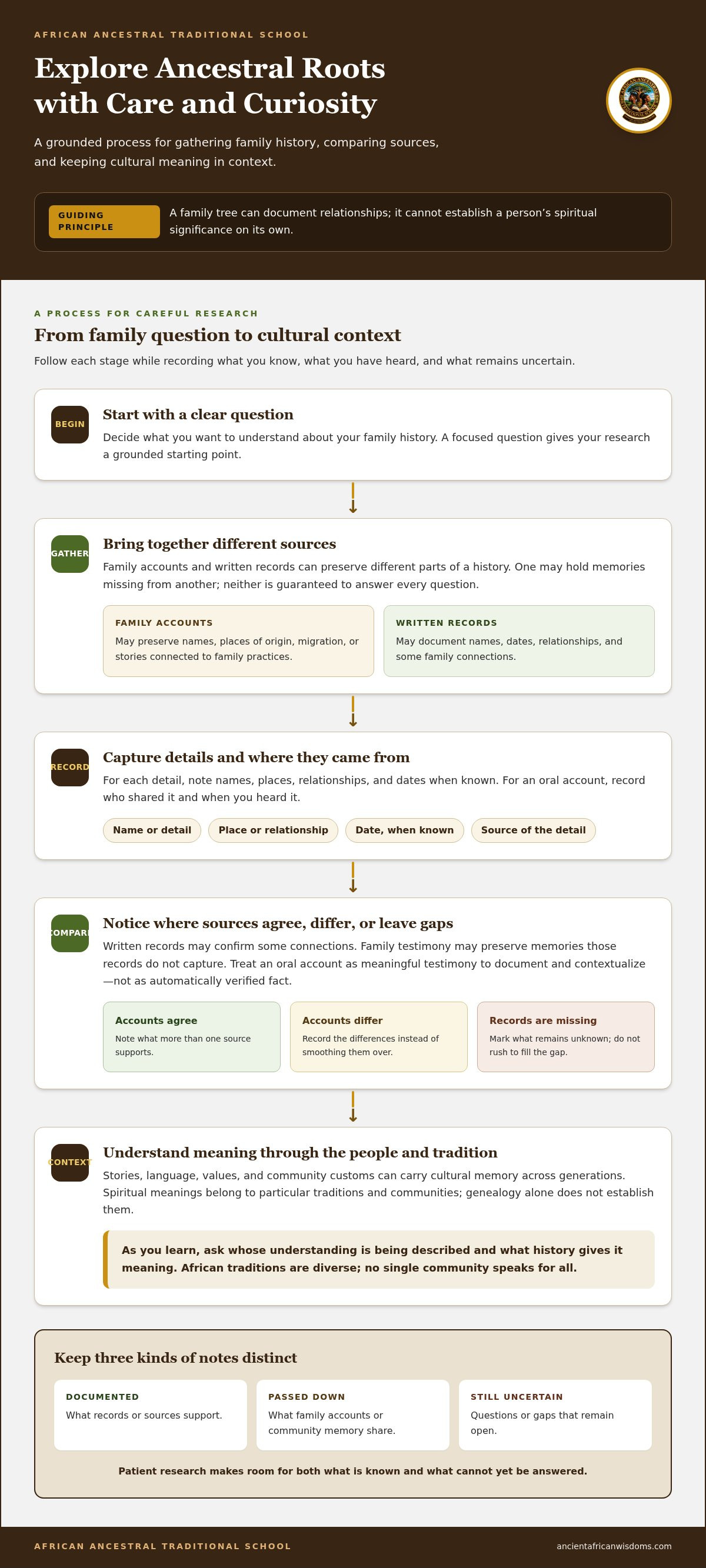
Begin with a question you can explore, such as “What places did my family live?” or “Which stories have been passed down about our names?” A clear starting point makes research manageable and helps you distinguish family history from assumptions about spiritual meaning.
Move through the inquiry patiently: gather family accounts, record where each detail came from, and study the historical and cultural context. Label what is documented, what you’ve heard, and what remains uncertain. A gap isn’t an invitation to invent an answer.
Where can you begin if family records are incomplete?
Start with what’s already within reach: names, places, languages, relationships, dates, photographs, letters, and stories shared by relatives. Ask permission before recording someone’s account, and note who shared it and when. If memories differ, preserve each version instead of forcing them into one account.
Displacement, enslavement, migration, and missing records can interrupt the paper trail. The effects differ across families and histories, so look for reliable sources specific to the time and place you’re researching. Keep a simple record with three headings: known, uncertain, and source. This makes it easier to revisit questions without mistaking a possibility for a fact.
How can you learn without generalizing or appropriating?
Choose sources that name the community, tradition, or people whose knowledge they discuss. Notice whether a statement comes from a documented teaching, a writer’s interpretation, or personal reflection. One account can offer insight, but it shouldn’t stand in for every African community or define what your own family believes.
Approach learning as study, not as a claim to authority. Listen, take notes, and ask thoughtful questions while respecting that some knowledge belongs within particular cultural settings. Learning about ancestors doesn’t require you to adopt a practice or reach a spiritual conclusion.
If you’re looking for the separate practical topic of rituals, explore African ancestral rituals for beginners. For deeper study grounded in African spirituality, culture, and tradition, explore structured African ancestral learning at your own pace.
Continue Learning About Ancestors Through Structured African Education
Independent research can open meaningful questions, but it may not explain how a particular idea fits within a wider cultural or spiritual tradition. Structured study offers a way to follow concepts over time, connect them with their contexts, and notice where practices and interpretations differ. This can help you approach what you discover with care instead of treating a single account as universal.
What can structured study add to independent research?
Family research and cultural learning serve different purposes. A relative’s account or a record can help you understand your own history; a curriculum can place spiritual ideas within broader study of African culture, spirituality, and tradition. One doesn’t replace the other. Together, they can support a more grounded understanding of what you know and what you’re still learning.
The African Ancestral Traditional School offers online courses focused on African spirituality, culture, and tradition, with learning levels and community access. A structured learning path gives you room to build understanding step by step, while community access provides a setting for shared study. Courses don’t determine your family history or speak for every tradition. Your own questions and research remain part of the process.
As you learn, return to context: Which tradition is being discussed? What does the source say, and what remains open to interpretation? These questions make space for curiosity while honoring the distinct histories and teachings behind the material.
How can you take the next step in your learning journey?
Choose a starting point that matches your interest. You might study African spiritual teachings, explore cultural traditions, or build a wider foundation before going deeper into a particular subject. Move at a pace that allows you to reflect, revisit your notes, and connect new learning with the questions you already carry.
Learning about ancestors doesn’t require rushing toward a conclusion. It can be a steady practice of listening, reading, and understanding ideas in their proper context. Online education offers structure for that exploration, while community access gives learners a place to share in study.
If you’re ready to continue, explore African ancestral teachings and online courses through the school’s educational programs.
Carry Your Learning Forward with Care
Exploring ancestry can begin with family names, stories, and records, but spiritual meaning belongs within the cultural traditions that shape it. The word “ancestor” doesn’t carry one universal meaning across African communities, and a family tree alone can’t answer every question. Let curiosity guide you, track what you know and what remains uncertain, and seek context before drawing conclusions.
Learning is a continuing journey. Structured study can help you understand African spiritual teachings within their cultural settings, while leaving room for your own family research and reflection. Digital courses focused on African spirituality, culture, and tradition, tiered learning levels, and community access offer a way to keep exploring at your own pace.
When you’re ready to take the next step, explore African ancestral teachings and online courses. Approach each question with patience and respect. Every thoughtful step can deepen your understanding of the histories and wisdom you’re exploring.
Frequently Asked Questions
What does ancestor mean?
An ancestor is a person from an earlier generation in a family or lineage. The word can also carry spiritual meaning, depending on a community’s teachings and practices. Those meanings aren’t identical across African traditions, so identify the particular community or source being discussed. Records or oral history may document a family relationship, while understanding its spiritual significance requires cultural context beyond genealogy alone.
Are ancestors worshipped in African spiritual traditions?
There isn’t one answer that applies to every African spiritual tradition. Some communities describe honoring or venerating ancestors, but the meanings and forms of these relationships depend on cultural context. Sources may also use “worship” and “veneration” differently. Rather than applying one label broadly, look for an explanation that names the tradition and describes how its community understands the relationship.
What is the difference between ancestors and ancestry?
Ancestors are people from earlier generations, while ancestry refers to descent, heritage, or the family lines through which history is traced. A family tree can help document relationships, but it doesn’t explain every meaning a community may give to ancestors in a spiritual context. Keep genealogical information distinct from spiritual interpretation, and consider the tradition and source before drawing conclusions.
Can I learn about my ancestors if my family records are incomplete?
Yes. Begin with the names, places, languages, dates, and family stories available to you, and record the source of each detail. Mark gaps as unknown rather than filling them with guesses. Displacement, enslavement, migration, and missing records can complicate family research. Incomplete documents don’t establish spiritual meaning, so study cultural interpretations separately and in the context of the specific tradition being discussed.
How do African traditions understand ancestors?
African peoples and spiritual traditions understand ancestors in diverse ways, so no single account represents them all. Discussions may involve lineage, memory, community, or spiritual relationships, with meanings shaped by particular teachings and histories. For a grounded explanation, check which community a source names, what cultural setting it describes, and whether it distinguishes documented teachings from broad interpretation. Avoid assuming one tradition’s account applies to another.
How can I learn about African ancestors respectfully?
Start with sources that identify the community or tradition behind their claims, and compare those claims with reliable cultural or scholarly material. Keep family-history research separate from spiritual interpretation, and be clear about what remains uncertain. Structured study can help build context over time. The African Ancestral Traditional School offers digital courses on African spirituality, culture, and tradition, with learning levels and community access for shared study.


