
What are African traditional spiritual practices? The answer varies across communities, histories, and lineages. Practices such as honoring ancestors, ceremony, music, healing, or divination can hold different meanings from one tradition to another, so a broad online summary may leave important context out. Understanding the topic begins with recognizing that there is no single system to learn.
If unfamiliar terms or sacred customs make you pause, that care is a good place to begin. This article will help you recognize the breadth of African spiritual traditions, understand broad practice categories without treating them as universal rules, and approach further learning with respect. We’ll explore how community, lineage, and local history shape belief and practice, then offer practical ways to assess what a source explains and what it leaves unclear. You’ll also find a starting point for continued study through structured learning that keeps cultural context in view.
Key Takeaways
- What are African traditional spiritual practices? The answer depends on specific communities, histories, and lineages, not one universal system.
- Consider community history and local context before interpreting a ceremony, teaching, or observance.
- Use broad practice categories as starting points for learning, not as a checklist shared by every tradition.
- Build a respectful learning approach by identifying the tradition, understanding its terminology, and pausing before drawing conclusions.
- Tiered online courses and community access can support gradual study of African spirituality, culture, and ancestral teachings.
What are African traditional spiritual practices? Start with diversity, not a single definition
What are African traditional spiritual practices? The phrase broadly describes culturally grounded ways people relate to spiritual life, community, and heritage. These may include beliefs, teachings, observances, and relationships understood within a particular cultural setting. It’s an introductory umbrella, not the name of one shared faith or a guide to universal customs.
Africa is home to many peoples, languages, histories, and spiritual traditions. Beliefs and practices have developed within distinct communities and places, and some have also been shaped by movement, exchange, and changing circumstances. An overview can introduce the subject, but it can’t explain every tradition’s meanings or protocols. The African Traditional Religions article offers a broad starting point. Read summaries like this for orientation, not as a substitute for context specific to a community.
Why there is no single African spiritual practice
Customs and meanings can vary between communities, families, lineages, and regions. Even when practices look similar from a distance, their purpose, language, and place in community life may differ. For example, remembrance of ancestors in one tradition shouldn’t automatically be treated as equivalent to an observance elsewhere. Similarity can prompt a question, but it doesn’t prove that two practices share the same meaning or rules.
Broad labels can help readers begin, but they can also hide important distinctions. “African” names a vast continent, not a single cultural identity. “Traditional” doesn’t mean every custom is ancient, unchanged, or shared by all. When you encounter an unfamiliar practice, look for the specific people and context associated with it. If those details aren’t available, keep your description general rather than filling gaps with assumptions.
How to understand the word “traditional” today
Tradition is often imagined as something fixed in the past. A more careful view recognizes knowledge and practice carried forward, interpreted, and lived across generations. People may preserve teachings while responding to new conditions, and traditions can be expressed in changing ways without losing their cultural meaning. How that continuity is understood belongs to the communities who carry it.
A tradition is knowledge and practice carried across generations, with meaning shaped by the people who continue to live it. This is a broad working definition, not a claim that every community describes tradition in the same way.
As you continue, keep broad explanations separate from community-specific names, meanings, and protocols. That distinction makes room for learning without turning diverse spiritual lives into a checklist. For a wider introduction to ancestral wisdom and its cultural context, explore African Spirituality: A Guide to Ancestral Wisdom.
How community, lineage, and place shape African spiritual practices
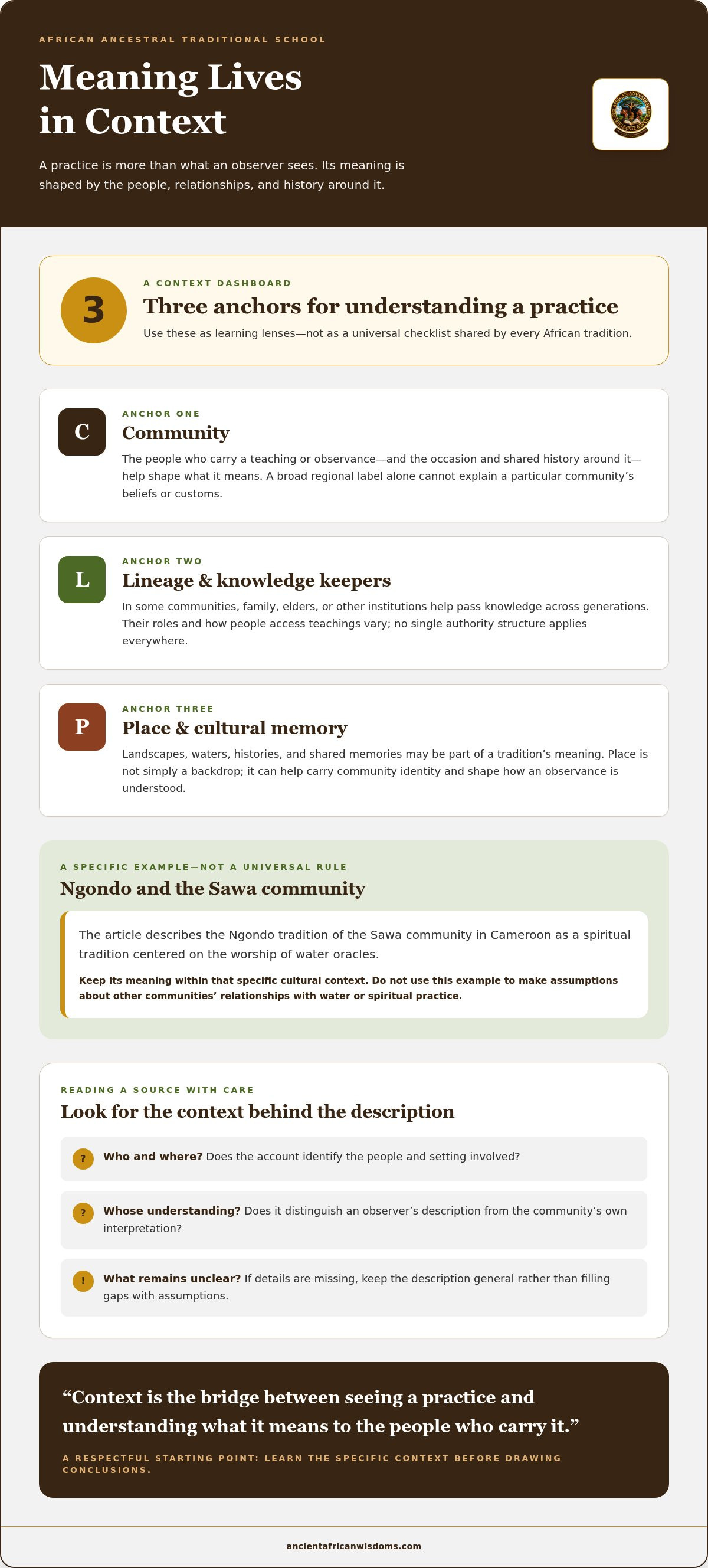
A ceremony or teaching gains meaning through the relationships around it. The people who carry it, the occasion for its observance, and the community’s history can all shape how it is understood. A description that names an action but leaves out these relationships may tell you what an observer sees while missing why the practice matters to those who know it.
That’s why broad regional labels are only a starting point. “West African,” for example, covers many peoples and histories; it doesn’t explain a particular community’s beliefs or customs. When asking what a practice means, consider not only what it looks like, but which people describe it, what language they use, and what local context informs it.
What lineage and community context can clarify
In some communities, family, elders, or other community institutions help pass knowledge across generations. Their roles and the ways people access teachings vary; there is no single authority structure shared by every tradition. Who performs an observance and where it takes place may affect its meaning. Public accounts can offer useful orientation, yet they may not convey community-specific interpretations or protocols.
Approach a description as an opening, not a complete account. Ask what context it provides: Does it identify the people and setting involved? Does it distinguish an observer’s description from the community’s own understanding? If those details are absent, avoid treating a brief explanation as a rule that applies elsewhere. This doesn’t mean you can’t learn from public sources. It means recognizing what they may not show.
How place and cultural memory shape practice
Spiritual relationships may be connected to particular landscapes, waters, histories, or shared memories. Place isn’t simply a backdrop; within a tradition, it may help carry community identity and shape how an observance is understood. The meaning of a practice can’t always be separated from the stories and relationships that give it life.
The Ngondo tradition of the Sawa community in Cameroon illustrates this connection: it is a spiritual tradition centered on the worship of water oracles. This example belongs to its specific cultural context and shouldn’t be used to make assumptions about other communities’ relationships with water or spiritual practice. Context is the bridge between seeing a practice and understanding what it means to the people who carry it.
For further worldview context, explore Understanding the African Worldview: Ancestral Wisdom. The African Ancestral Traditional School also offers structured online courses across learning levels, with ancestral teachings and community access, for learners who want to build their understanding gradually.
What kinds of practices appear in African spiritual traditions?
There’s no universal checklist of practices. The answer may include forms of devotion, remembrance, ceremony, divination, and relationships with the natural world, but each category is only a broad doorway into more specific traditions. The presence, purpose, and expression of any practice depend on its cultural setting.
These categories can help you organize what you encounter in an introduction or overview. They shouldn’t be treated as proof that all African traditions share the same customs, beliefs, or instructions. Keep the question open: What does this practice mean within the tradition being described?
Ceremonies, prayer, and acts of remembrance
Some traditions include ceremonies that gather people for communal observance, marking significant moments or renewing relationships. Prayer may express devotion or ask for guidance, while offerings can have meanings shaped by the particular tradition. There is no single correct object, phrase, time, or ritual sequence that applies across African spiritual life, so introductory descriptions shouldn’t be mistaken for instructions.
Remembrance of ancestors may also be important in some communities, helping sustain connection across generations. But remembrance shouldn’t automatically be described as worship. Traditions differ in how they understand ancestors, the living, and the spiritual world. A careful account names the community and explains its own understanding rather than assigning one interpretation to everyone.
Divination, spiritual beings, and relationships with nature
Divination appears in some traditions as a way of seeking insight or guidance through culturally specific systems of interpretation. The methods and the people who interpret them vary. A general mention of divination can introduce the topic, but it can’t explain a tradition’s teachings or justify copying practices without their context.
Beliefs about spiritual beings also differ. For example, Orishas are part of Yoruba spiritual traditions; the term shouldn’t be used as a universal label for spiritual beings across Africa. Learning the name is a start. Understanding its place within a specific tradition takes more context.
Some traditions also understand relationships with land, water, plants, animals, or other aspects of nature in spiritual terms. These connections are not interchangeable: their significance depends on community knowledge, history, and belief. Nature is not simply a backdrop or a collection of symbols to interpret on your own.
As you encounter an example, notice whether it’s presented as a broad category or a teaching tied to a particular tradition. That distinction helps you stay curious without turning an introductory overview into universal rules. Readers interested in this theme can explore Nature and the Spiritual World: Ancestral Insights for more context on spiritual relationships with nature.
How to learn about African spiritual practices with care
Curiosity can be a meaningful beginning, but it doesn’t make anyone an authority on a tradition. A respectful approach moves from broad interest toward specific context, while recognizing that an educational summary is not the same as community-specific instruction. Some knowledge is shared publicly; other teachings may be sacred, restricted, or best understood through relationships within the community. You can learn without assuming every detail is yours to reproduce or teach.
A beginner’s sequence for responsible study
Take the learning one step at a time. When a source gives you a name, place, or cultural context, use that information to guide what you read next. Keep track of what the source actually says and what remains unclear.
- Identify the tradition. Note the specific people, region, or tradition named. If a source only says “African,” treat that as a broad introduction, not enough context to make claims about a specific practice.
- Seek context. Compare explanations from culturally informed scholarship with sources grounded in the tradition. Notice who is speaking and whether they describe their perspective, community, or limits of knowledge.
- Learn the terminology. Record unfamiliar words and how the source defines them. Avoid assuming a term has the same meaning across languages, communities, or traditions.
- Reflect before concluding. Separate what is clearly shared in a public educational source from what needs more context. Leave unanswered questions open rather than filling them with guesses.
Questions to ask before interpreting a practice
Pause over a description and ask what it helps you understand and what it leaves out. These questions can guide your reading:
- Who practices or describes this, and in what community setting?
- What meaning does the source give the practice, and whose interpretation is it?
- How is knowledge transmitted, and does the source explain who is responsible for teaching it?
- Does the account distinguish the tradition it discusses from other communities and practices?
Online visibility isn’t permission. A post or video may explain something for educational purposes without inviting viewers to perform it, adapt it, or present themselves as representatives of a community. When a source doesn’t establish that permission or context, choose the careful path: learn what’s shared, avoid copying sacred or community-specific elements, and don’t teach beyond what you’re qualified to explain.
If your question is where to begin, let it lead to patient study, not a search for a single set of rules. The African Ancestral Traditional School offers tiered online learning, ancestral teachings, and community access for continued study. Explore the learning levels at explore structured African ancestral learning.
Continue exploring African spiritual traditions through structured learning
An introductory article can help you recognize the range of African spiritual traditions, but deeper understanding grows through patient study. If you’re wondering how to continue, a structured learning path can help you explore related themes over time, connect new ideas to cultural context, and notice where your knowledge is still developing.
What a structured online learning path can offer
The African Ancestral Traditional School offers online courses in African spirituality, culture, tradition, ancestral teachings, and spiritual practices. Its digital courses are arranged across tiered learning levels, giving learners an organized way to build understanding gradually rather than relying on disconnected pieces of information. The levels provide structure for study, not a promise of a particular spiritual outcome.
Studying related themes together can help place teachings and practices in a wider cultural context. Community access also gives learners a space to connect while studying. Shared learning can encourage reflection and make the process feel less solitary, while each learner remains responsible for approaching traditions with care and respect.
It’s useful to understand what online education is and isn’t. Courses provide education about African spirituality, culture, and tradition. They are not in-person initiation ceremonies or personalized psychic readings. Study can support understanding, but it shouldn’t be confused with initiation, a personal spiritual service, or authority to represent a tradition.
Choose a thoughtful next step in your learning
Before choosing what to study next, name the question that brought you here. Are you interested in a specific tradition, a concept you encountered, or the way ancestral teachings relate to culture and community? A clear question can focus your reading and keep your learning grounded in context rather than broad assumptions.
Move at a steady pace. Return to unfamiliar terms, note which sources speak from a particular community, and leave room for what you haven’t learned yet. There’s no need to rush toward authority or seek a shortcut to initiation. Humility and curiosity are enough to begin, and continued study can deepen your understanding over time.
A guided, progressive approach can be a useful next step. Explore African Ancestral Traditional School and continue your learning with care.
Let your next question guide the way
Let the question remain an invitation to listen closely, not a demand for one final definition. As you continue learning, choose a tradition or question that matters to you, and give it time. Understanding grows through attention, reflection, and respect for the people who carry these teachings.
The African Ancestral Traditional School offers tiered digital learning in African spirituality, culture, and tradition, with community access for learners. This provides a structure for ongoing study without promising a particular spiritual outcome or replacing community-specific guidance.
You don’t need to arrive with every term understood. Begin with humility, stay curious, and let each new insight deepen your care. Explore African Ancestral Traditional School as a next step in your learning journey.
Frequently Asked Questions
Are African traditional spiritual practices all the same?
No. The phrase refers to many distinct traditions, not one shared system. A useful first step is to identify the community connected to a practice before comparing it with another. For example, don’t assume that a ceremony described in one cultural setting has the same purpose elsewhere simply because the actions appear similar. Specific names and local explanations help preserve important distinctions.
Do all African traditional spiritual practices involve ancestors?
No. Ancestors are central in some traditions, but they aren’t the defining focus of every African spiritual system. If a source discusses ancestral relationships, check whether it describes a particular community’s beliefs or makes a broader claim. Look at what other forms of spiritual life the account discusses as well. This helps prevent one familiar theme from becoming a template for traditions with different priorities.
Can African traditional spiritual practices coexist with Christianity or Islam?
Sometimes, but there’s no single answer for everyone. A person’s relationship with traditional practices and Christianity or Islam may reflect individual conviction, family history, community life, and local context. The Harvard Gazette interview describes adaptation and endurance, but that perspective shouldn’t be extended to every person or tradition. Avoid assuming either that these faiths always conflict or that people combine them in the same way.
Are African traditional spiritual practices still followed today?
Yes. These are living traditions, though how people relate to them varies. A person might encounter a practice through family or community observance, while another may study cultural teachings without participating in a ceremony. Migration and changing social circumstances can also shape how traditions are maintained or expressed. Look for present-day voices and descriptions rather than relying only on accounts that frame African spiritual life as something belonging exclusively to the past.
What role does oral tradition play in African spiritual knowledge?
Oral transmission can carry histories, teachings, values, and community memory between generations. It may take forms such as spoken narratives, songs, or teaching within relationships, but it isn’t the only way knowledge is preserved, and practices vary. When reading an account, notice who is sharing the knowledge and how they learned it. A written summary can introduce an idea, but it can’t stand in for community-specific teaching or lived relationships.
Can someone study African spiritual practices online without receiving initiation?
Yes. Online study can provide educational context about African spirituality, culture, and tradition, while remaining distinct from initiation. The African Ancestral Traditional School offers online education and community access; its courses aren’t in-person initiation ceremonies. If you’re beginning your studies, use learning to build understanding and clarify questions, not to claim authority or represent a tradition. Where initiation is relevant, its meaning and process belong to that tradition and community.


