
What if the world around you is not separate from the spiritual world, but part of an ongoing web of relationships? If you’ve wondered, “What is African cosmology?” the answer starts with an important distinction: African cosmology is a broad way of understanding existence, not one doctrine shared across an entire continent.
It’s natural to look for common threads while respecting differences between communities. This guide explains the term in clear language and explores themes found in many African worldviews, including relationships between visible and spiritual realities, the place of ancestors, and humanity’s connection with the natural world. These themes are not identical across traditions. Their meanings are shaped by particular histories, languages, and teachings.
Cosmology can also help make sense of everyday life, spirituality, and community. As you read, use this overview as a starting point. When a teaching interests you, follow it into the specific tradition and context it comes from.
Key Takeaways
- What is African cosmology? It’s an umbrella term for diverse ways of understanding existence and its order, not one belief system shared across the continent.
- Explore how relationships among human life, community, nature, and the spiritual world can shape particular traditions.
- Compare Yoruba, Igbo, and Akan contexts with care, focusing on their distinct questions and terms rather than treating them as interchangeable.
- When you encounter a teaching, look for the tradition, place, language, and history it comes from.
- Continue your learning through structured, entirely online study of African spirituality, culture, and tradition, with progressive school levels and community access.
What Is African Cosmology? A Clear Definition for Beginners
Cosmology is how a tradition understands the nature and order of existence: where life comes from, what kinds of beings and forces are part of reality, and how they relate. So, what is African cosmology? It’s an umbrella term for diverse African worldviews that explore these questions. It does not name one doctrine shared by every society on the continent.
African cosmology is a way of understanding how existence is ordered and how people, community, nature, and spiritual realities may relate within a particular tradition. This definition points beyond a list of religious practices. A ritual or belief may express part of a worldview, while cosmology is the wider frame that helps explain why relationships, responsibilities, and events matter.
What does cosmology mean in this context?
In everyday language, cosmology is a picture of how the world works and what belongs within it. A worldview may address origins, life and death, the place of human beings, and the relationships that sustain a community. It can also influence how people interpret nature and spiritual realities. The details depend on the tradition being discussed.
Think of the difference between a map and one place marked on it. A single deity, story, ritual, or institution is not the whole map. Cosmology offers a broader way to understand how such elements may fit together and what meaning they carry. This distinction helps beginners avoid reducing a living tradition to customs detached from its community and history.
Is there one African cosmology?
No single account represents every African society or spiritual tradition. The continent holds many communities, histories, and knowledge systems. Shared questions about existence can have distinct answers, and similar terms may carry different meanings in different settings. Avoid assuming that a teaching from one community applies across the continent.
For example, Yoruba, Igbo, and Akan traditions should be approached as distinct contexts, not interchangeable examples of one system. To understand a particular teaching, ask whose knowledge it describes, where it comes from, and how it has been passed on. A broad introduction such as African cosmology on Wikipedia can offer an initial overview, but tradition-specific sources are important for understanding particular terms and interpretations.
This distinction matters in everyday learning, too. Rather than asking whether one practice represents “African belief,” ask what it means within its own community and how it relates to that community’s understanding of life and order. Begin with the broad idea, then make room for the particular histories and voices that give each tradition its shape.
How African Cosmology Connects Visible Life, Spirit, and Community
One useful way to approach a particular cosmology is to notice the relationships it describes. In some traditions, human life may be understood in connection with community, the natural world, inherited knowledge, and spiritual realities. This relational lens can help explain how a worldview gives meaning to responsibilities and events. It does not mean every African tradition uses the same framework or describes these relationships in the same way.
How can cosmology include visible and spiritual realities?
Some traditions describe existence as having visible and spiritual dimensions that are connected in particular ways. This is a way of explaining how people understand the world, not a universal map with fixed levels or identical roles. A teaching about spiritual presence, for instance, should be understood in its cultural and historical setting rather than treated as a claim that can be tested like a physical observation.
This distinction invites careful listening. Saying “this teaching understands an event as spiritually meaningful” describes a worldview. It does not mean every community interprets the event that way, or that the spiritual explanation is an empirically testable claim. These are different kinds of statements: one concerns what a tradition teaches, while the other concerns what can be independently observed or tested.
In some African traditions, relationality means understanding people, community, nature, and spiritual realities through their connections, while recognizing that each tradition gives those connections its own meaning. This is a useful starting point, not a definition to impose on every community.
Why do community and nature matter in some accounts?
A worldview can shape how people understand their ties to place, one another, and knowledge carried across generations. Consider a general example, not a claim about every tradition: a community’s account of planting might connect seasonal observation with shared responsibilities and inherited knowledge. The practical act and its wider meaning can be related, while the exact interpretation belongs to the community and context in question.
When learning about a specific account, look for who is describing it, where it comes from, and whether the source identifies a particular community or history. Avoid turning a teaching about land, ancestors, or communal life into a statement about all African peoples. This approach helps you consider how relationships and inherited knowledge inform a worldview without flattening distinct traditions.
Hold two ideas together: a tradition’s teachings deserve to be represented on their own terms, and a broad overview can only introduce them. To continue from this foundation, explore structured online learning in African spirituality, culture, and tradition as one path for deeper study, while keeping each tradition’s specific voices and contexts in view.
African Cosmology Across Traditions: Shared Questions, Distinct Answers
Comparing traditions can reveal the questions people ask about existence, order, and relationships. It cannot show that their answers are the same. Yoruba, Igbo, and Akan communities have distinct histories and bodies of knowledge, and each includes internal variation. The terms below are entry points, not complete definitions or labels for everyone within those communities.
What can examples from Yoruba, Igbo, and Akan contexts show?
Terms can help you notice how a tradition names aspects of reality, but a word’s meaning depends on its use and context. Read names and concepts through sources that focus on the specific tradition, rather than assuming a quick translation captures their full significance.
| Context | Questions a cosmological account may address | Terms to encounter in tradition-specific sources |
|---|---|---|
| Yoruba | How are divine powers and human life understood in relation to one another? | Olódùmarè, orìṣà, and àṣẹ |
| Igbo | How are the divine, personal life, and community understood? | Chukwu and chi |
| Akan | How are spiritual dimensions of personhood and the divine described? | Nyame, okra, and sunsum |
| Ancient Nile Valley, including ancient Egypt | How was order understood in relation to justice and right conduct? | Ma’at, within its specific ancient Egyptian context |
This table offers prompts for further reading, not definitive translations. Terms may have layered meanings, and explanations can differ among scholars, communities, and historical periods. Ma’at, for instance, belongs to ancient Egyptian thought. It should not be presented as a universal African principle simply because it concerns order.
How can readers compare traditions respectfully?
Start with a shared question, then let each tradition answer in its own terms. You might ask how a source describes the divine, human responsibility, or the relationship between people and the natural world. Keep the context attached to the answer: note the community, place, language, period, and type of source. A documented teaching is not automatically a belief held by every person in that community.
Separate a specific source’s account from a modern summary. Ask whether the writer identifies where a term comes from and explains how it is being used. If a source presents one idea as “African,” look for the particular tradition and evidence behind that claim. This helps you recognize recurring questions without turning resemblance into sameness. It also lets you consider relationships between nature and the spiritual world without assuming every tradition describes them alike.
Entirely online courses in African spirituality, culture, and tradition can support continued learning through structured study. Explore online African spiritual and cultural learning while remembering that broad education can complement, not replace, knowledge rooted in a particular community.
How to Read and Learn About African Cosmology Respectfully
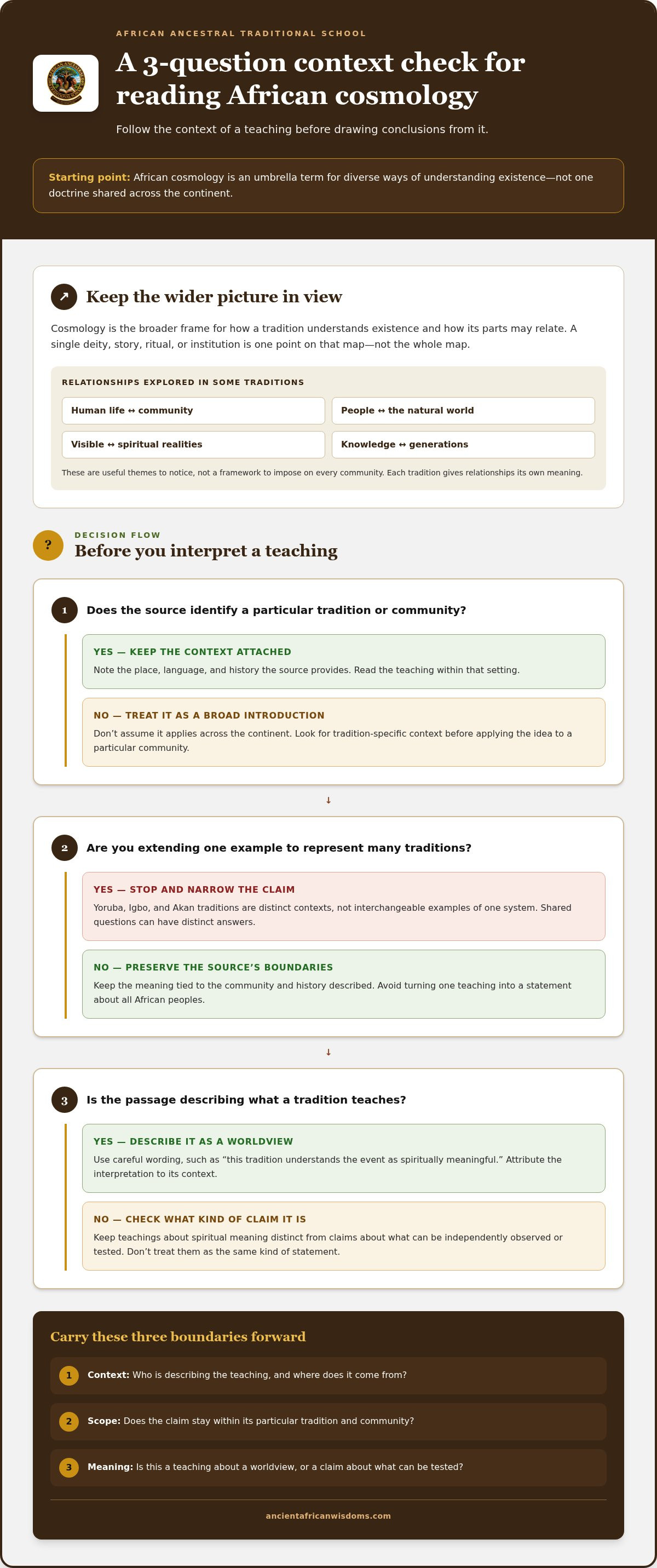
Learning about a tradition takes more than collecting striking ideas or unfamiliar terms. It calls for attention to who is speaking, the context they describe, and the difference between an explanation of a belief and a claim that applies to everyone. A steady approach helps you stay curious without turning distinct teachings into one simplified account.
What questions help evaluate a claim?
Pause when a source makes a broad statement. Ask which community or tradition it refers to, who is explaining the teaching, and whether the explanation names its place, language, and historical setting. Then notice whether the source distinguishes documented history, oral knowledge, and a modern interpretation. These forms of knowledge can inform one another, but they are not interchangeable, and each deserves clear attribution.
Use this short method when you encounter an unfamiliar claim:
- Identify the context. Write down the community or tradition named, along with any place, language, period, or lineage the source provides.
- Check the speaker. Notice whether the explanation comes from a community knowledge-holder, scholar, educator, or general overview. Their roles and perspectives may differ.
- Trace the evidence. Look for whether the source explains its basis, such as a historical record, oral account, or contemporary interpretation. Don’t treat a summary as a direct quotation or universal teaching.
- Question absolute wording. Phrases like “all Africans believe” flatten a continent of distinct histories. Before repeating the claim, look for a more precise description.
Before repeating a broad claim, check whose tradition it describes, where and when it applies, which language and sources inform it, and whether it is documented history, oral knowledge, or interpretation.
How can beginners continue learning thoughtfully?
Begin with an accessible overview, then follow a specific question into tradition-focused study. If a term catches your attention, note its spelling, source, and stated context. Look for an explanation that treats it within that cultural setting rather than relying on a quick translation. This habit makes learning more grounded and helps you see where a source is certain, where it offers interpretation, and where it leaves room for further inquiry.
Keep personal belief distinct from cultural authority and historical description. A writer may explain a tradition without speaking for every person who belongs to it, and an educational summary cannot stand in for all community knowledge. Ask what you can responsibly learn from a source and what you should leave open.
The African Ancestral Traditional School offers entirely online study in African spirituality, culture, and tradition through structured levels and community access. Explore structured online learning as one educational path for deepening your understanding, while remaining attentive to the particular voices and contexts that guide each subject.
Continue Exploring African Cosmology Through Structured Learning
A foundational overview can open a door, but understanding grows through patient study of particular teachings, histories, and cultural contexts. If your first question was “What is African cosmology?”, the next step doesn’t have to be mastering every tradition. Choose one question that stayed with you and follow it carefully. Broad introductions are starting points, not complete accounts.
What can structured online study add?
A curriculum can give your learning a clearer path beyond a single article. Instead of moving between disconnected explanations, you can progress through structured levels and explore African spirituality, culture, and tradition through digital courses. This gradual approach gives you a way to organize your study and return to key ideas with more context.
Learning can also feel less solitary. Community access offers an opportunity to connect with other learners as you study, share questions, and reflect on what you’re discovering. These conversations can support curiosity, though they do not make one person or course a representative voice for every African tradition. No single educational path can stand in for the distinct knowledge and authority held within particular communities.
The African Ancestral Traditional School is an entirely online educational platform with structured levels, digital courses, and community access. Its courses cover African spirituality, culture, tradition, and ancestral spiritual teachings. It offers a setting for continued study, not a claim that every tradition can be contained within one curriculum.
Where should a learner begin after this introduction?
Return to a question you noted while reading. Perhaps you want to understand how one specific tradition describes relationships among people, nature, and spiritual realities, or how a term is used in its original language. Let that curiosity guide your next reading. Look for material that names the tradition and context, and pause when a broad summary leaves important details out.
You can make the process steady and manageable:
- Choose one tradition-specific question rather than trying to study everything at once.
- Keep notes on unfamiliar terms, including where you encountered them and how the source explains their use.
- Return to the source’s context when comparing explanations, and distinguish a general interpretation from a particular community’s teaching.
There’s no need to rush toward a final answer. Let foundational learning lead into deeper questions, and allow each tradition the care its history and teachings deserve. If structured study feels like a helpful next step, explore the African Ancestral Traditional School and continue learning at a thoughtful pace.
Let Your Next Question Guide the Journey
What is African cosmology? It can be a starting question, not a finish line. Let the answer lead you toward a particular tradition, a word you want to understand more deeply, or a story whose context deserves careful attention. Learning with humility leaves room for complexity and honors the people and communities who carry knowledge forward.
The African Ancestral Traditional School offers structured digital courses in African spirituality, culture, and tradition, with tiered learning levels and community access. This online learning path supports continued study while recognizing that no single course represents every tradition or replaces its specific sources of knowledge.
Explore the African Ancestral Traditional School and take your next step with curiosity. Your learning can unfold one meaningful question at a time.
Frequently Asked Questions
What is African cosmology in simple terms?
African cosmology is a way of making sense of existence within a particular African tradition. It can help explain how people understand life, relationships, and what gives events meaning. For example, someone studying a community’s account of a harvest might ask how the teaching connects human responsibility, place, and spiritual understanding. The answer depends on that tradition, so one example can’t stand for everyone.
Is there one African cosmology, or are there many?
There are many distinct cosmological traditions, not one account that represents every African society. The same broad question, such as how human beings relate to the divine, may receive different answers across communities. When learning about one, look for the specific people, language, and historical setting described. This makes it easier to recognize a tradition’s own teachings without treating a regional account as a continent-wide belief.
How does African cosmology relate to African spirituality?
Cosmology can provide a framework for understanding spiritual ideas, while spirituality can include the beliefs, values, and forms of devotion people live through. Their relationship varies by tradition. For instance, a spiritual practice may make sense within a community’s particular understanding of responsibility or sacred presence. Studying both together can offer context, but avoid assuming that one explanation of spirituality applies to every African culture or to every person within it.
Can African cosmology include both visible and spiritual worlds?
Yes, some African cosmological traditions describe visible and spiritual realities as connected. The way that connection is understood differs, so there is no single map or set of spiritual layers to apply everywhere. When you read an account, note whether it describes a community’s teaching or makes a claim about something that can be independently observed. That distinction helps you understand the tradition without confusing its explanation with universal proof.
What role can ancestors have in African cosmological traditions?
Ancestors may be understood as continuing members of a family or community, or as figures associated with guidance, memory, and moral responsibility. Their place and the ways people relate to them vary across traditions and families. If you encounter a source describing ancestors as intermediaries or protectors, check which community it discusses and how the source explains the relationship. Don’t assume every African tradition shares the same practices or beliefs.
Are Yoruba, Igbo, and Akan cosmologies the same?
No. Yoruba, Igbo, and Akan cosmological traditions belong to distinct cultural and historical contexts, even when a broad theme seems familiar across them. A term, story, or spiritual concept should be understood through sources focused on the tradition it comes from. If you’re comparing explanations, keep each term and teaching attached to its context rather than treating similarities as evidence that the traditions are interchangeable.
Can I study African cosmology online as a beginner?
Yes. Start with an introductory resource, then follow one question into more focused study rather than expecting one course to cover every tradition. The African Ancestral Traditional School offers entirely online digital courses on African spirituality, culture, and tradition, with structured learning levels and community access. As you study, keep track of the specific contexts a lesson addresses and treat broad learning as a foundation for continued inquiry.


