
What if reconnecting with your ancestors begins not with adopting a practice, but with learning the stories and traditions that shaped your lineage? If you’ve been asking, “What is ancestral spirituality?”, start with this distinction: it is not one universal religion or set of rituals. It describes ways people relate to those who came before them, shaped by memory, community, and particular cultural traditions.
It’s understandable to want a clear starting point, especially if family knowledge was lost or never passed down. Ancestral spirituality can be explored through family stories, cultural history, and the teachings of a specific tradition. These are related but not interchangeable sources of understanding, and distinguishing them can help you learn without treating one person’s experience as universal.
This article explains the central idea in plain language while recognizing differences among traditions. You’ll learn how ancestry, remembrance, and community can shape this relationship, why cultural context matters, and how to take a thoughtful next step even if parts of your family story remain unknown. Begin with listening and learning, rather than rushing to adopt a practice or settle every question.
Key Takeaways
- What is ancestral spirituality? It’s a broad way to describe relationships between ancestry, inherited memory, and present-day life, not one universal faith.
- Lineage, community, and tradition can offer context, even when family records or stories are incomplete.
- Ancestor veneration and worship are not interchangeable terms across all cultures and spiritual traditions.
- Explore with care: clarify your questions, seek cultural context, and distinguish established teachings from personal accounts and online claims.
- Structured online study in African spirituality, culture, and tradition can support a gradual learning journey.
What Is Ancestral Spirituality? A Clear Definition for Beginners
Ancestral spirituality is a spiritual orientation that connects ancestry, inherited memory, and present-day life through relationships with lineage, culture, and tradition. If you’re asking, “What is ancestral spirituality?”, begin with that broad idea. It describes ways people understand and honor their connection to those who came before them, while carrying cultural knowledge forward.
The term is an umbrella description, not the name of one universal religion or doctrine. Beliefs and practices differ across communities, families, and spiritual paths. Some people understand ancestors as continuing spiritual presences; others connect with lineage through family stories, cultural values, or remembrance. No single experience defines the whole subject.
How ancestry can connect past, present, and future
Lineage is a relationship across generations. It links you with people who lived before you and with those who will come after you. That connection may be spiritual, cultural, familial, or a combination of these. It can prompt practical questions: What knowledge was carried forward? Which family stories have been passed down? What values do you want to preserve or share with future generations?
Cultural memory lives in more than formal records. It may be carried in stories told by relatives, familiar words and expressions, shared values, or inherited ways of understanding family and community. When records are incomplete, these fragments can still offer meaningful context. They cannot provide a complete account of the past, but they can help you approach it with curiosity and care. You might note who shared a story, what details are clear, and what remains uncertain.
People interpret this connection differently. Some traditions include beliefs about ancestors’ ongoing spiritual presence, while others may emphasize remembrance and cultural continuity. Don’t assume that everyone experiences ancestors as spirits or receives direct guidance from them.
Why African ancestral spirituality is not one single system
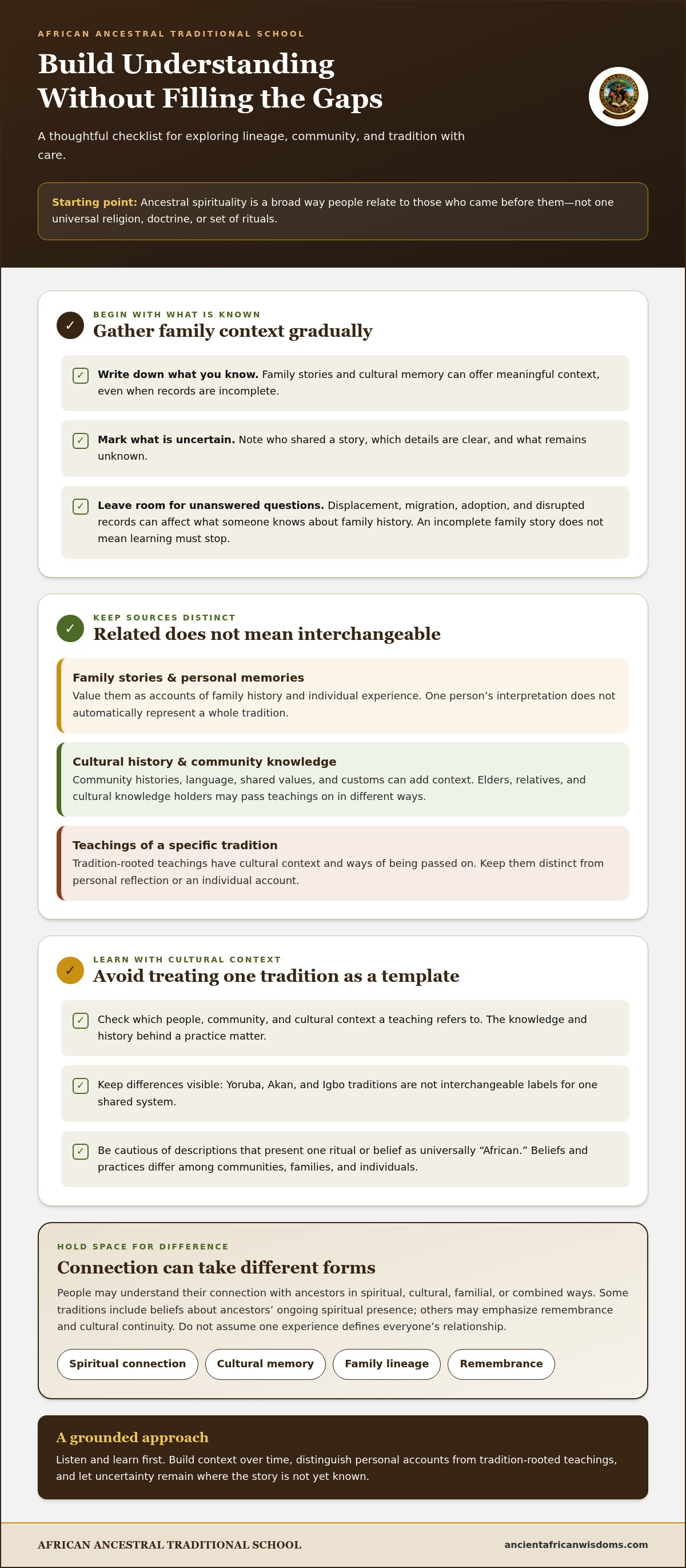
African spiritual traditions are diverse, shaped by distinct peoples, places, histories, and teachings. Yoruba, Akan, and Igbo traditions, for example, are not interchangeable labels for one shared system. Each has its own cultural context, and practices or beliefs associated with one community shouldn’t automatically be attributed to another. Experiences can also differ among families and individuals within a tradition.
This distinction matters when learning online. A description that presents one ritual or belief as universally “African” can obscure the knowledge and history that give it meaning. Notice which people and cultural context a teaching refers to. Rather than looking for one definition that explains every lineage, keep room for differences.
Ancestor Veneration offers a broad overview of how honoring ancestors appears across cultures, but it isn’t a substitute for learning about specific traditions. Explore African spirituality and ancestral wisdom with attention to context. A careful understanding recognizes both the shared human impulse to remember and the distinct ways communities give remembrance meaning.
How Ancestral Spirituality Relates to Lineage, Community, and Tradition
Lineage can offer a starting point for understanding ancestral traditions, but it isn’t the only doorway. Family histories are sometimes incomplete or difficult to trace. Displacement, migration, adoption, and disrupted records can all affect what someone knows about relatives and heritage. A missing name or story doesn’t mean you must stop learning, or that you need a complete genealogy before exploring what ancestry means to you.
What lineage can mean when family history is incomplete
Build context gradually. Write down what you know, mark details that are uncertain, and listen to relatives who are willing to share memories. Community histories, cultural resources, and careful research may add context over time. Keep space for unanswered questions; don’t fill gaps with assumptions simply to make a family story feel complete.
Personal memories matter, but they aren’t automatically the same as established teachings within a specific tradition. A relative’s account may reflect their experience, interpretation, or family history. Teachings rooted in a tradition have their own cultural context and ways of being passed on. Keeping these categories distinct lets you value family knowledge without presenting one person’s understanding as universal.
The role of community and cultural transmission
Understanding can also be carried through community life. Elders, relatives, and cultural knowledge holders may pass on teachings through shared memory, language, values, and customs. Listening can show how a tradition is understood within a living community, rather than reducing it to a collection of online descriptions. The people who carry knowledge and the ways they share it differ across African peoples and traditions.
Ancestral traditions are understood through the cultural context that gives their teachings, roles, and customs meaning. A practice or explanation from one community shouldn’t be treated as a template for another. Consider what community or tradition a teaching relates to, and distinguish cultural teachings from personal reflection.
As you learn, hold two kinds of knowledge side by side: what your family remembers and what a particular tradition teaches. They may illuminate each other, but they aren’t interchangeable. This distinction is especially useful when family knowledge is fragmented or online sources use broad labels without explaining their cultural setting.
If you’d like to deepen your understanding of the African worldview and ancestral wisdom, structured learning in African spirituality, culture, and tradition can provide context across related subjects. Let your learning unfold gradually, with care for the histories and communities behind the knowledge.
Ancestral Spirituality, Ancestor Veneration, and Common Misconceptions
Ancestral spirituality and ancestor veneration are related terms, but they don’t mean exactly the same thing in every context. Ancestor veneration generally refers to showing respect for or honoring ancestors within particular cultural and religious traditions. Ancestral spirituality is broader: it can describe how ancestry and spiritual understanding relate, without naming one set of beliefs or rituals.
This distinction helps answer “What is ancestral spirituality?” without treating African traditions as one system or assuming everyone relates to ancestors in the same way. The meaning of a practice depends on the people, teachings, and context it belongs to.
| Term or perspective | What it describes |
|---|---|
| Umbrella concept | Ancestral spirituality is a broad description of spiritual relationships with ancestry and inherited tradition. |
| Specific tradition | A particular community’s teachings and practices, understood in their own cultural and religious context. |
| Individual interpretation | How a person makes sense of ancestry, memory, or spiritual connection in their own life. |
Does ancestral spirituality mean worshipping ancestors?
There isn’t a universal yes-or-no answer. In some contexts, people honor ancestors through particular forms of veneration; in others, the relationship is described differently. The act of honoring doesn’t, by itself, explain the theology behind it. Words such as worship and veneration carry different meanings, so applying one label across traditions can misrepresent what a community believes or practices.
If you encounter a claim about ancestor veneration and worship, look for the tradition and cultural context it describes. A focused discussion of those terms is most useful when it explains how a specific tradition understands the distinction, rather than presenting one definition as universal.
Why healing claims and one-size-fits-all descriptions need care
Ancestral traditions can hold cultural, spiritual, and communal meaning, but that meaning shouldn’t be turned into a promise of emotional or physical healing. Reflection on family history may be personally meaningful; it doesn’t guarantee a particular outcome. Keep that difference clear, especially when reading claims that present a spiritual practice as a universal remedy.
One personal story or modern interpretation can also be mistaken for an entire culture. Treat individual accounts as individual accounts, not proof of what all African communities believe. Avoid descriptions that make traditions seem mysterious, unchanged, or interchangeable. They are living bodies of knowledge with distinct histories and contexts.
As you read, ask: Whose teaching is being described? Does the source name a specific tradition, or make a broad claim? These questions can help you learn with respect, hold uncertainty where needed, and distinguish a general term from a community’s own teachings.
How to Explore Ancestral Spirituality with Care and Cultural Respect
Learning can begin with attention, not a ritual or a claim about what you should believe. There’s no single practice required to start exploring ancestral spirituality. Begin with a question, a family story, or a desire to understand a particular cultural worldview. Move at a pace that leaves room for listening and for what you don’t yet know.
Start with questions, stories, and reliable context
First, name what you hope to understand. Are you curious about family history, cultural values, a tradition connected to your heritage, or the meaning of a particular teaching? A clear question helps you choose relevant sources instead of collecting disconnected advice. For broader background, consider how African cosmology and origins shape the ways different communities understand life and relationship.
If relatives share memories, listen with care and ask permission before recording or passing those stories on. A memory can be precious without being a complete historical record. Note who shared it, what they remember, what remains uncertain, and where accounts differ. Then compare personal recollections with sources that identify the specific people, place, or tradition being discussed.
Approach cultural teachings without appropriation or pressure
Seek sources rooted in the culture they describe, and pay attention to whose perspective is being shared. A symbol or practice removed from its teachings may lose the context that makes it meaningful. Don’t treat a brief online post as an instruction, especially if it doesn’t explain the practice’s community or history.
Respect boundaries around what is shared publicly, who participates, and what knowledge is intended for a particular community. Learning doesn’t require copying a practice or claiming authority over it. If a source presents one person’s interpretation as the belief of an entire people, pause and look for context. These habits let you stay curious while honoring the traditions you’re studying.
Use this sequence to guide your next steps:
- Reflect: Write down the history, value, or teaching you want to understand.
- Seek context: Look for sources that name the tradition and community, rather than relying on broad claims.
- Listen: Make room for family or community perspectives, while recognizing that memories and interpretations can differ.
- Keep learning: Revisit your question as you gain context, distinguishing established teachings from personal reflection or unsupported online claims.
There’s no need to rush toward certainty. A gradual learning path can help you understand African spirituality, culture, tradition, and spiritual rituals with more grounding than isolated posts can offer. Explore structured African spirituality courses as one way to continue learning through progressive levels and community access.
Continue Learning Through African Ancestral Spirituality Education
A short definition can open the door, but it can’t explain the full history, meaning, and variety of African spiritual traditions. An isolated online post may be a useful starting point, yet leave out the context that helps readers understand how spirituality, culture, tradition, and ritual relate. If you’re still asking, “What is ancestral spirituality?”, continued study can help you explore the question with more depth and care.
Structured education offers a way to follow connected topics over time rather than relying on scattered explanations. It doesn’t need to promise a shortcut or a particular personal outcome. Its value is in supporting understanding: learners can build knowledge gradually, return to foundational ideas, and consider each subject within a wider cultural context.
What structured online learning can offer
The African Ancestral Traditional School offers online education in African spirituality, culture, tradition, and spiritual rituals. Its progressive learning levels give students an organized path through study, while community access creates an opportunity to learn alongside others. Together, these elements support continuity across related subjects instead of treating each new idea as a stand-alone post or claim.
Learning in community can also make room for thoughtful questions and shared study. It doesn’t replace the distinct knowledge or boundaries of particular traditions, and it shouldn’t be treated as a guarantee of transformation. The courses provide an educational setting for deepening cultural understanding at a considered pace.
Choose a thoughtful next step in your learning journey
Begin with foundations that help you place a teaching in context. As you move into related subjects, note which tradition or cultural setting is being discussed, and allow your understanding to grow over time. You don’t have to absorb everything at once. A steady approach gives you space to revisit ideas and distinguish what you’ve learned from what you still want to explore.
For readers reconnecting with heritage, structured study can be especially helpful when family knowledge is limited or online explanations feel contradictory. It offers a path to learn about African traditions without assuming that one account represents every community. Let curiosity guide you, while keeping respect for cultural specificity at the center.
When you’re ready to continue, explore the African Ancestral Traditional School and its online learning levels in African spirituality, culture, and tradition. Take the next step at your own pace, with learning as the purpose and deeper understanding as the ongoing work.
Let Your Next Question Guide the Way
Reconnection doesn’t require you to have every answer before you begin. Let one honest question shape your next step: Which story do you want to understand more deeply? What would it mean to carry a family value forward with intention? Questions like these can turn curiosity into a steady practice of listening, learning, and reflection.
If you’re still wondering, “What is ancestral spirituality?”, let your understanding grow through continued study rather than forcing a single, final definition. Each tradition has its own context, and each learner arrives with a different history. Patience can make room for both discovery and respect.
When you’re ready to deepen your learning, explore the African Ancestral Traditional School and take a thoughtful next step. Your path can begin with a question and unfold at your own pace.
Frequently Asked Questions
What is ancestral spirituality?
Ancestral spirituality is a way of relating spiritual understanding to ancestry, lineage, and cultural memory. In plain terms, what is ancestral spirituality? It’s a broad description, not a single religion with one shared set of beliefs. For example, someone might study how a particular community understands its ancestors without assuming that understanding applies to every African tradition. Start with the specific culture or teaching you want to learn about, and keep its context in view.
Can you explore ancestral spirituality if you do not know your full family history?
Yes. You can learn without knowing every name or branch of your family tree. If your family history is unclear, choose a focused question, such as how a cultural value or historical event is understood in a tradition you’re studying. Keep a note of what you know, what you’ve heard, and what remains uncertain. This helps you learn without treating incomplete information as proof or feeling pressure to fill every gap.
Is ancestral spirituality the same as ancestor worship?
Not necessarily. “Ancestor worship” is a broad label, and it may not reflect how a particular community describes its beliefs. Some traditions speak of honoring or venerating ancestors, while others use different language or understand the relationship in another way. When discussing a specific tradition, use terms found in reliable sources about that tradition. Avoid assuming that a word used in one context carries the same meaning everywhere.
Do you have to follow a particular religion to study ancestral spirituality?
No. You can begin by learning about history, culture, and ideas without joining a religion or taking up a practice. Still, some teachings are connected to particular religious or community settings. Studying about a practice isn’t the same as being invited or prepared to perform it. If a subject has specific boundaries, respect them and focus on understanding its context rather than treating information alone as permission to participate.
Can ancestral spirituality be learned online?
Yes. Online study can introduce cultural histories and connected ideas, especially when lessons are organized and identify the tradition being discussed. The African Ancestral Traditional School offers digital courses in African spirituality, culture, and tradition through progressive levels, with community access. As you study, note where each teaching comes from and which questions remain. Use online learning to build understanding, not as a substitute for every community’s knowledge.
Does ancestral spirituality always involve rituals?
No. Rituals are part of some traditions, but they aren’t the only way to learn about ancestral spirituality. You can study a community’s history, values, or cultural concepts without performing a ritual. If you encounter instructions for a practice online, first understand which tradition it belongs to and whether its teachings are intended to be shared publicly. Learning about a practice and taking part in it are different choices.


