
What is African spirituality? There isn’t one answer, because the phrase describes a wide range of living traditions shaped by distinct peoples, places, and lineages across Africa and its diaspora. If you’ve encountered conflicting definitions, it’s understandable to feel unsure where to begin.
Many African spiritual traditions understand spiritual life, community, nature, and ancestral connection as deeply intertwined. But shared themes don’t make every tradition the same. Each has its own history, teachings, and practices. A respectful approach avoids broad assumptions and pays attention to the communities that carry those traditions.
This guide explains what the term can mean, why traditions differ, and how to continue learning with humility and care. Structured online study can offer a next step, but no general overview replaces knowledge held within a specific cultural lineage.
Key Takeaways
- What is African spirituality? It’s best understood as an umbrella term, not the name of one religion.
- Explore how people, community, the natural world, and spiritual realities may be understood in relation to one another, while recognizing that meanings differ.
- Approach a specific tradition through its cultural and historical context instead of relying on broad regional labels.
- Learn respectfully: identify the tradition, seek reliable sources, and stay curious without claiming authority or belonging.
- Structured online study and community learning can support deeper learning about African spirituality, culture, and tradition.
What Is African Spirituality? A Definition That Respects Its Diversity
African spirituality is an umbrella description for diverse spiritual traditions and worldviews rooted in African communities and their histories. It can include beliefs about the sacred, relationships with ancestors, and ways of connecting spiritual life with community and the natural world. Beliefs, language, and practices vary, so the phrase is a starting point, not a complete account of any one tradition.
“African” encompasses distinct peoples, languages, histories, and systems of belief across the continent, as well as communities in the diaspora. Some traditions are transmitted through oral teaching, stories, songs, and communal practice; others have written histories and sources. A broad overview such as Traditional African Religions on Wikipedia can introduce this range, while a broader guide to African spirituality and ancestral wisdom offers further context. Neither replaces learning about a particular tradition on its own terms.
Why African spirituality is not one single belief system
Broad labels can make distinct traditions seem more alike than they are. Two communities may both honor ancestors, for example, yet understand who ancestors are, how they are approached, and what responsibilities connect the living with them in different ways. A shared theme is a point of comparison, not proof of a shared doctrine.
Language and history matter, too. A name for a sacred being, practice, or role has meaning shaped by the people who use it. It may not translate neatly into another language or map directly onto a similar-sounding idea elsewhere. Don’t use one community’s teachings as a template for the whole continent. Start by asking which tradition, community, and source a description refers to.
What the term can, and cannot, tell a beginner
“What is African spirituality?” is a useful first question because it opens a path of inquiry. The phrase can point toward traditions in which spiritual life is connected with social relationships, inherited knowledge, or the natural world. It can’t tell you which teachings belong to a specific lineage, how a particular practice is understood, or who is authorized to carry it forward. Those questions require cultural and historical context.
African spirituality is an umbrella term for diverse traditions, not a single unified religion. Keep that distinction in mind as you read. When you encounter a specific name or teaching, note the community it comes from and seek sources that explain its context. Don’t treat it as a universal African belief. This approach makes room for both shared questions and meaningful differences.
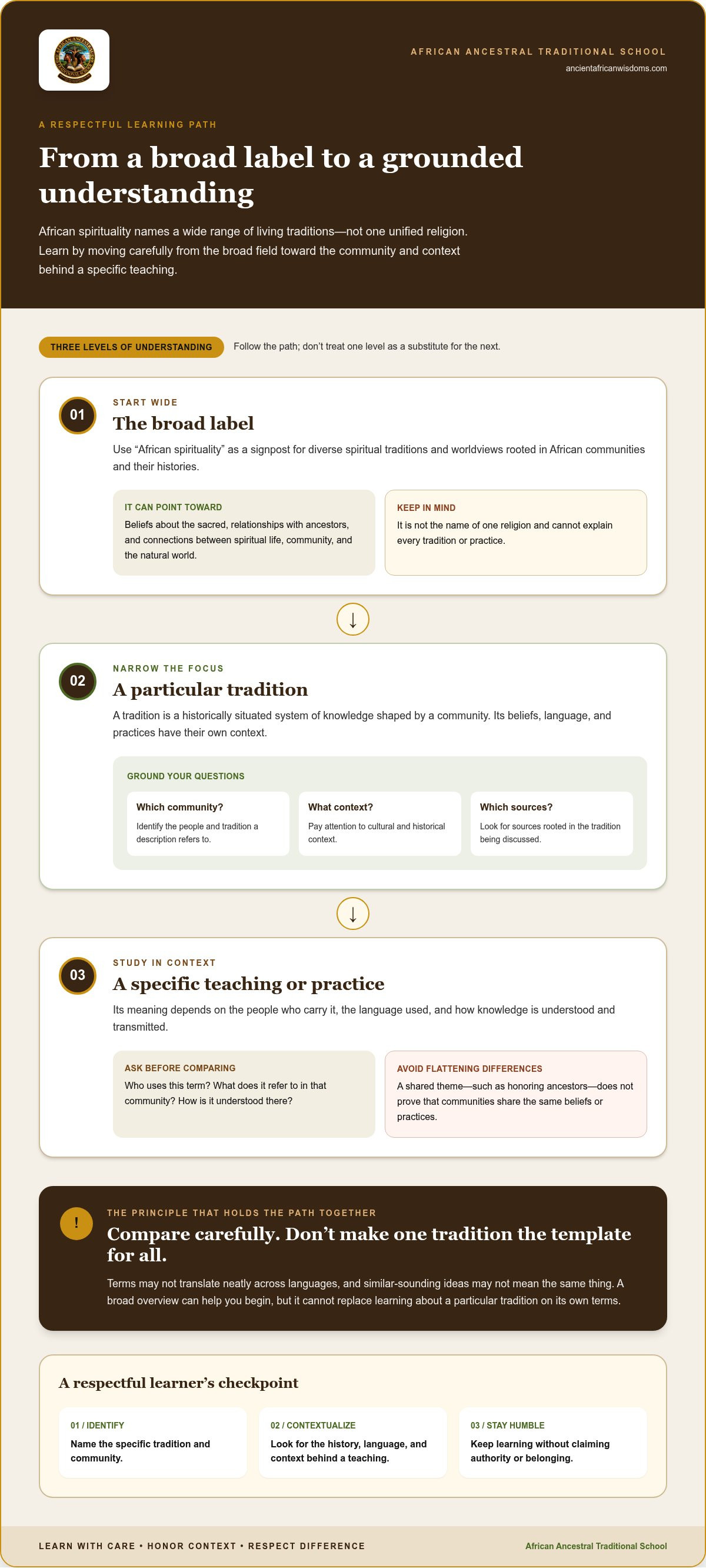
For beginners, it helps to separate three levels of understanding:
- The broad label: a signpost for a diverse field of traditions and worldviews.
- A particular tradition: a historically situated system of knowledge shaped by a community.
- A specific teaching or practice: something whose meaning depends on its context and transmission.
Moving from the broad label toward a particular tradition takes patience. The aim isn’t to find one definition that explains every tradition, but to learn how to ask more grounded questions.
How African Spiritual Worldviews Connect People, Community, and the Sacred
In some African traditions, spiritual life is understood through relationships rather than as a separate sphere set apart from everyday experience. A person may be understood in connection with family, community, ancestors, land, and other spiritual realities. This relational view can help orient a beginner, but it isn’t a universal formula. The relationships that matter, and their meanings, vary across communities and traditions.
Thinking relationally can change the questions you ask. Instead of asking only what a tradition believes, consider how its teachings shape responsibilities, connections, and ways of understanding life. The discussion of African worldview and ancestral wisdom explores this broader perspective without reducing it to one shared doctrine.
Relationships between the visible and spiritual worlds
Introductory explanations sometimes describe a relationship between the visible world of daily life and spiritual realities that may not be directly seen. In particular traditions, that relationship might involve ancestors, spirits, divinities, or other understandings of sacred presence. These terms and roles aren’t interchangeable, and communities don’t all describe such relationships in the same way. Treat this language as a starting point, then look for sources rooted in the tradition being discussed.
This matters when familiar words are used in unfamiliar contexts. “Spirit,” for instance, may be a convenient English translation, but it may not fully convey a concept’s meaning or place in a community’s teachings. Before drawing a comparison, learn who uses the term, what it refers to, and how it is understood there. That care helps prevent a general overview from becoming an inaccurate claim about a specific tradition.
Community, ethics, and the sacred
Some traditions connect spiritual understanding with obligations among people, such as care for relatives, respect for elders, participation in community life, or maintaining reciprocal relationships. These aren’t a checklist shared by every tradition. They illustrate how spiritual ideas can shape people’s understanding of their duties to one another, while the details remain grounded in local history and teaching.
Ubuntu is sometimes discussed in relation to personhood, community, and mutual care. It has its own histories and contexts, however, and shouldn’t stand in for African spirituality as a whole. A concept can illuminate one line of thought without defining every tradition across a continent. Ideas about divinity also differ, so avoid assuming there is one common account of the sacred. Exploring divinity across African spiritual traditions calls for attention to those differences.
As you learn, keep three questions nearby: Which community or tradition is being described? What relationships or responsibilities does the teaching address? Whose words and context guide the explanation? These questions help you distinguish a broad introduction from specific cultural knowledge.
To continue learning in a structured way, online courses in African spirituality, culture, and tradition provide a path to deeper study.
How African Spiritual Traditions Differ Across Communities and Regions
When you move from a broad overview to a particular tradition, names and context matter. Yoruba, Igbo, and Akan, for example, refer to distinct cultural communities, not interchangeable labels for one shared system. Those names alone don’t explain a community’s spiritual teachings, how they developed, or how knowledge is carried forward. To understand a specific practice, look for sources that identify the people and tradition being discussed rather than treating a regional label as a full explanation.
A compact comparison is useful only when its entries are grounded in reliable sources and clearly scoped. Without sources that establish each tradition’s terminology, history, and practices, a table can create false equivalences. A careful comparison should explain its evidence and limits instead of filling gaps with broad assumptions.
What a respectful comparison should include
Begin by naming the particular community or tradition, then make clear what the source covers. Is it describing a specific place, period, lineage, or practice, or making a broader claim? Keep that scope visible. A description of one community’s teaching shouldn’t become a claim about every group that shares a regional or cultural label.
Next, separate what appears similar from what may differ in meaning. Two traditions might both include reverence for ancestors, but that doesn’t establish that ancestors hold the same role, are approached in the same way, or are understood through identical teachings. Compare carefully, and don’t combine terms from Yoruba, Igbo, Akan, or other traditions as if they name equivalent ideas.
Why local history and cultural context matter
Teachings take shape within community histories. Language, relationships with place, contact with other groups, migration, and the ways knowledge is transmitted can all affect how a tradition is understood and practiced. These influences don’t follow neat regional boundaries. “West African,” for example, can encompass many communities and histories, while a community name may also cover differences across places, generations, and lineages.
Transmission matters, too. Knowledge may be shared through family and community life, oral teaching, written sources, or a combination of forms. Relevant sources and authorities vary by tradition, so no single account should automatically be treated as complete. Ask whose perspective a source represents, what period it describes, and whether it distinguishes local practice from broader interpretation.
No short list can represent every African spiritual tradition; each example is a doorway into a specific history, not a map of the whole continent. Keep that in mind when asking, “What is African spirituality?” A useful comparison doesn’t rank traditions or turn difference into sameness. It helps you notice what is documented, what is specific to a community, and where more context is needed before drawing conclusions.
As you read, pause over familiar terms and ask whether they carry the same meaning in each source. This habit can prevent a quick comparison from becoming inaccurate and keeps the focus on traditions as living, particular bodies of knowledge.
How to Approach African Spirituality Without Flattening Its Traditions
Respectful learning begins with curiosity and a willingness to be specific. Instead of looking for one account that explains every tradition, choose a particular community, teaching, or question to explore. This gives your inquiry a clearer direction and helps prevent a broad introduction from being mistaken for the whole story.
A grounded starting point for learning
Move through your inquiry deliberately. These steps can help you keep context in view:
- Choose a focus. Name a tradition or ask a focused question, such as how a particular community understands a sacred relationship.
- Learn the context. Look for the community, history, language, and scope behind the explanation. Notice whether the source describes one place or lineage, or makes a wider claim.
- Compare sources carefully. Give more weight to materials that identify their perspective and limits. Don’t treat a quick summary or familiar translated term as a complete account.
- Keep a learning journal. Separate what a source says from your own response. Record questions and uncertainties rather than filling gaps with assumptions.
This approach can help anyone, including people in the African diaspora seeking connection with ancestral heritage. Family histories and access to inherited knowledge vary. Curiosity can be a meaningful beginning, but learning about a tradition is different from claiming authority to speak for it or assuming belonging to a particular community. Let your questions guide further study, and make room for what you don’t yet know.
Common misunderstandings to avoid
African traditions don’t all share identical beliefs, names, or practices. Similarity between two teachings doesn’t make them interchangeable. Avoid turning a specific community’s account into a universal rule.
Living traditions shouldn’t be reduced to ancient history, spectacle, or generalized mysticism. Historical knowledge matters, but traditions are carried and understood by people in changing contexts. A brief online overview may orient you, but it can’t offer the depth of a particular community’s history, language, or teaching. Treat introductory material as a doorway, not a final authority.
As your questions deepen, exploring African cosmology and its origins can help you consider how different understandings of the universe are shaped by their own contexts. Keep asking who is speaking, which tradition is being described, and what the source can reasonably tell you.
For a guided next step, explore structured online courses in African spirituality, culture, and tradition and continue your studies through a planned curriculum.
Continue Learning Through Structured African Ancestral Education
An introductory article can explain why “What is African spirituality?” has more than one answer. A useful next step is to follow a question in greater depth, building understanding gradually instead of gathering disconnected facts. Structured study gives learners a path through a broad subject while keeping attention on learning and cultural context.
What structured online study can offer
The African Ancestral Traditional School offers online education in African spirituality, culture, and tradition. Its structured learning levels give students a way to progress through the curriculum. This can help turn an initial interest into sustained study without suggesting that every community or lineage is covered in the same way.
Community access connects learners as they study shared themes. It offers a space to reflect and learn alongside others, but it isn’t a substitute for the knowledge, history, or authority of a specific cultural lineage. Bring openness to community learning, and remember that learners may have different questions and experiences.
Online education is distinct from in-person initiation. A course offers teaching and structured study; it shouldn’t be treated as a rite, a claim of belonging, or proof of authority within a tradition. Keeping that distinction clear helps learners value education for what it is while respecting practices and roles with their own cultural context.
Choose a thoughtful next step in your learning
Begin with what you genuinely want to understand. Is your interest in ancestral teachings, African cultural history, spiritual traditions, or how these subjects connect? Naming your questions can help you choose a direction and notice how your understanding develops. You don’t need to settle every question at once. Let learning build steadily.
As you continue, track what you’ve learned and what you want to explore next. Revisit your questions as new context emerges, and distinguish general introductory knowledge from teachings specific to a community or lineage. A careful learning path isn’t about collecting claims quickly; it makes room for context, reflection, and deeper understanding.
The African Ancestral Traditional School’s online courses offer progressive levels for studying African spirituality, culture, and tradition, along with community access for connection with fellow learners. If this approach fits your next step, explore the school’s online learning.
Let Your Curiosity Become a Steady Practice
What is African spirituality? It can be the start of a deeper conversation, one that grows as you listen, study, and reflect. You don’t need every answer before taking another step. Choose a question that matters to you, then give yourself time to explore it with care and humility.
If you’re ready for a guided path, the African Ancestral Traditional School offers structured online courses in African spirituality, culture, and tradition. Progressive learning levels support continued study, and community access connects learners. Use these resources to deepen your learning while respecting the distinct histories and lineages behind the teachings.
Explore the African Ancestral Traditional School and choose your next step in learning. Every sincere question can open a door to greater understanding. Move forward patiently, with curiosity and respect.
Frequently Asked Questions
Is African spirituality the same across all African countries?
No. Spiritual beliefs and practices vary between countries and among communities within the same country. National borders don’t define one shared tradition, and neighboring communities may have distinct languages, histories, sacred concepts, and customs. If you’re exploring a particular teaching, look for the community it belongs to instead of assuming a country name explains it. This makes comparisons more accurate and prevents broad labels from being mistaken for complete descriptions.
Can African spirituality be practiced outside Africa?
Yes. African and African-descended communities around the world maintain, adapt, and learn traditions beyond the continent. Diaspora experiences differ: some people inherit family knowledge, while others are beginning to explore ancestry with fewer direct connections to it. Start with a specific tradition and its context. Learning about a practice can be meaningful, but it doesn’t automatically establish authority or belonging within the community that carries it.
Are African spiritual traditions still practiced today?
Yes. They are living traditions, though their forms and visibility differ across communities and generations. A 2010 Pew Research Center survey across 19 African countries found that some people who identified as Christian or Muslim also held beliefs associated with traditional African religions. This finding illustrates why religious identity and inherited spiritual beliefs don’t always fit into separate boxes. It doesn’t mean every person or community shares the same beliefs.
How were African spiritual teachings passed from one generation to another?
Methods differed by community and tradition. Teachings could be shared through spoken stories, songs, family and community instruction, ceremonies, or written sources. A particular practice might be taught in a specific setting or by people with a recognized role, so there isn’t one transmission model for the whole continent. When researching a teaching, look for information about who carries it, how it is learned, and what sources describe its history.
Can African spirituality coexist with Christianity or Islam?
For some people, yes. Pew Research Center’s 2010 survey documented traditional beliefs among respondents who identified as Christian or Muslim in several African countries. Individual experiences vary, and religious communities may understand these relationships differently. It’s more accurate to ask how a particular person or community holds these beliefs together than to assume there’s one universal answer. Avoid labeling someone’s faith from the outside based on a single practice or belief.
Is it possible to study African spirituality online?
Yes. Online learning can help you study wherever you live and follow lessons rather than relying only on scattered introductions. The African Ancestral Traditional School offers online courses in African spirituality, culture, and tradition, with progressive learning levels and community access. Treat online education as a way to build knowledge and ask informed questions, not as a substitute for the authority or specific teachings of a cultural lineage.
What should a beginner read first about African spirituality?
Begin with an accessible overview, then narrow your reading to a tradition or question that interests you. Choose sources that name the community, explain the historical context, and distinguish documented information from interpretation. As you read, note unfamiliar terms and look for how the source defines them instead of assuming translations are exact. A useful first reading should help you ask more precise questions, not promise that one book can explain every tradition.


