
African spirituality is not one tradition to discover, but a broad family of living ways of understanding ancestry, community, and the sacred. If you’ve found conflicting explanations or worried about treating distinct practices as interchangeable, that uncertainty makes sense. The term is broad, and no single overview can speak for every people, place, or lineage.
A respectful starting point is to recognize that African spirituality takes many forms, shaped by specific histories, cultures, and communities. This guide explains what the term can mean, where its limits lie, and why context matters when learning about ancestral traditions. You’ll explore how spirituality can connect with relationships, heritage, and everyday experience, while avoiding stereotypes and oversimplification.
Grounded learning can deepen your understanding over time. Online courses in African spirituality, culture, and tradition, including structured study levels and community access, offer one way to continue learning with care and intention.
Key Takeaways
- Understand why African spirituality is a broad term for distinct, living traditions rather than one universal system.
- Explore themes such as ancestry, responsibility, memory, and belonging while recognizing that their meanings vary across communities.
- See how geography, language, history, and diaspora shape spiritual traditions in different ways.
- Use a respectful learning sequence: begin with cultural context, identify the tradition, and approach community-specific knowledge with care.
- Discover how online courses, structured learning levels, and community access can support deeper study over time.
What Is African Spirituality? Understanding the Broad Tradition
African spirituality is a broad term for spiritual understandings and practices rooted in the histories, cultures, and communities of Africa and its diaspora. It doesn’t name one faith with a single set of beliefs. Across the continent, peoples have developed distinct traditions shaped by different languages, places, histories, and ways of transmitting knowledge.
African spirituality is an umbrella term for diverse, living traditions, not a universal African religion. Keeping that distinction in mind prevents an introductory overview from flattening sacred teachings into one story. The phrase can be useful for discussing a broad area of study, but it cannot replace learning the name, context, and teachings of a specific tradition.
For an introduction to the range of beliefs and practices often discussed under this broad subject, see this overview of African traditional religions. The terms aren’t always interchangeable. Specific communities may describe their spiritual inheritance in ways an umbrella label cannot fully express.
Why African spirituality is not one single belief system
Geography, community, history, and lineage all shape how spiritual knowledge is understood and passed on. A practice or teaching that holds meaning in one community shouldn’t be assumed to apply elsewhere. Even when ideas seem familiar across traditions, their roles and interpretations may differ.
Use broad descriptions as a starting point, not a complete account. When you encounter a claim, ask which people and tradition the source describes. This simple check helps you avoid treating a continent-wide label as proof of shared doctrines or rituals, and makes room for distinct histories.
How spirituality connects with everyday life and heritage
In some traditions, spiritual meaning may be explored through family and community relationships, identity, inherited knowledge, or responsibilities to others. These are useful lenses, not universal features. Their significance depends on the tradition and the people who carry it, so avoid assuming one explanation speaks for everyone.
For a closer look at one area of this subject, read African spirituality and ancestral veneration. Following a focused topic can help you move from a broad introduction toward more grounded learning, with attention to the heritage and context behind the teachings.
Core Themes in African Spirituality and Ancestral Wisdom
Some themes offer helpful starting points for exploring African spirituality, but they shouldn’t be mistaken for a shared creed. Relationships, responsibility, memory, and belonging can each illuminate how a tradition understands human life and the sacred. Their meanings, teachings, and importance differ among communities and lineages.
A recurring theme can open a path of inquiry, but it doesn’t establish a universal doctrine. As you read, remember that a concept in one account may be absent, understood differently, or expressed through other teachings elsewhere. In a Harvard Gazette interview, religion scholar Jacob Olupona discusses the endurance and adaptability of African spiritual traditions. His perspective can help readers consider continuity without assuming traditions remain unchanged or are all alike in The spirituality of Africa.
Ancestral connection as a varied spiritual relationship
Ideas about ancestors are specific to the communities and lineages that carry them. A relationship may involve remembrance, guidance, reverence, or other forms of connection, but these terms aren’t interchangeable and shouldn’t be used to describe every tradition in the same way. Ancestral connection also cannot be reduced to one ritual or practice. Learn how a community describes its own teachings before applying a broad interpretation.
Likewise, Asè is a specific concept, not a blanket explanation for ancestral relationships across African traditions. Explore Asè as a focused topic, while keeping it distinct from the wider and varied subject of ancestral connection.
Community, continuity, and ethical responsibility
Spiritual teachings may shape how people understand obligations to family, community, and inherited knowledge. In some contexts, belonging can be tied to continuity between generations; in others, different values and relationships may take precedence. These are lenses for careful exploration, not rules to apply everywhere.
As you encounter a teaching, ask whose perspective it represents and how it relates to lived community life. This question makes broad ideas more grounded while honoring the people who preserve and interpret them. To continue exploring cultural learning, visit African spirituality and cultural teachings.
Why African Spiritual Traditions Differ Across Peoples and Places
Spiritual traditions take shape within particular places and relationships. Geography, language, local histories, community life, and lineage all influence how teachings are expressed and passed on. Migration and diaspora add further layers as people carry, adapt, preserve, or seek to reconnect with heritage in new settings.
Cultural context is essential to understanding African spirituality without turning many distinct histories into one story. A regional description can offer a starting point, but it cannot stand in for every community in that region. Even neighboring peoples may have different names, teachings, and ways of expressing spiritual life.
How history and community shape spiritual traditions
Traditions are living inheritances, not relics frozen in the past. Communities may preserve teachings while responding to changing circumstances, new generations, and movement across regions. The balance between continuity and change differs, so avoid assuming that a current practice is either unchanged from the past or disconnected from it.
In The spirituality of Africa, Harvard religion professor Jacob Olupona discusses the enduring and adaptive nature of Indigenous African spirituality. This broad perspective can help readers understand why change doesn’t automatically erase continuity. Still, an overview isn’t a substitute for accounts rooted in a specific community. Notice whose knowledge is being shared, how a tradition is named, and whether the description reflects a particular place and history.
When researching a named tradition, compare its spelling and description across reliable cultural or scholarly sources. Be cautious of sweeping statements that treat a regional pattern as a rule for all peoples or rank traditions as more authentic than others.
African diaspora perspectives and living heritage
For people in the diaspora, connection to heritage can follow different paths. Displacement, family histories, migration, and unequal access to records or community knowledge may shape what someone can learn and how they approach reconnection. Not everyone knows their lineage, and no single route makes a person’s relationship to heritage more or less meaningful.
Approach this journey with patience. Begin with the histories and sources available to you, and let questions develop without expecting one account to answer everything. Learning resources can build context, while community knowledge offers perspectives that broad summaries may miss. For a related starting point, explore African spirituality courses for reclaiming heritage.
How to Explore African Spirituality with Care and Respect
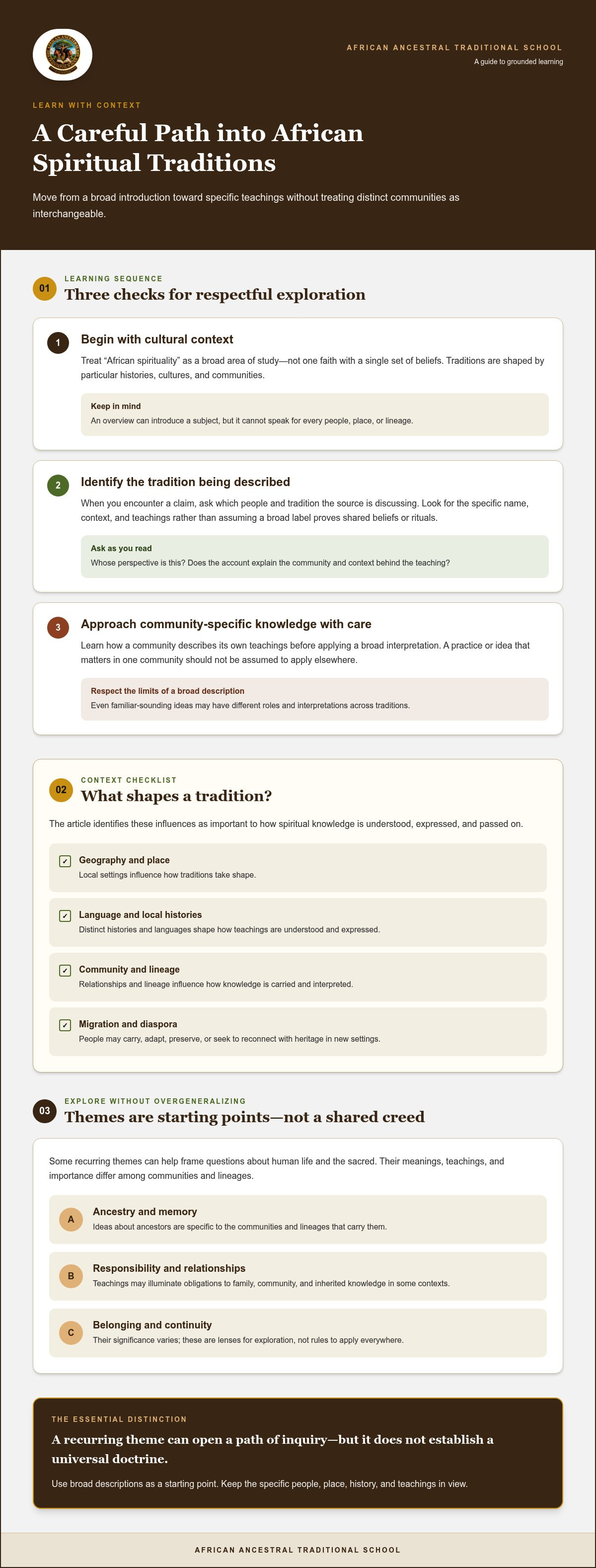
A thoughtful approach starts with context, moves toward a specific tradition, and continues through careful study. This sequence helps you learn without assuming a broad overview explains every community’s beliefs or practices. It also leaves room for questions, correction, and deeper understanding.
A beginner-friendly path for learning
Start with reliable introductory material about the history and cultural setting of the topic that interests you. Then identify the specific tradition, community, or concept being discussed. As you read, note the names and terminology used, who created or shared the source, what context it provides, and which questions remain unanswered.
Compare explanations without treating every source as equally grounded. Notice whether an author distinguishes their own perspective from a community’s teachings and explains the limits of a general overview. Introductory reading can build context, but it cannot replace every form of cultural transmission, including knowledge shared within a community or through tradition-specific teaching.
For a separate practical introduction, see African ancestral rituals for beginners. Treat it as a starting point for learning, not a set of instructions to apply without understanding the practice, its meaning, and its community context.
Respectful study without assumptions
Approach unfamiliar teachings with patience and cultural humility. A practice described in one source may carry responsibilities or meanings that aren’t visible in a brief explanation. Avoid lifting a sacred practice from its context and recasting it as a generic self-help technique. Curiosity is welcome, but it doesn’t mean every form of knowledge is yours to claim.
Before sharing an explanation, consider whether it names the tradition clearly, acknowledges whose knowledge it represents, and avoids speaking for an entire continent. If a source leaves those questions unanswered, keep researching rather than filling the gaps with assumptions. This care respects the teaching and supports more meaningful learning.
Once you have a foundation, structured study can help you move beyond scattered information. Online courses in African spirituality, culture, and tradition offer a way to deepen understanding through progressive learning levels and community access. Explore structured African spirituality learning as a next step in your study.
Continue Learning African Spirituality Through Structured Study
A broad introduction can open the door, but deeper understanding grows through attentive study. Structured learning helps you move from general context toward more focused exploration, giving ideas time to connect instead of leaving you to piece together isolated explanations. In a subject as varied as African spirituality, steady progression can support thoughtful questions and a clearer sense of cultural context.
What a structured digital learning path can offer
The African Ancestral Traditional School provides online courses in African spirituality, culture, and tradition through progressive educational levels. Digital lessons offer a way to study over time, while community access provides a shared setting for reflection and learning. The levels create a path for building understanding step by step without suggesting every learner follows the same personal or spiritual journey.
As you study, pause to reflect: Which tradition or cultural context is being discussed? What ideas would benefit from more reading? Where might a broad explanation leave important details out? These questions connect curiosity with care and make room for continued learning.
Courses can support cultural and spiritual education, but they don’t replace every form of transmission within a specific tradition. Knowledge may also be carried through community relationships, lineage, and teachings particular to a people or place. A structured course is one way to deepen understanding, not a claim to represent every tradition or provide every kind of knowledge.
Choose a next step that fits your learning journey
Begin with the subject that speaks most clearly to your questions. You might want to explore cultural foundations, ancestral teachings, or a specific area of tradition. Let your interest guide your first step, then build your understanding through study and reflection. Continued learning can offer insight and context, but it shouldn’t be treated as a promise of a particular spiritual outcome.
If you’re ready to continue, explore the school’s educational levels and choose a starting point for your learning journey. Explore the African Ancestral Traditional School and take the next step at a pace that feels grounded and respectful.
Let Your Learning Continue with Care
African spirituality is a broad family of living traditions shaped by distinct cultures, histories, and communities. Shared themes can offer a starting point for reflection, but they don’t make every tradition the same. Learning with respect means seeking context, naming the specific teachings you’re exploring, and staying open to what you still have to learn.
If you’re ready to deepen your understanding, structured study can help you move from a broad introduction toward focused learning at a steady pace. The African Ancestral Traditional School offers online courses in African spirituality, culture, and tradition, with educational levels learners can progress through and community access as part of the learning experience. These resources support cultural learning without claiming to replace every form of knowledge carried within a tradition.
Choose a next step that meets your questions with curiosity and patience. Explore the African Ancestral Traditional School and continue your learning journey with care. Each thoughtful step can bring you closer to a richer understanding of heritage and ancestral wisdom.
Frequently Asked Questions
What is African spirituality?
African spirituality is a broad term for diverse spiritual traditions and worldviews rooted in African communities and histories. It doesn’t name one uniform religion, doctrine, or set of practices. Its meaning depends on cultural context, including the people and tradition being discussed. To understand a specific teaching, look beyond general descriptions and learn about its history and perspectives.
Is African spirituality a religion?
It depends on how the term is being used and which tradition is under discussion. Some people use “African spirituality” to describe spiritual beliefs and practices broadly; others focus on particular Indigenous African religions or cultural systems. There isn’t one distinction that fits every use. In different traditions, spirituality may intersect with community, ethics, and everyday life in distinct ways, so context helps clarify what a speaker means.
Are all African spiritual traditions the same?
No. Africa is home to many peoples, languages, histories, and communities, and their spiritual traditions aren’t interchangeable. Broad themes may appear in different settings, but their meanings, teachings, and practices can vary. When discussing a belief or practice, name the specific people, place, or tradition if you can. Choose sources that explain cultural context rather than presenting one account as representative of the whole continent.
How do ancestors relate to African spirituality?
Ancestors and ancestral relationships carry different meanings across African traditions and diaspora communities. Some teachings include remembrance or veneration, but these aren’t identical everywhere and shouldn’t automatically be equated with worship. Terms matter, so look for explanations rooted in a specific community’s language and context. For a more focused discussion, explore ancestral veneration and heritage.
Can I learn about African spirituality online?
Yes. Online learning can introduce histories, concepts, and cultural context, while structured courses can support deeper study over time. The African Ancestral Traditional School offers online courses in African spirituality, culture, and tradition, with learning levels and community access. A digital introduction can’t represent every tradition or replace all forms of community-based knowledge transmission. Approach lessons with patience and treat one course or overview as a beginning, not the whole journey.
How can I explore African spirituality respectfully as a beginner?
Begin with reliable, culturally grounded sources, then learn the specific context behind the terms and teachings you encounter. Don’t assume one practice represents the continent. Approach unfamiliar material with humility, ask thoughtful questions, and avoid copying isolated sacred practices without understanding their meaning or context. A broad introduction can help you find a focused topic or tradition to study more deeply as your understanding grows.
What is the difference between African spirituality and African traditional religion?
“African spirituality” is a broad expression that may refer to spiritual ideas and practices, while “African traditional religion” can refer to particular religious systems. In practice, usage varies by writer and community, so the terms don’t always have a neat boundary. Rather than assuming either phrase has one universal definition, clarify which tradition, community, or context is being discussed. Specific language can make explanations more accurate and respectful.


