
Cultural memory and indigenous knowledge are carried forward through teaching, language, ritual, relationships, and practices renewed across generations. They help communities preserve ancestral insight while reflecting the distinct histories and values of the people who hold that knowledge.
Africa does not share one spiritual tradition. Colonial histories and interrupted lines of teaching can make ancestral knowledge harder to trace, while online explanations may blur spiritual practice with academic language. These challenges call for curiosity, care, and attention to cultural differences.
This article explores how cultural memory keeps diverse African traditions meaningful without making them one. You’ll learn how knowledge is carried and renewed, why an example from one community shouldn’t stand for all, and how to continue learning respectfully. Patient, structured study and community can support a deeper understanding of African Traditional Spirituality.
Key Takeaways
- Understand cultural memory as knowledge communities carry, recall, and renew, shaped by their histories, relationships, and places.
- Recognize how oral teaching, language, observation, and practice can pass knowledge across generations, with roles that vary between communities.
- Explore carefully sourced Yoruba, Igbo, and Akan examples without assuming that any one tradition represents all of Africa.
- Build a respectful learning practice: identify cultural context, seek credible sources, learn terminology, reflect, and revisit what you learn.
- Explore cultural memory and indigenous knowledge, then continue into African Traditional Spirituality, a broader pillar connecting diverse traditions and practices through guided study.
What Cultural Memory Means in African Traditional Spirituality
Cultural memory is knowledge a community carries, recalls, and renews through shared life. It may live in stories, language, values, relationships, and spiritual practices, rather than in written records alone. Indigenous knowledge is rooted in particular peoples and places, shaped over time by experience, history, and connection to the land and community.
Together, cultural memory and indigenous knowledge help explain how teachings can link generations while remaining specific to the traditions that carry them. Communities draw on these teachings to understand identity, responsibility, and the sacred. Knowledge stays alive not simply because it is recorded, but because people interpret and pass it on within meaningful relationships.
How are cultural memory and indigenous knowledge connected?
Cultural memory is the knowledge and meaning a community carries, recalls, and renews across generations through relationships, language, stories, values, and shared practices. A story, for example, may hold more than a sequence of events. Its meaning can depend on who shares it, the language used, and the community’s understanding of its place in collective life.
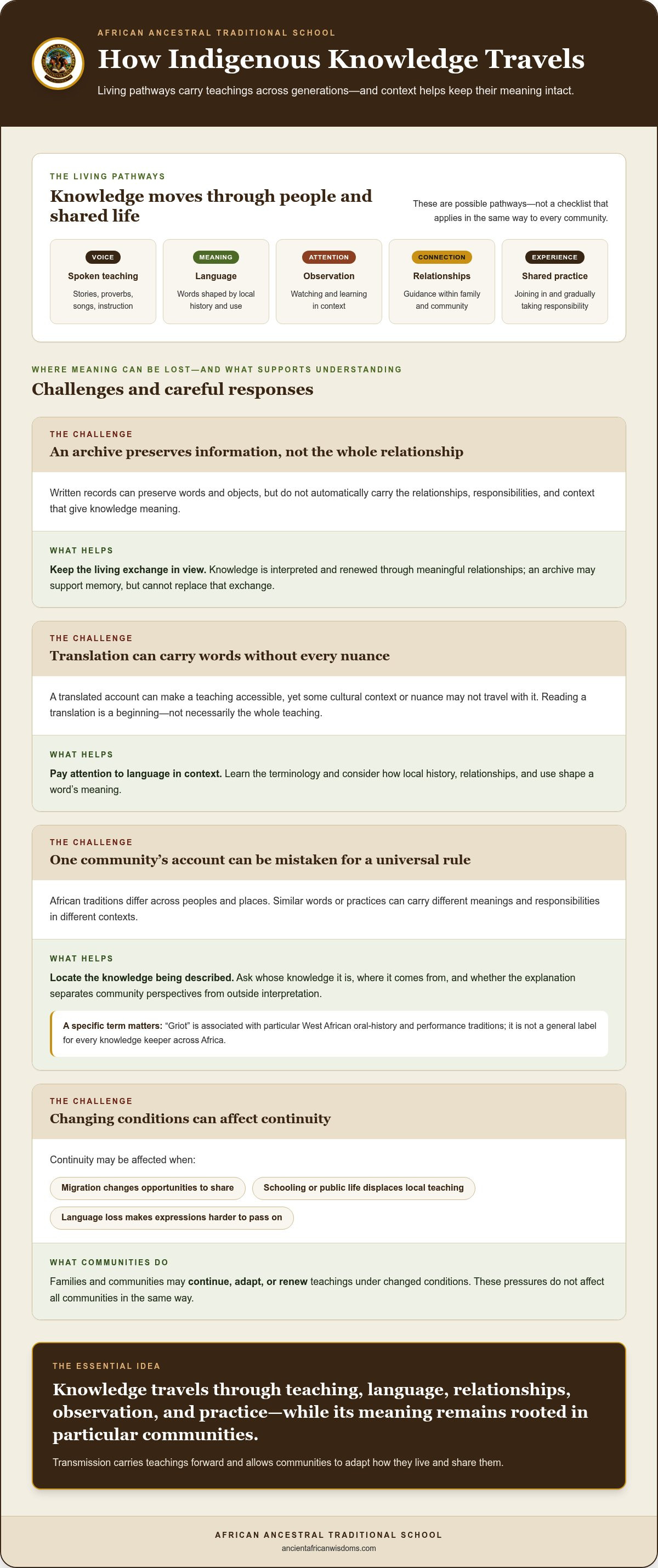
That is different from simply collecting or archiving cultural information. Records can preserve words and objects, but they do not automatically carry the relationships, responsibilities, or context that give knowledge meaning. Broader discussions of traditional and indigenous knowledge describe transmission through cultural expression and practice. An archive may support memory, but it cannot replace the living exchange through which people interpret and renew it.
Why does context matter when discussing African spirituality?
African traditions are not one continent-wide religion or worldview. Beliefs and practices vary across peoples and places, shaped by language, lineage, local history, and lived experience. Even when people use similar words or practices, the meanings and responsibilities attached to them may differ. Understand an account of a community’s teachings within that context, rather than treating it as a template for everyone.
As you learn, ask whose knowledge is being described, where it comes from, and whether the explanation distinguishes community perspectives from outside interpretation. Holding continuity and diversity together is essential when exploring cultural memory and indigenous knowledge. For a related exploration, see African spirituality and ancestral wisdom.
How African Indigenous Knowledge Travels Across Generations
Knowledge can move through spoken teaching, language, observation, relationships, and shared practice. These are possible pathways, not a checklist that applies to every community. In one context, a story or proverb may carry a teaching; in another, learning may depend more on guided participation or attention to a particular place. The people who sustain knowledge may include elders, relatives, practitioners, and wider community networks, each with distinct responsibilities.
Memory also gives knowledge a living presence. As Africa Is a Country reflects in its discussion of the role of memory in African spirituality, remembrance can be bound up with belonging and continuity. The meaning of that connection, however, is grounded in particular communities rather than one universal African belief.
What role do oral tradition and language play?
Where culturally appropriate, stories, proverbs, songs, and spoken instruction can carry histories, values, and ways of understanding the world. Language holds more than dictionary meaning: a word may carry associations shaped by local history, relationships, and use. Translation can make a teaching accessible across languages, yet some nuance or cultural context may not travel with it. Reading a translated account is a beginning, but it may not convey the whole teaching.
Take care with terms for cultural roles. “Griot,” for instance, is associated with particular West African oral-history and performance traditions. It should not be used as a general label for every knowledge keeper across Africa.
How do relationships and practice carry knowledge?
Some learning happens by watching, joining in, receiving guidance, and gradually taking responsibility within a family or community. The relationship matters: a practice learned with context and guidance may carry meanings that a written description alone cannot convey. Not every teaching is public, and information available in books or online should not be assumed to represent all community-held knowledge.
Migration can change how often relatives and community members share language, stories, and practices across generations. Colonial disruption may also affect continuity when systems of schooling or public life displace local languages and forms of teaching. Language loss can make inherited expressions harder to understand or pass on, especially when younger generations have fewer opportunities to use them. These pressures do not affect all communities in the same way. Families and communities may continue, adapt, or renew teachings under changed conditions.
Knowledge transmission carries teachings forward while allowing communities to adapt how they live and share them as conditions change. This helps explain why cultural memory and indigenous knowledge are living, relational processes. For a structured way to explore African culture, tradition, and spiritual teachings, consider the online learning offered through African ancestral spiritual teachings.
What Connects African Traditions, and What Remains Distinct
Some African spiritual traditions give attention to ancestry, community, ethical responsibility, and relationships between human life and the sacred. These can be useful themes for comparison, but they do not prove that traditions share one religion. Their meanings are shaped by particular peoples, histories, languages, and places. A similar word or practice in two settings does not establish that the beliefs, histories, or responsibilities behind it are identical.
The South African Institute of International Affairs discusses cultural memory and indigenous knowledge in relation to youth futures and ecological resilience in East and Southern Africa. That contemporary focus offers one way to consider why knowledge matters, but it should not be used to make claims about Yoruba, Igbo, or Akan teachings.
Which themes appear across some African spiritual traditions?
The table offers a starting point for comparison. It names distinct cultural contexts and suggests questions to guide further learning, rather than presenting a single account of what each tradition believes.
| Context | Theme to explore | Context-specific caution |
|---|---|---|
| Yoruba communities | Ask how a particular source describes relationships among community, ethics, and the sacred. | Don’t treat one Yoruba account as representative of every Yoruba community or lineage. |
| Igbo communities | Examine how the source connects its teachings to local history, identity, and community life. | Don’t transfer a description of one place or group to all Igbo people. |
| Akan communities | Look for how a specific account explains responsibility, belonging, and spiritual meaning. | Don’t assume Akan concepts or practices are interchangeable with Yoruba or Igbo ones. |
These are prompts for careful reading, not claims that the three traditions share one doctrine. A useful comparison should name its scope: identify the specific Yoruba, Igbo, or Akan community discussed, the theme being examined, and the source supporting the account. If a source does not establish a comparison, do not imply one.
How can readers avoid treating African traditions as one system?
Start by asking who is speaking, which people and region the account concerns, and whether it reflects community teaching, academic interpretation, or an individual perspective. Use terms such as Ubuntu with similar care: it is associated especially with Southern African ethical and philosophical contexts, not a synonym for every African worldview.
Hold shared themes lightly. Ancestry, community, and ethics may offer points of comparison, but they do not erase distinct cosmologies or histories. Learning about ancestral veneration in the African diaspora can provide a focused related perspective. Careful context lets connections emerge without blending Yoruba, Igbo, Akan, and other teachings into a composite practice.
How to Learn About African Indigenous Knowledge Respectfully
Respectful learning begins with context, not assumption. Cultural memory and indigenous knowledge can deepen your understanding of African Traditional Spirituality, a broader pillar connecting distinct traditions and practices. Approach each teaching with patience: ancestral reconnection is not a shortcut, and no source can promise a particular spiritual outcome.
What should beginners consider before studying a tradition?
Use this sequence to keep your learning grounded:
- Identify the context. Note the people, place, tradition, and historical period described. Avoid applying a teaching from one community to another without evidence.
- Seek credible sources. Look for clear attribution and context. Notice whether a source presents academic interpretation, community teaching, or an individual perspective.
- Learn the terminology. Record culturally specific words and how the source explains them. Do not assume a familiar translation captures every meaning.
- Reflect and revisit. Keep notes on what you have learned, where it came from, and what remains uncertain. Return to questions as you encounter more perspectives.
Also consider whether a teaching is publicly shared and how its custodians describe it. Some knowledge may be sacred, restricted, or held within a community. Consent, careful attribution, and humility matter: information appearing in a book or online is not automatically permission to reproduce, teach, or practice it. When you cannot establish the context, pause rather than fill gaps with guesswork.
Keep different kinds of learning distinct. Academic writing may analyze a tradition from a research perspective; community teaching may carry responsibilities and meanings rooted in lived relationships; personal spiritual reflection describes your own response. Each can inform your understanding, but one should not be presented as a substitute for another.
How can cultural memory stay meaningful in modern life?
Learning can continue through reading, reflection, language study, listening to community perspectives, and participation where it is welcomed. You might keep a journal that separates source information from your own interpretation, or revisit a teaching over time to notice what you understand differently. These are possible approaches, not universal prescriptions.
Rituals also need cultural context. Do not assume a practice is appropriate for every learner or interchangeable between traditions. For a focused introduction to the topic, explore African ancestral rituals for beginners, keeping in mind that context and guidance shape how any practice is understood.
Continue your study with structured online courses in African culture, tradition, and spiritual teachings, supported by patient learning and community. Explore guided African ancestral learning as one way to deepen your understanding over time.
Continue Exploring African Traditional Spirituality Through Guided Learning
Cultural memory carries knowledge across generations, while the traditions that hold it remain distinct. Continuity does not mean every tradition shares the same teachings or history. Keeping both ideas in view helps you explore connections without overlooking the particular communities and contexts behind them.
Independent reading can open a door, but it may leave questions about sequence, terminology, and how ideas relate. Structured online courses offer a path through African culture, tradition, and spiritual teachings, with room to revisit core ideas. Use cultural memory and indigenous knowledge as a starting point for learning with both connection and cultural distinction in view.
What can structured study add to independent reading?
A curriculum can organize learning into stages, helping foundational ideas build and giving you a chance to return to them over time. At the African Ancestral Traditional School, tiered learning levels provide structure, while community access offers connection with fellow learners. Study and reflection can unfold at your own pace, without a promise of a particular spiritual outcome.
Learning in community can make room for thoughtful questions and shared reflection. It does not replace knowledge held within a specific cultural community or collapse distinct traditions into one teaching. Instead, structured study can support continued learning about African spirituality, culture, tradition, and ancestral spiritual teachings.
Where can a reader begin their next step?
Begin with a question that matters to you. Which tradition, language, story, or aspect of cultural memory would you like to explore? Naming your interest can help guide what you study next while keeping your learning grounded in context and open to revision.
The African Ancestral Traditional School offers a digital learning environment for continued study, with tiered levels and community access. Take time to reflect, revisit core ideas, and learn alongside others. If you’re ready to continue at your own pace, explore African ancestral spirituality courses.
Carry Your Learning Forward
Cultural memory keeps knowledge meaningful as it moves across generations, while each African tradition retains its own histories, teachings, and context. Learning respectfully means staying curious, recognizing those distinctions, and approaching ancestral knowledge with care rather than assuming one account speaks for all.
Cultural memory and indigenous knowledge are living inheritances, not simply information to collect. African Traditional Spirituality offers a broader frame for exploring different traditions and practices, while patient study helps you appreciate their particular roots and meanings.
If you’d like a structured next step, the African Ancestral Traditional School offers digital courses in African spirituality, culture, tradition, and ancestral teachings. Tiered learning levels provide a path for continued study, and community access offers connection with fellow learners.
Continue exploring at a pace that feels thoughtful and grounded. Explore the African Ancestral Traditional School and take your next step toward deeper learning.
Frequently Asked Questions
What is cultural memory in African traditional spirituality?
Cultural memory is how communities remember and carry knowledge, values, histories, and meaning across generations. Depending on the tradition, it may be expressed through language, stories, relationships, or shared practices. It is not one unified African system. To understand a particular teaching, consider the cultural and historical context in which it is held and how the community itself describes its significance.
How is indigenous knowledge passed down in African communities?
Indigenous knowledge may be transmitted through oral teaching, observation, language, family and community relationships, and participation in practices. How knowledge is shared differs among peoples and traditions, and some teachings are not intended for public circulation. When learning about a practice, look for sources that name the specific cultural context. Avoid treating an example from one community as a rule for the whole continent.
Is African traditional spirituality one religion?
No single belief system represents every African people or tradition. Spiritual teachings and practices vary with community, history, language, and place, even where some themes may appear familiar. Treating them as one religion can hide important differences in meaning and practice. Look for sources that identify the particular people or tradition being discussed and explain the context behind its terms and teachings.
What is the difference between cultural memory and indigenous knowledge?
Cultural memory describes how communities remember and carry meaningful histories and identities across generations. Indigenous knowledge refers to knowledge rooted in particular peoples, places, and lived experience. The ideas can overlap: stories and practices remembered within a community may carry locally grounded knowledge. They are related concepts, not interchangeable labels. Use them carefully by considering whose knowledge is being described and the context in which it has meaning.
Can African indigenous knowledge change over time?
Yes. Communities may carry knowledge forward while responding to changing circumstances, languages, and lived experience. Continuity does not require every practice to remain unchanged. At the same time, describing change should not erase cultural authority or historical context. When you encounter a claim about how a particular tradition has changed, consider whether the source identifies the people and place involved and supports its account with appropriate evidence.
How can I learn about African spiritual traditions respectfully?
Begin by identifying the people, place, and tradition a source discusses. Seek culturally grounded explanations, learn terms in context, and distinguish public teachings from knowledge that may be restricted. Attribute examples accurately, and do not combine distinct traditions into a single practice. Approach learning with patience and humility, allowing communities and credible sources to describe their own teachings rather than filling gaps with assumptions.
How can online learning support the study of African ancestral knowledge?
Online learning can offer structured lessons and a way to revisit ideas over time, while cultural context and careful sourcing remain essential. The African Ancestral Traditional School provides digital courses in African spirituality, culture, and tradition, with tiered learning levels and community access. These features support continued study and connection with fellow learners without making diverse traditions interchangeable or replacing the importance of understanding each teaching in context.


