
What does lineage mean in African spiritual traditions? It can describe more than a family tree, but it is not one spiritual path shared across Africa. If you’re trying to understand your roots, conflicting explanations can make the word difficult to pin down. Depending on the context, lineage may refer to family descent, cultural connection, or a spiritual relationship understood within a particular tradition. These meanings can overlap, but they are not interchangeable.
It’s understandable to look for a clear answer, especially when family histories are incomplete or disrupted. For many people of African descent, the effects of enslavement have made records difficult to trace. A missing paper trail, however, does not erase the value of family stories, cultural ties, or careful study.
This article explains how lineage can be understood across African spiritual traditions and how it differs from ancestry and heritage. You’ll consider how family history and spiritual connection may relate without assuming they are the same, and find practical ways to continue learning. Because African traditions are diverse, approaching lineage with patience, cultural context, and humility can help you honor both your own search and the communities whose teachings you encounter.
Key Takeaways
- Lineage can describe family descent, cultural belonging, or a spiritual connection within a particular tradition.
- Ancestors, living relatives, community, and inherited knowledge may be connected in different ways across traditions.
- Ancestry, heritage, and spiritual tradition are distinct ideas, even when their meanings overlap.
- When family history is incomplete, begin with what you know, record unanswered questions, and approach family stories with consent and care.
- Structured learning and community access can deepen your understanding of African spirituality, culture, and tradition in context.
What Does Lineage Mean in African Spiritual Traditions?
In African spiritual traditions, lineage can describe connections across generations and communities. Depending on the context, it may refer to family relationships, cultural belonging, or a spiritual relationship understood within a particular tradition. It can connect someone with those who came before, living relatives and community, or teachings and practices passed on over time. The meaning depends on the people, place, history, and tradition being discussed.
There is no single African model of lineage. African peoples have distinct histories and spiritual systems, and ideas about ancestors, community, and inherited knowledge vary. An overview of African traditional religions can provide general context, but it cannot stand in for the teachings or lived understanding of a particular community. Treat broad descriptions as a starting point, then look for the specific context behind the account.
How Is Lineage Different from a Family Tree?
A family tree usually records relationships such as parents, children, and grandparents. Lineage may include those connections, but it can also refer to cultural belonging or a spiritual relationship recognized within a specific tradition. A tree can help organize names, dates, and relationships; it may not capture the meanings, responsibilities, or memories a family or community associates with them.
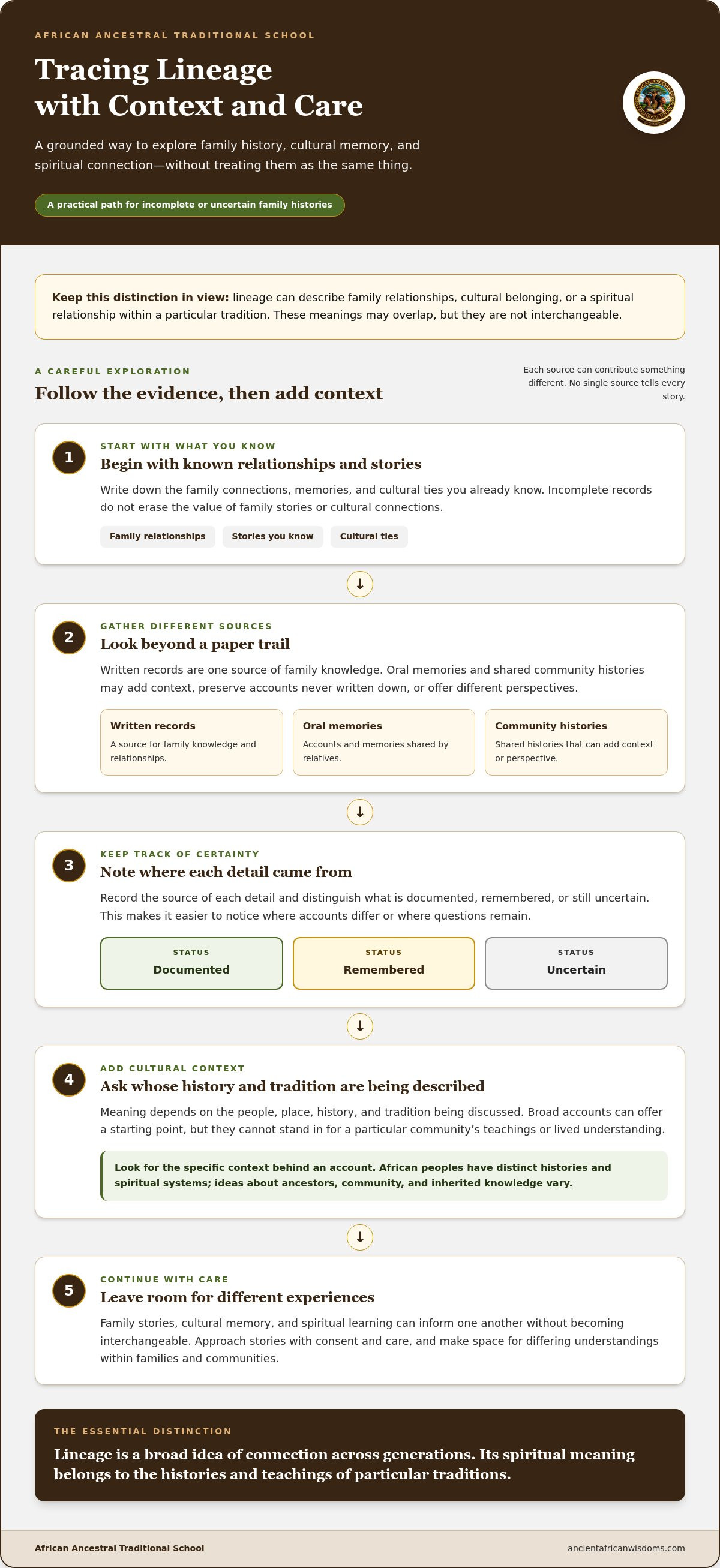
Written records are one source of family knowledge. Oral memories and shared community histories may add context, preserve accounts that were never written down, or offer different perspectives. When researching, note where each detail came from and whether it is documented, remembered, or still uncertain. No single source tells every story, and families and traditions may understand these connections in their own ways.
Why Lineage Matters to Identity and Continuity
Connections across generations can shape a sense of belonging. Family stories, language, customary practices, and community memories may help people understand where they come from and how the past remains present. For some, spiritual teachings also provide a framework for relating to ancestors or carrying inherited knowledge forward.
Continuity is not only about looking back. It can take shape through relationships among living people, the stories they choose to share, and learning that continues within a community. Your understanding may differ from someone else’s, even within the same family or cultural setting. Approach the subject with curiosity and respect, leaving room for those differences instead of expecting one account to define everyone’s experience.
How Can Lineage Connect Ancestors, Living Kinship, and Tradition?
Lineage can be understood as a living thread among ancestors, relatives, community, and knowledge passed between generations. These connections may overlap, but they are not identical. Family history describes relationships and events; cultural memory carries shared understandings; spiritual teachings offer frameworks for interpreting those connections. The shape and meaning of each thread depend on the community and tradition.
Lineage is a broad idea of connection across generations; its spiritual meaning belongs to the histories and teachings of particular traditions. Keep that distinction in view when reading general accounts. They can introduce themes, but they cannot speak for every African people or spiritual community.
What Roles Can Ancestors and Living Relatives Have?
Relatives and community members may carry family histories, shared memories, and responsibilities to one another. In some traditions, ancestors also hold an important spiritual place, though the nature of that relationship varies. A Harvard Divinity School professor discusses the role of ancestors in African cosmology, offering perspective without making one account a rule for every tradition.
For a focused discussion of practices and meanings in diaspora settings, read more about ancestral veneration in the African diaspora. As you learn, ask whose perspective is being shared and whether it reflects a specific community, family, or spiritual path.
How Can Tradition Carry Lineage Across Generations?
Continuity can be carried in many ways. A relative might tell a family story; community members might teach a language or explain the meaning of a cultural practice. Within a particular spiritual tradition, knowledge may also be learned through that tradition’s teachings and practices. These are examples, not requirements, and their significance differs across communities.
Family stories, cultural memory, and spiritual learning can inform one another without becoming interchangeable. A story may preserve a family’s experience, while cultural study can place it in a wider historical setting. Tradition-specific learning can clarify the context of particular teachings rather than treating them as universal. As you compare these sources, note what each one helps explain and what remains outside its scope.
If you’d like to deepen your understanding through guided study, explore structured African spirituality courses that connect teachings with cultural context.
Lineage, Ancestry, Heritage, and Spiritual Tradition: What Is the Difference?
These terms often appear together, but they point to different parts of a person’s connection to family, culture, and spiritual life. The table offers a general guide, not a universal cultural rule. Meanings and usage can shift between communities, families, and traditions, and the ideas may overlap.
| Term | Common meaning | Where it may overlap |
|---|---|---|
| Ancestry | Family descent and the people from whom someone is descended. | Can contribute to family identity and a person’s sense of connection to the past. |
| Heritage | Inherited cultural history, such as memories, customs, language, or shared experiences. | May include family stories and cultural knowledge passed between generations. |
| Spiritual tradition | A particular framework of teachings and practices. | May shape how a community understands ancestors, belonging, and inherited knowledge. |
| Lineage | A connection that may bring family descent, cultural belonging, or a tradition-specific spiritual relationship together. | Can touch on all three ideas, but does not mean the same thing as any one of them. |
Use these distinctions as starting points, not fixed boundaries. A family story can be part of heritage and help someone understand their ancestry, while a spiritual tradition may offer its own teachings about relationships across generations.
Is Ancestry the Same as Spiritual Lineage?
No. Ancestry refers to descent; spiritual belonging is shaped by the teachings and practices of a particular tradition. The two may be meaningful to the same person, but genetic ancestry alone does not establish spiritual knowledge, authority, or participation. When learning about a tradition, look to its teachings and community context rather than assuming family background answers every question.
How Does Lineage Relate to African Diaspora Heritage?
Migration and enslavement have disrupted family histories for some people of African descent, and records may be incomplete or difficult to trace. Experiences differ across diaspora communities and families, so no one account represents them all. Gaps in documentation can make the search more complex, but they do not define the full measure of a person’s cultural connections or identity.
To explore how ancestral spirituality and heritage may connect in this context, read this guide to African ancestral spirituality courses. Keep family history, cultural inheritance, and spiritual learning distinct as you study them. Each can offer insight without standing in for the others.
How Can You Explore Lineage Respectfully When Family History Is Incomplete?
An incomplete family record can leave important questions unanswered, but it does not make your interest in learning less meaningful. Begin with what you know, then make a record of what you are still trying to understand. Treat the search as a gradual process, not a test you must pass before learning about family, culture, or history.
Historical research can add context to your story, but it does not prove spiritual status or certainty. Keep what records and family accounts can show separate from personal beliefs or the teachings of a particular tradition.
What Can You Learn from Family Stories and Historical Records?
Start by writing down names, places, languages, dates, and stories you’ve heard. For each detail, note who shared it, whether you heard it directly, and what remains uncertain. For example, you might record that a relative remembers a family connection to a particular place, while the exact town or date is unknown. Keeping the question open is more accurate than filling the gap with a guess.
Listen to relatives and community members with care. Ask permission before recording or sharing their stories, and respect a decision not to discuss private matters. Written records and oral accounts may differ, offer only part of a story, or leave important details unresolved. Treat discoveries as valuable context, not a complete account of who you are.
How Can You Learn Without Assuming One Tradition Speaks for All?
Let your question guide where you begin. If you’re exploring a family’s history, focus on the relevant places, time periods, and community accounts. If you’re learning about a spiritual tradition, seek its specific cultural context rather than relying on broad statements about African beliefs. Distinguish what a source describes from your own reflections, and note whose perspective it represents.
Move with respect. A practice may carry meaning within a community that is not clear from an outside description, so avoid copying sacred practices without understanding their context. Reading, listening, and studying can be ways to learn without claiming authority over knowledge held within a specific tradition or community.
For continued study, explore the African Ancestral Traditional School’s online courses in African culture, spirituality, and tradition. Progressive learning levels and community access offer a structured setting to deepen your understanding with cultural context. Explore structured African spirituality courses.
How Can Structured Learning Deepen Your Understanding of Lineage?
Personal exploration often begins with questions, but broad explanations can leave you unsure how an idea fits its history. Structured study gives you a way to follow questions in sequence, connect concepts to cultural context, and notice where traditions differ. It can support understanding and reflection without promising a particular spiritual outcome.
What Can a Guided Curriculum Add to Personal Exploration?
Organized lessons can help clarify terms, histories, and the relationships among family, culture, ancestors, and spiritual teachings. Rather than treating every account as interchangeable, a curriculum can help you consider where an idea comes from and what context matters. That foundation supports thoughtful study, but it does not replace knowledge held within a specific family or community.
Education is distinct from personal spiritual status or certainty. A learning path can deepen cultural understanding; it is not a substitute for community-specific knowledge or the practices of a particular tradition.
How Can You Continue Learning at Your Own Pace?
Let new understanding shape the questions you ask. You might revisit a family story after studying its historical setting, or look again at a term once you’ve learned how a particular tradition uses it. Keep notes on what has become clearer and what remains open. Learning can unfold gradually, with space for reflection rather than pressure to reach a final answer.
The African Ancestral Traditional School offers online courses in African spirituality, culture, and tradition, with progressive learning levels and community access for students. These educational formats provide a way to learn alongside others while keeping the focus on cultural context and understanding. Coursework supports learning and reflection rather than guaranteeing a specific personal outcome.
If you’re ready to continue exploring, take a look at these African ancestral spirituality courses and choose a thoughtful next step in your learning.
Continue Your Learning with Care and Curiosity
Lineage can connect family descent, cultural memory, living relationships, and spiritual teachings, but these meanings are not identical. Their significance varies across African communities and traditions, so thoughtful exploration starts with context rather than assumptions.
When family records are incomplete, begin with what you know, listen respectfully to family and community stories, and keep open questions visible. Historical discoveries can offer valuable context, but they do not determine spiritual standing or tell the whole story of who you are.
To deepen your understanding, the African Ancestral Traditional School offers structured online learning in African spirituality, culture, and tradition, with progressive educational levels and community access for students. Explore the African Ancestral Traditional School and continue at a thoughtful pace. Every question you carry can be a meaningful beginning.
Frequently Asked Questions
Is lineage the same as ancestry?
No. Ancestry usually refers to descent from earlier generations, while lineage may also describe cultural, community, or tradition-specific connections. The terms can overlap, but they are not always interchangeable. A family tree might document names and relationships, for example, without explaining the cultural meaning attached to them. It also does not establish spiritual authority or participation within a tradition, which must be understood through that tradition’s own teachings and context.
Can I explore my African lineage if I do not know my family history?
Yes. Incomplete family records do not prevent you from learning about African histories, cultures, or the experiences that shaped your family and community. Start with what you know, write down unanswered questions, and explore sources with care. You can also listen to family or community stories with consent and respect for privacy. Uncertainty is not a personal failure, and one tradition will not necessarily answer every question you have.
How is spiritual lineage different from genetic ancestry?
Genetic ancestry concerns biological relationships, while spiritual lineage depends on the teachings and meanings of a particular tradition or community. The two may intersect in some contexts, but one does not automatically establish the other. An ancestry result alone cannot prove spiritual status, authority, or participation. If you’re studying a spiritual path, look to its teachings and cultural context rather than treating genetic information as a guide to spiritual belonging.
What happens if family stories and historical records do not match?
Differences may reflect incomplete records, changing names, varied memories, or gaps in historical documentation. Keep each account with its source, and note what remains uncertain instead of forcing a single explanation. You might record who shared a story, when they shared it, and which details differ from a document. Comparing accounts can add context, but a discrepancy does not erase family connection or make your interest in learning less valid.
How can I learn about African lineage without generalizing across cultures?
Begin with the specific people, place, historical period, or tradition relevant to your question. Choose sources that identify whose history or knowledge they describe, and distinguish documented information from personal interpretation. African spiritual traditions are diverse, so one community’s beliefs or practices should not be presented as representative of the whole continent. Cultural context helps you approach each tradition on its own terms and recognize the limits of broad explanations.
Can online courses help me understand ancestral lineage?
Yes. Online courses can offer structured learning in African spirituality, culture, and tradition, helping you build context as you study. The African Ancestral Traditional School offers progressive educational levels and community access for students exploring ancestral teachings. Courses can support reflection and cultural understanding, while knowledge held within a specific community remains rooted in its own context. Approach each lesson with curiosity and respect for the tradition being studied.


