
What if the first step toward African Ancestral Wisdom is letting go of the idea that it has one universal meaning? If you’re searching for African Ancestral Wisdom, a page explaining ancestral traditions should begin with an honest truth: practices and teachings vary across Africa’s many cultures and communities.
It’s understandable to want a clear starting point, especially when broad explanations can blur important differences or make unsupported claims sound certain. Ancestral wisdom is a varied inheritance of knowledge, values, and practices, carried through generations and rooted in specific cultural and lineage contexts. Learning about it calls for patience, respect, and a willingness to listen.
This guide explores what ancestral wisdom can mean across different traditions, why context matters, and how to approach learning with care. You’ll also discover how structured online courses and community access, such as those offered through the African Ancestral Traditional School, can support continued study at a thoughtful pace, without replacing the living traditions and contexts behind the teachings.
Key Takeaways
- Understand ancestral wisdom as inherited knowledge, values, memory, and practice, shaped by distinct communities rather than one universal rulebook.
- Explore shared themes such as continuity and community responsibility without assuming they mean the same thing in every tradition.
- Use this guide, “African Ancestral Wisdom. A page explaining ancestral traditions,” to recognize why cultural context matters when comparing Yoruba Ifá, Akan, and Igbo traditions.
- Approach your questions with care: identify the cultural context, compare credible sources, and reflect before drawing conclusions.
- Build on foundational learning through structured online courses and community access, studying traditions progressively rather than collecting disconnected practices.
What Does African Ancestral Wisdom Mean Across Different Traditions?
African ancestral wisdom is knowledge, values, memories, and practices passed between generations within particular African peoples and communities. It may shape how people understand family, responsibility, history, spirituality, and relationships with the living and the dead. The details are not the same everywhere: each tradition carries its own histories, languages, teachings, and ways of interpreting the world.
So ancestral wisdom isn’t one religion, a uniform doctrine, or a continent-wide ritual system. The phrase can describe related forms of inherited knowledge, but it shouldn’t suggest that every African community shares the same beliefs or practices. The broad overview of African traditional religions offers a starting point for seeing the range of religious traditions, while each community’s own context remains essential.
If you’re searching for “African Ancestral Wisdom. A page explaining ancestral traditions,” begin with this distinction: a shared subject doesn’t make traditions interchangeable. Understanding grows by asking whose knowledge is being discussed, how it has been carried forward, and what it means in its particular setting.
How Is Ancestral Wisdom Different From a Single Set of Beliefs?
Inherited knowledge can include ethical teachings, family and community memory, customs, stories, and spiritual understandings. Some traditions may share themes, such as respect for elders or attention to ancestral presence, but the meaning and expression of those themes can differ. A familiar word or practice in one context shouldn’t be treated as proof that another community understands it in the same way.
Think of ancestral wisdom as a broad description, not a checklist of beliefs that everyone must follow. This leaves room to learn about individual traditions without making one example stand for an entire continent.
Why Does Cultural Context Matter When Learning Ancestral Traditions?
Practices take meaning from the histories, relationships, and communities that sustain them. Translation can carry ideas across languages, but a translated term may not hold every layer of meaning in its original context. For people in the diaspora, family histories and distance from ancestral communities may also shape what is accessible, remembered, or newly explored.
Approach each teaching with curiosity and care. Ask what community it comes from and how the knowledge is shared, rather than treating sacred practices as interchangeable content. That respect helps keep learning grounded in the people and histories behind it.
Which Ideas Connect African Ancestral Traditions Without Making Them Identical?
Once you recognize that traditions have their own contexts, you can compare themes without turning them into universal rules. Continuity, reciprocity, community responsibility, memory, and relationships between generations may offer useful points of comparison. But the presence of a similar theme doesn’t mean people understand or practice it in the same way.
A recurring theme is a lens for comparison, not proof of a shared doctrine. This distinction matters when discussing words such as “ancestor,” “spirit,” and “lineage.” Their meanings can depend on a tradition’s language, teachings, and worldview. Even when English translations seem familiar, they may not carry the same significance across communities.
Some descriptions of Indigenous African spirituality emphasize oral knowledge and traditions that continue to adapt over time. The Harvard Gazette’s discussion of Indigenous African religion can help frame why teachings should be understood within their living contexts, rather than reduced to a fixed set of statements.
How Can Lineage, Community, and Memory Shape Ancestral Teachings?
Family stories, language, customs, and shared memories can carry values and cultural knowledge across generations. They may help a person understand where they come from and how they relate to others. Yet family memory isn’t automatically the same as formal teaching within a particular tradition. The ways knowledge is preserved, shared, and interpreted vary between families and communities.
Listen for who is speaking and what kind of knowledge they’re sharing. A personal recollection can be meaningful without representing an entire lineage or cultural tradition.
What Role Can Ancestors Have in Different Worldviews?
Some traditions describe active relationships with ancestors, while others understand ancestral presence, remembrance, or responsibility in different ways. Practices and teachings may also differ within a community. Describe these beliefs as part of particular worldviews, not as claims every reader must accept.
To explore one perspective more closely, read this guide to ancestral veneration and African diaspora heritage. Let it deepen your questions, rather than stand in for every tradition.
If you’d like to carry that curiosity into sustained study, explore structured learning in African spirituality and culture. A thoughtful learning path can help you keep context alongside comparison, and approach ancestral teachings with patience and care.
How Do African Ancestral Traditions Differ Across Cultural Contexts?
Comparison is most useful when it stays specific. Yoruba Ifá, Akan traditions, and Igbo traditions each contain varied histories and practices, so the examples below are partial entry points, not complete descriptions of any people. The Harvard Gazette’s overview of African indigenous religions also underscores the diversity and living character of these traditions.
Terms and translations need care. An English word such as “ancestor” may be convenient, but it can’t automatically convey a community’s full understanding of lineage, spiritual presence, or responsibility. Use the table to orient your questions, not to make the traditions interchangeable.
| Context | One point of entry | What to keep in mind |
|---|---|---|
| Yoruba Ifá | Ifá is associated with divination and a body of oral verses and teachings. | Practitioners, interpretations, and local histories shape how Ifá is understood and transmitted. |
| Akan | Some Akan contexts describe ancestors as part of relationships connecting generations and community life. | Akan communities are not uniform; meanings and practices vary by place, family, and context. |
| Igbo | Odinani is commonly used for Igbo indigenous religious and cultural thought. | Igbo communities have diverse experiences and interpretations; one description cannot represent all of them. |
What Can a Carefully Contextualized Comparison Show?
It can show how particular communities organize and transmit knowledge, while leaving room for differences within each tradition. For example, describing Ifá through divination and oral verses gives a starting point, not a complete account of Yoruba life or belief. Likewise, broad references to Akan ancestors or Odinani need more precise sourcing before they’re applied to a specific community or practice.
For “African Ancestral Wisdom. A page explaining ancestral traditions,” a responsible comparison names the people and context, identifies what is documented, and separates that information from personal reflection or contemporary interpretation. Shared themes do not prove identical beliefs.
How Can Readers Avoid Treating African Traditions as One System?
When you encounter a teaching, note who it describes, where it comes from, and whether it reflects scholarship, community knowledge, or an individual account. Check spellings and translations against tradition-aware sources, and don’t assume that a familiar word carries the same meaning elsewhere. This steady approach makes comparison an act of listening, not ranking.
How Can You Explore Ancestral Traditions With Respect and Care?
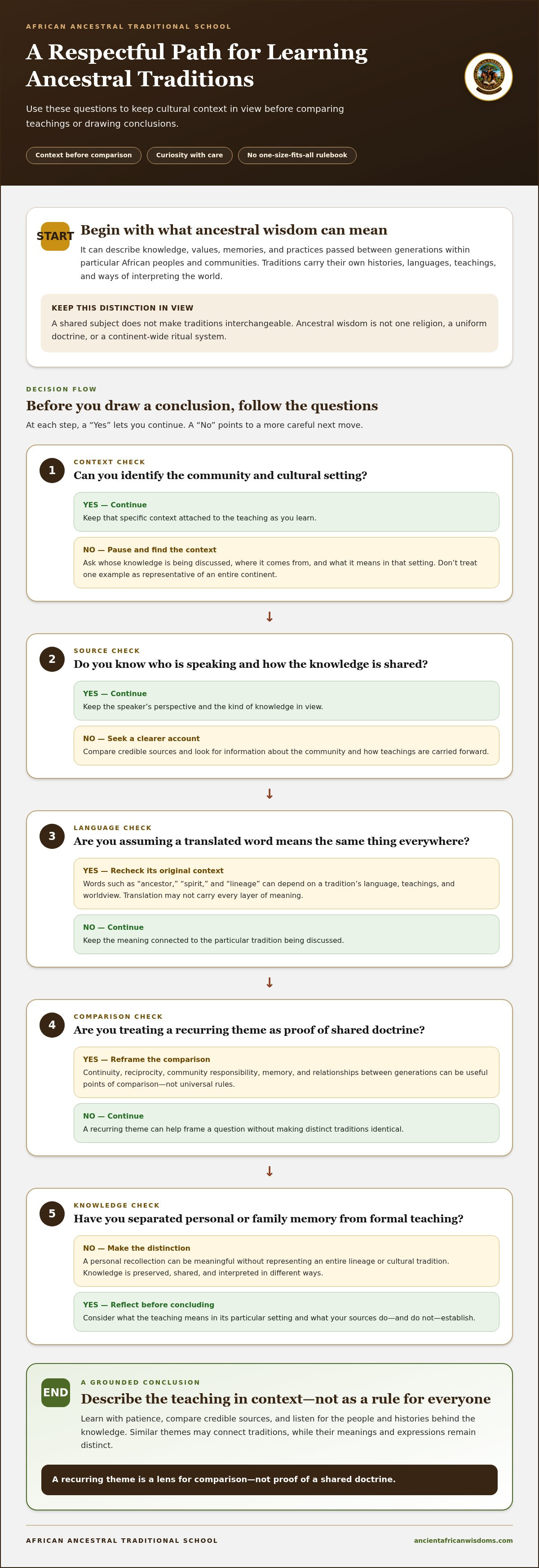
Begin with a question, not an assumption. You might be tracing a family story, trying to understand a cultural term, or learning about a particular community’s tradition. Then move carefully from curiosity toward context, checking what your sources can establish and leaving room for what remains unknown.
If your search is “African Ancestral Wisdom. A page explaining ancestral traditions,” use this simple process to keep your learning grounded:
- Identify one question. Keep it focused on a person, place, term, or practice.
- Locate its cultural context. Note the specific people, community, language, and history involved, where known.
- Compare sources. Look for credible scholarship and community knowledge, while remembering that no single source speaks for everyone.
- Reflect with care. Separate what a source documents from your own response or interpretation.
Reflection can help you notice what a story or teaching brings up for you. It isn’t proof of a spiritual message or a promise of healing. For practical context on the subject, read this introduction to African ancestral rituals for beginners, and keep in mind that a general guide can’t represent every community’s practice.
Where Should Beginners Start When Researching Ancestral Heritage?
Choose a starting point you can describe clearly, such as a relative’s account, a place name, or a tradition you’re studying. As you read, record the source, the cultural context it addresses, and what it can’t confirm. If family records are incomplete, let that be a reason to keep asking thoughtful questions, not to fill gaps with certainty. Patient inquiry is meaningful progress.
How Can You Learn Without Flattening or Appropriating Tradition?
Use specific names when sources support them, and preserve distinctions between peoples, communities, and practices. Treat sacred or restricted knowledge with humility; not every teaching is intended for public sharing or personal use. Respectful learning doesn’t require adopting every practice you encounter. You can listen, study, and reflect while recognizing the limits of your perspective.
Continue at a measured pace through structured online courses in African spirituality, culture, and tradition, with tiered learning levels and community access. The African Ancestral Traditional School’s online learning offers a way to study progressively while keeping cultural context at the center.
How Can Structured Learning Deepen Your Understanding of African Ancestral Wisdom?
Curiosity opens the door; sustained learning helps you move through it with care. As you study a tradition, cultural context can help you understand where a teaching comes from. Comparison can reveal points of connection while keeping differences visible. Respectful inquiry gives you room to question, listen, and revise what you thought you knew.
That kind of learning takes more than collecting rituals or isolated practices. Studying in sequence helps place ideas alongside the histories and cultural settings that give them meaning. If you’re looking for “African Ancestral Wisdom. A page explaining ancestral traditions,” consider what questions you want to pursue next, and give yourself time to explore them thoughtfully.
What Can a Structured Online Learning Path Offer?
The African Ancestral Traditional School offers online courses in African spirituality, culture, tradition, and spiritual practices, organized through tiered learning levels. A progressive structure can help learners build understanding step by step instead of approaching each topic as a standalone practice. Community access also gives learners space to explore cultural heritage alongside others, without suggesting that everyone will share the same beliefs or interpretations.
These courses provide education. They aren’t in-person initiation ceremonies or personalized psychic readings, and they don’t promise a particular spiritual outcome. For another perspective on continued study, explore this guide to African ancestral spirituality courses.
What Is a Thoughtful Next Step After This Introduction?
Choose one question to carry forward. You might want to learn more about a cultural term, a family story, or the history of a particular tradition. As you study, keep track of the context behind what you read and make room for reflection. You don’t need to rush toward a practice or a definitive answer. Steady learning can be valuable in its own right.
If you’re ready to continue, explore the school’s online learning levels and find a structured starting point for further study. Let your questions guide the next step, at a pace that allows understanding to deepen.
Explore the school’s online learning levels
Carry Your Learning Forward With Care
African ancestral wisdom is a diverse inheritance, shaped by distinct peoples, histories, and communities. Shared themes can offer thoughtful points of comparison, but they don’t make traditions identical. Learning with care means asking where a teaching comes from, listening to context, and staying open to what you don’t yet know.
If you came here through the search phrase “African Ancestral Wisdom. A page explaining ancestral traditions,” let this introduction be a beginning, not a final answer. Choose a question that matters to you, then give it time. A structured learning path can help you build understanding in sequence rather than gathering practices without their cultural grounding.
The African Ancestral Traditional School offers online courses with tiered learning levels and community access for people exploring African cultural heritage. These provide a space for continued study and shared learning, while each learner’s questions and reflections remain their own.
Explore the African Ancestral Traditional School’s online learning path and take your next step at a pace that feels thoughtful. Each careful question can help you deepen your understanding with respect.
Frequently Asked Questions
What is African ancestral wisdom?
African ancestral wisdom is knowledge, values, memories, and practices carried across generations within particular peoples and communities. It can include family histories, ethical teachings, customs, and spiritual understandings, though their meaning depends on context. The search phrase “African Ancestral Wisdom. A page explaining ancestral traditions” points to a subject with many distinct expressions, not one shared doctrine. Begin by asking whose knowledge is being described and where it comes from.
Are African ancestral traditions the same across the continent?
No. African traditions are diverse, shaped by distinct peoples, languages, histories, and communities. Yoruba Ifá, Akan traditions, and Igbo traditions, for example, have their own contexts and cannot stand in for every African community. Even when two traditions share a theme or use similar translated terms, their teachings and practices may differ. Compare specific traditions carefully, and avoid treating the continent as one cultural or spiritual system.
How do African ancestral traditions differ from African traditional religions?
The terms overlap, but they aren’t interchangeable. “African traditional religions” generally refers to religious beliefs and practices rooted in African communities, while “ancestral traditions” can also include inherited cultural knowledge, family memory, values, and customs. Some ancestral traditions are closely connected to religious life; others may be discussed through cultural or historical contexts. The meaning of either term depends on the particular community and source using it.
Can people in the African diaspora learn about ancestral traditions?
Yes. People in the African diaspora can study African traditions through credible scholarship, family and community knowledge, and resources that identify the specific cultures they discuss. Migration, enslavement, and gaps in family records can shape what someone is able to trace, so uncertainty is part of some learning journeys. Approach what you discover with patience, distinguish documented history from interpretation, and don’t assume one account represents every community.
How can beginners study African ancestral traditions respectfully?
Start with one focused question about a family story, cultural term, or specific tradition. Identify the people and historical context involved, then compare credible sources, including community knowledge where available. Keep track of what each source can and can’t establish. Use specific cultural names, respect boundaries around sacred or restricted teachings, and treat personal reflection as learning rather than proof of spiritual messages or guaranteed healing.
Do all African traditions believe ancestors guide the living?
No. Beliefs about ancestors and relationships between the living and the dead vary among African traditions and communities. Some traditions describe ancestors as having an ongoing role in community or spiritual life; others understand these relationships differently. The word “ancestor” may not capture every tradition’s meaning. Describe beliefs in their specific cultural context rather than assuming everyone shares them or that readers must adopt them.
Can I learn African ancestral traditions through online courses?
Yes. Online courses can offer structured education in African spirituality, culture, tradition, and spiritual practices. The African Ancestral Traditional School provides digital courses through tiered learning levels, with community access for learners exploring African cultural heritage. Studying online can support progressive learning, but course materials should be approached with attention to cultural context. The school’s online education is not in-person initiation or personalized psychic readings.


