
What can preparation tell you, and what does it not prove? Understanding preparation traditions and the distinction between traditional knowledge and modern medical claims means keeping cultural meaning separate from evidence of a medical effect. A practice can carry deep cultural significance, while a claim that it treats illness needs evidence suited to that claim.
Preparation may reflect teachings, relationships, spiritual purpose, and knowledge passed through generations. African traditions are not one uniform system, and no single account represents every community or lineage. To understand a practice, look at who is describing it, the context they provide, and the meaning they assign to it.
This guide explains what preparation methods can communicate beyond a health outcome, how to assess evidence behind medical claims, and why safety matters when a practice is considered for treatment. The aim is to approach ancestral knowledge with respect without treating cultural meaning as clinical proof or dismissing inherited knowledge because it answers different questions.
Key Takeaways
- Preparation practices can pass on knowledge through teaching, observation, community memory, and local meaning.
- Distinguish cultural accounts and personal experiences from early research and clinical evidence when assessing health claims.
- Ask what a source actually supports. A description of a tradition is not, by itself, evidence of a medical effect.
- Check a practice’s cultural context and source. Do not treat a cultural description as personal medical instructions.
- Learn from sources that provide context and community perspectives, while keeping cultural respect and careful attention to health evidence side by side.
What Traditional Preparation Knowledge Means, and What It Does Not Claim
Traditional preparation knowledge is more than a sequence of actions. It is practice understood within a particular community, history, relationship, and purpose. Its meaning may be practical, cultural, spiritual, or a combination of these. The broad overview of Traditional medicine provides a starting point, but it cannot stand in for the knowledge of a specific people or lineage.
Cultural knowledge describes what a practice means and how it is understood. A medical claim says what health effect it produces and requires evidence for that effect. A tradition can be significant to a community without proving that a preparation prevents, treats, or cures illness. Respecting its meaning and assessing a health claim are distinct responsibilities.
How to distinguish cultural meaning from a health claim
Start by identifying what kind of statement you are reading. Does it describe heritage, a ritual purpose, or one person’s experience? Or does it promise a specific health outcome? A hypothetical account might describe a preparation as part of a gathering and explain what that moment means to participants. That offers cultural context. Saying the same preparation cures an illness is a separate claim that needs appropriate medical evidence. Spiritual meaning can be important without serving as clinical proof.
Pay attention to the exact wording. “This practice is meaningful to a community” does not mean “this practice has been shown to treat a condition.” One person’s experience also does not establish that others will have the same result. Understand the tradition on its own terms, then assess any health statement according to the evidence it requires.
Why African preparation traditions need cultural context
African traditions are not one uniform system. Knowledge and interpretation can vary by community, lineage, place, history, and purpose. An account from one source cannot automatically represent another people’s practice, and a broad label can hide important differences. Ask who is speaking, which context they are describing, and what meaning they give the practice.
This guide focuses on how to interpret preparation knowledge, not on cataloguing plants or their uses. An article on African herbalism offers a related, plant-focused lens. Here, the central task is to distinguish cultural description from evidence-based health claims. That distinction supports respectful learning without turning a tradition into universal instructions or an unsupported promise of treatment.
How Preparation Traditions Preserve Knowledge Across Generations
Knowledge can travel through more than written instructions. In some settings, it may be shared through oral teaching, observation, repeated practice, or community memory. A learner might hear an explanation, watch an experienced person, and understand a practice’s purpose through participation. These ways of teaching can preserve relationships and context that a brief written description may leave out.
A record can document what people say or do, while demonstrating a specific medical effect requires separate evidence. The World Health Organization's framework offers wider context for considering traditional practices alongside questions of evidence. Neither documentation nor cultural importance, on its own, establishes that a preparation prevents or treats an illness.
What a preparation practice may communicate
A practice may express identity, continuity, care, spirituality, or community roles, depending on its context. For example, the meaning of a preparation shared at a family gathering may be shaped by who teaches it, why it is shared, and how participants understand the occasion. That meaning should not be assumed to apply to other families or communities. Preparation is not always just a technical sequence. It can also carry relationships and responsibilities.
A preparation tradition makes the most sense when understood through the relationships, purpose, and place that give it meaning. Avoid reducing a practice to a list of actions or turning a cultural account into a recipe or personal health instruction.
What changes when knowledge moves between generations
Transmission is not always uninterrupted. Migration, shifts in language, access to knowledgeable teachers, and changing social conditions can affect what is shared and how it is understood. A written summary may preserve a detail while leaving out tone, setting, appropriate use, or knowledge usually learned through an ongoing relationship. Written accounts can still be useful, but it helps to recognize what they can and cannot tell you.
When information is available, name the specific community, lineage, or source rather than describing a practice as representative of Africa as a whole. Ask who is sharing the account and what context they provide. Readers seeking structured cultural context can also explore online courses in African spirituality, culture, and tradition. These are an educational resource, not medical guidance. This approach honors knowledge and its transmission without treating a record of practice as proof of a health outcome.
Traditional Knowledge vs. Modern Medical Claims: A Clear Evidence Framework
To assess a health statement fairly, first identify what kind of support is being offered. A community account can document how a preparation is understood or used. That is meaningful evidence of knowledge and practice, but it does not, by itself, show that the preparation produces a particular medical effect. The key is to match the evidence to the specific claim.
| Evidence type | What it can tell you | What it doesn’t establish on its own |
|---|---|---|
| Cultural or historical account | How a practice is described, transmitted, or understood in a specific context. | That it prevents, treats, or cures a health condition. |
| Personal experience | What an individual reports experiencing. | That the preparation caused the outcome or will have the same effect for others. |
| Preliminary study | Early findings, such as laboratory observations or patterns worth further investigation. | A confirmed benefit for people in everyday use. |
| Clinical evidence | Findings about a defined intervention and health outcome in people studied under specified conditions. | That results apply to every preparation, population, or use. |
Evidence applies to a particular claim, not to an entire tradition. Research on one preparation cannot automatically support claims about another, even if both use the same broad label. Check whether a study examined the preparation, use, population, and outcome being discussed. A finding about one measured effect should not be stretched into a promise to treat unrelated conditions.
What counts as evidence for a modern medical claim?
Laboratory findings can suggest how something behaves under test conditions, but they do not demonstrate a health outcome in people. Observational research may identify patterns, though other factors could help explain them. Clinical studies can examine a defined intervention and outcome in people, but their relevance still depends on the methods and how closely they match the claim. When a source refers to research or an institution, check the original source, study design, and publication details before repeating the statement.
A medical claim needs evidence suited to the specific outcome, preparation, and people it concerns. No single label, including “traditional” or “clinical,” answers every question about evidence quality.
Questions to ask when evaluating a wellness claim
- Who is making the claim, and can you trace it to a credible source or study?
- Does it promise to prevent, treat, or cure illness without evidence relevant to that exact outcome?
- Does the source explain uncertainty and limitations, or rely mainly on testimonials?
These questions do not diminish cultural knowledge. They help distinguish a record of tradition from proof of a medical effect, so each can be understood with care.
How to Explore Preparation Traditions Responsibly and Safely
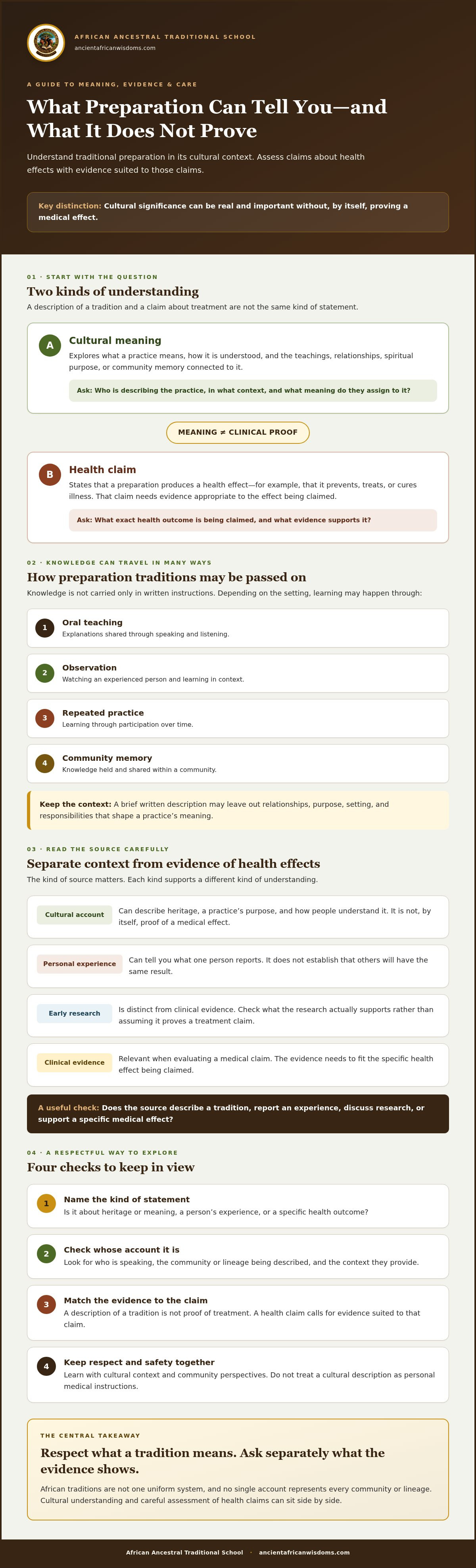
A thoughtful approach makes room for cultural learning while keeping personal health decisions on a separate, well-supported path. Use this checklist to consider what an account can tell you, what it leaves unanswered, and when a health question calls for professional guidance. Looking at each claim in context helps keep preparation traditions and medical claims distinct.
A practical checklist for reading preparation accounts
- Identify the source and context. Note who shared the account, which community or lineage it concerns if known, and the purpose described. Is it firsthand, community-based, or someone else’s interpretation?
- Separate description from evidence. Record what the source says people traditionally do or believe, then distinguish that from what medical research has established. A cultural description can offer valuable context, but it is not personal instruction or proof of a health effect.
- Look for gaps and overstatement. Does the account explain its limits and context, or make a broad claim without showing where it came from? Be cautious with absolute promises, cure claims, and language that presents a practice as universal.
- Keep safety questions open. Do not assume an account contains everything needed to judge whether something is suitable for you. If it raises questions about symptoms, treatment, or medicines, discuss them with a qualified healthcare professional.
This process supports careful reading without asking you to dismiss a tradition or accept every health claim attached to it. It helps separate learning about cultural knowledge from making decisions about your own care.
When a health question belongs with a clinician
Speak with a qualified healthcare professional about symptoms, diagnoses, treatment choices, or whether to start, stop, or change medication. Online cultural education can help you understand history and context, but it cannot assess your individual health, medical history, or circumstances. Cultural learning and modern healthcare do not have to be opposing choices. A clinician can help you consider health decisions while you continue learning respectfully.
For cultural context, choose learning sources that make room for specific histories and community perspectives. You can explore African culture and tradition courses to deepen that understanding. These courses are educational, not medical guidance or treatment.
Learning African Ancestral Traditions with Respect and Clear Boundaries
Cultural respect and careful evaluation of health claims can belong in the same conversation. You can honor inherited knowledge, spiritual meaning, and community memory while asking whether a specific health claim is supported by evidence. Learn what a tradition means in context, then assess medical statements on their own terms.
What responsible cultural learning looks like
Choose sources that name the tradition and community they discuss, explain the context, and acknowledge the limits of what they know. A careful account distinguishes firsthand knowledge from interpretation and does not present one lineage as a voice for every African people. As you learn, stay mindful of your own position. Listening and studying are not the same as having authority to speak for a community or interpret sacred teachings.
Guides to African ancestral spirituality courses can offer a focused starting point for understanding cultural and spiritual learning. Read them for context, not as a substitute for knowledge held within a particular community. Ask who created the material, whose perspectives are included, and whether it explains what it cannot represent. These questions help you move beyond decontextualized claims and recognize the people and histories behind the subject.
Continue learning without confusing education and healthcare
Online study can support exploration of African culture, spirituality, tradition, and ancestral teachings. It is not medical instruction, diagnosis, or individualized health guidance, and it cannot replace a clinician’s advice about symptoms, treatment, or medication decisions. Cultural learning and healthcare have different purposes. Keeping that boundary clear lets you value both without asking either to do the work of the other.
A guide to African ancestral rituals for beginners may also help you explore the subject through a cultural and spiritual lens. Look for material that treats practices with care, provides context where possible, and avoids turning cultural descriptions into universal directions. Let questions lead to further learning, and leave room for perspectives that may not be yours to claim.
If you would like to continue with structured cultural and spiritual education, explore the school’s African ancestral learning and community access. Its online courses and learner community offer an educational setting for exploring these traditions, not a source of medical care. Continue with curiosity, respect, and clear boundaries.
Carry Respectful Learning Forward
Preparation practices can hold cultural, spiritual, and community meaning that deserves careful attention. A statement that something prevents or treats illness, however, calls for evidence suited to that specific health claim. Keep the meaning of a tradition distinct from evidence for a medical effect.
As you continue learning, look for sources that name their cultural context and acknowledge the limits of what they can represent. Leave personal health decisions with qualified healthcare professionals, and let curiosity deepen your understanding without turning cultural knowledge into medical instructions.
The African Ancestral Traditional School offers structured online courses focused on African spirituality, culture, and tradition, along with community access for learners exploring ancestral teachings. This is cultural and spiritual education, not medical guidance or treatment. If this kind of study feels like a meaningful next step, explore the African Ancestral Traditional School's online courses.
Move forward with humility and care. Respectful learning can help you honor what has been carried across generations while staying thoughtful about the claims made in its name.
Frequently Asked Questions
What is the difference between traditional knowledge and a medical claim?
Traditional knowledge may describe cultural practice, history, meaning, or community experience. A medical claim goes further by saying something can prevent, diagnose, treat, or cure a health condition, so it needs evidence suited to that specific outcome. Respecting a tradition does not require treating every health statement connected to it as clinically established.
Does a traditional preparation prove that it works medically?
No. A preparation tradition can preserve important cultural knowledge and explain how a community understands a practice, but that alone does not establish a medical effect. Evidence needs to relate to the particular preparation, its use, and the health outcome being claimed. Keep cultural significance and clinical conclusions distinct. If you are considering something for your own health, consult a qualified healthcare professional rather than relying on tradition alone.
How can I tell whether a traditional medicine claim is supported by research?
Start by identifying the exact health claim, then look for reliable research on the same preparation and outcome. A historical account or testimonial can offer context, while a laboratory finding may point to a question for further study. Neither automatically establishes effectiveness in people. Check whether the source explains limitations and uncertainty. For symptoms or treatment decisions, discuss the issue with a qualified healthcare professional.
Can traditional knowledge and modern medicine be discussed together?
Yes, as long as each is represented accurately. Cultural accounts can explain history, meaning, and community practice, while medical research evaluates specific health claims using appropriate methods. Neither source should be asked to prove more than it can. You can approach ancestral knowledge with respect and still seek qualified healthcare advice about diagnosis, treatment, or medication. These are different kinds of guidance and can be considered without dismissing either.
Is natural preparation automatically safe?
No. Calling something natural does not establish that it is safe for every person or situation. Safety may depend on the substance, how it is prepared, the amount, a person’s health, and possible interactions. This article does not provide recipes or personal health instructions. If you are considering anything for a health concern, speak with a qualified healthcare professional, and do not stop prescribed treatment without medical advice.
What should I do if a traditional preparation is presented as a cure?
Treat a cure promise as a medical claim that needs relevant evidence, not as something established by tradition or testimony alone. Check who made the claim, what evidence supports it, and whether the source acknowledges limitations. Do not delay needed care or change treatment based on an online promise. Discuss your health concerns and treatment choices with a qualified healthcare professional who can consider your individual situation.
How can I learn about African preparation traditions respectfully?
Look for sources that identify the specific community, lineage, or context, rather than treating African traditions as one uniform system. Notice whether the source separates cultural explanation from medical advice, and be cautious with decontextualized recipes or cure claims. Structured courses on African spirituality, culture, and tradition can support cultural learning, and community access can offer a shared educational setting. Neither is clinical training or individualized healthcare guidance.


