
What if a plant’s meaning depends as much on where it grows and who tends its knowledge as on the plant itself? Across African traditions, medicinal plants are not part of one shared catalogue with one set of meanings. Knowledge is connected to particular places, communities, histories, and relationships. An online list can offer a starting point, but it cannot speak for every tradition or explain what a practice means in its own context.
It is natural to look for clear answers about plants used in spiritual rituals. Yet cultural significance, traditional use, and evidence of a medical effect are different kinds of claims. “Natural” does not automatically mean safe, either. Identification, preparation, and a person’s health circumstances can all matter.
This guide explains why plant knowledge is rooted in community and place, how to assess cultural and botanical claims, and what to consider when evaluating safety and sources. It also distinguishes cultural learning from medical advice and offers a grounded next step for continuing your study. Let curiosity be the beginning, and respect for the people and knowledge behind each tradition the way forward.
Key Takeaways
- Recognize that plant knowledge belongs to diverse traditions, not one uniform African system.
- Consider how community, place, and knowledge-holders shape a plant’s meaning in a cultural setting.
- Assess claims about medicinal plants by distinguishing documented cultural context from evidence of medical effects.
- Before acting on plant-related information, verify the plant’s identity and source, then seek qualified medical advice about safety.
- Continue learning about African traditions with patience and respect, while keeping cultural education distinct from herbal or health instruction.
What medicinal plants mean across African traditions
Medicinal plants are plants that people use within specific knowledge systems for health-related, cultural, or spiritual purposes. The term describes reported uses, not a guarantee that a plant heals or is medically effective. In African traditions, a plant’s role may be practical, spiritual, symbolic, or connected to more than one of these dimensions. Meanings and practices differ across communities, so they should be understood in their own context.
The phrase African traditional medicine offers a broad overview, but it can make the many traditions it refers to sound more uniform than they are. There is no single continent-wide practice or shared plant catalogue. A use documented in one place cannot automatically be applied to another community or treated as representative of all African traditions.
Why place and community matter to plant knowledge
Plant knowledge develops in relationship with its surroundings. Local climate and ecology influence which plants are available, while language, community history, and teaching practices shape how people identify and understand them. The same common name may refer to different plants in different places, and one plant may carry different meanings among communities. Even within one setting, knowledge-holders may have distinct perspectives. When you encounter an account, ask whose perspective it represents, where it comes from, and what context gives it meaning.
Traditional knowledge is not the same as a medical claim
A description of a plant’s spiritual significance or traditional use is a cultural or historical account. A claim that it treats a condition is a medical claim, which requires relevant clinical evidence for the specific plant, preparation, and use. A history of use alone does not establish safety or effectiveness. Plant identity, preparation, amount, and a person’s health circumstances can all affect risk.
This distinction does not diminish traditional knowledge. It helps readers approach it carefully, recognizing that cultural understanding and clinical evaluation ask different questions. This article is educational; it cannot diagnose, treat, or prevent illness. Do not use it as a substitute for advice from a qualified health professional, especially before ingesting or applying a plant or changing medical care.
How African plant knowledge is carried and interpreted
Knowledge about plants is not held in books alone. Depending on the community and source, it may be taught through spoken accounts, observation, practical experience, or shared memory across generations. These are possible ways knowledge is carried, not a pattern that applies everywhere. To understand a plant’s role, look for whose knowledge is being described, the setting it comes from, and how the account was recorded.
A plant’s name can help identify it, but its name alone cannot establish what it means within a culture. Common names vary by language and location, and one name may refer to different plants. Even when botanical identity is clear, that does not tell you whether a community regards the plant as sacred, medicinal, ordinary, or inappropriate for a particular use. Meaning depends on context and should not be guessed.
How oral knowledge and written records can complement each other
Written research can preserve details and make historical accounts easier to compare, but a published record may reflect only what its author observed or was permitted to share. Community knowledge may also be living, changing, and held by people whose perspectives are not represented in print. Read scholarly work alongside reputable, community-specific sources when available. Note who created each account and when. Neither oral knowledge nor a written record should automatically be treated as the whole story.
Why one plant can carry different meanings
A plant’s use or meaning may differ across regions, communities, and circumstances. An account about a plant in a particular place documents that source’s description; it does not prove that the same interpretation is shared elsewhere or practiced today. As you read, separate what a historical source records, what a present-day community source says, and what you infer. Keep your interpretation modest, especially when you cannot verify the attribution.
This care is especially valuable when reading about medicinal plants. Look for sources that name the community and location, distinguish past documentation from current practice, and explain the limits of the account. If those details are missing, treat the claim as unverified rather than filling gaps with assumptions.
For a wider understanding of African spirituality, culture, and tradition, structured cultural education can offer a path beyond general summaries. Explore African ancestral teachings as one educational avenue, while remembering that cultural study is distinct from plant-specific or medical instruction.
How to assess medicinal plant examples without flattening traditions
A plant profile should make clear what is known, who documented it, and where the limits are. A familiar name or promising laboratory result is not enough to assign a plant spiritual meaning or represent a community’s practice. The examples below are research candidates, not claims about African ritual use. No tradition-specific source has been provided here to verify a cultural attribution, so each remains unconfirmed.
| Common name | Botanical name | Documented context | Evidence limits |
|---|---|---|---|
| Aloe vera | Aloe vera | No specific African community or use verified here. | Do not infer ritual meaning or medical benefit from the name alone. |
| Moringa | Moringa oleifera | No specific African community or use verified here. | Any cultural or clinical claim needs its own reliable source. |
| Rooibos | Aspalathus linearis | No specific ritual context verified here. | Research candidate only, not evidence of spiritual use or efficacy. |
What to verify in a medicinal plant profile
Start with the scientific name and check the accepted botanical identification against Kew’s Plants of the World Online or an equivalent botanical reference. Then look for sources that identify the region, community, and specific reported use. Compare what each source actually says, rather than relying on a summary that repeats a claim without attribution. If sources disagree or a claim lacks key details, say so plainly. Do not fill gaps with assumptions based on a common name or broad regional label.
How to compare cultural accounts and scientific evidence
Keep cultural documentation and clinical research distinct. A source may record a community account, while a clinical study examines a defined preparation or outcome. Neither automatically establishes the other: laboratory findings cannot explain a practice’s full cultural meaning, and traditional use alone does not prove clinical effectiveness. When summarizing research, include its publication date and assess the source, study design, and limits. Do not claim a plant cures, prevents, or treats illness based solely on traditional use.
These checks make examples more useful without turning distinct traditions into a single catalogue. They also show when the responsible answer is that evidence is limited, an attribution remains unverified, or more community-specific documentation is needed. That restraint is part of respectful learning.
How to learn about medicinal plants safely and respectfully
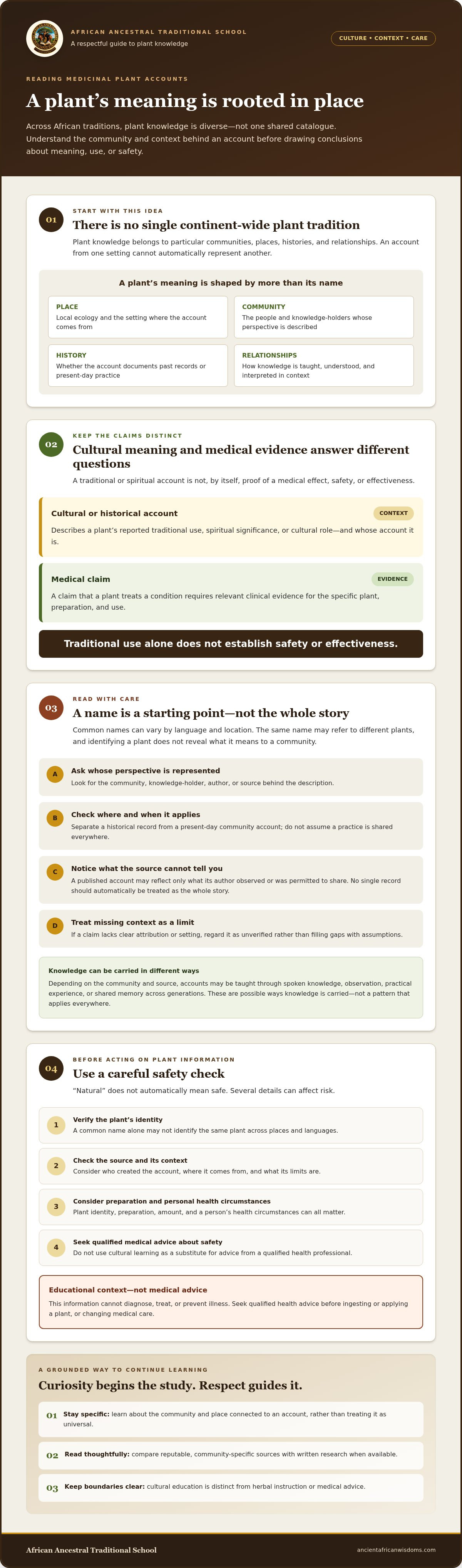
Approach plant knowledge as a learner first, not as treatment instruction. Use this sequence to separate cultural context from decisions about personal health:
- Identify the plant: Confirm its botanical identity. Do not rely on a common name, photo, or online description alone.
- Verify the source: Look for clear authorship and reliable information about where the claim comes from.
- Understand the context: Check which community or location is described and whether the account is historical or contemporary.
- Seek qualified advice: Before using a plant for health purposes, discuss it with a physician or pharmacist.
Plant identity, preparation, amount, and individual health circumstances can all affect safety. Cultural learning can deepen understanding, but it is not personal treatment guidance. Do not ingest or apply a plant you cannot confidently identify, and do not stop or replace prescribed care based on a traditional-use claim or online advice.
Questions to ask before trusting a plant claim
Pause and check the source. Who documented the information, and which community or location does it describe? Does it distinguish historical use from evidence of clinical benefit? Does it acknowledge uncertainty, possible risks, and interactions, or present the plant as universally safe? If these details are missing, treat the claim cautiously and look for better-supported, context-specific information.
When to consult a qualified health professional
Speak with a physician or pharmacist before combining a plant product with medication or using it to address a health concern. Take extra care during pregnancy, for children, and when managing chronic conditions or allergies. If you suspect poisoning or experience a severe reaction, contact your local poison-control service or emergency services promptly. Do not wait for an online source to confirm what to do.
Respectful study also means knowing when a question belongs to cultural learning and when it calls for medical care. For continued learning about African spirituality, culture, and tradition, explore African culture courses. This is an educational path, not a source of plant-specific treatment advice.
Continue learning about medicinal plants through cultural context
Plant knowledge asks for patience. A name or short online summary rarely tells the full story of a tradition, the place where an account was recorded, or the people who keep that knowledge. As you continue learning, let curiosity sit beside humility: distinguish what a source documents from what you infer, and allow uncertainty to remain when evidence is incomplete.
Build context before drawing conclusions
Keep a simple note for each account you encounter. Record the plant name as given, the tradition or community named, the location, who created the source, and whether it describes historical documentation or present-day knowledge. Add what the source does not establish. This practice can help you compare accounts carefully without turning one community’s knowledge into a claim about an entire continent.
Give priority to community-specific sources, and return to them when a viral summary leaves out its origins or context. If you cannot verify an attribution, treat it as uncertain rather than repeating it as fact. Spiritual reflection may deepen personal understanding, but it is not a substitute for medical consultation or advice about using a plant for health.
Explore African ancestral traditions through structured learning
Learning about African spirituality, culture, and tradition can provide a broader foundation for understanding how knowledge is held and interpreted. The African Ancestral Traditional School is an online education platform offering courses in these areas, with tiered learning levels and community access. This is cultural education, not a promise of plant-specific instruction, herbal treatment, or medical guidance.
Let your next step be steady rather than hurried. Continue exploring the sources behind what you read, listen for context, and stay open to what a source cannot tell you. If you would like to continue your cultural learning, explore African culture courses as one educational option.
Carry Your Learning Forward with Care
Approaching medicinal plants with respect begins with remembering that knowledge is held in specific places and communities. A plant name or traditional-use account can open a door to learning, but it does not establish a shared meaning across African traditions or prove a medical effect. Check who documented the information, stay attentive to its context, and seek qualified health advice for personal treatment decisions.
Careful study is one way to honor the knowledge and people behind each account. If you would like to continue exploring African spirituality, culture, and tradition, the African Ancestral Traditional School offers structured online courses, tiered learning levels, and community access. Explore African ancestral teachings through structured online learning.
Take the next step at your own pace, with curiosity, humility, and care.
Frequently Asked Questions
What are medicinal plants?
Medicinal plants are plants used in traditional or contemporary practices connected with health. That description reports a use; it does not establish that a plant is safe, effective, or clinically proven to treat a condition. Nor does the label give a plant one shared cultural meaning. Names, identification, preparation, and uses vary by place and knowledge context. Before using a plant for a personal health concern, confirm its identity and consult a qualified health professional.
What medicinal plants are used in African traditions?
There is no single list of plants used across African traditions. Any example should identify the plant, the specific location and community, and a reliable source documenting that association. A record of traditional use describes a cultural or historical account, not necessarily clinical evidence of benefit. An example in an article is not a recommendation to use the plant. Treat broad claims without clear attribution cautiously, and look for community-specific sources.
Are African medicinal plants safe to use?
Safety depends on correct plant identification, preparation, amount, individual health circumstances, and possible interactions with medicines. Traditional use alone does not guarantee that a plant is safe for every person or situation. Do not ingest or apply a plant you cannot confidently identify. Ask a physician or pharmacist before using one for health purposes, especially during pregnancy, for a child, or if you take medication or have an ongoing health condition.
Can medicinal plants replace prescribed medicine?
No. Do not stop, reduce, or replace prescribed treatment because of a cultural account or online article. Evidence and safety can vary depending on the plant and how it is prepared, and interactions with medicines may occur. If you are considering complementary use, discuss it with your healthcare professional first. They can consider your health history and current medicines, and help you weigh potential risks without interrupting care that has been prescribed.
How do I identify a medicinal plant correctly?
Do not rely on a common name or an online image alone, because names may refer to different species and photos can be difficult to interpret. Check the botanical name against a trusted botanical reference, and consult a qualified local expert where appropriate. Identification is only one part of safe use, so seek reliable safety information too. Do not ingest or apply a plant unless its identity and safety have been confirmed.
What is the difference between traditional plant knowledge and herbal medicine research?
Traditional plant knowledge is held and shared within particular cultural and community contexts. Herbal medicine research investigates defined questions using research methods, which may examine a specific plant, preparation, or outcome. Keep these forms of information distinct: customary use does not by itself prove clinical effectiveness, and a study does not capture every cultural meaning. Check who produced each source, what it actually documents, and where its evidence or interpretation has limits.
How can I learn about African medicinal plants respectfully?
Begin with sources that name the community, place, and knowledge context they describe. Cross-check botanical names and cultural claims, and be cautious of summaries that present Africa as one uniform tradition. Respect that some knowledge may be sacred or held within a community, and not intended for public use. Keep cultural learning separate from self-treatment; for personal health decisions, consult a qualified health professional rather than relying on an article or cultural account.


