
What if there isn’t one African herbal tradition to learn, but many distinct bodies of knowledge shaped by place, community, and history? If online explanations have left you with broad claims but little context, your caution is well placed. African Herbalism is not a single system, and traditional knowledge should not be confused with medical evidence or treated as a substitute for clinical care.
This guide offers a grounded starting point. You’ll explore why African herbal knowledge varies across regions and traditions, how it can be carried through families and communities, and why respectful learning depends on clear sources and cultural context. You’ll also find ways to assess health claims thoughtfully and continue learning without assuming one account can speak for an entire continent.
Along the way, we’ll consider the responsibilities involved in sharing and preserving traditional knowledge, including the importance of recognizing its holders. Let this be an invitation to listen closely, ask better questions, and approach a rich heritage with care.
Key Takeaways
- Understand why African herbal knowledge is diverse and rooted in particular communities, places, histories, and knowledge holders.
- Explore how local environments, language, relationships, and different ways of sharing knowledge shape herbal traditions.
- Distinguish the cultural meaning of traditional healing from biomedical evidence, and avoid treating them as interchangeable.
- Use this African Herbalism guide, a substantial resource covering traditional African herbal knowledge, to begin learning with care, check sources, respect boundaries, and prioritize safety.
- Continue your study through patient, structured learning; the African Ancestral Traditional School offers online courses on African culture, spirituality, and tradition, but no herbalism-specific course is confirmed.
What Is African Herbalism? Understanding a Diverse Knowledge Tradition
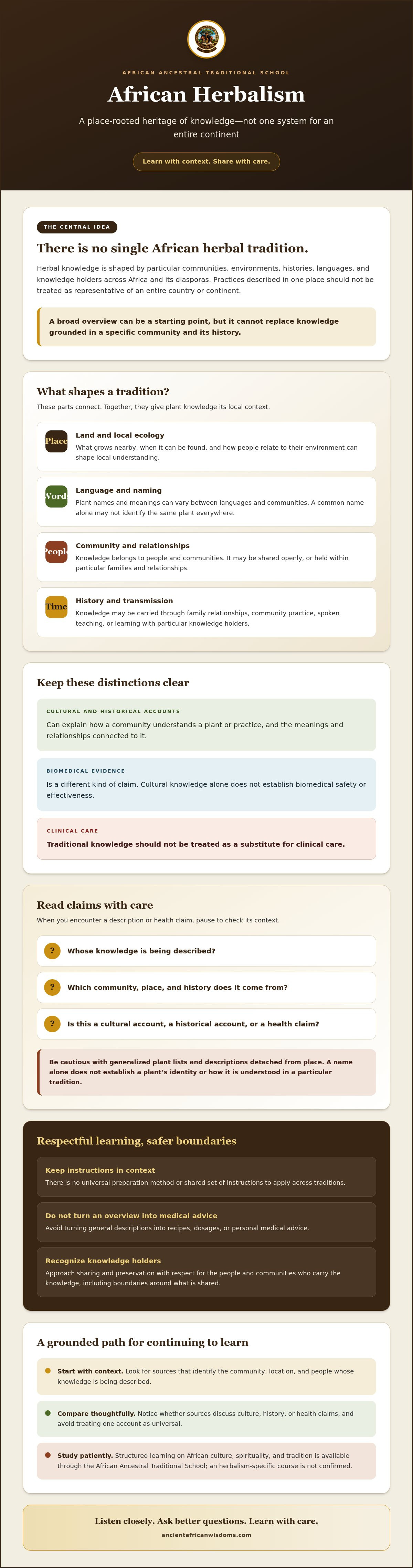
African herbalism is place-rooted knowledge and practice related to plants, shaped by particular communities, environments, histories, and knowledge holders across Africa and its diasporas. It is not one continent-wide system with a shared set of plants or methods. The subject is broad, and its many traditions need to be understood in their own contexts rather than grouped into a single account.
Herbalism is one part of a wider picture. Traditional medicine can include plant knowledge alongside other approaches to care and healing, while African Indigenous knowledge encompasses broader ways of understanding relationships among people, land, history, and community. These areas may overlap, but they are not interchangeable. Cultural knowledge alone does not establish biomedical safety or effectiveness.
Why African herbalism cannot be reduced to one tradition
African societies have distinct languages, histories, ecologies, and knowledge systems. These differences shape which plants are present, what people call them, and how knowledge is understood and shared. Even neighboring communities may relate to local plants in different ways. A practice described in one place, therefore, should not be presented as representative of an entire country or continent.
Knowledge also belongs to people and communities, not only to written records. Some teachings may be shared openly; others may be passed on within families or particular relationships. A broad overview such as African traditional medicine can provide an entry point, but it cannot replace sources grounded in a specific community and its history.
What traditional herbal knowledge can include
Depending on the tradition, knowledge may involve recognizing plants in a local landscape, observing their characteristics, and understanding when and how they are gathered or prepared. It may also include names and meanings carried in a language, teaching through practice, and responsibilities within a community. There is no universal preparation method or shared set of instructions to apply across traditions.
Keep context in view as you read. A cultural or historical account can explain how a community understands a plant or practice; it is not the same as clinical evidence that a remedy treats a condition. Avoid turning general descriptions into recipes, dosages, or personal medical advice. Respectful learning begins by asking whose knowledge is being described, where it comes from, and what kind of claim is being made.
How Place, Community, and Ancestral Knowledge Shape Herbal Traditions
A plant is never known in isolation. The land where it grows, the language used to name it, and the relationships through which people learn about it all shape what that plant means within a particular tradition. This is one reason African herbal knowledge is place-specific: local ecologies and community histories differ, so knowledge rooted in one setting should not automatically be applied elsewhere.
The World Health Organization’s overview of traditional medicine offers broader context, but regional summaries are only a starting point. To understand a particular practice, look for accounts that identify the community, location, and people whose knowledge is being described.
Ecology, language, and local knowledge
Plant knowledge develops through attention to a living environment. What grows nearby, when it can be found, and how people relate to it can inform local understanding. Names may also vary across languages and communities, and the same common name may not reliably identify the same plant everywhere. A name alone is not enough to establish a plant’s identity, much less how it is understood or used in a specific tradition.
For that reason, be cautious with generalized lists or online descriptions detached from place. A useful account explains its context instead of treating one community’s vocabulary or knowledge as universal. When comparing sources, note whether they identify a community and location, and whether the account is cultural, historical, or making a health claim.
How knowledge is transmitted and protected
There is no single model of transmission. Knowledge may be shared through family relationships, community practice, spoken teaching, or learning from particular knowledge holders. Language can carry details that a translation misses, while repeated practice may teach forms of attention that a short written summary cannot capture. Some knowledge may be shared publicly; other teachings may have boundaries. Access to a description does not automatically mean every detail is appropriate to reproduce or use.
Colonization, migration, and diaspora can shape how people encounter inherited knowledge, including what remains accessible, what changes across generations, and what is carried into new places. These histories are not the same for every community or family. For a related reflection on continuity and inherited knowledge, see ancestral veneration and African diaspora heritage.
A substantial resource on traditional African herbal knowledge should make room for this diversity rather than present a single account as complete. If you want a wider foundation in African culture and spirituality, you can explore the structured online learning available at African heritage courses and teachings. This offers broader cultural context, not a confirmed herbalism-specific course.
Traditional Healing Perspectives, Evidence, and Common Misconceptions
Healing traditions can carry cultural, historical, and community meaning beyond a biomedical description. They may show how people understand care, relationships, and inherited knowledge. Those meanings deserve respectful attention, but they do not establish that a plant is clinically effective or safe for a particular person. Tradition and modern medicine are not automatically opposed, and neither should be treated as a substitute for evidence about a specific health claim.
This guide to African Herbalism is educational. It is not a diagnosis, treatment plan, or medical advice. Do not use traditional knowledge in place of care from a qualified health professional, or delay seeking help for a health concern.
Traditional knowledge and clinical evidence answer different questions
Historical and community accounts can help explain how a plant or healing practice is understood within a particular context. Clinical research asks different questions: whether a specific preparation has been studied, what effects and risks have been observed, and for whom the findings may apply. A scientific review such as Potent African Medicinal Plants can inform further reading about selected plants, but it should not be taken as evidence for every traditional remedy or use.
These forms of knowledge can be considered alongside one another without collapsing their differences. A cultural account can be valuable on its own terms, while claims about preventing, treating, or curing illness require strong, relevant clinical evidence. Without that evidence, avoid presenting a plant as a proven remedy.
Why broad claims and remedy lists can mislead
A plant’s identity and effects cannot be assumed from a common name or a broad online list. Risk may depend on the exact species, preparation, amount, quality, and a person’s health and circumstances. Allergies, interactions with medicines, and contamination are also concerns that general descriptions may not address.
Before using an herbal product or preparation, speak with a qualified clinician, especially if you have a health condition, take medication, are pregnant, or are considering giving it to a child. Share what you are considering, including the product or plant name and how it was prepared, so they can offer relevant guidance. Do not stop prescribed treatment or replace clinical care with an unverified remedy. Respect for traditional knowledge includes being honest about what is known, what has not been established, and when professional medical advice is needed.
How to Explore African Herbal Knowledge Respectfully and Safely
Approach African herbal knowledge with curiosity and care, not as a set of instructions to collect and apply. This guide is a starting point for thoughtful study, not a substitute for guidance from knowledge holders or qualified health professionals. Use this process to guide your learning:
- Identify the tradition. Look for the community, location, language, and historical context behind the account. Do not assume a description represents every African tradition.
- Check the source. See whether the author names their expertise, sources, and the limits of what they can speak to. Compare cultural or historical documentation with evidence for specific health claims.
- Respect boundaries. Consider who holds the knowledge, whether it is shared with permission, and how attribution and benefit-sharing are handled. Not everything described online is appropriate to reproduce or claim.
- Prioritize safety. Do not self-diagnose, ingest plants based on online descriptions, or forage from a photo or common name. Consult a qualified clinician before using herbs for a health concern.
Plant identification alone does not establish safe use: identity, preparation, amount, quality, possible interactions or allergies, and individual health circumstances all matter. Online descriptions cannot reliably assess those factors for you.
Questions to ask before trusting a source
Ask who created the account, which community and place it concerns, and whether its references can be checked. Does it distinguish documented historical use from verified safety or effectiveness? Reliable writing acknowledges uncertainty and context. Be cautious of universal promises, guaranteed outcomes, or lists that offer health instructions without explaining the source or limits of their claims.
Cultural respect, consent, and ecological care
Knowledge is not automatically free to use because it appears in a book or online. Avoid publishing restricted teachings or presenting community knowledge as your own. Where knowledge is shared, look for appropriate attribution, consent, recognition of Indigenous rights, and fair benefit-sharing. These are part of responsible engagement, not optional details.
Let learning begin with listening and research rather than collecting plants. If you are considering gathering any plant, first verify the relevant local harvesting rules and conservation guidance; do not assume access or collection is permitted. A substantial resource on traditional African herbal knowledge should mean careful attention to sources, context, and the people connected to the knowledge, not a universal set of instructions.
To build broader cultural context through structured online learning, explore courses on African culture, spirituality, and tradition. This learning is broader than herbalism, and no herbalism-specific course is confirmed.
Continuing Your Study of African Herbalism Through Structured Learning
Learning about African Herbalism takes patience. A useful resource on traditional African herbal knowledge should offer context, name its sources, and acknowledge what it cannot represent. Keep returning to credible, community-informed material, and approach each account with cultural humility rather than expecting one guide to provide a complete picture.
Build a grounded learning practice
Before looking for plant-specific instructions, build a foundation in the relevant community’s culture, history, language, and relationship to place. As you study, keep notes on who created each source, which community and location it discusses, what evidence it offers, and what remains uncertain. These habits make it easier to distinguish a well-contextualized account from a broad claim presented without support.
Remember that public information is only what someone has chosen to share. It may not represent all community knowledge, and some teachings may not be intended for wider circulation. Let unanswered questions remain open rather than filling gaps with assumptions or treating online material as permission to practice.
For a wider foundation in heritage and spiritual traditions, explore African ancestral spirituality courses. Broader cultural learning can help you understand context, though it is not a substitute for community-specific sources or qualified medical advice.
Where structured ancestral education can fit
The African Ancestral Traditional School offers structured, level-based digital courses focused on African spirituality, culture, tradition, and ancestral teachings, along with community access. This can be one path for deepening your understanding of African heritage. No herbalism-specific course is confirmed, so approach the school’s offerings as broader cultural and spiritual education, not as training in herbal preparations or medical use.
Let your study unfold steadily: return to sources, note whose knowledge is represented, and seek guidance from credible voices connected to the tradition you are exploring. If you are ready to continue your broader learning, explore the African Ancestral Traditional School.
Carry Your Learning Forward With Care
African herbal knowledge is diverse, place-rooted, and held within distinct community histories. Learning about it well means seeking context, respecting knowledge holders and boundaries, and distinguishing cultural understanding from evidence about health and safety.
Let African Herbalism be a resource for exploring traditional African herbal knowledge, not a single set of practices or a substitute for qualified medical care. Patient study, careful source-checking, and cultural humility can help you continue with respect while recognizing what remains uncertain.
The African Ancestral Traditional School offers structured, level-based digital courses focused on African spirituality, culture, and tradition, along with community access for learners. These broader heritage studies can add context to your learning; a dedicated herbalism course is not confirmed. Explore the African Ancestral Traditional School and take your next step at a thoughtful pace.
Frequently Asked Questions
What is African herbalism?
African herbalism refers to place-rooted knowledge of plants and their meanings, observation, and preparation within particular African communities and traditions. It is one part of broader traditional medicine and Indigenous knowledge, not a single continent-wide system. Practices differ with local ecology, language, history, and knowledge holders. The term describes diverse cultural knowledge; it does not by itself establish that a plant is safe or clinically effective for a health condition.
Is African herbalism one single tradition?
No. African herbalism encompasses distinct traditions shaped by specific communities, places, histories, and languages. The plants known in one environment, and the cultural meanings or practices connected with them, may differ from those elsewhere. A description of one community’s knowledge should not be presented as universal. Look for sources that name the tradition, location, and knowledge holders, and treat broad overviews as introductions rather than complete accounts.
How is traditional herbal knowledge passed down in African communities?
There is no single transmission model. Depending on the community, knowledge may be shared through family relationships, spoken teaching, observation, practice, or particular knowledge holders. Language and local context can carry meanings that a short written description does not capture. Some knowledge may be shared publicly, while other teachings have boundaries. A source available online does not necessarily represent the full tradition or mean every detail is appropriate to repeat.
Can traditional African herbs replace prescribed medicine?
Do not stop or replace prescribed medicine with herbs without first consulting a qualified clinician. Cultural or historical use does not establish that a preparation can treat a condition or safely take the place of a prescribed treatment. If you are considering an herbal product, tell your clinician what it is and how you plan to use it. Seek medical care for health concerns rather than relying on online remedy claims or self-diagnosis.
Is it safe to use African traditional herbs with medication?
Not always, and safety depends on the specific plant, preparation, amount, product quality, medication, and your health circumstances. Herbs may cause allergic reactions or interact with medicines, and a common name may not reliably identify a plant. Ask a qualified clinician or pharmacist before combining an herbal product with medication. Share the product label or exact plant information if available, and do not change prescribed doses without medical guidance.
How can I learn about African herbalism respectfully?
Start with sources that name the community, location, author, and basis for their claims. Learn the cultural context before seeking plant-specific instructions, and distinguish historical accounts from evidence of safety or effectiveness. Respect knowledge holders, attribution, consent, and boundaries around what may be shared. This guide to African Herbalism is a starting point, not a complete account; continue learning through credible, community-informed sources and consult a clinician about health decisions.
Are traditional African medicinal plants at risk from overharvesting?
Risk can vary by plant, location, habitat, and harvesting pressure, so it is not accurate to assume every traditional medicinal plant is threatened or that none are. Look for conservation information tied to the specific species and area rather than relying on a generalized claim. Do not forage based on an online description. Before considering collection, check local rules and conservation guidance, and remember that cultural knowledge does not automatically grant permission to harvest or use a plant.


