
What if the meaning of an Igbo spiritual term depends not only on its definition, but on how it relates to people, place, and community? Words such as Ala and Ani, or Alusi and Arusi, may appear with different spellings and explanations. Understanding terminology and role within Igbo traditional spirituality means looking beyond a simple glossary to the relationships these words describe.
If broad accounts of African spirituality have left you unsure whether a term names a spiritual force or a person’s community role, that uncertainty is understandable. Meanings and practices can vary across Igbo communities, so one explanation may not tell the whole story.
This guide introduces concepts including Chukwu, chi, Ala, and Alusi, alongside roles such as dibia and the place of elders. It explains how these ideas connect, why translations can flatten important distinctions, and how to approach further learning with care. Use the terms as a starting point for understanding context, not as substitutes for the living traditions and communities they come from.
Key Takeaways
- Igbo spiritual terms may vary by dialect, locality, lineage, and religious history, so context matters when interpreting them.
- Chukwu, Ala, chi, and Alusi are related concepts, but they should not be forced into one universal hierarchy.
- Spiritual concepts differ from community responsibilities and the people who may hold particular roles, including dibia and elders.
- Use terminology and role within Igbo traditional spirituality as a starting point for learning, not as a one-size-fits-all glossary.
- Check where a definition comes from, compare credible accounts, and make room for uncertainty.
Igbo Traditional Spirituality: Why Terms Need Cultural Context
Igbo traditional spirituality is a broad name for spiritual beliefs, practices, and ways of understanding life among Igbo people. It is not one identical system followed in the same way by every community. A word’s meaning and use may depend on the speaker, source, locality, lineage, dialect, and religious history. An overview can be a helpful beginning, but it cannot represent every community’s understanding.
This distinction matters when learning the terminology and role within Igbo traditional spirituality. A word may name a spiritual concept, while a role describes a person’s place or responsibilities within a community. A term names an idea or being; a role describes what a person does or is recognized for in a particular community. Keeping these meanings separate helps prevent a glossary from turning complex relationships into fixed labels.
This article is an introduction, not a final authority. For a starting point, Odinani, the traditional Igbo religion offers an accessible survey of concepts and roles, including Chukwu, Alusi, chi, and dibia. Treat any single account, including this one, as a guide to further learning rather than a complete description of living traditions.
What does “Odinani” refer to?
Odinani is commonly used to refer to Igbo traditional religion or worldview. The word can point to more than a list of spiritual beings or practices. It may also frame how people understand relationships among the spiritual, human, and natural worlds. Writers and communities may use the term differently, so a brief definition should not be mistaken for a complete account of Igbo belief or practice.
Why do spellings and meanings differ?
Igbo words may be written with tone marks that indicate how a syllable is spoken, but everyday writing and published sources do not always represent those marks consistently. Dialect, transliteration choices, and an author’s spelling conventions can also affect how a term appears. A different spelling does not automatically mean a different concept, just as a familiar spelling does not guarantee identical local meaning.
When you encounter an unfamiliar form, note where it came from and how the source explains it. Give greater weight to community-informed accounts and Igbo-focused scholarship than to unsourced online glossaries. If sources disagree, record the difference rather than forcing a single answer. That uncertainty can be part of understanding how language and tradition live within particular communities.
Core Igbo Spiritual Terms: Chukwu, Ala, Chi, and Alusi
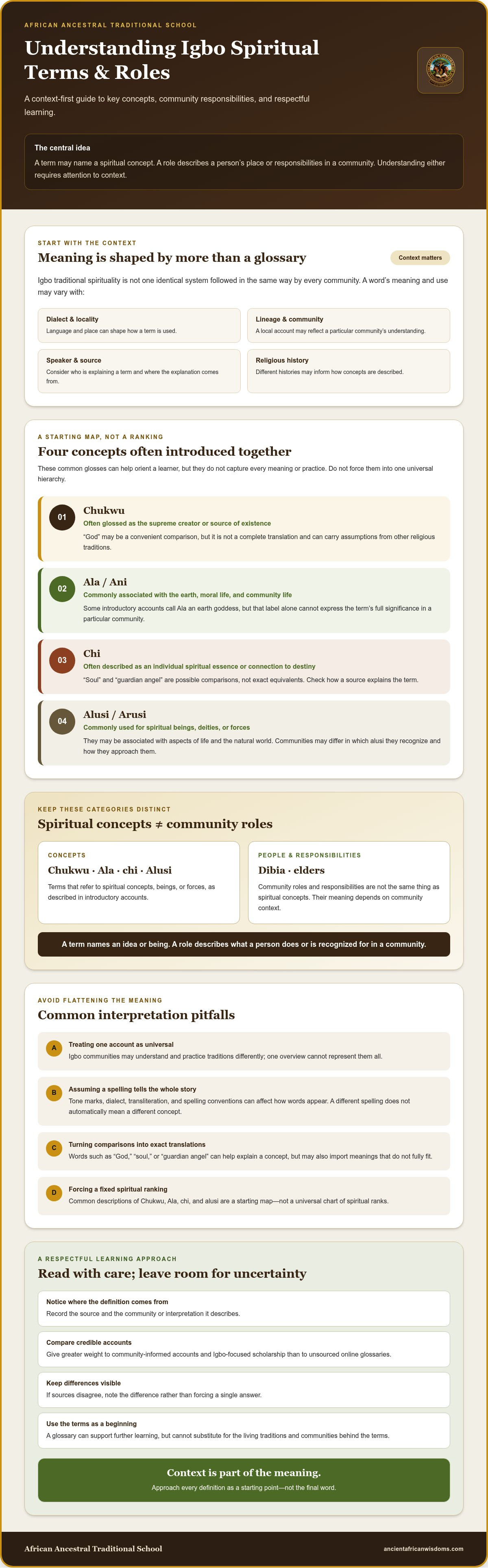
These four terms offer a starting map, not a fixed chart of spiritual ranks. Introductory accounts commonly describe Chukwu as the supreme creator, Ala or Ani in connection with the earth and community life, chi as an individual spiritual essence, and alusi as spiritual beings or forces. These English glosses are useful, but they do not capture every meaning or practice across Igbo communities. The terminology and role within Igbo traditional spirituality become clearer when each concept is understood in its community context.
How are Chukwu and Ala understood?
Chukwu is often glossed as the supreme creator or source of existence. “God” may be a convenient comparison, but it can carry assumptions from other religious traditions and should not be treated as a complete translation. Ala, also written Ani, is commonly associated with the earth and with moral and communal life. Some introductory descriptions call Ala an earth goddess, but that label alone cannot convey the term’s full significance in a particular community.
These descriptions should not be turned into a universal ranking. A common gloss is not a complete account of a term’s status, relationships, or place in local practice.
What do chi and alusi mean in context?
Chi is often described as a person’s individual spiritual essence or connection to destiny. Translations such as “soul” or “guardian angel” can mislead if they suggest exact equivalents. Check how a source explains chi and whether it describes a particular community or interpretation before assuming one meaning applies everywhere.
Alusi, also spelled arusi, is commonly used for spiritual beings, deities, or forces associated with aspects of life and the natural world. Some accounts describe them in relation to Chukwu, but that does not mean every community recognizes the same alusi or approaches them in the same way. The Harvard Divinity Bulletin’s discussion of Igbo eco-spirituality offers further perspective on how spiritual understanding can be woven into relationships with the natural world.
Context shapes interpretation: the same spiritual term may carry different relationships and significance depending on the community, source, and practice being described. As you encounter these words, check the scope of each account. To continue learning beyond introductory definitions, explore online education in African spirituality and culture. Check whether a learning resource specifically addresses Igbo terms before relying on it for that purpose.
Igbo Spiritual Roles: Dibia, Elders, and Community Responsibilities
Spiritual concepts and community roles are not the same kind of thing. Chukwu or chi names a spiritual concept; dibia describes a person recognized for particular knowledge or work, while elders may hold social responsibilities grounded in community relationships. Understanding terminology and role within Igbo traditional spirituality therefore depends not only on a word’s gloss, but also on who uses it and in what setting.
The word dibia is often translated as “spiritual expert,” “healer,” or “diviner.” These are introductory descriptions, not interchangeable job titles. Some accounts distinguish a diviner, sometimes called a dibia afa, from an herbalist, sometimes called a dibia ogwu. The Odinani overview offers a broad introduction to the term. For specific duties and standing, check Igbo-focused sources and community context.
What role may a dibia hold?
A dibia may be associated with traditional knowledge, healing, divination, spiritual guidance, or ritual responsibilities. These areas can overlap, but do not assume every dibia undertakes them all. The work described in one account may not match practice in another locality. When reading about a dibia, check the source’s location, terminology, and explanation of the person’s responsibilities rather than relying on a broad English label.
| Term or role | Cautious description | Context note | Source |
|---|---|---|---|
| Dibia | A person associated with specialized spiritual or traditional knowledge. | Work may include distinct practices; don’t assume one uniform function. | Odinani overview; local accounts |
| Dibia afa / dibia ogwu | Terms used in some accounts for divination and herbal knowledge. | Labels and responsibilities should be verified in context. | Igbo-focused accounts; community context |
| Elders | People respected as custodians of wisdom and tradition. | Responsibilities may depend on community and lineage. | Community knowledge; local context |
How do lineage and community shape responsibilities?
Knowledge and responsibilities may be rooted in particular families, lineages, or communities. That context can shape who teaches a practice, who carries a responsibility, and how it is understood. The Harvard Divinity Bulletin’s discussion of Igbo eco-spirituality offers broader cultural grounding, but it is not a complete account of every local role.
An introductory article can help you recognize terms; it does not confer authority, training, or initiation. Approach community-specific teachings with humility, and distinguish learning about a role from claiming that role. For related context on ancestry and continuity, explore ancestral veneration in the African diaspora.
Common Misunderstandings About Igbo Spiritual Terms and Roles
A glossary can help you begin, but it cannot define how every Igbo community uses a term. Treating one explanation as universal risks overlooking differences in dialect, locality, lineage, religious history, and lived practice. A careful introductory gloss says, “This term is often described this way.” An overconfident claim says, “This is what all Igbo people believe.” The first leaves room for context; the second can erase it.
Translation can blur distinctions, too. For example, chi is a spiritual concept, alusi refers to spiritual beings or forces in some accounts, and dibia describes a person associated with particular knowledge or responsibilities. They do not name the same kind of thing. A short English equivalent may make a concept easier to approach, but it can hide the relationships and local meanings that give it significance.
Why can a single English translation mislead?
An English word may offer a point of entry without being an exact substitute. Terms such as “spirit,” “deity,” or “healer” carry associations shaped by English-speaking religious and cultural traditions. Those associations may not match how a particular Igbo source or community understands the term. Pronunciation and tone can matter, too, while written forms may not show every distinction.
Use a simplified translation as a starting point, then ask what it leaves out. Who uses the term? Does the source describe a specific community, a scholarly interpretation, or a broad introductory overview? These questions help keep a convenient gloss from becoming a claim about every tradition.
How can readers recognize overgeneralization?
Pause when an account uses absolute wording such as “all Igbo people believe” or gives one spelling and definition without identifying its source. Check the author’s background and publication, the locality or community discussed, and whether the account explains its spelling choices. A useful explanation makes its scope clear and acknowledges when meanings or practices differ.
Read Igbo cosmology alongside community-informed and scholarly sources rather than treating one account as the final word. A helpful rule is: Before accepting a definition, check who uses the term, where it is used, and what context gives it meaning. This care helps you understand terminology and role within Igbo traditional spirituality without confusing spiritual concepts, human responsibilities, or community-specific teachings.
To learn more about African spirituality and culture in a structured way, explore online ancestral education. Check whether the available materials specifically address Igbo traditions before relying on them for Igbo-specific study.
How to Continue Learning About Igbo Traditional Spirituality Respectfully
Learning does not end with a list of definitions. As you explore terminology and role within Igbo traditional spirituality, trace where an explanation comes from and what it can and cannot tell you. The aim is not to collect words detached from people, but to approach them with care, curiosity, and respect for the communities that keep their meanings alive.
How can you evaluate sources and explanations?
Start with the term, then check the source’s context. Does the writer identify the community, language, or location being discussed? Do they explain the limits of their account? Compare scholarly work with community-informed sources rather than relying on a single glossary. If accounts differ, note the variation instead of forcing one answer.
A personal glossary can help you keep track of what you learn. For each term, record:
- The spelling used, including any tone marks shown by the source.
- The source and its community or scholarly context.
- The meaning offered, along with uncertainty or alternate interpretations.
This practice helps distinguish a broad introductory explanation from knowledge rooted in a particular place or lineage. It also gives you a way to revisit a term as you encounter new accounts.
Where possible, listen to Igbo voices and engage with Igbo-focused scholarship. Respect boundaries around knowledge that may be community-held or not intended for general explanation. Reading about a tradition can support understanding, but it does not make a reader a representative or authority on that tradition.
Where can structured online learning fit?
Structured online education can provide a wider foundation in African spirituality, culture, and tradition. The African Ancestral Traditional School offers digital courses and learning levels in these broader areas, along with community access. Check the current course descriptions before enrolling, since Igbo-specific terminology or teachings should not be assumed unless the syllabus confirms them. Online learning can support your study, but it is not a substitute for community knowledge or authority.
For broader background, explore African ancestral spirituality courses as a general learning resource, not as confirmation of an Igbo-specific course. Take one term at a time, keep track of sources, and allow room for what you do not yet know. If you are ready to continue with broader African ancestral education, explore African ancestral learning.
Carry Your Learning Forward with Care
Understanding terminology and role within Igbo traditional spirituality begins with recognizing that definitions live within relationships, communities, and histories. Chukwu, Ala, chi, and alusi offer useful points of entry, but no single glossary can represent every interpretation. Roles such as dibia and the responsibilities of elders also need to be understood in their local and lineage context.
As you continue, note where each explanation comes from, compare credible sources, and make room for differences rather than forcing certainty. Learning from Igbo voices and scholarship can deepen your understanding while reminding you that reading about a tradition is not the same as holding community authority.
The African Ancestral Traditional School offers structured digital courses on African spirituality, culture, and tradition, as well as online community access for learners. Check course descriptions for their specific scope, since Igbo-specific content is not confirmed. Explore African ancestral learning to build a broader foundation.
Frequently Asked Questions
What does Odinani mean in Igbo spirituality?
Odinani is a term commonly associated with Igbo traditional religion and worldview. It can refer to a way of understanding spiritual life and its connections with people, community, and the natural world, rather than only a list of beliefs. Spellings and explanations may vary by source and community. Treat a short definition as an introduction, then check who uses the term and the cultural context they describe.
Who is Chukwu in Igbo traditional spirituality?
Chukwu is commonly described in introductory accounts as the supreme creator and source of existence. The English word “God” is sometimes used as a gloss, but it may not capture every nuance of the term or how it is understood in a particular community. Consider the source’s explanation rather than assuming the translation is exact. Accounts may also describe relationships among Chukwu and other spiritual concepts differently.
What is the difference between chi and alusi?
Chi is commonly described as an individual spiritual essence, while alusi refers in some accounts to spiritual beings, deities, or forces. They are not interchangeable: one is associated with a person’s spiritual identity, the other with spiritual beings or powers. These are broad glosses, not exact translations. Interpretations and practices may differ, so check how an Igbo-focused source explains each term and its local context.
What role does a dibia have in Igbo tradition?
A dibia is often described as someone with specialized spiritual or traditional knowledge, but the role is not necessarily the same in every community. Some accounts distinguish divination from herbal knowledge, while others describe healing, guidance, or ritual responsibilities. Avoid assuming every dibia performs all these functions. Look for sources that identify the community and clarify which responsibilities they describe, rather than relying on a single English label.
Are Igbo spiritual beliefs the same in every community?
No single account should be assumed to describe every Igbo community’s beliefs and practices. Meanings and customs may vary with locality, dialect, lineage, source, and religious history. A glossary can offer a useful starting point, but it cannot settle every interpretation. Compare community-informed accounts and scholarship, and be cautious of statements that claim all Igbo people understand a term or practice in exactly the same way.
Is Igbo traditional spirituality a religion or a worldview?
It can be described as a traditional religion and as a worldview, depending on the source and the aspect being discussed. “Religion” can point to spiritual beliefs and practices, while “worldview” can emphasize how spiritual understanding relates to community, morality, nature, and daily life. These descriptions are not necessarily contradictory, but neither is a complete definition. Notice how each source uses the terms and what it includes.
How can I learn Igbo spiritual terms respectfully?
Start by recording a term’s spelling, source, and stated meaning. Compare credible scholarship with community-informed explanations, and note when accounts differ rather than forcing certainty. Give priority to Igbo voices, respect boundaries around community-held knowledge, and do not treat reading as authority or initiation. Structured online courses can support broader learning about African spirituality and culture; check the current syllabus before assuming it includes Igbo-specific teachings.


