
What if the most helpful way to understand African ancestral spiritual teachings is not as one shared doctrine, but as a set of relationships shaped by distinct cultures and histories? Concepts discussed online can sound universal when they’re stripped of context, leaving readers unsure what belongs to a particular tradition and what may be a recurring theme.
That uncertainty is understandable. Ancestry, community, ethical responsibility, and spiritual life may be closely connected, but their meanings and expressions differ across African traditions and diasporic communities. Learning about these teachings also isn’t the same as practicing them, receiving lineage-specific guidance, or undergoing initiation.
This article offers a respectful starting point. You’ll explore themes found in some traditions, consider how they may relate, and learn why they shouldn’t be treated as one pan-African belief system. You’ll also find a practical way to assess sources and continue learning, including through structured education that provides context without claiming to replace community or tradition-specific guidance.
Key Takeaways
- Understand spiritual concepts as guiding ideas rooted in particular traditions, not as one shared African doctrine.
- Explore how ancestry and living communities may connect, while recognizing that remembrance and respect take different forms.
- See why ideas such as Aṣẹ need their Yoruba context rather than being treated as universal spiritual terms.
- Use a thoughtful study process: identify the tradition, check the source and context, and distinguish community knowledge from interpretation.
- Consider structured online learning as a way to deepen your understanding, while keeping education distinct from lineage-specific guidance or initiation.
What Do African Ancestral Spiritual Concepts Mean?
A spiritual concept is a guiding idea that helps a community understand relationships, responsibilities, and the meaning of particular practices. In African ancestral teachings, its meaning belongs within a specific cultural and historical setting, not a single system shared across the continent.
Definition: An African ancestral spiritual concept is an idea used within a particular tradition to understand spiritual life, relationships, or responsibilities, interpreted in the context of that community’s history and practices.
African traditions are diverse, shaped by different peoples, languages, histories, and forms of practice. Even when broad themes appear similar, they may carry distinct meanings or play different roles. An overview of African traditional religions can introduce this breadth, but no single summary can speak for every community.
Why context matters when discussing African spiritual concepts
English terms can introduce an idea, but they don’t always convey the meaning or nuance of a word in its original language. A broad comparison may point to a recurring theme, while a teaching tied to a particular people, family, or lineage needs to be understood on its own terms. When you read a source, check whose teachings it describes, where they come from, and whether the source explains the limits of its account.
A starting framework: relationships, responsibility, and continuity
Relationships, responsibility, and continuity can be a useful framework for exploration, not a definitive shared creed. In some traditions, spiritual ideas may connect individuals with family and community, ancestors, and the living world. The particular relationships, obligations, and practices vary, so treat these themes as questions to investigate rather than conclusions to apply everywhere.
For broader context, explore African spirituality and heritage courses. As you read, notice whether a resource distinguishes community knowledge, scholarship, and personal interpretation. That distinction can help keep your learning grounded and respectful, while leaving room for deeper study within the traditions being discussed.
How Ancestry and the Living Community Relate in African Traditions
Ancestral connection can mean different things across African traditions and families. It may involve memory, lineage, identity, or a sense of responsibility carried across generations. For some practitioners, ancestors remain part of spiritual life; others may understand this connection through family history, cultural continuity, or shared values. No single description captures every community’s belief.
These relationships can also help make sense of a holistic African worldview, in which spiritual life may be woven into family and community life rather than separated from it. How this understanding takes shape depends on the tradition and the people who carry it.
What does ancestral connection mean in context?
Remembering those who came before may affirm a family’s history, strengthen a sense of belonging, or connect present responsibilities with past generations. In some traditions, ancestors are venerated and understood to have an ongoing spiritual relationship with the living. Veneration and worship aren’t always treated as the same thing, but their distinction and meaning vary. Don’t assume either term applies uniformly.
For a focused discussion of diaspora perspectives, see ancestral veneration in the African diaspora. If you’re considering a particular practice, seek guidance from people knowledgeable within the relevant tradition rather than relying on a general online description.
Why community and reciprocity matter
Spiritual understanding may be shaped not only by individual beliefs, but also by relationships of care, belonging, and mutual responsibility. Community can help carry memory forward, interpret teachings, and provide context for how values are lived. The details differ, so avoid turning a shared theme into a rule for every tradition.
Ubuntu, associated with particular Southern African contexts, is sometimes discussed in connection with personhood and relationships. It shouldn’t be used as a slogan for all African societies or reduced to one simple translation. Its meaning deserves attention to the language and context in which it’s used.
Approach these concepts with curiosity and care: ask whose understanding is being shared, and listen for the community and history behind it. If you’d like to continue learning through structured online courses on African spirituality, culture, and tradition, explore African ancestral teachings and learning levels. Online study can provide educational context while remaining distinct from lineage-specific guidance.
How Spiritual Agency, Life Force, and Ethical Action Fit Together
Ideas about spiritual power, vitality, or the capacity to act appear in discussions of some African traditions, but their meanings aren’t interchangeable. Each term belongs to a particular language and cultural setting. A translation such as “life force” may offer an entry point, but it can’t convey every layer of meaning or explain how a concept is understood in practice.
How to explain spiritual power without flattening traditions
Aṣẹ is a Yoruba concept often discussed in relation to power or the capacity for words and actions to take effect. That short description is a starting point, not a complete translation or a universal African principle. For focused context, explore the meaning of Aṣẹ, and look for sources that identify the tradition behind any term they explain.
The comparison below is deliberately cautious. It distinguishes a tradition-specific example from a broad phrase whose meaning changes across contexts.
| Term | Tradition or context | Cautious plain-language explanation |
|---|---|---|
| Aṣẹ | Yoruba context | A concept associated with power or efficacy; an English gloss alone doesn’t capture its full meaning. |
| Spiritual power or life force | Broad comparative language, not one tradition | A general phrase used to discuss ideas that require specific cultural and linguistic attribution. |
Use comparisons as prompts for further study, not proof that different traditions share an identical teaching. When you encounter a translated term, ask who uses it, what sources explain it, and whether the explanation distinguishes interpretation from established teaching.
What ethical responsibility adds to spiritual understanding
Ethical action is another theme to explore, not a single rulebook shared across cultures. A teaching may invite reflection on how a person treats others, contributes to community life, or takes responsibility for harm. The humanistic foundations of African ethics offer a scholarly perspective, while specific teachings still need to be understood in their own contexts.
In everyday life, this kind of reflection might mean listening before responding, repairing a strained relationship where appropriate, or considering how a choice affects others. These are practical prompts, not spiritual prescriptions or promises of a particular outcome. Cultural and spiritual teachings also aren’t substitutes for medical care, legal advice, or guaranteed solutions to life’s challenges.
Approached with care, these concepts can prompt thoughtful questions about agency and conduct. For continued study, online courses in African spirituality and tradition can provide educational context without replacing guidance specific to a community or lineage.
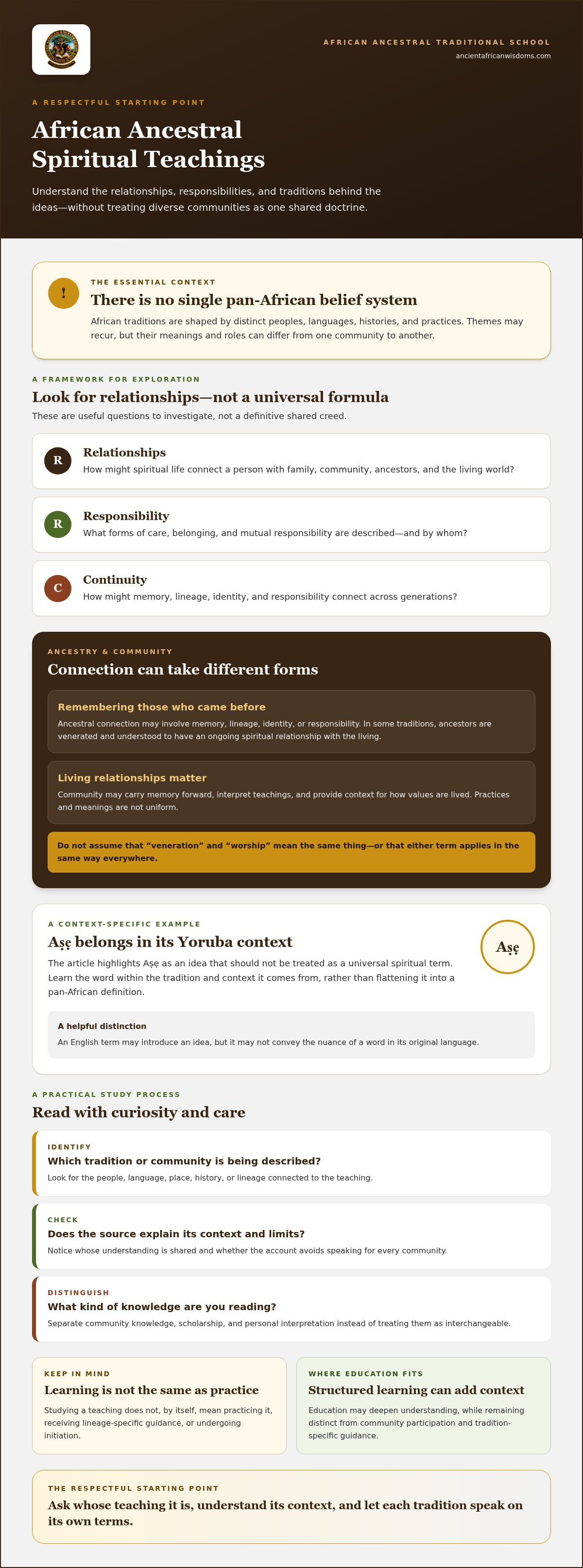
How to Study African Ancestral Spiritual Concepts Respectfully
Respectful study begins with pausing before turning an unfamiliar teaching into a universal rule. Use this sequence to keep your learning grounded:
- Identify the tradition: Look for the specific people, region, language, family, or lineage being discussed.
- Locate the source: Find out who is sharing the teaching and whether they describe their perspective or draw on documented research.
- Check the context: Notice when and where the idea is used, and what practices or relationships give it meaning.
- Reflect: Consider what you’ve learned without assuming a general description tells you what to believe or do.
- Continue learning: Compare careful sources and seek appropriate community context for questions that require tradition-specific knowledge.
Questions to ask before trusting a spiritual explanation
Before accepting a broad claim, ask: Which people, language, region, or lineage does this explanation refer to? Does the author distinguish historical or community context from personal interpretation? Are sources named, and are their limits acknowledged? Be especially thoughtful when a source claims to explain all African traditions. Sweeping language can erase important differences, even when the writer intends to be helpful.
It also helps to separate different kinds of information. Community knowledge may be shared within a living tradition; scholarship offers a particular research perspective; personal interpretation describes an individual’s understanding; and online summaries may simplify all three. None should automatically be treated as a substitute for the others.
How to learn online without confusing education with initiation
Digital courses can organize material, introduce cultural context, and support discussion. They provide education, not initiation, and can’t stand in for guidance from the community or lineage connected to a particular teaching. If a question concerns what to practice, whom to approach, or whether a practice is appropriate, look for guidance specific to that tradition. Reflection is always your choice; no general article or course should assign you a ritual.
If you’re researching practical ritual topics, online African ancestral rituals for beginners offers a focused place to continue reading. Approach practical descriptions with care, and remember that learning about a practice doesn’t mean you’re being asked to perform it.
To continue through structured online education, explore African ancestral spiritual teachings and learning levels. Use each lesson as a starting point for thoughtful, context-aware study.
Where Structured Learning Fits into an Ancestral Wisdom Journey
After exploring foundational ideas, you may want a learning path that gives you room to revisit them, ask questions, and build context over time. Structured study can help organize that process. It doesn’t make diverse traditions interchangeable, but it can help learners approach ancestral teachings with greater care and clarity.
What a structured online learning path can offer
The African Ancestral Traditional School offers online courses in African spirituality, culture, and tradition through educational learning levels. A tiered structure gives learners a way to develop understanding gradually, while community access creates a setting for learning alongside others. The school’s courses include ancestral teachings and rituals; check course descriptions to understand which subjects and cultural contexts a particular course covers.
Learning in a course is educational. It doesn’t, by itself, establish a relationship with a specific community or lineage, and community access isn’t a promise of spiritual outcomes. The school does not provide in-person initiation ceremonies or personalized psychic readings. If you’re seeking guidance tied to a particular tradition, consider what a course can offer and where community-specific guidance may be needed.
Choosing a next step that respects your own path
Before choosing a program, consider what you hope to learn. Are you looking for cultural and historical context, a clearer understanding of spiritual concepts, or a learning community? Your background and questions can help you decide whether structured online study feels useful now or whether you’d prefer to keep researching first.
There’s no need to rush. Read course descriptions carefully, ask what traditions are covered, and note what the learning environment does and doesn’t include. A thoughtful next step should support your learning without suggesting that one course represents every African tradition or replaces lineage-specific instruction.
If community learning is part of what you’re seeking, you can explore this guide to African spiritual community membership as one resource for considering how connection and study may fit into your journey. Continue at a pace that feels grounded, making space for context, questions, and deeper understanding.
Continue Your Learning with Care and Context
African ancestral spiritual concepts are best approached as teachings rooted in particular communities, histories, and practices, not as one universal doctrine. Ancestry and community may shape spiritual understanding, while ideas about spiritual agency and ethical responsibility call for careful, tradition-specific interpretation.
As you continue, ask whose knowledge a source represents and distinguish learning about a tradition from practicing it or receiving lineage-specific guidance. Patient study leaves room for questions, deeper context, and respect for the communities that carry these teachings.
The African Ancestral Traditional School offers structured digital courses focused on African spirituality, culture, and tradition, with tiered educational levels and community access. This is online education, not a substitute for lineage-specific guidance or in-person initiation. If this approach fits your learning goals, explore the African Ancestral Traditional School’s online learning path and continue your study with care and context.
Frequently Asked Questions
What are the core concepts in African ancestral spiritual teachings?
There isn’t one set of core concepts shared by every African tradition. Themes explored in some communities include relationships with ancestors, responsibilities to family and community, spiritual life, and continuity across generations. Their meanings and practices differ by culture, language, and lineage. Treat these themes as starting points for learning, then look for sources that explain which tradition they describe rather than assuming they form a universal doctrine.
Are African spiritual beliefs the same across all African cultures?
No. African cultures include distinct histories, languages, communities, and spiritual traditions, so beliefs and practices aren’t uniform across the continent. Similar English descriptions may refer to different ideas, while a teaching important in one tradition may not be present in another. When reading an explanation, check which people or region it discusses and whether its author recognizes the limits of their account.
What is the role of ancestors in African spiritual traditions?
The role of ancestors varies by tradition, family, and practitioner. In some communities, ancestors are understood as having an ongoing spiritual relationship with the living; in others, ancestral connection may be discussed through memory, lineage, identity, or continuity. These understandings can influence how people think about family and community responsibilities. A general description can introduce the subject, but it can’t define every community’s beliefs or practices.
Is ancestor veneration the same as ancestor worship?
Not necessarily. “Veneration” often refers to honoring or showing respect, while “worship” can suggest a different relationship, but the distinction depends on the tradition and on how practitioners use these words. The terms shouldn’t be treated as interchangeable labels for every African practice. To understand a particular teaching, look for explanations from sources that identify its cultural context and avoid imposing a single outside definition.
What does Aṣẹ mean in African spirituality?
Aṣẹ is a Yoruba concept often explained in English through ideas such as power or the capacity for words and actions to take effect. These are introductory glosses, not complete translations of its meaning within Yoruba contexts. Aṣẹ isn’t a universal term for spiritual force across African traditions. Look for sources that identify its Yoruba context and explain how their interpretation relates to the original language and tradition.
Can I learn African ancestral spiritual teachings online?
Yes, online study can introduce African spirituality, culture, and tradition through structured educational courses. The African Ancestral Traditional School offers online courses, tiered learning levels, and community access for learners. Course materials can support study, but online education isn’t the same as initiation or lineage-specific guidance. The school doesn’t provide in-person initiation ceremonies or personalized psychic readings, so review course information to understand its educational scope.
How can I study African spiritual concepts respectfully?
Begin by identifying the tradition, people, language, or region a source describes. Then check who created it, what sources it relies on, and whether it distinguishes community knowledge, scholarship, and personal interpretation. Be cautious of claims that speak for all African traditions. You can reflect on what you learn without taking it as an instruction to practice. For tradition-specific questions, seek appropriate context from knowledgeable community sources.


