
What if your purpose isn’t a single destiny waiting to be uncovered, but a relationship that grows through reflection, responsibility, and connection? If you’re unsure what meaningful step comes next or feel distant from your ancestral heritage, it’s natural to seek guidance. African ancestral wisdom can offer ways to reflect on your direction without insisting that everyone must follow one path.
Your values, family stories, responsibilities, and community can all shape how you understand purpose. African traditions are diverse, and reconnecting with heritage doesn’t require you to have every answer or adopt a prescribed belief. It can begin with listening, learning, and asking what feels meaningful in your life now.
In this article, you’ll explore how ancestral wisdom can inform your sense of purpose while leaving room for your own discernment. We’ll consider questions that connect personal values with heritage and community, then look at grounded next steps for further learning. Let this be a beginning, not a demand to arrive at one final answer.
Key Takeaways
- Explore purpose as meaning, direction, and responsibility in your lived experience, rather than assuming it has one fixed answer.
- Consider purpose, destiny, and calling as related ideas, then use reflective questions to clarify what each means to you.
- Approach ancestral guidance with curiosity and care. African traditions are diverse, and wisdom isn’t a promise of instant answers.
- Reflect on your values, responsibilities, sense of belonging, and unanswered questions to identify a grounded next step.
- For continued learning, consider structured online study of African culture and spirituality, with tiered courses and community access.
What Does Purpose Mean Through an African Ancestral Lens?
Uncertainty about your direction doesn’t mean you’re failing to hear a message or missing a path everyone else can see. Ancestral wisdom can offer ways to explore meaning, but it doesn’t provide one authoritative answer for every person. Your questions, circumstances, and relationships matter.
Purpose is a sense of meaning, direction, and responsibility expressed through how a person lives, relates to others, and responds to what matters. Through an ancestral lens, reflection may include heritage and community alongside personal values and present choices. Purpose isn’t necessarily a fixed role assigned once and for all.
How can heritage shape a person’s sense of purpose?
Heritage can prompt questions about the values, relationships, and sources of belonging that shape your life. Family stories, cultural practices, language, or knowledge passed between generations may help you consider what you want to carry forward. Learning how earlier generations met responsibility and change may also help you reflect on your own choices.
You may not know where all your ancestors came from or have access to family histories. That absence doesn’t make your search less valid. Reconnection can begin with honest questions: What traditions shaped the people who raised me? What values feel meaningful now? This isn’t a test of authenticity. It’s an invitation to learn at a pace that respects what you know and what remains uncertain.
Why is there no single African answer to purpose?
African peoples and communities have distinct histories, beliefs, and practices. Their teachings differ and continue to be interpreted in varied ways. Claiming there is one universal African formula would flatten that diversity and risk assigning one community’s ideas to people whose traditions are different.
For example, Yoruba thought includes the concept of Orí, discussed in relation to a person’s inner head and destiny. The Yoruba concept of Orí is a starting point for learning about one tradition, not a definition shared across the continent. Approach it as a specific cultural idea to explore with curiosity, not as a rule for interpreting everyone’s life.
As you learn, make room for both connection and difference. Heritage may illuminate questions without resolving them immediately. Your next step might come from thoughtful study as much as from certainty. Consider traditions in their own contexts, then reflect on how they relate to your responsibilities and lived experience.
Purpose, Destiny, and Calling: Related Ideas That Are Not Identical
These words often appear together, but they don’t have to mean the same thing. As working definitions, purpose is the meaning and direction you give your life through values and choices; destiny is an anticipated or believed course of life; and calling is a felt invitation toward a particular kind of work, service, or commitment. Meanings shift across cultures, spiritual traditions, and individual lives, so these definitions are starting points, not universal rules.
You can reflect on what feels meaningful now without claiming certainty about your destiny. A sense of direction may become clearer through experience or change as your responsibilities and relationships change.
| Idea | Central question | Possible meaning | Reflective use |
|---|---|---|---|
| Purpose | What feels meaningful to me? | A direction shaped by values, choices, and responsibilities. | Notice what you want your actions to serve. |
| Destiny | What do I believe may be ahead? | A future understood as possible, shaped, or fated, depending on one’s beliefs. | Ask what you know, hope, or assume about the future. |
| Calling | What am I drawn to answer? | A strong pull toward a role, practice, or form of service. | Explore the feeling without treating it as a command. |
Is purpose something you discover or create?
For some people, purpose feels discovered: a value, talent, or inherited teaching comes into view and helps name a direction. For others, it takes shape through choices and commitments over time. These views can coexist. You might recognize a value passed through your family, then decide how to express it in your present circumstances. You don’t need to believe that a spiritual purpose is fixed, assigned, or supernatural to take your search seriously.
How do responsibility and relationships inform purpose?
Care for others, reciprocity, and commitments can reveal what matters in daily life. Ubuntu, a philosophical concept associated with relational understandings of personhood, is often expressed through the idea that a person becomes a person through other people. It is one concept, not a universal African doctrine. Consider it as a prompt: Which relationships help you become more accountable, generous, or grounded?
Supporting a relative, sharing knowledge, or contributing to a community might feel meaningful, but none is a required path. Ask which responsibilities align with your values and capacity, and which commitments may need reconsideration. For cultural context, structured African ancestral learning may offer one way to explore teachings and traditions with care.
Common Misunderstandings About Ancestral Guidance and Personal Purpose
Interest in ancestral wisdom can bring a sense of connection, but it can also raise questions about what guidance should look like. One common misunderstanding is that African traditions share a single teaching about how to live or what a meaningful life requires. They don’t. Teachings and practices differ among communities and within them, shaped by distinct histories, knowledge keepers, and ways of interpreting tradition.
Another misunderstanding is that spiritual learning will deliver an instant answer or guarantee a particular outcome. Reflection may deepen understanding, but it can’t remove the need to weigh choices, circumstances, and consequences. A ritual, story, or spiritual idea may hold meaning within its tradition without serving as a universal instruction.
Does ancestral guidance mean following a fixed path?
Not necessarily. Traditions understand guidance differently, so don’t assume that a sign, practice, or teaching carries the same meaning across communities. Consider its context and seek an informed explanation before applying it to your life. Then use discernment: Does this interpretation encourage care and responsibility, or pressure you to surrender your judgment? No practice or course can promise to reveal a guaranteed life direction.
How can you explore heritage without overgeneralizing?
Begin with a specific question and pay attention to whose knowledge you’re learning from. Look for sources that name the community, history, or tradition they discuss, and distinguish lived knowledge from broad claims about all of Africa. You can also explore ancestral veneration in the African diaspora for related context.
Family knowledge may be incomplete because of migration, loss, silence, or disrupted connections. That gap is not a reason for shame, and it doesn’t give anyone permission to present guesses as established tradition. Hold uncertainty honestly as you continue to learn. Respectful study means acknowledging what you know, what you don’t, and whose teachings you don’t yet have the context to interpret.
- Ask whose tradition a teaching comes from.
- Check whether a source explains its cultural and historical context.
- Keep personal reflection distinct from claims about a whole community.
These habits make exploration steadier. They help you consider what feels meaningful without treating ancestral wisdom as a shortcut, a universal rulebook, or a substitute for careful choices.
A Practical Reflection Process for Exploring Your Purpose
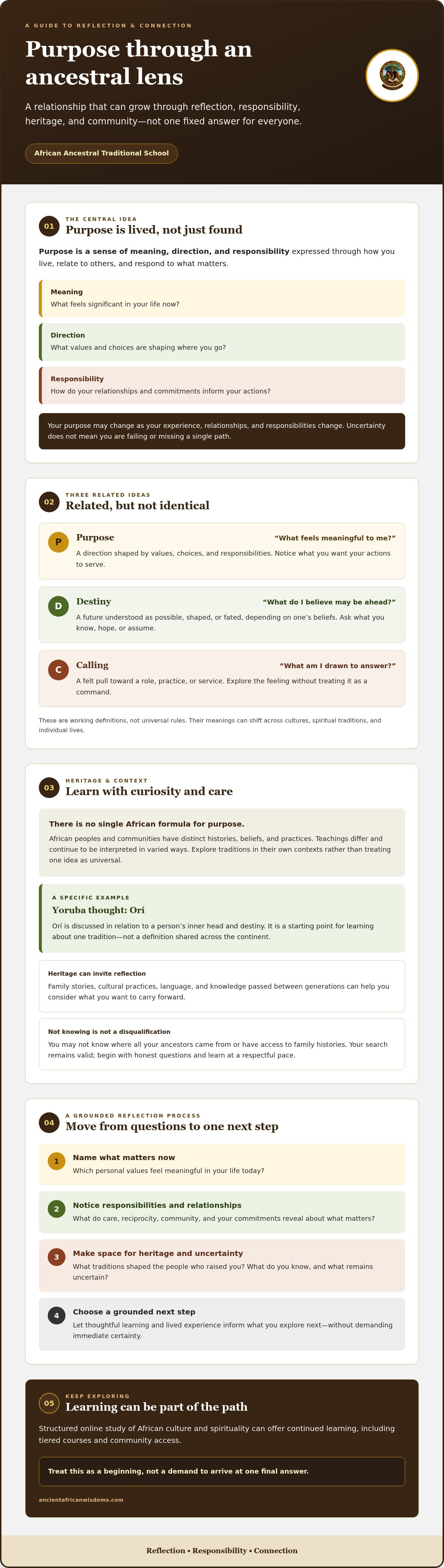
You don’t need to settle every question before taking a thoughtful step. Try this sequence as a personal reflection exercise, not a required spiritual practice. Write in a journal, talk with someone you trust, or sit with each question for a while.
- Notice. What moments, relationships, or activities leave you feeling grounded or useful? Pay attention without rushing to label them a calling.
- Question. Name the values you want your choices to reflect. Which responsibilities feel meaningful, and which feel heavy or may need a different boundary?
- Learn. Identify what you want to understand about your heritage. If you explore cultural teachings, note which community or tradition a source describes.
- Reflect. Consider where you find belonging, what remains unknown, and how your present commitments relate to what you’ve learned.
- Choose one next step. Make it small and specific, such as asking a relative about a family story, reading a source, or reconsidering a decision in light of a value you named.
This exercise can stand on its own. You don’t need to enroll in a course or arrive at a final answer for your reflections to be useful.
What questions can help clarify what matters to you?
Ask yourself: Which commitments feel meaningful, even when they require effort? What values guide my everyday decisions when no one is watching? Where do I feel connected to people, place, or tradition? What would I like to learn about my heritage, and which questions don’t yet have answers? Let your answers be provisional. Priorities can shift as your circumstances and understanding change.
How can learning support reflection without replacing it?
Learning can add context, but it shouldn’t make your choices for you. Compare interpretations, look for sources that identify the specific tradition they discuss, and be cautious of claims presented as universal. For more context on approaches to further study, explore this guide to African ancestral spirituality courses.
If you’d like to continue learning, the African Ancestral Traditional School offers online courses in African culture, spirituality, and tradition. Study is organized into tiered levels, with community access for learning alongside others. Explore online learning in African ancestral traditions as one possible next step, while allowing your own discernment to guide what comes next.
Continue Exploring Purpose Through Structured African Ancestral Learning
Personal reflection can help you name the questions that matter. Structured study can provide cultural context, introduce teachings and practices, and support more careful learning. It isn’t a promise of transformation or a way to receive a guaranteed answer about your life. Consider it one possible continuation of your inquiry, and take time to decide whether a program’s approach fits your interests.
What can an online ancestral learning program offer?
The African Ancestral Traditional School offers online courses in African culture, spirituality, tradition, and spiritual practices. Learning is organized into tiered levels, and community access offers a way to study alongside others. Digital courses provide a more structured path through material than exploring isolated sources alone, while leaving space to reflect on what you’re learning and how it relates to your questions.
This is educational study. The school’s online learning is not an in-person initiation ceremony or a personalized psychic reading, and it shouldn’t be treated as a source of guaranteed personal direction.
How can you choose a respectful next step?
Before beginning, review the curriculum and consider which traditions and subjects it covers. Ask whether the material speaks to the questions you’ve identified and whether you’re ready to learn without expecting one lesson to settle everything. If learning alongside others interests you, this guide to African spiritual community membership offers related context.
Consider what you hope to gain from study: broader cultural knowledge, a clearer understanding of a particular teaching, or a community in which to continue learning. Your answers may change as you encounter new perspectives. That’s part of an attentive process, not a sign that you’ve chosen the wrong direction.
There’s no need to hurry or treat enrollment as the only next step. Keep reflecting, compare sources, and choose learning that respects the diversity of African traditions. If the school’s approach fits your questions, explore its online African ancestral learning programs at your own pace.
Carry Your Questions Forward
Your search for purpose doesn’t need to end with one final answer. Reflection can help you notice what you value, which responsibilities matter to you, and what you still want to understand. Ancestral wisdom can offer meaningful perspectives, while attention to the diversity of African traditions keeps learning grounded in context rather than broad assumptions.
Choose one next step that feels honest and manageable. You might continue reflecting, seek sources about a particular tradition, or explore structured learning. The African Ancestral Traditional School offers online educational programs focused on African spirituality, culture, and tradition, organized into tiered learning levels with community access. Study can provide context and shared learning, but your choices remain your own.
If continued study feels right for you, explore African ancestral learning at your own pace. Move gently, stay curious, and let each thoughtful step help you learn more about what matters.
Frequently Asked Questions
What does purpose mean in African spirituality?
There isn’t one definition shared across all African spiritual traditions. Purpose can mean meaning, direction, or responsibility in a person’s life, but specific teachings depend on the community and tradition. Some perspectives emphasize relationships and obligations alongside individual reflection. To learn about a particular view, look for sources that identify its cultural context rather than treating one explanation as representative of every African tradition.
How can I find my purpose through ancestral wisdom?
Begin with reflection, then learn about a specific tradition or family history without expecting an instant answer. Consider which values guide your choices, which responsibilities feel meaningful, and what you’d like to understand about your heritage. Journaling or talking with someone you trust can help you explore those questions. Choose one grounded next step and allow your understanding to develop over time.
Is purpose the same as destiny in African traditions?
Not necessarily. The terms don’t carry one universal meaning across African traditions. As working definitions, purpose may refer to meaning or direction in lived choices, while destiny can refer to a believed or anticipated course of life. You can explore what feels meaningful without claiming certainty about destiny. If you encounter a tradition-specific teaching, study it in context rather than assuming its terms mean the same thing everywhere.
Can I explore ancestral purpose if I do not know my lineage?
Yes. Not knowing your lineage or having access to family records doesn’t disqualify you from learning or reflecting. Begin with what is available, such as family stories, cultural practices you’ve encountered, or questions you want to investigate. Hold gaps in your knowledge without shame, and avoid presenting guesses as established history. You can also study a clearly identified African tradition while recognizing that it may not be part of your own ancestral lineage.
How do I know whether spiritual guidance about purpose is trustworthy?
Consider whether the guidance names its tradition and context, allows room for questions, and avoids pressuring you to accept a guaranteed outcome. Compare interpretations with reliable, tradition-specific sources, and be cautious of claims that present one teaching as universal to all African peoples. Guidance can inform reflection, but it shouldn’t replace your judgment or responsibility for your choices. Take time before acting on advice that feels coercive or unclear.
Can an online course help me understand my purpose?
An online course can provide structured cultural and spiritual learning, but it can’t guarantee a personal answer or transformation. The African Ancestral Traditional School offers online courses focused on African spirituality, culture, and tradition, arranged into tiered learning levels with community access. These programs are educational, not personalized psychic readings or in-person initiation ceremonies. Review the curriculum to see whether its subjects and approach match what you hope to learn.
Do African ancestral teachings give everyone one fixed life purpose?
No single answer should be assumed across the many African traditions and communities. Teachings differ, and a concept or practice from one tradition shouldn’t be presented as a rule for everyone. Approach ancestral learning as a source of context and reflection, not a command to follow one predetermined role. Consider how a teaching relates to your values, relationships, and present responsibilities, while leaving room for your understanding to change.


