
What if Afa divination is less about predicting the future and more about understanding the patterns shaping a life? If you’ve encountered African spirituality mainly through Hollywood portrayals, you may wonder whether Afa offers a meaningful way to explore your path and ancestral connection, or is simply fortune-telling presented as mystery.
Afa is an Igbo system of knowledge and spiritual guidance. A trained practitioner interprets signs connected to stories, teachings, and counsel. Its purpose reaches beyond prediction: it offers a framework for reflection, restoring balance, and considering how personal choices relate to family and community. Learning about Afa can also help you understand a tradition that is often misrepresented or difficult to approach without cultural context.
In this article, you’ll learn how the system is organized, why interpretation matters, and how Afa holds cultural and spiritual significance. We’ll also consider how studying West African traditions can support a thoughtful connection with ancestral heritage.
Key Takeaways
- Understand Afa’s place in West African traditions and why it is more than a method of predicting the future.
- Learn how the 256 Odu signs and divination tools help organize and interpret traditional knowledge.
- Explore how Afa can offer guidance for reflection, choices, and restoring balance.
- See why cultural context and study are important foundations for approaching Afa with respect.
- Find out how structured African Ancestral Traditional School Levels can support a broader study of heritage and ancestral wisdom.
What Is Afa Divination? Defining the Sacred System
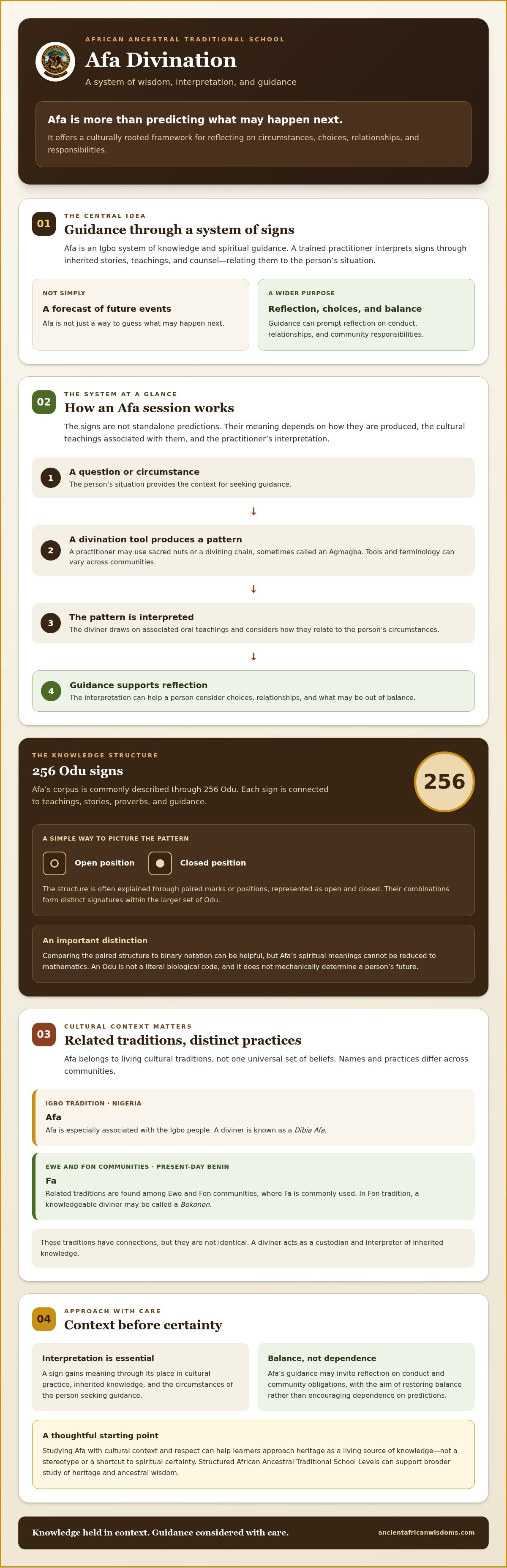
To understand Afa, start with its purpose: it is a traditional system of wisdom through which people seek guidance from the divine and spiritual forces recognized in their culture. It is not simply a way to guess what may happen next. Its signs and interpretations provide a framework for considering a person’s circumstances, choices, relationships, and responsibilities within a wider spiritual and social world.
Traditions and names differ across West Africa. Afa is especially associated with the Igbo people of Nigeria, while related divination traditions are found among Ewe and Fon communities in present-day Benin, where the name Fa is commonly used. These traditions have connections, but they are not identical. Within Igbo practice, a diviner is known as a Dibia Afa; in Fon tradition, a knowledgeable diviner may be called a Bokonon. Each serves as a custodian and interpreter of inherited knowledge.
The Cultural Roots of Afa
Rooted in communities across modern-day Nigeria and Benin, Afa belongs to living cultural traditions, not a single universal set of beliefs. Practitioners may understand its teachings as a language through which ancestral wisdom and spiritual guidance become accessible. Here, “language” means a system of signs and interpretation, not a literal conversation. The knowledge can help individuals and communities reflect on what may be out of balance and how to respond with care.
Divination as a Tool for Ancestral Connection
Within the tradition, a divination session can create a structured dialogue between the living and the spirit world. The diviner interprets signs through cultural knowledge, helping a person consider guidance in relation to their circumstances. For a concise introduction to Afa within Odinani, see Odinani and Afa Divination, which discusses the Dibia’s role and spiritual connections associated with the practice.
This differs from the Western idea of a psychic making personal predictions. Afa is grounded in an inherited system of interpretation and cultural responsibility, not simply a forecast of future events. Guidance may invite reflection on conduct, relationships, or community obligations, with the aim of restoring balance rather than encouraging dependence on predictions.
For people in the African diaspora who feel distant from their cultural roots, learning about Afa can offer one point of connection. It also sits within the wider practice of ancestral veneration for the African diaspora. Studied with context and respect, Afa can help learners approach heritage as a living source of knowledge, not a stereotype or a shortcut to spiritual certainty.
The Mechanics of Wisdom: How the Afa System Works
Afa divination follows an organized method. Its corpus is commonly described through 256 Odu, or signs, each connected to teachings, stories, proverbs, and guidance. The signs are not standalone predictions. Their meaning depends on how they are produced and interpreted, and on the knowledge a trained diviner brings to the situation.
In a session, a practitioner may use sacred nuts or a divining chain, sometimes called an Agmagba, to produce a pattern. The diviner then draws on associated oral teachings and considers how they relate to the question or circumstances at hand. Tools and terminology can vary across communities, so no single description applies universally. For an academic account of the practice and its social meaning among the Anlo Ewe, see Afa Divination in Anlo.
The Binary Logic of the Odu
The system’s structure is often explained through paired marks or positions, which can be represented as open and closed. Arranged in combinations, these produce distinct signatures within the larger set of 256 Odu. This offers a useful comparison to binary notation, but it does not mean Afa was simply an early computer or that its spiritual meanings can be reduced to mathematics. Each sign gains significance through its place in a cultural and interpretive tradition.
Calling an Odu “spiritual DNA” can be a helpful metaphor for its role as a pattern through which a situation is explored. It is not a literal biological code, and a sign does not mechanically determine someone’s future. Meaning emerges through interpretation, inherited knowledge, and the context of the person seeking guidance.
Afa and the Concept of Asè
The Yoruba concept of asè meaning is often described as the power or authority that enables things to happen. Afa and asè belong to distinct cultural contexts, so it is best not to treat them as one doctrine. As a point of comparison, the idea can help explain how some African spiritual perspectives understand vitality, intention, and the capacity for change.
Through interpretation, guidance may help a person reflect on what is obstructing balance or supporting it. Rather than promising a guaranteed fix, a diviner may offer counsel or recommend actions within the tradition. Treat this as a considered path for responding, not a formula. For readers seeking cultural grounding, structured African ancestral teachings can provide a learning context for exploring these ideas with care.
Mapping Destiny: The Purpose of Seeking Afa Wisdom
Seeking Afa wisdom can help a person reflect on direction, responsibilities, and choices. Some discussions connect this purpose with Ayanmo, a Yoruba concept often translated as destiny or an individual’s life path. Because Afa is rooted especially in Igbo traditions, Yoruba ideas and Afa teachings should not be treated as interchangeable. West African traditions are diverse, and their concepts of destiny may differ.
The comparison can still open a useful question: if a life has a spiritual direction, how does a person live toward it? Afa can offer guidance for considering challenges and possible responses, without implying that every outcome is fixed. Wisdom may illuminate choices, but it does not remove the responsibility to make them.
Understanding Your Life Path
A divination may identify what the tradition interprets as obstacles to progress, such as harmful patterns of conduct, strained relationships, or neglected responsibilities. This is not a clinical diagnosis or proof that a spiritual force caused a difficulty. It is a culturally grounded way to reflect on circumstances and consider whether a change in action, attitude, or relationships could restore balance.
Re-alignment, then, is less about waiting for destiny to unfold than responding thoughtfully to what has been revealed. You might ask: What can I change? What do I owe my family or community? Which habits support the person I hope to become? These questions frame life as a journey of growth, shaped by inherited wisdom and present-day agency.
Myth vs. Reality: Debunking Common Misconceptions
Afa is sometimes misrepresented as “dark magic” or reduced to a dramatic prediction. That stereotype obscures its structure as a system of indigenous knowledge, interpretation, and ethical reflection. Spiritual beliefs may be part of divination, but sensational images alone do not explain its cultural purpose or the responsibility involved in interpreting tradition.
Character matters, too. Iwa, often translated as character in Yoruba thought, offers a point of comparison, but it should not be presented as the same term or doctrine in every Afa community. In this view, insight has value when met with integrity, patience, and responsible action. A reading cannot substitute for that work.
Commercialized readings may emphasize quick answers, while deeper study asks learners to understand cultural context, teachings, and the limits of interpretation. This is not a judgment about every contemporary practitioner. It is a reminder to approach claims carefully: seek clear explanations, respect the diversity of traditions, and consider whether guidance supports reflection and agency rather than fear or dependence. Afa wisdom can inform a path, but how you walk it remains your responsibility.
Studying Afa: From Curiosity to Sacred Knowledge
Curiosity can open the door to Afa, but learning its meanings takes more than collecting symbols or searching for quick answers. Like other African traditional systems, Afa is grounded in cultural context, inherited knowledge, and ways of understanding the world carried across generations. Studying that foundation helps prevent sacred teachings from becoming disconnected techniques.
For someone beginning to explore Afa divination, philosophy offers an important first step. What does a sign mean within its tradition? How are teachings interpreted, and what responsibilities come with sharing or applying them? These questions help learners approach the subject with respect rather than assuming that one source or online explanation speaks for every community.
The Role of the Student in Traditional Schools
The shift from seeker to student begins with patience. Listen, ask thoughtful questions, learn the cultural setting of a teaching, and reflect on how knowledge should shape your conduct. Progress is not only about gaining information. Reverence, humility, and character matter because how a person handles knowledge is part of learning.
Community can support this process. Learning alongside others creates space to exchange perspectives, ask questions, and stay connected while exploring a tradition. It also encourages care: one learner’s understanding may be incomplete, and a community can help place teachings in a broader context. When comparing online resources about African ancestral rituals, look for clear explanations of cultural meaning and context, not just steps to imitate.
Build Understanding Before Practice
Approaching a ritual without understanding its purpose, cultural setting, or responsibilities can lead to confusion or misrepresentation. Education helps learners recognize what they know, what they still need to learn, and when to seek guidance from knowledgeable cultural sources. It offers a grounded entry point without suggesting that every student must follow the same path or move at the same pace.
Digital learning can make study accessible to people reconnecting with heritage from different parts of the world. The African Ancestral Traditional School provides structured digital courses across school levels, focused on ancestral teachings and African spirituality, culture, and tradition. Community access gives learners a setting for continued study. Together, structure and shared learning can support the move from curiosity to deeper understanding.
To explore a structured approach to ancestral teachings, review the African Ancestral Traditional School courses and consider how they fit your learning goals.
Reclaiming Your Heritage Through African Ancestral Wisdom
Learning about Afa can be part of a wider journey into African ancestral wisdom. It offers a way to explore how a particular tradition organizes spiritual knowledge, interpretation, and guidance. For readers seeking a broader foundation, African ancestral spirituality courses can help place Afa within a larger cultural context rather than treating it as an isolated practice.
Reconnection does not require having all the answers. It can begin with learning, reflection, and questions about the histories and teachings that shaped your heritage. For people in the diaspora, a grounded educational path can make space to explore identity with care, while recognizing that African traditions are diverse and cannot be reduced to one shared experience.
The Levels of Learning at Our School
The African Ancestral Traditional School offers structured digital courses organized across school levels. Learners can begin with foundational study and continue toward more advanced ancestral teachings, building understanding progressively rather than approaching complex traditions all at once. The curriculum focuses on African spirituality, culture, and tradition, providing a framework for studying ancestral systems with attention to their cultural roots.
Learning can also be strengthened through community access. Studying alongside others offers opportunities to exchange perspectives and continue exploring questions in a shared setting. If you’re considering how connection supports ancestral learning, read about African spiritual community membership and the role community can play in a heritage journey.
Your Invitation to the Ancestral Journey
You do not need to rush. Let curiosity lead into study, and give each teaching room to deepen your understanding. Afa divination can be one doorway into ancestral knowledge, while sustained learning helps you approach its meanings with cultural awareness and respect.
The school offers digital education for people exploring African ancestral teachings, including learners across the diaspora. Review the curriculum and consider which school level aligns with your learning goals. Structured study can help you build understanding over time and explore your heritage with care.
Carry Your Learning Forward
Afa divination offers one path into ancestral wisdom, inviting study that honors cultural context, reflection, and personal responsibility. The deeper journey is not about collecting quick answers. It is about building understanding over time and allowing what you learn to inform your connection with heritage.
The African Ancestral Traditional School offers a structured, level-based curriculum focused on African spirituality, culture, and tradition, with community access for learners. Explore the courses to see whether the school’s approach suits your next step.
Explore African Ancestral Traditional School courses and begin your study of ancestral teachings.
Frequently Asked Questions
Is Afa divination the same as Ifa?
No. Afa is associated primarily with the Igbo people, while Ifa is the Yoruba divination system. They are related West African traditions with similarities in their structures and use of signs, but they have distinct cultural contexts, names, and bodies of knowledge. Fa is also associated with Ewe and Fon traditions. Treating these practices as interchangeable can overlook the communities and lineages that preserve them.
Can I learn Afa divination online?
Yes, online study can introduce you to Afa’s cultural background, concepts, and place within African spiritual traditions. Look for courses that explain context and encourage thoughtful learning rather than presenting isolated symbols as quick answers. The African Ancestral Traditional School offers online courses on African spirituality, culture, and tradition, organized through school levels. Check the curriculum to see which topics it covers and whether it addresses Afa specifically.
Do I need to be initiated to study the Afa system?
No, you can begin by studying the system’s cultural and philosophical foundations. Learning about its history, terminology, and role in community life can help you approach the subject with respect before considering any form of practice. Paths and expectations vary among traditions and communities, so avoid assuming one rule applies everywhere. If you pursue deeper learning, seek guidance rooted in the relevant cultural tradition and be patient with your progress.
How does Afa divination help me connect with my ancestors?
Within the traditions that practice it, Afa can offer a structured way to seek spiritual guidance and reflect on inherited wisdom. A trained diviner interprets signs through cultural knowledge, which may help a person consider choices, relationships, and responsibilities. This connection is understood differently across communities, and it is not a guarantee of direct communication or a substitute for learning. Study can complement broader practices of ancestral veneration and cultural reconnection.
What is the difference between Afa and a psychic reading?
Afa is a divination system grounded in particular cultural traditions, with signs interpreted through inherited knowledge by a trained practitioner. It is not simply a personal prediction or generalized forecast. A psychic reading may follow a different approach and is not necessarily connected to a specific West African system. If you’re exploring Afa, look for clear explanations of cultural context, interpretation, and the limits of what guidance can claim.
Is Afa divination a religion?
Afa is best described as a divination system and body of knowledge associated with African spiritual traditions, rather than a religion by itself. In Igbo contexts, it is connected with Odinani, while related practices belong to other communities and belief systems. Understandings and observances can differ. Learning about Afa alongside its cultural setting helps distinguish the divination practice from the broader traditions in which it has meaning.
How many Odu are there in the Afa system?
The Afa system is commonly described as having 256 Odu, or signs. Each Odu is associated with teachings and interpretations that a trained practitioner considers in context. The signs are not simple, fixed predictions; understanding them involves cultural knowledge and oral teachings. Interpretation can depend on the tradition and circumstances being discussed, so the number alone does not explain the system’s depth.
What tools are used in Afa divination?
Tools can vary by community and lineage. Descriptions of Afa include sacred nuts and a divining chain, sometimes called an Agmagba. A practitioner uses the tools to produce signs or patterns, then interprets them through knowledge of the tradition. The objects alone do not provide meaning; training, oral teachings, and context matter. If you encounter different tool names or methods, consider the specific community and practice being described.


