
What does African Cosmology mean? There isn’t one single answer. African Cosmology offers ways of understanding existence and relationships with the living world, ancestors, community, and the sacred. These teachings differ across peoples and traditions, so seeing that diversity clearly is the first step toward learning with respect.
Broad descriptions can flatten those differences or blur living traditions with interpretations made by outsiders. This guide explains key ideas in accessible language, shows how to compare traditions without treating the continent as one belief system, and offers a practical approach to further study. We’ll look at how traditions make sense of existence and relationships, why context matters, and how to assess the sources you encounter. For a guided next step, structured online courses in African spirituality, culture, and tradition support continued learning while leaving room for the knowledge held within specific communities.
Key Takeaways
- Understand African Cosmology as an umbrella term for diverse worldviews, not one belief system shared across the continent.
- Use questions about community, land, ancestors, and spiritual realities to compare traditions without assuming their answers are the same.
- Compare Yoruba, Maasai, and Kongo cosmologies by looking for context and distinctions, not by assuming their teachings match.
- Assess teachings by identifying the tradition, source, author’s perspective, and limits of each claim.
- Explore structured online study as one way to deepen your understanding of African spirituality, culture, and tradition.
What Is African Cosmology? Begin with a Plural, Not Singular, Definition
Cosmology is the way a tradition understands the nature and order of existence: what the world is, how its parts relate, and what gives life meaning. African Cosmology is plural in practice: it refers to diverse, place- and culture-specific ways of understanding existence, not one worldview shared by an entire continent. The phrase is useful as an umbrella, but it should not erase the communities and histories beneath it.
Cosmology can include questions about the visible world and realities understood through spiritual, ethical, or communal life. Astronomy, by contrast, studies celestial objects and phenomena. The two are not necessarily opposites: observing the sky may be part of practical knowledge and may also carry meaning within a particular tradition. The connection and its meaning depend on that tradition, rather than on a universal template.
A single account would leave too much out. Language shapes how ideas are named and shared; histories shape how knowledge is preserved, interpreted, or disrupted; and community life gives teachings their context. A broad summary can offer an entry point, but it cannot stand in for the knowledge of specific peoples.
Why ‘African cosmologies’ is often the more accurate framing
Africa holds a vast range of cultural and linguistic traditions, each with its own histories and ways of expressing knowledge. Even careful writers can overgeneralize if they rely on a narrow set of texts, translate concepts without enough context, or treat one community’s account as representative of others. To assess a source, ask whose knowledge it includes, who is interpreting it, and what the account leaves outside its frame.
Encyclopedia.com’s discussion of African cosmologies cautions against treating diverse cultures as one system. Use that warning as a practical guide: qualify broad statements, name the tradition being discussed, and avoid turning a recurring theme into a belief attributed to everyone. For one example, its overview of Serer religion and cosmology discusses a creator deity, the significance of trees, and the charting of Sirius. These details belong to that account, not to every African tradition.
Cosmology, worldview, and religion: where the terms meet
Cosmology concerns how existence and its order are understood. A worldview is a broader set of ideas through which people make sense of life, relationships, and experience. Religion refers to forms of belief and practice connected with the sacred, though its meaning varies by context. These ideas overlap, but they are not interchangeable: a worldview may include religious teachings, while cosmology describes particular understandings within it.
To explore how ancestral wisdom and a broader worldview can shape everyday understanding, continue with African worldview and ancestral wisdom. As you read, notice whose perspective is being described and where its boundaries lie.
How African Cosmologies Relate Existence, Community, and the Unseen
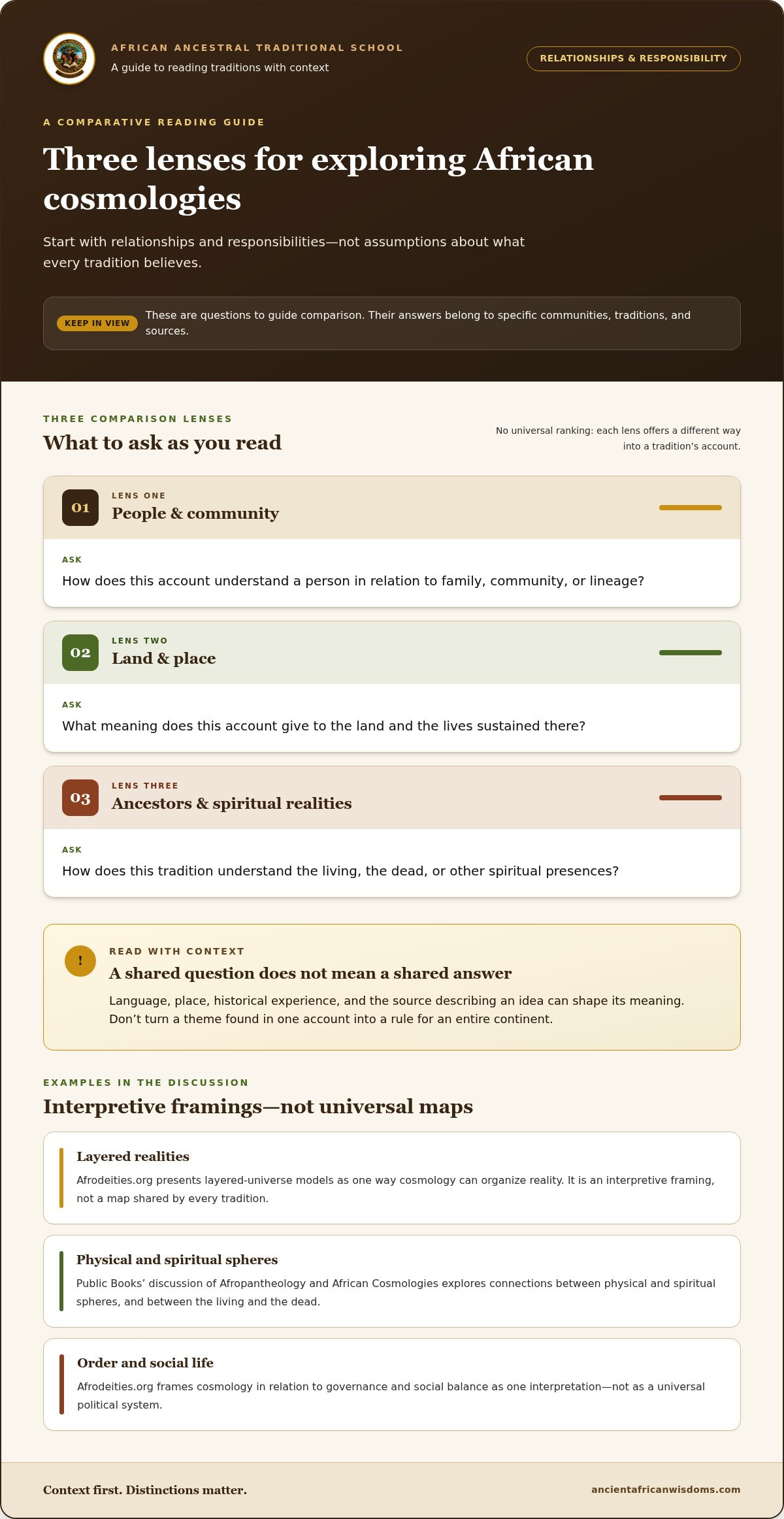
Instead of asking what all African traditions believe, use comparative questions to explore how a particular tradition understands existence and relationships. How are people connected to one another and to the land? What place, if any, do ancestors or spiritual realities hold in that account? How might these ideas shape responsibility in daily life? The questions offer a path into the subject, but their answers belong to specific communities and sources.
Cosmological ideas can connect existence with relationships and responsibility, though each tradition gives those connections its own meaning. This relational approach makes cosmology more than an abstract account of how the world began. It invites us to consider how people understand their place within a wider order and the responsibilities that may follow.
- People and community: How does a particular account understand a person in relation to family, community, or lineage?
- Land and place: What meaning does the account give to the land and the lives sustained there?
- Ancestors and spiritual realities: How does this tradition understand the living, the dead, or other spiritual presences?
These are prompts, not shared answers. A term translated into English may not carry the same meaning as the original, and an idea’s significance can change with language, place, historical experience, and the source describing it. Keep the tradition in view as you read. Don’t turn a theme found in one account into a rule for an entire continent.
Visible and spiritual realities in specific cosmological accounts
Some accounts describe existence through layers or interacting realities, rather than dividing the visible and spiritual into wholly separate worlds. Afrodeities.org presents layered-universe models as one way cosmology can organize reality. This is an interpretive framing, not a map shared by every tradition. Public Books’ discussion of Afropantheology and African Cosmologies also explores connections between physical and spiritual spheres and between the living and the dead. Read each account in its own context, without assuming the same realms or relationships apply everywhere.
Community, land, and the moral meaning of cosmic order
Cosmic order may also be discussed alongside social life. Afrodeities.org frames cosmology in relation to governance and social balance, offering one interpretation of how ideas about order can inform authority and communal responsibilities. That connection should not be mistaken for a universal political system. In a specific account, ask what responsibilities are described, who holds them, and how land and community figure in the teaching.
To reflect further on how nature and spiritual understanding may relate, explore nature and the spiritual world. You can also continue with guided digital learning through structured online study of African spirituality, culture, and tradition.
Yoruba, Maasai, and Kongo Cosmologies: Compare Without Collapsing Differences
Putting traditions side by side can help you notice the questions scholars ask about existence, relationships, and order. It cannot establish that different communities answer those questions in the same way. A careful comparison should reveal distinctions as well as possible connections. Treat each example as a particular cultural context, not as a stand-in for the whole continent.
Encyclopedia.com names Yoruba, Maasai, and Kongo traditions in its overview. Use those names as starting points for focused reading, then examine each account on its own terms. The table below offers questions to guide that comparison without filling gaps with assumptions.
| Context named by Encyclopedia.com | Questions to ask about order | Questions to ask about relationships | Questions to ask about the seen and unseen |
|---|---|---|---|
| Yoruba | How does the specific source describe the ordering of existence? | Which relationships does it emphasize, and how does it explain them? | Does it discuss visible and spiritual realities, and how does it distinguish them? |
| Maasai | How does the specific source describe the ordering of existence? | Which relationships does it emphasize, and how does it explain them? | Does it discuss visible and spiritual realities, and how does it distinguish them? |
| Kongo | How does the specific source describe the ordering of existence? | Which relationships does it emphasize, and how does it explain them? | Does it discuss visible and spiritual realities, and how does it distinguish them? |
What a careful comparison can and cannot show
A comparison is useful when it asks the same questions of each well-sourced account: How is existence ordered? Which relationships are emphasized? How are visible and unseen realities described, if they are discussed at all? The answers may reveal parallels in the questions being explored, while concepts, histories, and interpretations remain distinct. Shared English vocabulary does not prove identical meanings or origins.
For example, if two sources both refer to ancestors, that shared term alone does not establish that ancestors have the same role in each tradition. The source’s language, context, and limits matter. Avoid claiming specific similarities or contrasts among Yoruba, Maasai, and Kongo cosmologies unless the sources support them. African Cosmology is a useful broad topic, but three named examples cannot represent every community or tradition.
How to read cultural examples with their context intact
Keep the name of the tradition close to each claim. Say “the source’s account of Yoruba cosmology” or “the Maasai context discussed by the author,” rather than turning a specific description into a statement about Africa as a whole. Then look for the original source or fuller discussion before drawing conclusions. A short summary can introduce a question, but it may not contain enough evidence to answer it.
As you continue, distinguish what a source directly says from what you infer by comparing it with another account. This simple practice makes room for meaningful connections without flattening differences. For a broader introduction to the subject, explore this African spirituality guide.
How to Study African Cosmology Respectfully and Evaluate Sources
Careful study begins with curiosity and context. Rather than treating one book, website, or voice as the final word, consider what a source can show, whose perspective it represents, and what remains uncertain. This approach makes African Cosmology easier to explore without turning a particular account into a claim about every community.
Use this method as you read:
- Identify the tradition. Note the specific people, place, language, or community the source discusses. If it only says “African,” check whether it explains the breadth of that label.
- Identify the source. Is it community knowledge, a scholarly interpretation, or contemporary commentary? Each can offer insight, but they are not the same kind of account.
- Consider the author’s perspective. Look at who created the account, the context in which it was produced, and whether the author is explaining, interpreting, translating, or comparing.
- Mark the limits. Separate what the source directly supports from what it does not explain. Treat broad conclusions cautiously, especially when evidence or context is limited.
Questions to ask when reading a source
Who created this account, and which community, period, or research context does it describe? Does it distinguish its specific tradition from other African cultures? Are its claims attributed and supported, and does the writer signal uncertainty where evidence is limited? These questions help you read with discernment, not suspicion. They also reveal when a source is offering one interpretation rather than speaking for an entire community.
Translation deserves particular care. A translated word may not carry all the meanings or associations of a term in its original language. Historical setting matters too: a written account may reflect the period in which it was recorded, as well as the author’s position and purpose. Keep those layers visible instead of reading a description as timeless or complete.
Community knowledge, scholarly interpretation, and contemporary commentary can inform one another, but they should not be collapsed into a single voice. A scholar may analyze a tradition through a particular method; a community account may express knowledge shaped by lived relationships and practice; a contemporary writer may offer a personal reading. Ask what kind of knowledge each source presents, then note what it clarifies and what it leaves open.
Continue exploring related ideas without duplicating them
Keep this inquiry focused on cosmology: how a tradition understands existence, order, and relationships. Detailed practices of ancestor veneration are a distinct subject, so avoid treating them as interchangeable with cosmology as a whole. For a focused discussion of divinity across traditions, explore understanding divinity in African traditions.
As you continue, pause to reflect: What does this source explain clearly? What questions remain? For a more structured path of study, explore online courses in African spirituality, culture, and tradition, with tiered learning levels and community access, through guided digital learning at the African Ancestral Traditional School.
Continue Your African Cosmology Learning Through Structured Study
An introduction can open meaningful questions, while deeper understanding takes time. Learning about African Cosmology involves more than collecting broad ideas: it asks you to notice how culture, spirituality, history, and tradition shape the meaning of each teaching. Continued reading and reflection help you return to those questions with greater care.
Structured online education offers one way to continue. The African Ancestral Traditional School provides digital courses in African spirituality, culture, and tradition, organized across tiered learning levels. This creates a guided path through foundational and deeper material, while recognizing that no online program replaces the knowledge and context held within specific communities.
What structured online learning can offer
Studying in stages gives ideas room to settle. You can revisit a concept, consider it alongside related teachings, and build understanding over time rather than trying to absorb everything at once. The school’s courses cover African spirituality, culture, and tradition, providing a framework for exploring how those subjects connect.
Community access is also part of the learning environment. It creates an opportunity to study alongside others, share questions, and encounter different reflections. That exchange can support learning, though it does not make every participant’s perspective representative of a particular people or tradition. Keep cultural context in view as you listen and read.
- Move at a considered pace: Return to ideas and give yourself time to reflect on what they mean.
- Keep subjects connected: Explore spirituality, culture, and tradition as related areas of study.
- Learn with others: Use community access as an opportunity for shared learning and thoughtful discussion.
Choose a next step that respects the depth of the subject
There’s no need to rush toward a single conclusion. Continue reading, write down questions, and pay attention to which tradition and source each teaching describes. Notice what you understand more clearly and what remains open. This steady approach helps keep learning grounded, especially when broad explanations don’t capture the full detail of a community’s knowledge.
The school provides digital education, an educational path that complements continued reading and reflection. Online study can support learning while you remain attentive to the depth and living nature of particular traditions.
Continue at a pace that feels right for you. Explore the African Ancestral Traditional School’s online learning path and its tiered study of African spirituality, culture, and tradition.
Carry Your Questions Into Deeper Learning
Let your next step be a question you’re willing to keep exploring. As you encounter new teachings, note what resonates, what needs more context, and whose perspective is guiding the account. Learning with patience leaves room for insight without forcing different traditions into one explanation. It also helps you build a relationship with the subject through reflection, not quick conclusions.
If you’d like a guided path for continued study, the African Ancestral Traditional School offers online courses focused on African spirituality, culture, and tradition, with tiered learning levels and community access. This educational setting can support deeper exploration while you remain attentive to the particular histories and community knowledge that shape each tradition.
Take the next step at a pace that feels right for you. Explore the African Ancestral Traditional School and continue your learning with care, curiosity, and respect.
Frequently Asked Questions
Is African cosmology one shared belief system across the continent?
No. African cosmology is a broad label for distinct traditions, not a single shared belief system. Narrow your search to a particular people, place, language, or tradition, then notice how its sources describe ideas and practices. Similar words or themes across accounts can invite comparison, but they do not show that communities share the same teachings, histories, or meanings.
What is the difference between African cosmology and African spirituality?
African cosmology concerns how a tradition understands existence and its order; African spirituality refers more broadly to spiritual beliefs, practices, and relationships. They can overlap, but they are not identical. For example, a source might explain a tradition’s understanding of how life is ordered, then separately describe spiritual practices connected with that understanding. Keeping the terms distinct helps you identify whether a text discusses a worldview, a practice, or both.
Can someone study African cosmology without belonging to a specific tradition?
Yes. You can study published materials, courses, and scholarship without claiming membership or authority within a tradition. Approach the learning as a guest: name the particular tradition you’re studying, avoid presenting your interpretation as community knowledge, and respect boundaries around teachings intended for specific contexts. If your interest becomes personal or spiritual, take time to understand how community, lineage, and lived practice shape what you’re learning.
How have oral traditions helped preserve cosmological knowledge?
Oral traditions can carry knowledge through forms such as stories, songs, proverbs, praise, and spoken instruction. Their meanings may be reinforced through performance and shared memory, rather than preserved only in written texts. The forms and roles differ between communities, so no single description applies everywhere. When studying an oral account recorded in writing, consider who shared it, how it was collected, and what may have changed through translation or transcription.
Does African cosmology include explanations of the natural world?
Some cosmological accounts include ways of understanding the natural world, such as the significance of land, weather, plants, animals, or the sky. These may connect practical observation with cultural, ethical, or spiritual meaning, though details vary by tradition. A useful example to investigate is how a source describes seasonal change: does it focus on observation, communal life, spiritual significance, or several of these? Avoid assuming every account explains nature in the same way.
Are African cosmologies religions, philosophies, or both?
They can be discussed through religious and philosophical questions, but neither label fully captures every tradition. A source may focus on sacred beliefs and practices; another may examine ideas about existence, knowledge, ethics, or social life. These categories are tools for describing aspects of a tradition, not fixed boxes that communities must fit. Ask what the source is trying to explain and whether its chosen label leaves important parts of the account out.
How can readers tell whether a source represents a specific community or makes broad claims?
Look for clear naming: does the source identify the community, location, language, period, and people whose knowledge it discusses? Check whether claims are attributed to particular sources or presented as universal facts. Notice whether the author signals limits and distinguishes personal interpretation from community perspectives. For a practical test, choose one broad claim and compare it with a second source focused on the same tradition. Differences can reveal context the first account left out.


