
What changes when nature is understood not as a spiritual backdrop, but as part of a living relationship shaped by place, ancestry, and responsibility? The connection between nature and the spiritual world is explored in distinct ways across African traditions, and no single explanation can represent them all.
If you’re looking for spiritual teachings rooted in more than abstract ideas, cultural context matters. Broad summaries can blur important differences or mistake modern assumptions for inherited teachings. This article offers a grounded way to explore how particular traditions may understand relationships among people, the natural world, and spiritual life, while recognizing that beliefs and practices vary between communities.
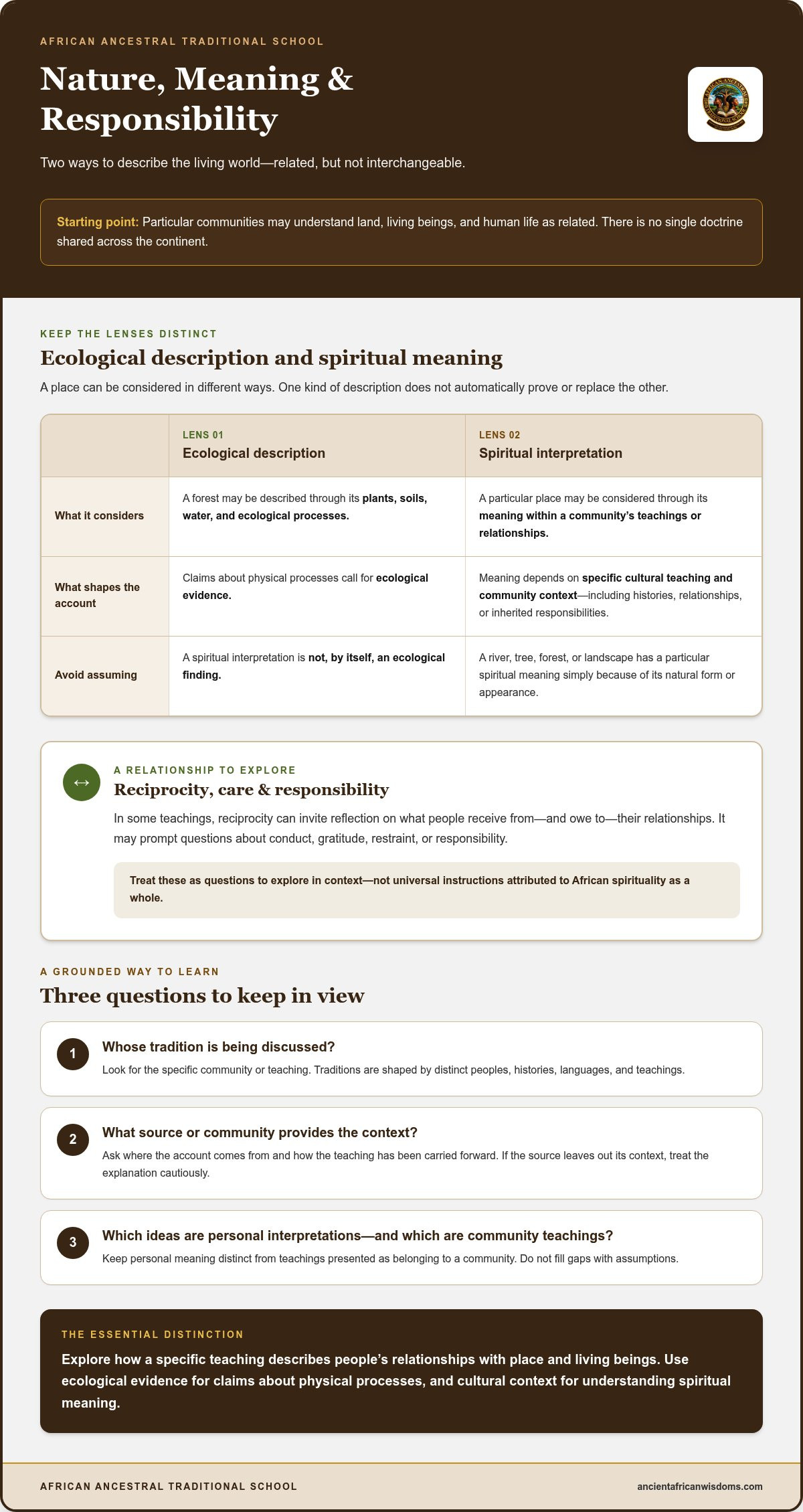
As you read, keep three questions in view: Whose tradition is being discussed? What source or community provides the context? Which ideas are personal interpretations, and which are presented as community teachings? These questions make it easier to approach the topic with patience and humility. Structured study of African spirituality, culture, and tradition can take that learning beyond a brief overview.
Key Takeaways
- Explore nature and the spiritual world through specific cultural contexts, not as a single doctrine shared across Africa.
- Consider how teachings may connect the natural world, community life, and responsibility without assuming every tradition expresses these ideas in the same way.
- When reflecting, observe first, learn the cultural context, consult reliable sources, and distinguish personal meaning from community teachings.
- Look beyond broad summaries through structured study of African spirituality, culture, and tradition.
What Does Nature Mean in African Spiritual Perspectives?
Nature and the spiritual world, in African spiritual perspectives, describes ways particular communities may understand land, living beings, and human life as related, without implying one doctrine shared across the continent. This definition is a starting point, not a claim that every community gives nature the same spiritual meaning. African traditions are many, shaped by distinct peoples, histories, languages, and teachings.
Nature as a relationship, not merely a setting
A landscape can be more than a backdrop to daily life. In some traditions, teachings may connect people with particular places, other forms of life, or inherited responsibilities. The meaning of a river, tree, animal, or piece of land cannot be assumed from its natural form alone. It depends on the cultural teaching and community context in which it is understood.
That distinction matters. A forest can be described scientifically through its plants, soils, water, and ecological processes. A spiritual interpretation may also consider what a particular place means within a community’s teachings or relationships. These are different kinds of description. One does not automatically prove or replace the other, and spiritual meaning should not be presented as an ecological finding.
The phrase Nature worship offers a broad overview of ways people in different cultures and religions have related spiritual life to nature. It can help orient a reader to the range of ideas, but it is not a substitute for learning how a specific African community describes its own teachings. Broad labels can hide meaningful differences.
Why cultural context matters
When you encounter an example, ask whose teaching is being described, where it comes from, and how it has been carried forward. A practice or interpretation may be tied to a people’s history and local knowledge. Removing it from that setting can make it sound like a universal rule when it is not. If a source does not identify the community or context, treat its explanation cautiously rather than filling in the gaps with assumptions.
This section offers an orientation, not a complete account of each African tradition. Keep a distinction between recurring questions, such as how people relate to the natural world, and the specific answers different communities may give. That approach leaves room for both shared lines of inquiry and real differences.
For wider background, the African spirituality guide can help place this topic within broader discussions of ancestral teachings and cultural tradition. Let context lead your learning: a careful question is more useful than a sweeping claim.
How Nature Connects Human, Community, and Spiritual Life
Thinking about relationships can make the connection between people, place, and spiritual life easier to explore. In some teachings, the natural world is considered alongside human conduct and community responsibilities. This is a lens for examining particular traditions, not a rule that applies to every African community. The details depend on whose teachings are being discussed and how they are understood in their cultural setting.
In some African traditions, care for the living world may be understood as part of a wider relationship among people, community, and place, but its meaning belongs to its specific cultural context.
Reciprocity, care, and responsibility
Reciprocity can describe a way some teachings consider what people receive from, and owe to, the relationships around them. It may invite reflection on conduct, gratitude, restraint, or responsibility. Those ideas should not be turned into universal instructions attributed to African spirituality as a whole. Without a reliable, community-specific source, it is more respectful to explore reciprocity as a question than to present it as a fixed teaching.
For example, ask how a particular teaching describes people’s responsibilities toward a place or living beings, and who has authority to explain that teaching. This inquiry differs from claiming that a spiritual principle directly determines an ecological outcome. Soil health, water quality, and species relationships are matters for ecological evidence; spiritual interpretations speak to meaning, value, and responsibility. Keeping those descriptions distinct allows both to be taken seriously.
Place, belonging, and shared life
A place may carry meaning through a community’s history, memory, or spiritual teachings, not simply because of its scenery. The same riverbank or forest can mean different things to different people. Its significance depends on relationships and context, including how the community itself speaks about the place. Avoid assigning a sacred meaning based only on appearance or on a generalized idea of African tradition.
Community life can also shape how a place is remembered and understood. People may share stories about where they have lived, worked, gathered, or experienced change. Those everyday connections can help explain why a specific landscape matters, but they do not authorize outsiders to define its spiritual meaning. Listen for the particular voices and histories involved.
To explore this carefully, keep three questions in view: What community or teaching is being discussed? How does that context explain the relationship to place? Which parts of the account describe spiritual meaning, and which make claims about physical processes? These questions offer a grounded way to learn without flattening differences. The African worldview and ancestral wisdom guide offers related framing for considering how cultural perspectives shape meaning.
If you’d like to deepen your understanding over time, structured study of African spirituality and culture can offer a thoughtful next step beyond a brief overview.
What Nature-and-Spirit Teachings Do, and Do Not, Mean
A broad phrase such as “African spiritual traditions” can open a discussion, but it cannot stand in for the teachings of every people or community across a vast continent. Explore the relationship between nature and the spiritual world through questions grounded in specific contexts, rather than a single explanation presented as universal.
Different traditions may consider questions about human responsibility, place, and life, yet their language, teachings, and answers are not necessarily the same. Without a reliable source naming the community and explaining its context, it would be misleading to attach a particular belief or practice to a tradition. Avoid filling gaps with familiar terms from another culture or assumptions drawn from general spiritual language.
Shared questions are not identical teachings
Questions offer a careful point of comparison: How does a particular teaching describe people’s relationship to a place? What responsibilities does it discuss, if any? How are those ideas explained within the community’s own history and language? Asking similar questions about different traditions does not mean their answers match. It creates a respectful framework for noticing both possible areas of inquiry and meaningful distinctions.
Attribution matters. Name a tradition only when a source supports the connection, and describe its teaching in the terms that source provides. Avoid presenting a ceremony, sacred meaning, or community consensus without specific evidence. This care helps prevent distinct teachings from being blended into a simplified account.
Avoiding a single pan-African explanation
Continent-wide claims can erase differences in language, history, and local context. Phrases such as “Africans believe” or “African spirituality teaches” imply a uniformity that the evidence may not support. More precise wording identifies whose perspective is being described and qualifies its scope: “in this community’s teaching,” or “some traditions may frame the question this way.”
The comparison below separates types of claims that are easy to confuse. Use it as a reading tool, not as a summary of any one tradition.
| Type of statement | What it describes | Careful way to read it |
|---|---|---|
| Cultural or spiritual meaning | How a specific teaching or community interprets a relationship, place, or responsibility. | Look for clear attribution and context. |
| Empirical description | Observable or measurable physical processes, such as changes to water, soil, or living populations. | Look for appropriate scientific evidence. |
| Universalized assumption | A claim that one interpretation or practice represents all African traditions. | Ask whether the source supports that breadth. |
Spiritual perspectives can inform how people understand meaning and responsibility, but they should not be presented as scientific evidence or medical guidance. Keep those boundaries clear, especially when a claim concerns physical health or environmental processes. For a broader philosophical framing, explore the nature of existence in African spiritual perspectives, while distinguishing general discussion from teachings attributed to a specific community.
How to Reflect on Nature Through a Respectful, Grounded Lens
Reflection can begin with attention, not interpretation. If you’re considering nature and the spiritual world, resist assigning a fixed meaning to a tree, river, animal, or landscape before understanding the people and teachings connected to it. A steady learning practice separates what you observe, what you personally feel, and what a cultural source actually teaches.
Begin with observation and context
Move through these steps at a patient pace. They support thoughtful learning; they are not a ritual or a claim of spiritual authority.
- Observe: Describe what you can directly notice, such as the season, the shape of a path, or how people use a shared outdoor space. Keep the description simple. A feature of nature does not carry one universal spiritual meaning.
- Identify context: If you’re reflecting on a particular place, learn about its history and the communities connected to it. Ask what is known, whose perspective is being shared, and whether the source identifies the cultural setting.
- Consult reliable learning: Look for material that names the community or tradition and distinguishes its teachings from general commentary. Be cautious of online claims that describe an entire continent in one broad sentence.
- Reflect with care: Note your personal response, but do not present it as an inherited teaching or as the voice of a community. Leave room for what you do not yet know.
A notebook can help keep these layers clear. Use separate lines or columns for direct observation, personal reflection, and teachings attributed to a named source. For example, “I felt calm near the water” records your experience; it does not establish what a specific tradition teaches about that water. This distinction lets you reflect sincerely without turning personal meaning into cultural fact.
Learn without assuming cultural authority
Respectful learning begins with context and careful attribution: name whose teaching you’re discussing, and do not claim authority beyond what you’ve learned. This matters especially when a concept is unfamiliar or appears in simplified online explanations. Before repeating it, ask: Does the source identify a people, place, or teaching? Does it explain the terms in context, or treat them as interchangeable across cultures?
Approach gaps in your knowledge with humility. You can value a personal connection to a landscape without claiming that connection represents an ancestral teaching. Likewise, you can study a tradition without speaking on behalf of the community that carries it. The essence of humanity in African spiritual teachings offers a related lens for considering how human relationships shape reflection and understanding.
For learning that develops beyond brief summaries, explore structured courses in African spirituality, culture, and tradition. Sustained study gives you room to follow sources, notice distinctions, and reflect with care.
Continue Learning About Nature and the Spiritual World
Exploring nature and the spiritual world calls for more than a single broad explanation. Relationships among people, community, place, and spiritual life are best considered within specific cultural contexts. Ideas such as responsibility can offer useful questions to explore, but their meanings and expressions belong to the traditions in which they are taught.
A short introduction can open a path, but it cannot replace sustained learning. Take time with concepts, sources, and cultural context, noticing where traditions differ rather than trying to fit them into one account. You do not need to arrive with expertise. Curiosity, patience, and a willingness to learn carefully are a sound beginning.
When a short introduction leads to deeper study
Structured study can help you follow an idea beyond a quick summary: where it appears, how it is explained, and what context clarifies its meaning. Learning gradually also creates room to revisit questions and refine your understanding. It does not promise instant expertise or a particular spiritual outcome; it offers a considered way to keep learning.
Whether you’re new to African cultural teachings or reconnecting with heritage, begin at a pace that feels steady. A curriculum provides continuity, while careful attention to sources helps keep learning grounded. The aim is not to claim authority over a tradition, but to approach its teachings with greater context and respect.
Learning online with community
The African Ancestral Traditional School provides online education in African spirituality, culture, and tradition. Its tiered learning levels let students progress through a structured curriculum, and community access helps learners connect with one another. Digital courses also explore ancestral spiritual teachings and practical rituals, offering a way to continue learning beyond a brief overview.
Explore the school’s African ancestral spirituality courses to continue your study. Move at a thoughtful pace, keep cultural context in view, and let your questions guide what you learn next. You can also explore the school’s online learning pathway as you build your understanding.
Carry Your Curiosity Into Deeper Learning
Let your next step be guided by a question you’re willing to keep exploring. What does a particular teaching ask you to notice about your relationships, your community, or the place you call home? Returning to that question with patience can make learning about nature and the spiritual world more meaningful, while reminding you to honor the cultural context behind each teaching.
If you’re ready to continue, the African Ancestral Traditional School offers online digital courses in African spirituality, culture, and tradition, with structured educational levels and community access for learners. This learning pathway supports studying at a considered pace, while keeping the cultural context of specific traditions in view.
Explore African ancestral teachings and continue your learning. Take your time, stay open to what you can learn, and let each thoughtful step deepen your understanding.
Frequently Asked Questions
How are nature and the spiritual world connected in African traditions?
In some African traditions, nature and the spiritual world may be understood through relationships among people, place, and spiritual life, though meanings differ by community. To explore a specific teaching, look for a source that names the people and setting involved. If a source describes a river as significant, for example, do not assume the same meaning applies to other rivers or traditions. Context helps you understand what the connection means there.
Do all African spiritual traditions view nature in the same way?
No. African communities have distinct histories, languages, and teachings, so their perspectives on nature can differ. Check whether an explanation identifies the community or tradition being discussed, rather than treating “African belief” as a single viewpoint. If the source makes a sweeping claim without showing where it comes from, look for more precise cultural context before repeating it.
Is nature considered sacred in African spirituality?
Some traditions may regard particular places or aspects of the natural world as spiritually significant, but it is not accurate to say that every African tradition treats all nature as sacred in the same way. “Sacred” needs context: ask what place or relationship is being described, whose teaching explains its importance, and how that meaning is expressed. Avoid assigning sacred status to a landscape based only on its appearance or on a generalization.
Can nature be understood spiritually without treating spiritual beliefs as science?
Yes. Spiritual interpretation can speak to meaning, relationship, or responsibility, while science investigates observable processes through evidence and methods suited to those questions. For instance, a spiritual account of why a place matters does not by itself establish a claim about water quality or plant growth. Keep the distinction clear, and do not use spiritual teachings as medical advice or as a substitute for scientific evidence about physical health or environmental conditions.
How can I learn about African spiritual perspectives on nature respectfully?
Start with sources that identify the specific community or tradition and explain the cultural setting of the teaching. Compare claims with other reliable learning, and avoid presenting personal impressions as inherited knowledge. If a concept is unfamiliar, learn how it is used in context instead of borrowing a similar-sounding term from another tradition. Keep notes on what a source says, what you infer, and what remains unanswered.
What role does community play in African spiritual relationships with nature?
Community can shape how people understand, remember, and relate to a place, but its role varies across traditions. Shared history, local knowledge, and community teachings may all inform how a landscape is understood. When reading about a particular example, notice whose voices are included and who is explaining the meaning. This helps distinguish a community’s own account from a general interpretation offered by someone outside that context.
Can I study African ancestral teachings about spirituality online?
Yes. The African Ancestral Traditional School provides online courses in African spirituality, culture, and tradition, with educational levels students can progress through and community access for connection with other learners. Structured learning can help you build understanding over time, rather than relying on isolated summaries. As you study, pay attention to the cultural context of each teaching and allow yourself time to learn without expecting instant expertise.


