
What if humanity is understood not only through who we are as individuals, but through the relationships we tend, the responsibilities we carry, and the generations to whom we remain connected? A dictionary definition can name the idea without explaining how it shapes daily life. Selected African spiritual perspectives offer ways to consider dignity and belonging, while reminding us that African traditions are diverse, not one single worldview.
This article explores how relational understandings of human life connect personal choices with community, care, and continuity. You’ll encounter Ubuntu as one influential expression of shared humanity, alongside a reminder that it cannot stand in for every African tradition. The aim is not to flatten distinct teachings into one answer, but to approach them with curiosity and respect.
As you read, consider how these ideas might shape everyday conduct: how we listen, support one another, and honor ties between the living and those who came before. We’ll trace these themes across selected perspectives and offer a thoughtful starting point for continued learning about African ancestral teachings.
Key Takeaways
- Separate humanity as humankind, human qualities, and a way of understanding human life to clarify the article’s central question.
- Explore how selected African philosophies connect identity with relationships while making room for individual agency.
- Consider Ubuntu in its particular cultural contexts rather than treating it as a universal summary of African thought.
- Use a simple reflection to notice relationships, consider your impact, act with care, and reflect on responsibility.
- Continue learning about humanity through structured study that deepens cultural, historical, and philosophical context over time.
What Does Humanity Mean in African Spiritual Thought?
Humanity can mean humankind, qualities associated with being human, or the condition and meaning of human life. This article focuses on the third sense: how human life and personhood may be understood through relationships, responsibilities, and connections that extend beyond the individual. It is a lens for exploring selected African spiritual perspectives, not a doctrine shared by every African people or tradition.
Three meanings of humanity: people, humaneness, and personhood
In everyday language, humanity can refer to people collectively, qualities such as compassion, or the state of being human. These meanings overlap, but they don’t fully answer the spiritual and philosophical question at the heart of this discussion: what gives a life meaning and shapes a person’s place in the world?
Personhood offers one way to consider that question. In accessible terms, it means what it is to be recognized and understood as a person, including how identity, agency, and belonging are shaped. Some African philosophies emphasize that a person develops in relation to others and community. That emphasis doesn’t erase individuality. Relationships can inform a person’s choices without making everyone identical or removing personal responsibility.
For this article, humanity means human life considered through relationships, responsibilities, and connections across generations. This is a guiding lens, not a universal definition. For a broader introduction, explore this guide to African spirituality, which places individual ideas within a wider cultural and spiritual context.
Why African perspectives need cultural context
African spiritual traditions are diverse. Beliefs and interpretations vary across peoples, places, languages, histories, and lineages, so a concept found in one context shouldn’t automatically be assigned to another. Even familiar terms can carry different meanings depending on who uses them and where they’re discussed.
That variety matters because broad descriptions can turn living, distinct traditions into a single imagined belief system. An overview of Traditional African religions offers an entry point to their range, but no short summary can stand in for knowledge held within particular communities and traditions.
Read with care. Ask which people, place, language, or lineage a teaching is connected to, and distinguish a specific interpretation from a general claim. This makes room for respect and a more accurate understanding without requiring suspicion toward every idea. Hold the relational lens as an invitation to learn, not as a statement that every African tradition understands human life in the same way.
How Relationships Shape a Relational Understanding of Humanity
In selected African philosophies, a person’s identity may be understood not as something formed alone, but as something shaped through relationships with others and the community. This perspective draws attention to how people are recognized, how they participate in shared life, and how their actions affect those around them. Belonging becomes active and reciprocal, rather than simply being part of a group.
This relational emphasis doesn’t mean individuality vanishes. A person can have their own judgment, needs, and responsibilities while recognizing that choices happen within a web of relationships. Community may shape how someone considers a decision without making personal dignity or agency less important.
Personhood, belonging, and mutual responsibility
Belonging can involve receiving care and recognition, as well as offering them in return. Consider an everyday commitment: someone agrees to listen when a relative or neighbor needs to speak, then follows through by giving their attention rather than dismissing the concern. The moment isn’t a ritual, but it shows how ordinary conduct can sustain trust. Each person remains an individual, yet the relationship carries meaning for both.
Responsibility, in this sense, need not mean surrendering every personal preference to the group. It can mean considering how a choice affects others, communicating honestly, and taking part in repairing trust when it has been damaged. The balance between personal freedom and communal expectations can differ across contexts. A relational approach invites reflection; it doesn’t supply one rule for every situation.
In the perspectives discussed here, relational humanity takes shape through individual lives lived in connection, where belonging and responsibility inform one another. Keep the scope in view: this is a summary of a relational lens, not a statement about all African traditions. A broader guide to the African worldview can help situate this lens among wider ways of understanding relationships and community.
Living relationships and continuity across generations
Some African spiritual perspectives also make room for connections across generations. A person’s sense of belonging may be shaped by inherited knowledge, family histories, and the choices of those who came before. These connections can prompt reflection on what a person receives, chooses to carry forward, and may contribute for those who follow.
This is a broad theme, not a description of one shared practice or a full account of ancestor veneration. Traditions understand and express relationships across generations in distinct ways, and careful learning keeps those differences visible. For a separate discussion of spiritual perspectives on existence, the nature of existence offers another angle without reducing every teaching to the same idea.
Approach each teaching with attention to its cultural setting and the people who carry it. Structured digital study in African spirituality, culture, and tradition can provide context over time, while shared learning offers space to reflect alongside others. Explore African ancestral teachings and cultural learning as one way to continue your study.
Ubuntu and Humanity: Shared Personhood Without Oversimplifying
Ubuntu is associated with particular southern African linguistic and philosophical contexts, especially Nguni languages such as isiZulu and isiXhosa. In philosophical discussions, it is often used to explore how a person’s life and identity connect with other people. The Stanford Encyclopedia of Philosophy’s overview of African ethics discusses Ubuntu among approaches to moral life, while showing why it belongs within a wider field of African philosophical thought.
Rather than treating a popular English rendering as a precise quotation or settled definition, it is more careful to describe Ubuntu here as a relationship-centered lens. It directs attention to mutual recognition, care, and how people’s lives are shaped through community. This lens can frame questions about personhood and dignity, but it isn’t a complete account of human life.
What Ubuntu can illuminate about human dignity
Consider how people recognize one another as worthy of attention and consideration. A relationship-centered reading of Ubuntu can prompt reflection on how social ties support dignity and how conduct affects shared life. It moves discussion beyond an isolated view of the person without suggesting that someone’s worth depends entirely on approval from a group.
The comparison below separates a general language sense from a philosophical lens. It also clarifies what neither one establishes on its own.
| View | What it can suggest | What it does not claim |
|---|---|---|
| Dictionary sense | Humanity can mean humankind, humaneness, or the condition of being human. | These meanings alone don’t explain a particular tradition’s understanding of personhood. |
| Relational lens | Identity and dignity can be considered in connection with other people and community. | It doesn’t mean individuality or personal agency disappears. |
| Ubuntu in context | A concept for thinking about relationship and moral life in particular contexts. | It doesn’t represent every African philosophy or provide one rule for all communities. |
What Ubuntu does not represent
Ubuntu shouldn’t stand in for every African tradition, spiritual teaching, or philosophy. The continent holds distinct intellectual and cultural histories, and a concept with particular linguistic and regional associations cannot serve as a universal summary. Even within discussions of Ubuntu, writers may emphasize different aspects, so consider whose interpretation is being presented and what context informs it.
Ubuntu can also lose depth when reduced to a feel-good slogan about kindness or togetherness. Such phrases may offer a useful contemporary interpretation, but they aren’t a complete account of the concept’s cultural history. The reflection on mutual recognition here is an interpretive application, not a claim that every community understands Ubuntu in the same way. Let it open questions about dignity and connection while continuing to learn from culturally grounded sources.
How a Relational View of Humanity Informs Everyday Choices
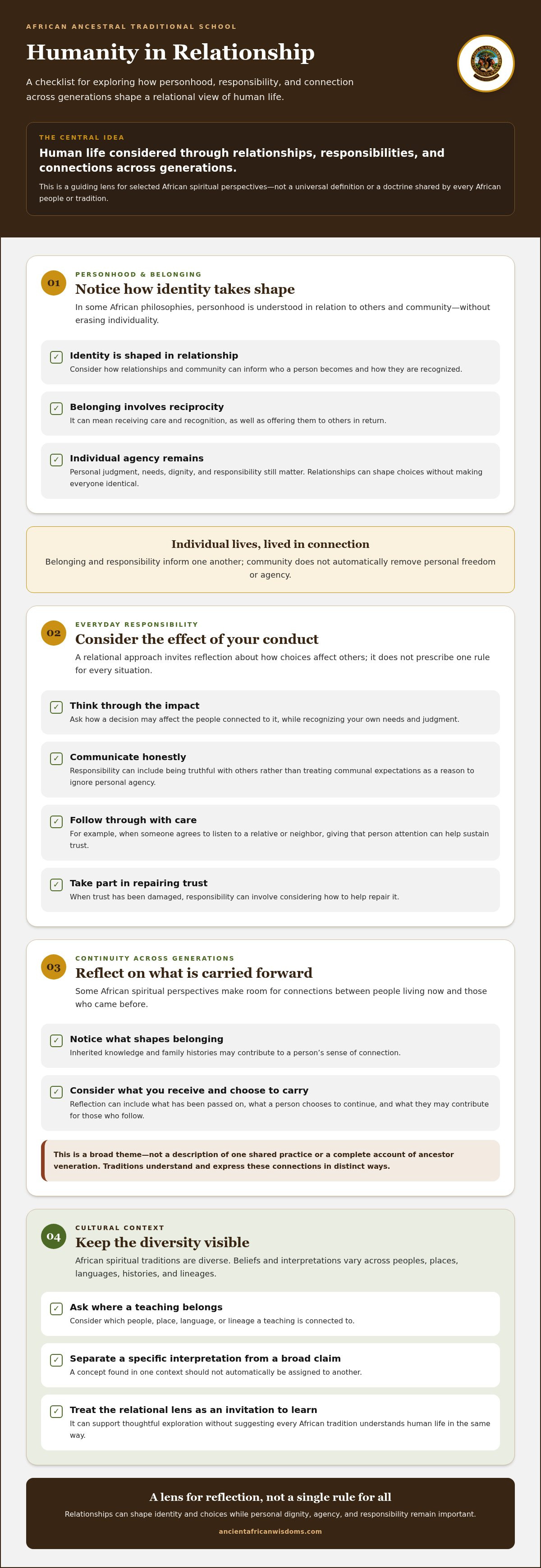
A relational perspective brings ideas about dignity and belonging into ordinary moments: deciding how to respond to someone, sharing a responsibility, or keeping a commitment. The reflection below is a practical tool inspired by the article’s carefully scoped relational lens. It isn’t a sacred practice, spiritual instruction, or a claim that every tradition offers the same guidance. Adapt it to your circumstances and the people involved.
Within this relational lens, ethical responsibility begins by noticing how our choices affect both our own dignity and the dignity of those connected to us. Try these steps when a decision affects another person:
- Notice the relationships. Who is directly involved, and what connection or shared responsibility matters here? Name the people affected, including anyone whose contribution might otherwise go unseen.
- Consider the impact. What could the effects be for each person? A choice that feels convenient to you may place extra work or difficulty on someone else.
- Act with care. Choose a response that takes other people seriously while respecting your own needs. You might listen before replying, explain a decision clearly, or keep a promise you’ve made.
- Reflect on responsibility. Afterward, consider what went well and what you might repair or approach differently. Reflection is an opportunity to learn, not a demand for perfection.
Questions for reflecting on dignity and belonging
Pause before a difficult conversation or shared decision. Whose dignity could be affected? Whose perspective is missing? Have you listened closely enough to understand what the other person needs, and is care moving in both directions? These questions can make reciprocity visible without assuming every relationship has equal power or that one response suits every situation.
Personal reflection can help you examine your conduct, but it isn’t a substitute for learning a tradition’s teachings from sources grounded in its cultural context. Keep the distinction clear: you’re considering an ethical question, not declaring what a community believes.
Keeping cultural learning respectful
As you continue learning, separate your interpretation from teachings attributed to a particular people or tradition. Before repeating a cultural claim, look for its context and reliable sources. Ask who is speaking, which community or history is being discussed, and whether the account presents a specific perspective or a broader conclusion. Curiosity works best as an ongoing practice of listening and learning, not as a claim of ownership.
Structured digital education in African spirituality, culture, and tradition can support study over time, with learning levels and community access for people exploring African heritage. Explore structured African ancestral education as a next step in learning with care.
Continue Exploring Humanity Through African Ancestral Teachings
This exploration has considered humanity through a relational lens: human life can be understood through connections, responsibilities, and belonging, while individual dignity and agency remain important. That lens can open meaningful questions, but it isn’t a single definition for every African tradition. Each teaching belongs within its own cultural and historical context, and learning that context takes time.
From a single idea to sustained study
A useful next step is to move from a broad concept toward careful study. As you encounter a teaching, ask where it comes from, how it has been understood, and which voices or histories can help explain it. Returning to these questions can help distinguish a specific tradition’s teaching from a general interpretation or a phrase shared without context.
Structured courses on African spirituality, culture, and tradition can give this exploration a clearer path. Learners can progress through educational levels and build understanding step by step. The aim is to develop cultural, historical, and philosophical context, not to promise a particular spiritual outcome. Detailed comparisons of school levels are a separate matter; the central invitation here is to keep learning with patience and care.
Learning with structure and community
The African Ancestral Traditional School provides its curriculum entirely online, with structured learning levels and community access. These educational supports serve people exploring African heritage: study can unfold over time, and community access connects learners as they engage with the subject. They are learning features, not a substitute for the distinct teachings of a particular community.
Approach the journey at a pace that leaves room for questions and reflection. The African Ancestral Traditional School offers digital education in African spirituality, culture, and tradition for those ready to continue their study. Keep a distinction between learning about teachings and claiming to speak for them. Respect grows through attention to context, thoughtful study, and a willingness to keep listening.
Which aspect of human connection would you like to understand more deeply: belonging within a community, responsibility in daily life, or ties across generations?
Carry Your Questions Into Deeper Learning
Let this inquiry become a starting point, not a final answer. As you continue exploring humanity, ask how a teaching took shape within its own history and community. Which voices can deepen your understanding? What might you learn by returning to a question after encountering new context? Patient study makes room for insight without forcing distinct traditions into one explanation.
Structured online courses in African spirituality, culture, and tradition offer a way to build knowledge over time. Tiered learning provides room to progress through educational levels, while community access connects learners exploring African heritage. Together, these supports can help you approach your questions with care, reflection, and a wider cultural frame.
When you’re ready to continue, explore the African Ancestral Traditional School and its digital educational offerings.
Stay curious, honor the depth of what you’re learning, and let each new understanding guide you toward the next thoughtful question.
Frequently Asked Questions
What does humanity mean in African spirituality?
There isn’t one definition of humanity shared by every African spiritual tradition. Here, the term points to human life considered through relationships, dignity, and responsibility, rather than only its dictionary sense of people collectively. The emphasis and meaning differ across communities and sources. For a clearer understanding, consider a specific teaching in its cultural setting and note whether the explanation comes from a community source or a writer interpreting it.
Is Ubuntu the same as African spirituality?
No. Ubuntu is associated with particular southern African contexts, while African spirituality refers to diverse traditions and teachings. Treating Ubuntu as a universal label can obscure the languages, communities, and philosophies that give it meaning. If you encounter a short description or a modern adaptation, consider who is using the concept and for what purpose. That context helps distinguish a specific interpretation from a claim about all African spiritual life.
Can humanity be understood without community?
Some relational philosophies give community and mutual responsibility an important place, but that doesn’t mean every African tradition rejects individual identity. A balanced reading can make room for both personal dignity and relationships. For example, a source might describe how belonging influences a person’s choices without suggesting that the group makes every choice for them. Look at how that particular source explains personhood before applying its view elsewhere.
How is human dignity connected to responsibility?
A relational lens can connect respect for a person with attention to how decisions affect others, without making this an identical rule across traditions. In a shared decision, pause to ask who may carry the consequences, whether their perspective has been heard, and what reciprocal care could look like. The answers depend on the people and circumstances involved. Use these questions to guide reflection, not to claim one universal spiritual teaching.
What is the difference between humanity and humanism?
Humanity commonly refers to humankind, human qualities, or the condition of being human. Humanism names a range of philosophical or intellectual approaches that emphasize human value or agency. Their meanings shift with context, and neither word automatically describes African spiritual traditions. Seeing the word “humanism” in an essay, for example, doesn’t establish that the author is describing an ancestral teaching. Identify the framework the writer means before drawing connections.
How can I study African ideas about humanity respectfully?
Begin with sources that name the tradition, language, community, and historical setting they discuss. When a writer makes a broad statement, look for the specific teaching behind it and distinguish the source’s account from the writer’s interpretation. Structured digital courses offer a way to continue studying African spirituality, culture, and tradition, while community learning creates opportunities to engage with others. Keep your conclusions open to revision as your knowledge deepens.


