
What if existence is understood not as a solitary fact, but through the relationships that connect a person to family, community, land, and the spiritual world? If the question feels abstract, you’re not alone. Online explanations can make African spirituality sound like one shared system, even though traditions differ across peoples, places, and histories.
This article introduces ways selected African spiritual traditions approach existence. Rather than presenting one universal answer, it explores questions of connection, community, and the relationship between the living and ancestors, while keeping cultural differences in view. You’ll find practical ways to read and compare these perspectives without treating every tradition as the same.
As you read, connect the ideas to everyday questions about belonging, responsibility, memory, and inherited ties. Keep track of which claims come from a particular tradition and which are your own interpretations. That distinction is a useful starting point for respectful further study.
Key Takeaways
- Existence is a question of being, but African spiritual traditions do not share one continent-wide doctrine.
- Some perspectives connect a person’s life with family, community, place, and heritage. Those ideas do not necessarily apply everywhere.
- Compare traditions through their own questions, contexts, sources, and terms rather than ranking them or treating them as interchangeable.
- Use reflection prompts to examine how memory, place, relationships, and responsibility shape your own questions about existence.
- Structured online learning in African spirituality, culture, tradition, and ancestral teachings can support continued study.
What Does Existence Mean in African Spiritual Thought?
What does it mean to be, and what makes a life part of a larger reality? In ordinary philosophical language, existence refers to the condition or nature of being. Cambridge Dictionary offers a plain-language starting point by defining “existence” in terms of being real or living. Here, the question helps us consider how particular African spiritual traditions understand life, reality, and a person’s place in the world.
There is no single African doctrine that answers these questions for every people and community. The continent holds many distinct spiritual traditions shaped by different languages, histories, places, and teachings. Some discussions examine relationships between human life and spiritual realities; others use different concepts and frameworks. Understand each perspective on its own terms instead of combining them into a universal account.
How to use the word existence in a spiritual discussion
Here, existence is a philosophical lens, not the name of a shared religious rule. It helps frame questions such as: What is a person? How is life understood? What counts as part of reality? Answers are interpretations rooted in particular traditions, not claims that can automatically be established as scientific fact.
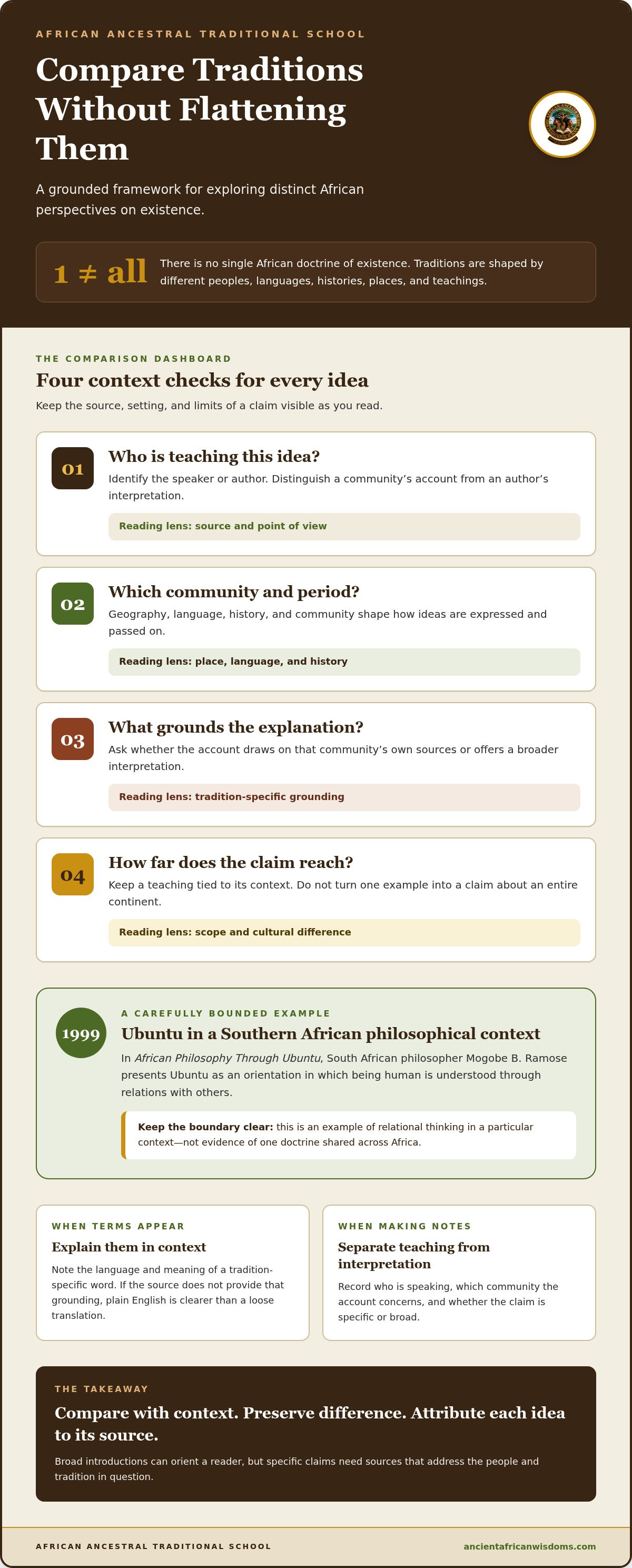
When reading a teaching, identify what kind of claim it makes. Does it express a community’s understanding of life, responsibility, or spiritual presence, or is it an author’s interpretation? Attribute the idea to its context rather than presenting it as a fact about all people. When a tradition-specific word appears, note its language and explain what it means in that context. If the source does not provide that grounding, plain English is clearer than a loose translation.
Why context matters across African traditions
Geography, language, history, and community shape how a tradition’s ideas are expressed and passed on. A concept discussed in one community may mean something different, or have no direct equivalent, elsewhere. Even a broad label such as “African traditional religions” groups many traditions together for an overview; it does not make their teachings interchangeable. Wikipedia’s African Traditional Religions entry can provide an initial orientation, but specific claims need sources that address the people and tradition in question.
As you learn, ask: Who is teaching this idea? Which community and period does it come from? Is the explanation grounded in that community’s own accounts, or is it a broad interpretation? Record the answers beside the claim. This makes it less likely that an example from one tradition will become a claim about an entire continent. Pair a broad introduction to African spirituality with tradition-specific learning, so comparison has context and room for difference.
How Relationship and Continuity Shape Accounts of Existence
A relational view asks not only “What am I?” but also “How do my connections shape who I am?” In some African philosophical and spiritual contexts, a person’s life may be considered in relation to other people, community, place, and inherited ways of understanding the world. This broadens the discussion beyond an isolated individual without implying that every African tradition holds the same view.
Being as part of a wider web of relationships
Ubuntu, discussed in Southern African philosophical contexts, offers one carefully bounded example. In African Philosophy Through Ubuntu (1999), South African philosopher Mogobe B. Ramose presents Ubuntu as a philosophical orientation in which being human is understood through relations with others. This is an example of relational thinking in a particular context, not evidence of one doctrine shared across Africa.
Use this idea to ask how care, cooperation, and mutual responsibility might shape a meaningful life. Do not turn it into a fixed formula for how every person must live or assume that it describes the practices of every community. A useful reading note separates the source’s teaching from the questions you draw from it.
A worldview is the wider lens through which a community may interpret reality, value, and human responsibility. When exploring an African worldview, identify the community and history involved. A concept from one setting can illuminate that setting without representing the whole continent.
Continuity, community, and the meaning of a human life
Consider a shared task, such as preparing food for a family gathering. As an everyday illustration, it draws attention to how individual effort can support a group and how skills or knowledge may pass between generations. It is an example of the kind of question a relational lens can raise, not a description of a particular culture’s ritual or custom.
Continuity also prompts questions about how a person’s choices respond to the people and places that have shaped them. In a tradition-specific discussion, rely on sources grounded in that community rather than inferring an answer from a broad label. Detailed teachings about ancestors, divinity, or the soul deserve careful treatment in their own context, so this section focuses on social relationships and shared life.
When comparing perspectives, separate a source’s teaching from your interpretation. Note who is speaking, which community the account concerns, and whether the claim describes a particular context or reaches beyond it. This approach makes it possible to explore connection without flattening distinct traditions into one story. For a deeper study of African spirituality, culture, tradition, and ancestral teachings, explore structured African ancestral learning.
How to Compare African Perspectives on Existence Without Flattening Them
Comparison can reveal meaningful differences when each idea stays connected to its tradition and community. Instead of asking “Which tradition has the right answer?” ask “What question is this teaching addressing, and how does it work in its own setting?” The aim is understanding, not ranking.
There is no single African spiritual philosophy. Yoruba, Igbo, and Akan traditions, for example, should not be treated as interchangeable, and naming one does not explain its beliefs. A specific claim about any of them needs a reliable source that identifies the community, concept, and historical context. Without that grounding, do not assign a teaching to a tradition.
A respectful framework for comparing traditions
Compare like with like. First, identify how a concept functions in the tradition where it is documented. Then ask whether another source addresses a similar question. Similar wording alone does not prove shared meaning. Use the table to organize your research before drawing conclusions.
| Comparison lens | Questions to ask | What to record |
|---|---|---|
| Question | What aspect of life or reality does the teaching address? | Describe the issue in plain language, without assuming another tradition asks it in the same way. |
| Context | Which community, place, language, and historical period are involved? | Keep these details beside the claim, not as optional background. |
| Source | Who presents the teaching, and what is the source’s relationship to that tradition? | Distinguish community-based accounts, scholarship, and later interpretation. |
| Terms | What does a key word mean in its original language and context? | Explain the term carefully; avoid treating a translation as an exact match elsewhere. |
As Mogobe B. Ramose’s account of Ubuntu demonstrates, a concept is interpreted within a particular intellectual and cultural setting. Meaningful comparison therefore requires attention to cultural and historical context, not just shared labels.
Common shortcuts that distort the question
Be cautious of summaries that describe “African belief” as one unified system. Broad overviews can orient readers, but they may obscure differences in language, teaching, and history. A translated term can be a useful first approximation, yet its meaning may shift across contexts. Do not assume that two words mean the same thing simply because they share an English translation.
Separate documented teachings from modern interpretations and unsourced online summaries. Before repeating a claim, record who makes it, what evidence they provide, and whom it describes. This helps you compare traditions carefully while leaving room for complexity and for communities to speak in their own contexts.
How to Reflect on Existence Through a Culturally Grounded Lens
Reflection can make a large philosophical question more personal, but it does not require you to adopt a belief or practice. Use the prompts below to notice what shapes your understanding of life, belonging, and responsibility. They are learning questions, not ritual instructions or a path to a guaranteed spiritual result.
Questions that make an abstract idea more concrete
Move through these prompts at your own pace. Write a few words, sit with a question, or leave it unanswered for now.
- Define your terms. What do you mean by being, belonging, continuity, and responsibility? Give each word a meaning in your own language before comparing it with a tradition-specific idea.
- Notice your relationships. How do family, community, or people who have shaped your life inform your sense of who you are? Which responsibilities feel chosen, inherited, or still unclear?
- Consider place and memory. What places hold meaning for you, and what memories influence how you understand your life? Separate what you know from what you are still learning.
- Make room for uncertainty. Which parts of your view feel settled, and which remain open? You do not need to force a single answer to make the question worthwhile.
These prompts are for personal reflection, not medical or psychological guidance, and they cannot promise a particular spiritual outcome. If a question brings up distress, pause and seek appropriate support rather than treating reflection as a substitute for care.
Reading with care and cultural humility
Before using an unfamiliar concept to explain your own life, learn how it is understood in its original context. Ask who produced the source, which people or community it discusses, and what place and period it describes. A firsthand account from a community member, a scholarly interpretation, and a personal online summary may offer different kinds of insight. Do not treat them as interchangeable.
Check whether a source identifies its terms and explains how it uses them. A translation can help you begin, but it may not carry every layer of meaning from the original language. If an account makes a broad claim about African traditions without naming its sources or context, look for more grounded reading before drawing conclusions.
Distinguish learning about a tradition from claiming authority within it. You can appreciate an idea, ask thoughtful questions, and continue studying without presenting one community’s teachings as your own or as universal. Let careful reading refine your questions, and leave uncertainty where evidence or context is limited.
For continued study beyond a single article, explore structured African ancestral learning through online courses focused on African spirituality, culture, and tradition.
Continue Exploring Existence Through Structured African Ancestral Learning
An introductory article can open a question, while sustained learning gives you room to return to it with greater context. Ideas about existence are not always best understood as short definitions; their meaning can depend on the tradition, language, and community in which they are taught. Structured study helps keep those contexts in view as you continue exploring African ancestral teachings.
What structured study can add to an introductory article
Reading an overview is a useful beginning, not a substitute for learning how particular teachings are presented and understood. Structured online courses provide a setting for continued study of African spirituality, culture, and tradition. An organized educational pathway gives you a way to return to subjects and consider what you are learning, rather than relying on isolated summaries.
The African Ancestral Traditional School offers tiered learning levels. This structure supports continued study without suggesting that every student follows the same pace or reaches a particular personal result. It makes space for ongoing engagement: returning to questions, building understanding, and distinguishing what a source teaches from what a reader may assume.
Keep these questions beside your notes as you learn:
- Which tradition or cultural context is being discussed?
- How is a key idea explained, and who is explaining it?
- What would you need to learn before comparing it with another tradition?
- Which questions remain open for further study?
These prompts do not demand instant certainty. They help turn curiosity into careful study while leaving room for complexity and continued reflection.
A welcoming next step for continued learning
Online courses offer an educational way to explore African ancestral teachings beyond a single introduction. The African Ancestral Traditional School focuses on African spirituality, culture, tradition, and ancestral teachings. Community access gives learners a setting to connect with others engaged in study, even when they bring different backgrounds and questions.
Approach this pathway as study, not a promise of transformation or a fixed answer to life’s deepest questions. Move through the learning levels with patience and let context guide your understanding. Explore the school’s African ancestral learning pathway to continue your study.
Let Your Questions Lead to Deeper Learning
You do not need to settle every question about existence before taking a next step. Keep track of what you want to understand, notice where your assumptions come from, and give each tradition room to speak in its own context. Learning can be a gradual practice of listening and revisiting, rather than a search for one final answer.
The African Ancestral Traditional School offers online courses focused on African spirituality, culture, and tradition, with tiered learning levels and community access. This educational setting supports sustained study, reflection, and connection as you explore ancestral teachings at a considered pace.
Explore structured African ancestral learning and take a thoughtful next step in your studies. Your questions are a meaningful beginning, and there is room to keep learning with care.
Frequently Asked Questions
What does existence mean in African spirituality?
Existence is a way to ask what it means to be alive, real, and part of the world. In a spiritual discussion, the question may lead to ideas about human life and reality, but the answer depends on the tradition being studied. Notice whether a source describes a community’s teaching or an author’s interpretation, rather than treating either as your own belief.
Is there one African philosophy of existence?
No. African philosophical and spiritual thought includes many distinct traditions, so one account cannot stand for the continent. To explore a particular perspective, identify the community and setting it concerns, then read how its sources explain the idea. If two sources use the same English term, compare their explanations before drawing a connection.
How do African traditions understand the relationship between people and community?
Some traditions and philosophies understand a person partly through relationships with others, but the details vary. Distinguish a philosophical ideal, such as mutual responsibility, from a claim about how every person in a community lives. When reading an example, ask whether it describes a teaching, a social practice, or an individual author’s view.
Are African spiritual beliefs the same across the continent?
No. Beliefs and practices differ across communities, languages, places, and histories, and they can also change over time. A translated religious term may mean one thing in its original language and not match a similar English label elsewhere. Treat broad introductions as a starting point, then learn about the specific community behind a claim.
Can I study African perspectives on existence if I am a beginner?
Yes. Begin with one question, such as how a particular tradition understands human life, and keep notes on the source, community, and unfamiliar terms. The African Ancestral Traditional School offers online courses focused on African spirituality, culture, and tradition, with tiered learning levels and community access. Structured learning can help you continue at a considered pace while developing questions of your own.
How can I learn about African spiritual traditions respectfully?
Choose sources that identify the tradition and explain who is speaking. Give priority to community knowledge and carefully contextualized scholarship over summaries that make sweeping claims without showing their sources. Note a term’s context and avoid presenting unfamiliar teachings as universal. Learning about a practice is not the same as adopting it; take time to understand its meaning before repeating or interpreting it.
What is the difference between existence and spirituality?
Existence concerns being or being alive; spirituality refers to ways people understand or engage with spiritual meaning, beliefs, or practices. The terms can overlap, but they are not interchangeable. Asking whether a person exists is different from asking how a spiritual tradition understands that person’s place in the world. Keeping the distinction clear can make your reading and questions more precise.


