
What changes when creation stories are understood not as interchangeable myths, but as teachings about how people should live with one another and the world? Exploring ethics and indigenous knowledge systems through African Cosmology means approaching creation within its cultural setting. This is a detailed resource explaining African cosmological concepts and how different African cultures understand creation, without reducing a continent’s many traditions to one belief system.
It’s understandable to look for shared themes across African worldviews. Yet each tradition carries its own histories, teachings, and relationships, and similarities don’t make them identical. This article explores selected creation traditions in context, considering how their understandings of existence can inform ethical relationships, knowledge, and responsibility. You’ll also find practical guidance for learning with care: attend to whose knowledge is being shared, respect community boundaries, and avoid treating sacred teachings as material to collect or generalize. Let this be a thoughtful beginning, grounded in curiosity, humility, and respect for the communities whose knowledge continues across generations.
Key Takeaways
- Understand cosmology as a culturally situated way of making sense of existence, origins, relationships, and humanity’s place in the world.
- Explore ethics and indigenous knowledge systems. African Cosmology. A detailed resource explaining African cosmological concepts and how different African cultures understand creation, while keeping distinct traditions in their own context.
- Compare selected Yoruba, Igbo, and Akan concepts carefully, and avoid treating shared themes as proof that their cosmologies are interchangeable.
- Learn to engage cultural knowledge with care: name the tradition, cite sources, preserve context, and respect community authority and consent.
- Continue your learning through reflection and structured study, noting your sources, questions, and the cultural context behind each teaching.
What African Cosmology Means, and Why One Definition Cannot Represent Every Culture
Cosmology is a way of understanding existence: how the world began, what gives it order, how beings relate to one another, and where humanity belongs. A concise definition is this: African cosmologies are culturally rooted ways of understanding origins, existence, relationships, and human responsibility. The plural matters. Africa is home to many peoples, languages, histories, and knowledge traditions. No single account can speak for them all.
The search phrase “ethics and indigenous knowledge systems. African Cosmology. A detailed resource explaining African cosmological concepts and how different African cultures understand creation” points toward a subject that needs both comparison and care. A broad overview can introduce ideas and questions, but it can’t stand in for the knowledge held within a particular community.
How cosmology connects creation, community, and the living world
A creation account may describe origins, but cosmology reaches further. It can also shape how a community understands order, belonging, relationships between generations, and human responsibilities within the living world. These connections should be explained through tradition-specific sources, rather than assumed to be identical across cultures.
Knowledge can travel through oral teachings, stories, song, ritual, philosophy, written records, and community memory. Oral transmission is one important pathway, not a description that fits every tradition in the same way. For a specific example, the Fon creation myth offers an entry point to a particular West African account. It should be approached as one tradition’s narrative, not as a universal African explanation of creation.
Why Indigenous knowledge must remain culturally situated
Meaning is shaped by the language in which an idea is shared, the place and history it carries, and the people who interpret and preserve it. A word translated into English may not hold all the associations it has in its original language. A story’s meaning may also depend on who tells it, when it is shared, and the community relationships around it. Where details are uncertain, it’s better to say so than to turn an interpretation into settled fact.
This is the difference between a comparative introduction and community-specific teaching. Comparison can help readers notice questions and themes, but it shouldn’t flatten distinct histories or suggest that one summary captures a tradition’s full depth. Keep track of which source describes which community, and separate what a source documents from your own interpretation.
That care also matters when knowledge is recorded or shared. Not every teaching is intended for every audience, and community authority helps guide what may be shared and in what context. Respectful learning begins by listening to those relationships, not treating cultural knowledge as material anyone can freely extract.
For a closer look at how knowledge is carried across generations, explore cultural memory and Indigenous knowledge. It offers a useful foundation for approaching the traditions that follow with attention to continuity, context, and the people who sustain them.
How Creation Narratives Carry Knowledge About Order and Responsibility
Creation narratives can describe beginnings while also carrying ideas about how existence is ordered and how people belong within it. A story may place human life in relation to the sacred, ancestors, community, land, or other living beings. Those connections can invite ethical reflection, but they shouldn’t be reduced to one universal moral lesson.
A creation narrative can preserve knowledge of origins alongside cultural memory, relationships, values, and responsibilities, carrying them through retellings shaped by particular communities and circumstances. This is an interpretive way to understand what narratives may do, not a claim that every story has the same purpose or meaning. Distinguish what a source records from what you infer, and identify the tradition and context behind each example.
Reading creation accounts as more than explanations of beginnings
Stories are shared in particular settings, and oral accounts may vary across tellers, generations, and communities. Variation doesn’t make a tradition unreliable; it cautions readers against treating one collected version as a fixed text that represents everyone. A published account is evidence of a telling recorded in a particular context, not automatic proof of a single, unchanging canon.
As one example, Bolaji Idowu’s Olódùmarè: God in Yoruba Belief (1962) discusses Yoruba understandings of the Supreme Being and accounts of creation. It offers a tradition-focused source to consult, while leaving room to ask whose account is being represented and how it was gathered. The broader observation that origin narratives can express relationships and social values is analysis; it shouldn’t be presented as Idowu’s precise conclusion unless a passage supports it.
Using Yoruba, Igbo, and Akan examples with care
Examples should illuminate difference, not stand in for a continent. Idowu’s work concerns Yoruba belief, while Victor C. Uchendu’s The Igbo of Southeast Nigeria (1965) offers a distinct account of Igbo social and religious life. R. S. Rattray’s Religion and Art in Ashanti (1927) documents Ashanti, an Akan cultural context. These sources come from different periods and approaches, so readers should attend to their scope and historical setting rather than treating them as interchangeable or exhaustive.
When studying any account, note the community named, the source’s date and purpose, and whether it records a story, a scholar’s interpretation, or both. The keyword phrase “ethics and indigenous knowledge systems. African Cosmology. A detailed resource explaining African cosmological concepts and how different African cultures understand creation” points to this central practice: keep cultural claims traceable, and don’t turn a careful comparison into a universal rule.
For a more sustained introduction, structured online courses in African spirituality, culture, and tradition can support continued study alongside community-specific sources. Explore guided learning in African traditions as one pathway for deepening that learning with care.
Yoruba, Igbo, and Akan Cosmologies: Compare Ideas Without Collapsing Differences
Comparing traditions can help us ask thoughtful questions: How are origins understood? How is divine presence described? What relationships connect people, community, and the wider world? But shared questions don’t mean shared answers. Yoruba, Igbo, and Akan communities have distinct histories and knowledge traditions, and each contains internal diversity.
The examples below draw on named scholarly works as starting points, not as complete or final accounts. Older ethnographic studies can preserve valuable records, but their scope and historical context matter. Read each source as an interpretation with limits, and distinguish its claims from community knowledge and your own analysis.
| Tradition and context | Sourced concept | Context and caution |
|---|---|---|
| Yoruba, especially in southwestern Nigeria | Bolaji Idowu’s Olódùmarè: God in Yoruba Belief (1962) examines Yoruba understandings of Olódùmarè and creation. | This is a scholarly study of Yoruba belief, not a complete account of every Yoruba community or a substitute for community-held teaching. |
| Igbo, in southeastern Nigeria | Victor C. Uchendu’s The Igbo of Southeast Nigeria (1965) describes Igbo religious and social life. | Its regional framing matters. Don’t assume one account captures the full range of Igbo beliefs, local histories, or interpretations of divine presence and responsibility. |
| Ashanti, an Akan cultural context in Ghana | R. S. Rattray’s Religion and Art in Ashanti (1927) records religious concepts within Ashanti society. | Ashanti is a specific context, not a synonym for every Akan community. The work’s age and ethnographic perspective should inform how its descriptions are used. |
What a respectful comparison can reveal
Placed side by side, sources can show that different communities have developed ways to speak about origins, sacred presence, social belonging, and human conduct. Those categories are useful only where the sources support them. They are prompts for careful inquiry, not proof that each tradition organizes spiritual life in the same way. Avoid ranking traditions or treating one as the default model.
Interpretations may also vary between sources and tellers. Where accounts differ, identify the difference and its context rather than smoothing it into a single settled version. This is especially important when a published description uses broad labels that obscure local distinctions.
What a comparison cannot claim
Three West African examples cannot establish a single continental doctrine. Nor should a scholar’s account or modern popular summary be presented as identical to knowledge held and interpreted within a community. For readers searching “ethics and indigenous knowledge systems. African Cosmology. A detailed resource explaining African cosmological concepts and how different African cultures understand creation,” a responsible comparison is one that makes its sources visible and its limits clear.
Keep that distinction in view as you continue exploring. A broader African spirituality and ancestral wisdom guide can offer wider context, while tradition-specific learning helps preserve the depth and differences that a short comparison can only introduce.
Ethics in Indigenous Knowledge Systems: Learn with Context, Consent, and Care
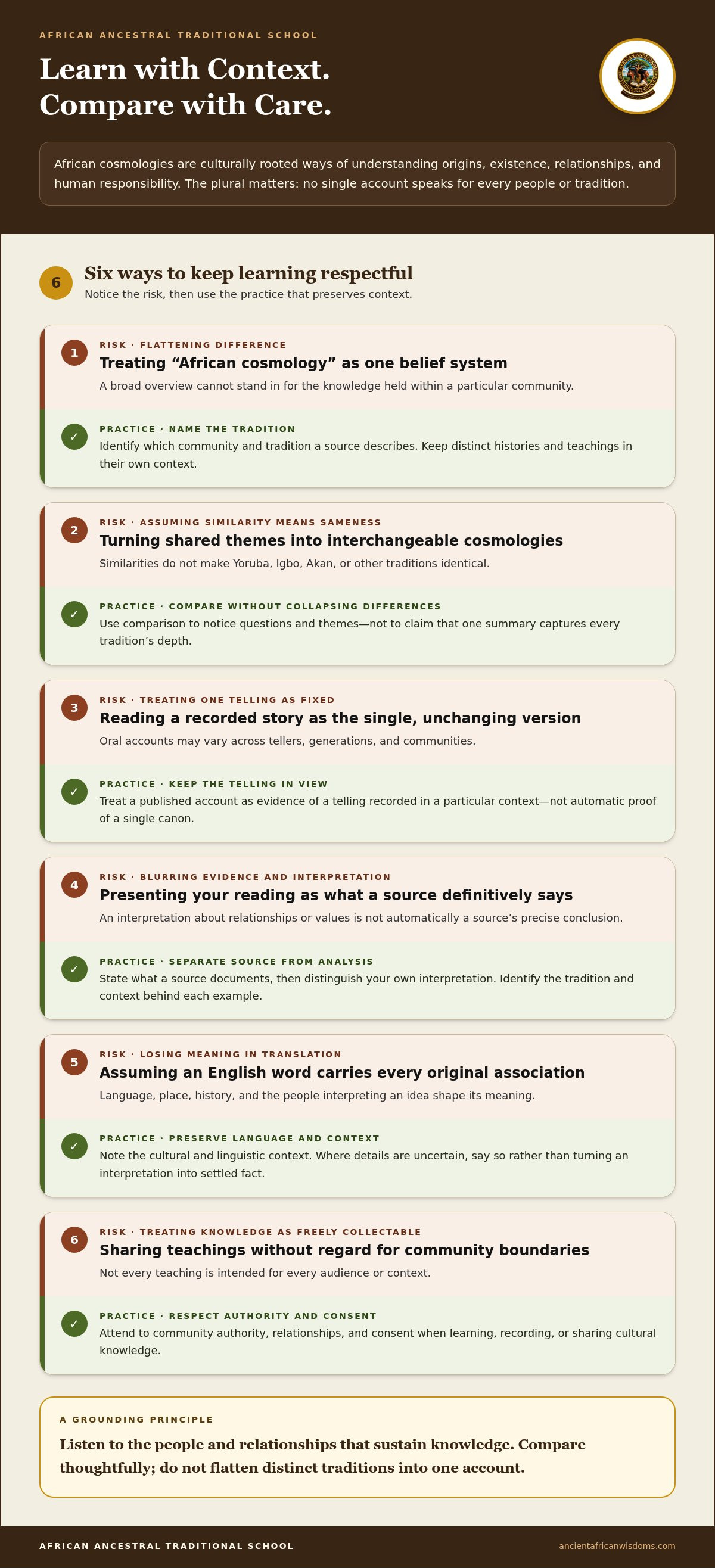
Learning about a tradition is not the same as having permission to record, reproduce, or teach every part of it. Ethical engagement means approaching knowledge with accountability to its cultural setting and to the people who carry it. Ethical engagement is accountable learning, not unrestricted access. That principle helps readers move beyond curiosity alone and consider how their choices affect the people and communities connected to what they study.
Begin with context. Name the people and place connected to a teaching, identify its language where possible, and cite the source. Make clear whether a statement comes from a community knowledge holder, a published scholar, or your own interpretation. If those distinctions aren’t clear, don’t present an interpretation as established cultural fact.
A practical checklist for responsible learning
Before quoting, recording, or sharing cultural knowledge, pause and ask what you know about its context and intended audience. These questions can help guide your next step:
- Can you identify the people, place, language, and source associated with the teaching?
- Is the material publicly shared, held within a community, or described as restricted? If its status is unclear, don’t assume that access means permission to reproduce it.
- Have you credited the knowledge holder or source, and obtained appropriate permission before recording or sharing material when permission is needed?
- Have you kept the surrounding context, including the responsibilities or relationships that give the knowledge meaning?
Community authority matters because knowledge may be carried within relationships and shared according to community protocols. Consent is not always an individual decision detached from those relationships. For recording or publication, seek guidance through appropriate community processes rather than treating a public appearance, online post, or published quotation as blanket permission to reuse material in any setting.
Avoiding appropriation and misleading generalizations
Translation calls for similar care. When an original term carries meanings that don’t fit neatly into English, retain the term where useful, provide a clear explanation, and note the limits of the translation. Avoid presenting an approximate English equivalent as though it captures every spiritual, historical, or social association of the original.
Take care not to detach sacred concepts from their community, history, or responsibilities and present them as free-floating ideas. One person’s account may be meaningful and well-informed, but it shouldn’t automatically be framed as consensus across a people or region. If accounts differ, describe that variation instead of forcing agreement.
Keep spiritual interpretation distinct from verifiable historical claims and from scholarly analysis. The phrase “ethics and indigenous knowledge systems. African Cosmology. A detailed resource explaining African cosmological concepts and how different African cultures understand creation” names a broad area of inquiry, but ethical study depends on specificity: identify which tradition and source a claim concerns, and be transparent about what remains interpretation.
For continued study, explore structured online courses in African culture, spirituality, and tradition as one guided learning pathway, while remembering that no course replaces community-specific knowledge. Explore guided learning in African traditions and carry these principles of context, consent, and care into your next step.
Continue Exploring African Cosmology Through Structured, Respectful Learning
An introductory article can open a door, but it can’t make anyone an authority on a living tradition. Let understanding grow over time: follow sources carefully, notice what you don’t yet know, and stay open to revising early assumptions. A search phrase such as “ethics and indigenous knowledge systems. African Cosmology. A detailed resource explaining African cosmological concepts and how different African cultures understand creation” points to a broad field of study, but meaningful learning begins with specific traditions, sources, and questions.
Build a grounded personal study practice
Choose one tradition to focus on first. Follow the sources connected to it before comparing it with others, and give yourself room to understand the historical and cultural context around each teaching. A reflection journal can help you keep your learning clear and accountable. For each entry, note:
- The concept or term, including pronunciation guidance when a trustworthy source provides it.
- The people, place, language, and source associated with the material.
- What the source states, what you infer, and what remains uncertain.
- Questions to revisit as you read or listen to other sources.
Return to earlier entries as your understanding deepens. You may find that a translation needs more nuance, a source has a narrower scope than you first realized, or a confident assumption deserves reconsideration. That’s not a setback. It’s part of learning with care.
Learn within a guided, community-oriented setting
Independent reading can be enriched by structured study. African Ancestral Traditional School offers tiered digital learning in African spirituality, culture, and tradition, alongside community access for learners. A guided setting can give your exploration continuity and a place to engage with others, while keeping an important boundary in view: online education supports learning, but it doesn’t replace the authority of communities holding their own knowledge.
As you study, reflect on how your learning shapes the way you listen, speak, and share. Are you preserving context when you discuss a teaching? Are you leaving space for knowledge holders to guide how their traditions are understood? These questions help turn study into a practice of respect, and connect personal learning with cultural continuity across generations.
Continue at a pace that allows knowledge to settle. Explore African ancestral learning as a next step in your study, with curiosity, humility, and care for the distinct traditions you encounter.
Let Respectful Study Grow Into a Lasting Practice
Let this exploration become a beginning, not a finish line. Choose a question that stayed with you, return to the sources behind it, and keep learning with patience. Understanding deepens through attention and relationship, not through rushing to collect answers or claim mastery.
The search phrase “ethics and indigenous knowledge systems. African Cosmology. A detailed resource explaining African cosmological concepts and how different African cultures understand creation” points toward a wide field of learning. Your own path can be more focused: follow one thread, notice whose knowledge you’re encountering, and consider how to carry it with care.
If you’re ready to continue, African Ancestral Traditional School offers tiered online learning, digital courses in African spirituality, culture, and tradition, and community access for learners. These provide a structured pathway for continued study, while community-specific knowledge remains rooted in the communities that hold it.
Explore structured African ancestral learning, and take your next step with curiosity, humility, and a commitment to respectful learning.
Frequently Asked Questions
What is African cosmology?
African cosmology is a broad term for culturally situated understandings of origins, existence, relationships, and humanity’s place in the world. It describes plural traditions, not one shared system. For example, a source discussing a Yoruba community shouldn’t automatically be used to explain an Igbo or Akan tradition. Treat any short overview as an entry point, then follow sources that identify the particular community, language, and historical setting.
Do all African cultures share the same creation story?
No. African peoples have distinct languages, histories, and knowledge traditions, so creation accounts differ in their characters, meanings, and forms of transmission. Two narratives may both address how the world began without making the beliefs identical. If you encounter a story described simply as “African,” look for more precise information: which people or region does it concern, who recorded or shared it, and when?
How do Yoruba, Igbo, and Akan traditions understand creation?
There isn’t one definitive summary for any of these traditions, and versions and interpretations can vary. For a starting point, Bolaji Idowu’s Olódùmarè: God in Yoruba Belief, Victor C. Uchendu’s The Igbo of Southeast Nigeria, and R. S. Rattray’s Religion and Art in Ashanti address distinct contexts. These works differ in date and approach; read them as sources to examine, not as substitutes for community knowledge.
What is the relationship between African cosmology and ethics?
Cosmological ideas can inform how people understand duties and relationships, but the ethical meanings belong to particular traditions and contexts. Don’t assume a single code applies across Africa. For instance, if a source links a sacred relationship to a specific responsibility, identify whose teaching it records before drawing broader conclusions. The phrase “ethics and Indigenous knowledge systems” is best approached through careful, source-based questions, rather than generalized claims about shared values.
How can I study African Indigenous knowledge respectfully?
Start by recording the specific people, place, language, and source connected to each teaching. Note whether the material is openly shared or described as restricted, and don’t treat access to a text or recording as permission to reproduce it. Credit the source, preserve relevant context, and mark uncertain interpretations clearly. If an account’s authority or intended audience isn’t clear, describe that limit instead of filling the gap with assumptions.
Are African creation narratives historical accounts or spiritual teachings?
They may carry spiritual, ethical, cultural, and historical significance, depending on the tradition and the source. Avoid forcing every narrative into a choice between literal history and metaphor; community members and scholars may interpret an account differently. If making a historical claim, specify what evidence supports it, such as a dated document or a carefully identified source. Keep that evidence distinct from spiritual meaning or later scholarly interpretation.
Can one article explain every African cosmology?
No. A single article can introduce selected questions and sources, but it cannot represent the full range of African communities and knowledge traditions. Use an overview to decide what you want to learn next, then focus on one tradition and trace its sources in context. As you broaden your study, keep notes on where each account comes from, and resist treating a concise summary as a universal reference.


