
What if a ritual’s meaning comes less from the steps themselves and more from the relationships, memory, and purpose they carry? Online instructions can make a practice look simple to copy, but repeating an action doesn’t explain what it means within a particular community or tradition.
If you’re seeking a deeper connection with your ancestors, wanting clarity is natural. African ancestral traditions are diverse, shaped by distinct histories and communities. A broad explanation can blur important differences, and a practice with sacred meaning in one context shouldn’t be treated as a universal script.
This article explores what ritual can mean, how it carries cultural memory and intention, and why context matters when approaching African ancestral traditions. You’ll find practical questions to use when learning about a practice, ways to recognize the limits of decontextualized instructions, and guidance for building understanding through patient study. Grounded learning can help you take a thoughtful next step without rushing toward practices you don’t yet understand.
Key Takeaways
- Recognize how intention, shared meaning, and symbolism distinguish ritual from routine action.
- Consider how symbols and practices gain meaning within the communities that carry them.
- Explore how people, place, history, language, and lineage shape distinct African ancestral traditions.
- Approach unfamiliar practices thoughtfully: identify the tradition, seek context, listen, and reflect on responsibility.
- Build understanding through structured, level-based online learning that places African culture, spirituality, tradition, and practical rituals in context.
What Is a Ritual? Meaning Beyond Repetition
A ritual is a patterned action made meaningful by its purpose and the context in which it takes place. Its meaning may be personal, shared by a community, or carried through a particular tradition. The movement or object alone doesn’t tell the whole story. Intention, memory, and relationships shape how people understand it.
This distinction matters when learning about African ancestral practices. African traditions aren’t one interchangeable system. Describing them as a single set of customs can hide the histories and meanings that make each practice distinct. Start with the context instead of assuming a familiar-looking action means the same thing everywhere.
How does meaningful practice differ from habit?
Repetition by itself doesn’t make an action a ritual. A habit might be making tea each morning without thinking much about the steps. A patterned action takes on meaning when someone performs it with a clear intention, or when a community understands it as expressing memory, respect, belonging, or another shared value.
The same outward act can carry different meanings in different settings. Lighting a candle might be practical in one moment, a personal gesture of remembrance in another, or part of a tradition with its own teachings and responsibilities. These examples aren’t equivalent. They show why appearance alone can’t explain what an action means to the people who practice it.
Why does the word have several meanings?
People use the word in religious, cultural, social, and personal settings. Those meanings overlap, but they aren’t identical. A repeated social custom may mark belonging, while an act within a spiritual tradition may carry particular teachings or obligations. In anthropology, the term is often used broadly for patterned, meaningful actions across human societies. The meaning and characteristics of rituals offers a general overview, but a broad definition can’t explain every tradition’s specific understanding.
For a wider grounding in spiritual context, explore African spirituality and ancestral wisdom. As you learn, ask what a practice expresses, who carries its meaning, and what knowledge surrounds it. These questions keep curiosity open while making room for differences among African peoples, places, histories, languages, and lineages.
How Ritual Creates Meaning Through Intention, Symbol, and Community
An action can look simple from the outside and still hold deep meaning for the people taking part. Intention helps shape what participants understand an action to express, whether gratitude, remembrance, welcome, or a passage into a new stage of life. But personal intention isn’t the whole story. In a cultural or spiritual tradition, meaning may also come from teachings, relationships, and shared understandings carried over time.
Ritual meaning depends on the people interpreting it and the context in which it is practiced. The same gesture or object may mean different things across families, communities, and traditions. There is no universal code for decoding every action from its appearance alone. Academic discussions of patterning, repetition, and symbolism offer useful ways to think about these practices. Academic perspectives on ritual and its functions can provide a broader frame without replacing knowledge held within particular traditions.
What roles can shared practices play?
A shared practice may bring people together around a significant moment, express care, or renew a sense of connection. Repeated forms can carry memory: participants may recognize familiar words, movements, or moments of gathering through what they’ve learned together. A practice may also mark a transition or give shape to gratitude. These are possible roles, not a checklist followed by every tradition.
Not every meaningful practice is communal. Some may be personal or family-based, with significance grounded in relationships and knowledge passed within a household. Even in a shared practice, participants may have different experiences. Attending to those differences helps avoid treating a community as a single voice or assuming one person’s explanation represents everyone.
How do symbols and words shape meaning?
Words, gestures, objects, and settings can focus attention and express what participants hold important. Their significance is learned through the context in which they’re used. An object doesn’t carry one fixed spiritual meaning everywhere, and a gesture familiar in one setting may be understood differently in another. Ask what a symbol means to the people who use it rather than assigning meaning based on appearance.
Some concepts within African spirituality also need context. Asè relates to broader spiritual understanding, but it shouldn’t be reduced to a definition of a practice or treated as a universal explanation. Learn concepts alongside the traditions and teachings that give them meaning.
Make room for listening as well as interpretation. Structured study of African culture, spirituality, and tradition can help build context before engaging with practices. Explore online learning in African ancestral traditions as one way to continue that grounded study.
African Ancestral Rituals Are Diverse, Not One Universal Practice
African ancestral traditions cannot be reduced to a single system of beliefs or practices. They have taken shape across different peoples, places, histories, languages, and lineages, with teachings carried and understood in particular communities. No single practice represents all African ancestral traditions. Keeping this in view helps prevent one account from standing in for many distinct ways of relating to ancestry.
When comparing traditions, look for context rather than ranking one practice against another. These factors can guide your questions without implying every community organizes spiritual life in the same way:
| Context factor | Why it matters | Question to consider |
|---|---|---|
| People and community | Teachings and shared meanings are carried within particular communities. | Whose perspective is being described? |
| Place and history | Local experiences can shape how beliefs and practices develop and are understood. | What historical or local context informs this account? |
| Language | Words for spiritual ideas may carry meanings that don’t map neatly onto English. | Are key terms being explained in context? |
| Lineage and teaching | Knowledge may be passed through relationships and specific forms of instruction. | Who carries or teaches this knowledge? |
| Occasion and purpose | The reason for an action can influence how participants understand it. | What moment or purpose is being addressed? |
Why can similar forms mean different things?
Two communities may use outwardly similar gestures or objects, but resemblance alone doesn’t establish a shared origin or meaning. Local history, community teaching, and the occasion all matter. Treat broad claims about origins carefully, especially when a source doesn’t explain how its account was researched or whose knowledge it reflects. A careful comparison describes what is known and leaves room for what it can’t establish.
What does ancestral context add?
In some traditions, ancestors are understood through living relationships that may involve memory, belonging, or responsibility. These understandings aren’t identical across African communities, and ancestors shouldn’t be treated merely as symbols or as a universal concept with one explanation. A Michigan State University overview discusses ancestral spirits and rituals in African religions. Use it as a starting point for broader context, not a complete account of every tradition.
For a focused discussion of ancestral connection in diaspora settings, explore ancestral veneration in the African diaspora. As you read, notice whose experience is represented, which community or history is discussed, and where the account acknowledges its limits. These questions support a grounded understanding without asking one source to speak for an entire continent.
How to Approach Ritual with Respect Before Practicing
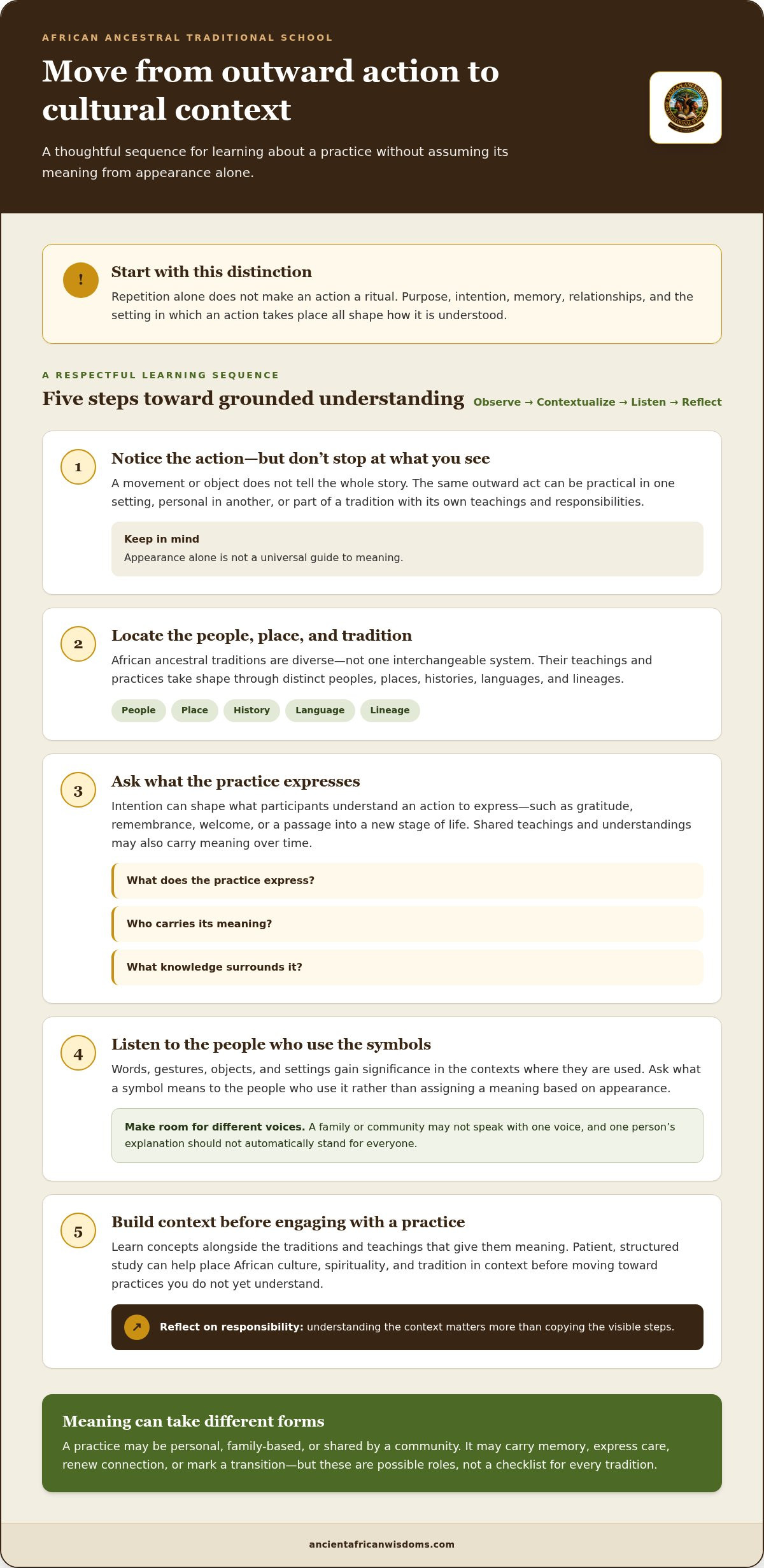
Curiosity can be a meaningful beginning, but it doesn’t create instant understanding or authority. Before engaging with a practice rooted in a living tradition, learn what it means, who carries its knowledge, and what responsibilities may accompany it. Respectful learning doesn’t require you to rush toward participation. Sometimes the most considered first step is listening.
Use this reflective sequence as a guide:
- Identify the tradition. Name the specific people, community, or lineage connected to the practice when that information is available. Don’t assume a practice represents all African peoples.
- Seek its context. Learn about its purpose, history, and community-specific meaning. Notice whether an explanation distinguishes documented information from an author’s interpretation or personal experience.
- Listen to those who carry the knowledge. Make room for community perspectives, including differences of opinion. One account may offer valuable insight without speaking for everyone.
- Consider responsibility. Ask whether the practice is intended for public learning, held within a family or community, or connected to specific teachings and relationships. Respect stated boundaries.
What should a beginner learn first?
Begin with the practice’s cultural setting and purpose, not a copied list of steps. Look for explanations that clarify who is speaking and what their account can support. If sources disagree or leave details unclear, keep those questions open rather than filling gaps with guesses. Curiosity doesn’t require immediate performance. Patient study can deepen understanding without turning sacred knowledge into a quick personal exercise.
How can you avoid treating traditions as interchangeable?
Name a tradition when you know it, and be precise about what you don’t know. Don’t remove sacred forms from their context and recast them as generic wellness routines or decoration. If you discover your understanding was incomplete, revise it. Learning responsibly includes accepting correction and recognizing that a practice may not be yours to reproduce or teach.
Learning about a practice is different from claiming authority to perform or teach it. An online description may introduce a topic, but it can’t automatically convey the relationships, teachings, or boundaries that give it meaning. Pay attention to what’s shared openly and what community members describe as private or lineage-specific. Treat access to information as an opportunity to learn, not automatic permission to practice.
For a focused introduction to learning about online African ancestral rituals, continue with a resource framed for beginners. To build understanding through structured study of African spirituality, culture, and tradition, explore online ancestral learning at your own pace.
Continue Learning About Ritual Through Structured Ancestral Study
Understanding a practice takes more than learning its visible steps. Culture, spiritual teachings, history, and community life help explain why a practice matters and how people understand their responsibilities within it. Studying these strands together can build a stronger foundation before you encounter specific practices. It also helps you approach what you learn with care instead of treating it as instructions detached from its roots.
How can structured learning deepen understanding?
Progressive study makes room to build context over time. Rather than beginning with a practice in isolation, learners can explore the cultural and spiritual ideas that inform it, then deepen their understanding through continued study. The African Ancestral Traditional School provides online, level-based education covering African culture, spirituality, tradition, and practical rituals. This structure supports careful learning while recognizing that knowledge and practice differ among communities and traditions.
Education has its own purpose and boundaries. Online courses provide digital learning; they aren’t the same as an in-person initiation ceremony, and study alone doesn’t establish authority to perform or teach every practice. Keeping those distinctions clear helps set realistic expectations. Learning can help you ask more thoughtful questions and understand context, without promising a particular spiritual outcome or making you an expert in traditions beyond what you’ve studied.
What can community-based online learning offer?
Community access gives learners an opportunity to reflect alongside others, hear questions beyond their own, and stay connected to study over time. That shared setting can encourage respectful inquiry and continuity. Members may have different backgrounds and perspectives, so approach discussion with humility and make room for cultural diversity.
Let your questions develop alongside your knowledge. Keep notes on what a course teaches, what remains uncertain, and which perspectives or contexts are represented. Return to those questions as your understanding grows. Reflection helps distinguish what you’ve learned from what you’re still exploring and discourages quick conclusions about traditions that hold different meanings for different people.
A grounded learning path doesn’t need to end with a single answer. Continued study can build familiarity with African cultural and spiritual teachings while keeping you attentive to the limits of your own knowledge. Take the next step by exploring the African Ancestral Traditional School and its structured online learning. Let study unfold at a thoughtful pace, with curiosity, respect, and openness to what each new layer of context may teach.
Let Your Learning Continue with Care
Your next step doesn’t need to be dramatic. Choose one question that has stayed with you and give it time: What context would help me understand this practice more fully? Whose knowledge am I learning from? What might respectful listening ask of me? A thoughtful approach to ritual grows through attention and reflection, not pressure to have every answer at once.
If you’re ready to keep learning, the African Ancestral Traditional School offers structured digital courses with progressive levels, a curriculum focused on African spirituality, culture, tradition, and practical rituals, and community access for students. This educational path supports continued study. It doesn’t replace an in-person initiation ceremony or make every learner an authority across traditions.
Explore the African Ancestral Traditional School and take a steady next step in your learning. Keep your curiosity open, your questions grounded, and your connection to ancestral knowledge growing through study and reflection.
Frequently Asked Questions
What is a ritual in simple terms?
In simple terms, a ritual is an action or series of actions given meaning through purpose, repetition, or shared understanding. For example, someone might pause at a family gathering each year to speak a loved one’s name. The significance lies not in the words alone, but in the remembrance they express for those taking part. Whether people call it a ritual depends on its meaning in that setting.
Are rituals always religious?
No. Rituals can be religious, but patterned actions may also express social belonging, mark a life transition, or help someone focus on a personal intention. A graduation procession, for instance, can carry shared significance without being a religious observance. Context matters: the label doesn’t reveal what participants believe, and a nonreligious practice shouldn’t be assumed to be spiritually empty. Ask participants how they understand it.
Can a personal practice be considered a ritual?
Yes. A personal practice may be considered a ritual when you give it deliberate meaning and return to it with purpose. You might write a note of gratitude at the close of each week or take a quiet moment before an important decision. These actions can support reflection, but they don’t automatically belong to a cultural or religious tradition. Describe them as personal rather than borrowing a traditional name without context.
How do rituals differ across African traditions?
They differ because communities have distinct histories, languages, teachings, and relationships to ancestors. Practices may also vary within a broad cultural group, including across families or lineages. When you encounter an online description, note which community it refers to and whether it describes one setting or makes a wider claim. That distinction helps prevent a specific account from being presented as a rule for an entire continent.
Can someone learn about African ancestral rituals online?
Yes. Online study can introduce terminology, historical context, and questions to carry into continued learning. Notice whether a lesson identifies the tradition it discusses, separates sourced information from interpretation, and explains the limits of its account. Keep a list of unfamiliar terms and unresolved questions. Digital materials can support learning, but reading a description alone doesn’t establish permission or authority to practice.
What is the difference between a ritual and a ceremony?
A ritual is often a patterned action or set of actions, while a ceremony is usually a larger, recognized occasion connected to a meaningful event. A ceremony may include several rituals, along with speeches, music, or other customs, depending on the community. The terms aren’t used identically everywhere, so follow the language used by the people whose practice you’re learning about.
How can I approach a tradition that is not part of my own heritage?
Begin as a learner, not as an owner of the practice. Learn its name and context, prioritize explanations from people connected to it, and be honest about what you don’t know. Avoid reproducing sacred words, gestures, or images as decoration or content, especially when boundaries are unclear. You can appreciate and study a tradition without performing it. Let community guidance shape what respectful participation, if any, means.


