
What does divinity mean in African spiritual traditions? The answer depends on the people, language, history, and teachings you’re looking at. A broad summary can offer a starting point, but it can also blur distinctions that matter.
If you’ve wondered how a supreme creator, ancestors, spirits, and human life relate, you’re asking an important question. These relationships aren’t understood in exactly the same way everywhere, and ancestors or spirits shouldn’t be treated as interchangeable with the divine. This article explores different approaches to divinity while honoring their distinct contexts. You’ll find practical ways to assess explanations, understand why accounts differ, and continue learning without seeking one answer for an entire continent. We’ll consider the connections between divine presence, ancestral relationships, and everyday life, and why cultural context matters at every step.
Key Takeaways
- Approach divinity as a concept shaped by specific cultural teachings, not as one shared definition across African traditions.
- Learn why accounts of supreme beings, divine forces, and sacred presence differ from one tradition to another.
- Distinguish ancestors, spiritual beings, and divine reality while recognizing that their roles vary across traditions.
- Trace each teaching to its tradition, source, language, and context to avoid confusing documented teachings with broad generalizations.
- Build understanding gradually through structured digital study of African spirituality, culture, and tradition.
What Does Divinity Mean in African Spiritual Traditions?
In African spiritual traditions, divinity refers broadly to culturally situated understandings of sacred reality, power, or presence. The meaning depends on a people’s teachings, language, and history. It isn’t one named deity or a single doctrine shared across the continent. The word offers a broad starting point, while its meaning takes shape within particular relationships, practices, and ways of describing the sacred.
This distinction matters because “African spirituality” includes many traditions, not one uniform belief system. Communities may describe a supreme creator, sacred forces, or divine presence in different ways. Even when two accounts seem similar in translation, their teachings and significance may differ. A general overview of African Traditional Religions reflects the range of beliefs and practices across the continent, but no summary can replace the context of a specific tradition.
Language is part of that context. A term translated into English as “god,” “spirit,” or “sacred power” may carry associations that don’t map neatly onto the original word. Translation can help you begin to understand, but it can also make a concept seem more familiar, fixed, or separate from daily life than it is in its own setting. When you encounter a translated term, note the original word if it’s provided, who uses it, and how the source explains its meaning.
How Is Divinity Different From a Deity?
A deity is generally understood as a named divine being or spiritual force. Divinity, by contrast, can refer more broadly to sacred quality, presence, or reality. This distinction is a useful starting point, not a rule that applies identically everywhere. Some traditions may distinguish these ideas; others may connect them in ways that don’t fit a simple English definition. Avoid assuming that every community divides the sacred into the same categories.
Why Context Matters When Defining the Divine
Meaning grows from language, place, history, and community. A word’s associations may be shaped by oral teaching, ritual, lineage, and the circumstances in which it is used. A translated label can flatten a teaching if it’s treated as an exact equivalent. For broader grounding, an African spirituality guide can help situate spiritual ideas within wider cultural and ancestral contexts.
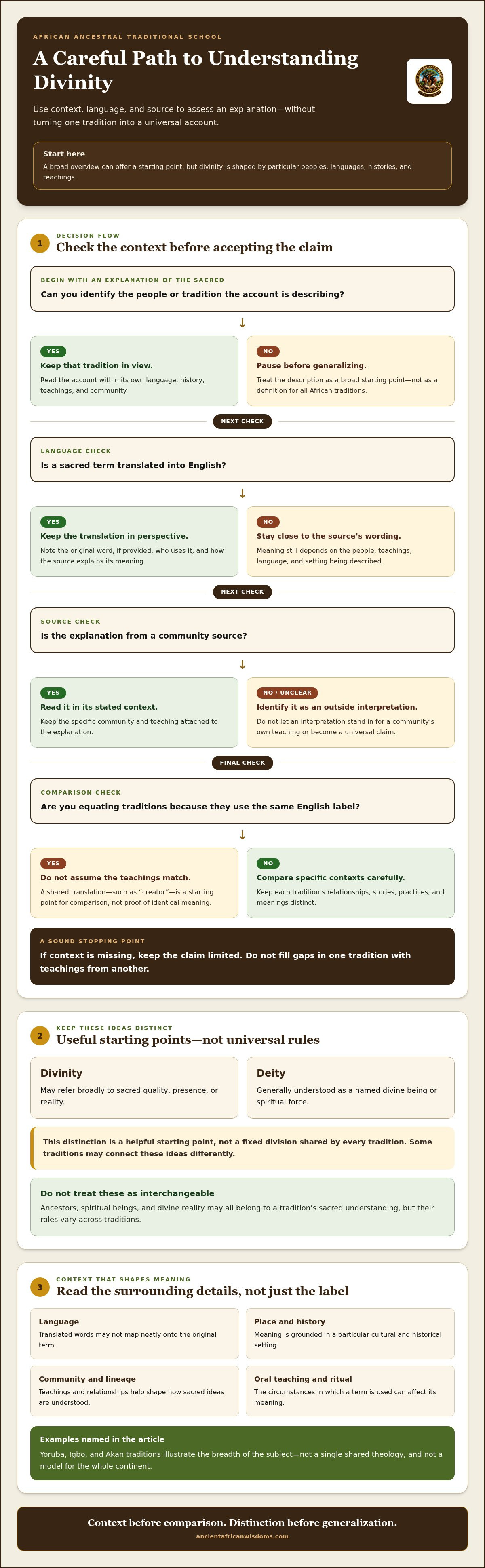
When you encounter a description of the divine, pause before applying it to another tradition. Check which people and teachings the account concerns, whether the term is translated, and whether the explanation comes from a community source or an outside interpretation. These questions keep an introduction from becoming a universal claim. They also lead to a more useful comparison: how do specific traditions describe the divine in their own distinct ways?
How African Traditions Describe the Divine in Different Ways
There isn’t one map of the sacred that fits every African people. Yoruba, Igbo, and Akan traditions, for example, have their own languages, histories, teachings, and ways of speaking about spiritual reality. Naming them side by side helps show the breadth of the subject, but it shouldn’t suggest that they share one theology or that any one tradition represents the whole continent.
Some accounts emphasize a supreme being or creator; others also describe divine forces, spiritual beings, or sacred presence in ways shaped by particular communities. Even when English translations use the same word, such as “creator,” that shared label doesn’t establish that the underlying teachings are identical. The concept may sit within different relationships, stories, and practices, so comparison calls for care rather than a quick equation.
No single model describes every African tradition, because each community’s account of divine reality is shaped by its own language, history, teachings, and relationships with the sacred.
Supreme Beings and Divine Order Across Traditions
In a specific tradition, a term translated as “supreme being” or “creator” belongs to a particular linguistic and cultural setting. Its meaning may connect to accounts of creation, the ordering of life, or relations among spiritual powers, but those connections should be learned from sources rooted in that tradition. Similar English descriptions are a starting point for comparison, not proof that beliefs match.
For readers, this means resisting the urge to build a single hierarchy from terms gathered across different communities. A description of one tradition’s divine order shouldn’t be used to fill gaps in another’s teachings. Those distinctions matter. Harvard’s discussion of African spirituality offers broader context for considering how spiritual beliefs can connect with daily life, while leaving room for distinct traditions and interpretations.
Divinity Within a Wider African Worldview
Spiritual reality may be understood in relation to human life, community, the natural world, and the cosmos. The emphasis and meaning of these relationships vary, so there isn’t one formula to apply everywhere. In some accounts, sacred life may be encountered not only through abstract teachings but also through relationships and communal practices. Treat this as a way to ask better questions, not as a universal description.
As you learn, keep the tradition in view: whose teaching is being described, in what language, and within which community? Exploring African worldview and ancestral wisdom can help place spiritual ideas within broader cultural context. For a gradual study of African spirituality and tradition, structured African ancestral learning offers a way to continue your exploration.
Divinity, Ancestors, and Spiritual Forces: What Is the Difference?
Ancestors, spiritual beings, and divine reality can all belong to a tradition’s sacred understanding, but they aren’t interchangeable labels. Their relationships and roles depend on the particular people and teachings being discussed. The comparison below can help clarify the terms, as long as you treat it as a guide rather than a universal map.
| Concept | General meaning | Important distinction |
|---|---|---|
| Divine reality | A tradition’s understanding of sacred presence, power, or ultimate reality. | Its meaning and relationship to other sacred beings or forces vary by tradition. |
| Ancestors | Deceased members of a lineage or community who remain significant within particular spiritual and cultural teachings. | Honoring ancestors does not automatically mean treating them as a supreme being or as identical to divine reality. |
| Spiritual beings or forces | Beings, powers, or presences understood through a community’s specific teachings. | They don’t belong to one universal category or hierarchy across African traditions. |
How Ancestors Relate to Divinity
In some traditions, relationships with ancestors can express continuity between generations, remembrance, respect, or guidance. The forms and meanings differ, so learn how a particular community describes them rather than assuming one pattern fits all. Ancestors may have a meaningful spiritual role without being another name for the divine.
This distinction also helps avoid a common shortcut: interpreting every act of remembrance or reverence as worship of a supreme being. Words such as “veneration” and “worship” carry their own assumptions and may not capture how practitioners understand a relationship. For focused context on how these practices take shape in diaspora communities, explore ancestral veneration in the African diaspora.
Spiritual Beings, Sacred Forces, and Divine Presence
“Spiritual being,” “sacred force,” and “divine presence” are broad descriptive phrases, not fixed categories that every tradition uses in the same way. A force may be understood through a specific community’s account of the world; a being may have a distinct role in its teachings. Without that context, placing either into a universal ranking can distort its meaning.
The Yoruba concept of àṣẹ is one example of a culturally specific idea often discussed in relation to spiritual power and efficacy. It shouldn’t be used as a generic label for every tradition’s understanding of sacred force. Learn more about Asè and divine life force as a distinct concept, and keep its cultural setting in view.
As you read, notice whether a source identifies the community and teaching behind its terms. Ask what each category means in that context and how it relates to other sacred relationships. Careful attention makes comparison more useful without turning distinct teachings into one simplified system.
How to Explore Ideas of Divinity With Care and Cultural Respect
Respectful study begins with specificity. Before comparing teachings, ask what you mean by the divine: a creator, sacred presence, spiritual power, or something else? Your starting point may come from your own upbringing or reading. Naming it helps you notice when you’re interpreting another tradition through familiar ideas. Let the community’s own language and teachings guide your understanding.
Cultural context strengthens spiritual learning because it helps you understand a teaching on its own terms rather than forcing it into assumptions from elsewhere. Use this approach as you read:
- Identify the tradition. Find out which people, community, or lineage the account describes. Don’t treat one writer’s explanation as a statement about all African traditions.
- Check the source. Notice who is speaking and whether the material draws on community knowledge, scholarship, historical records, or personal experience. Each can offer insight, but they aren’t the same kind of evidence.
- Attend to language. If a sacred term is translated, look for its original form and the meaning given in that specific context. A familiar English word may not carry all the associations of the source language.
- Place the teaching in context. Consider the community’s history and the setting in which the teaching is shared. Keep what the source documents distinct from what you infer or believe personally.
Questions to Ask When Reading About Divinity
Before accepting or sharing an explanation, ask: Which community does it concern? What period and language does it describe? Does the writer separate documented teaching from interpretation or personal belief? These questions help you judge what a source can support and where its limits may be. If accounts disagree, consider whether they describe different communities, contexts, or perspectives before assuming one must be wrong.
Learning Without Flattening Distinct Traditions
Approach each teaching with humility. Avoid combining sacred terms or practices from different communities simply because they seem similar in translation. Introductory learning can build understanding, but it isn’t a substitute for tradition-specific guidance, especially for ritual practice. Keep general reflection separate from instructions about ceremonies or customs, and resist the pressure to find one formula that explains every sacred relationship.
Understanding grows through steady study, careful listening, and a readiness to revise your first impression. The African Ancestral Traditional School’s structured digital courses cover African spirituality, culture, and tradition. Explore African ancestral learning levels to continue building context through progressive study.
Continue Your Study of Divinity Through African Ancestral Education
An overview can offer useful starting points, but it can’t represent every teaching or answer every question. If a particular idea has stayed with you, let it guide what you explore next. Continued study of African spirituality, culture, and tradition can help you build understanding gradually, while keeping each teaching connected to its own context rather than turning it into a universal account.
What Structured Online Study Can Add
Structured learning gives you a path for returning to ideas with greater context. A concept that first seemed unfamiliar may become clearer as you study related cultural and spiritual teachings. The African Ancestral Traditional School organizes digital courses into progressive learning levels, so you can develop your knowledge step by step rather than treating one introduction as the whole journey.
Course themes include African spirituality, culture, tradition, and spiritual practices. Ancestral spiritual teachings can also be part of a broader process of learning about heritage and spiritual life. The aim isn’t to suggest that one course represents every community or that study can produce a single answer to questions of divinity. Structured learning can instead help you build context over time and approach further questions with care.
Community access offers a setting to connect with other learners as you continue your studies. Shared learning can bring different questions and reflections into view, while each person remains responsible for listening carefully and distinguishing personal interpretation from a tradition’s teachings. Community is a companion to learning, not a replacement for cultural context or the specific knowledge a teaching requires.
Choosing a Thoughtful Next Step
Begin with the question that feels most meaningful to you. Perhaps you want to understand how ancestral teachings relate to spiritual life, or you’d like a stronger foundation in African culture and tradition. Naming that interest can make a broad subject more approachable and help you choose a direction for continued learning.
Keep expectations grounded. Digital courses offer educational study organized through learning levels, rather than a universal account of African traditions. Return to ideas as your knowledge develops and let new context refine what you first understood. There’s no need to rush toward certainty. Patient learning makes room for complexity, reflection, and respect for the communities whose teachings you’re exploring.
If you’re ready to take a next step, explore the African Ancestral Traditional School and its learning levels. Let your questions lead as you continue studying African spirituality, culture, and tradition.
Let Your Learning Continue With Care
Let curiosity become a steady practice. As you keep exploring divinity, allow questions to lead you toward deeper understanding rather than a single answer that claims to speak for every people or tradition. Return to what you learn, notice how your perspective develops, and make space for the histories and voices that give each teaching its meaning.
Structured study can help you build knowledge gradually. The African Ancestral Traditional School offers digital courses across learning levels, focused on African spirituality, culture, and tradition, with community access for learners. This provides a way to learn alongside others while continuing to consider each teaching in context.
Choose the subject that speaks most clearly to your questions, and take your time with it. Learning rooted in respect doesn’t need to be rushed. Explore the African Ancestral Traditional School to continue your learning journey. May each step bring you closer to understanding, connection, and a deeper appreciation of ancestral wisdom.
Frequently Asked Questions
Is divinity the same as God?
Not always. “God” is one English word people may use to translate ideas of the sacred, but it can carry assumptions from particular religious traditions. In another cultural or linguistic setting, the original concept may not match those assumptions exactly. When you encounter a translation, look for how the source explains the term and whether it names a being, describes sacred power, or refers to a broader spiritual reality.
Do all African spiritual traditions believe in one supreme being?
No single answer describes every tradition. Some teachings include a supreme creator, while other accounts frame sacred reality through different relationships, beings, or forces. Even where sources use similar words, their meanings may differ. Two traditions may both be summarized in English as recognizing a creator, yet tell distinct stories about that creator’s role. Check which people and teachings a particular account represents.
Are ancestors considered divine in African traditions?
Not automatically. A tradition may honor ancestors as part of ongoing relationships between the living and those who came before, without identifying them as divine or as a supreme being. The meaning of remembrance, respect, or spiritual connection depends on the community and its teachings. If a source describes ancestors as divine, look for its specific explanation rather than applying that label to ancestral practices generally.
What does divine essence mean in African spirituality?
“Divine essence” is a broad phrase, not a single established definition shared across African spiritual traditions. A writer might use it to describe sacred presence, power, or a quality associated with spiritual life, but the intended meaning depends on the source. To understand a particular use, check whether the phrase comes from a community’s own teaching, a translation, or an author’s interpretation, and read how it’s explained.
Is African spirituality one religion?
No. “African spirituality” is a broad umbrella phrase used to discuss diverse traditions, communities, and practices, not the name of one religion with a single doctrine. Teachings can differ by people, place, language, and history. When reading or speaking about a specific belief, use the tradition’s name when known. That helps you avoid treating a broad regional term as if it described one uniform faith.
Can someone learn about African ideas of divinity online?
Yes. Online learning can provide an accessible starting point for studying African spirituality, culture, and tradition. The African Ancestral Traditional School offers digital courses organized across learning levels, with community access for learners. As you study, keep notes on which tradition a lesson addresses and which questions remain open. Use online education to build knowledge progressively, while keeping each teaching connected to its cultural context.


