
What if the most powerful gift you could give your ancestors isn't something you can buy at a market? Many seekers feel a deep, quiet pull to honor those who came before them, yet they're often held back by the fear of making a mistake or offending the spirits. You might find yourself wondering exactly what offerings do ancestors prefer and whether your simple gestures are enough to bridge the gap of generations. It's natural to feel a bit lost when history has severed the specific threads of your family's traditions, but your intention acts as a sacred compass.
In this guide, you'll discover the sacred elements, symbolic foods, and non-material offerings that resonate most deeply with your lineage in African ancestral practice. We'll explore the profound "why" behind these rituals, helping you move past the confusion between ancestor veneration and religious worship. You'll gain a clear understanding of how to build a consistent practice that feels both authentic and respectful. By the end of our journey, you'll have a clear list of appropriate offerings and a renewed sense of peace as you reclaim your place within your family's eternal story.
Key Takeaways
- Understand that offerings serve as a vital vehicle for Asè, the divine life force that fuels a healthy cycle of reciprocity between you and your lineage.
- Learn why cool water and light act as the most essential, universal tools to calm the spirit and provide a clear beacon for your ancestors to find your physical space.
- Discover exactly what offerings do ancestors prefer by exploring traditional staples like grains, seeds, and the intentional sharing of unsalted meals.
- Recognize that your personal character and the act of researching your family history are among the most profound non-material gifts you can provide to those who came before.
- Realize that while physical gifts are a beautiful starting point, pursuing structured ancestral spiritual teachings provides the necessary foundation for a safe and deep connection.
Understanding the Spiritual Currency of Offerings: Why We Give
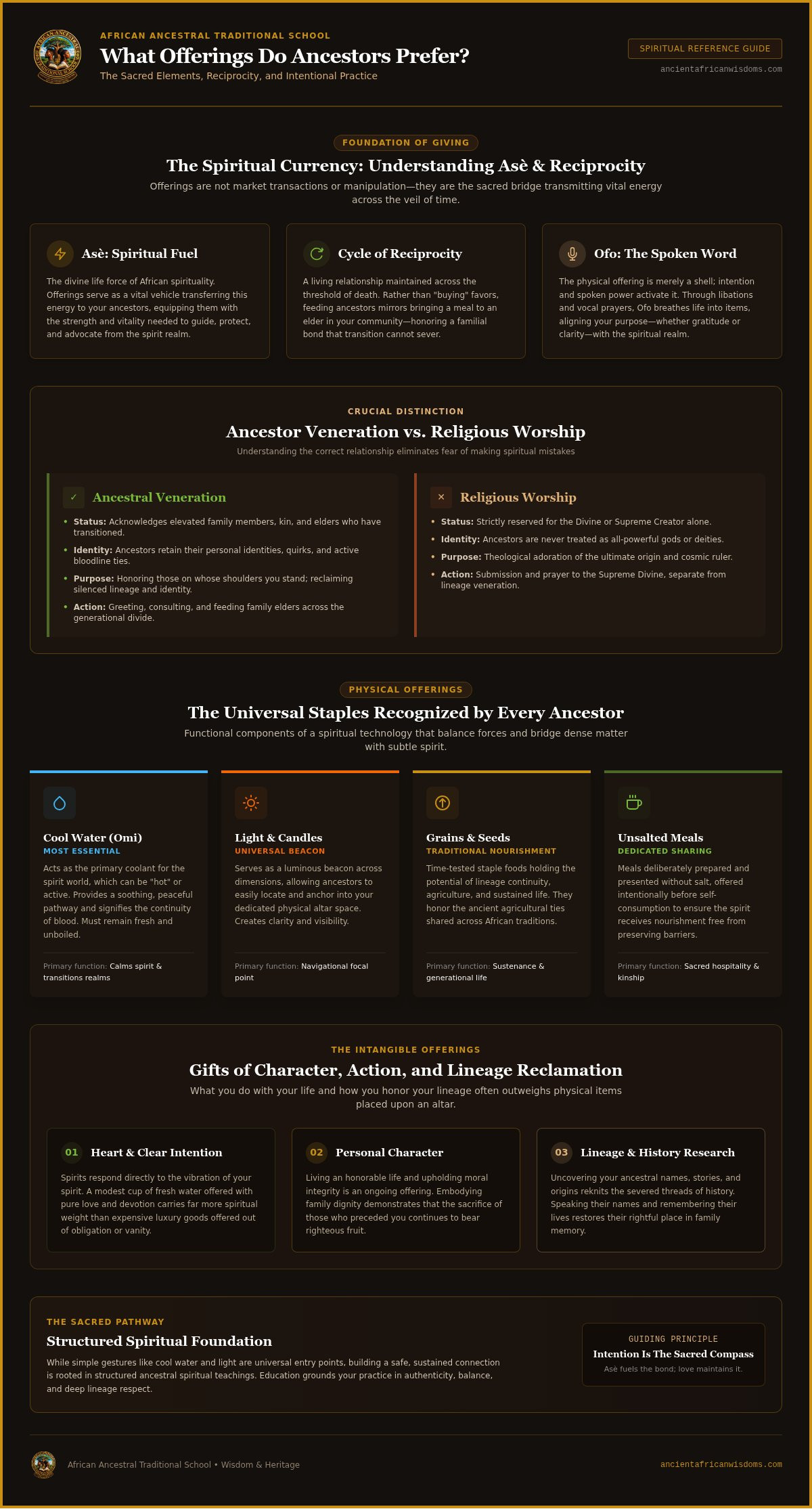
In African spiritual practice, an offering is much more than a physical object placed on a table. An offering acts as a sacred bridge between the visible and invisible worlds, allowing us to communicate across the veil of time. When you ask yourself what offerings do ancestors prefer, you're really asking how to effectively transfer energy to your lineage. This energy is known as Asè. By understanding the asè meaning, you realize that your gifts provide the spiritual fuel necessary for your ancestors to intervene in your life.
This process creates a beautiful cycle of reciprocity. We feed the ancestors to give them the strength and vitality they need to guide, protect, and advocate for us from the spirit realm. Recognize that we aren't "buying" favors or trying to manipulate the spirits. Instead, we're tending to a living relationship, much like you would bring a meal to an elder in your physical community. It's about maintaining a bond that death cannot sever.
The Difference Between Veneration and Worship
One of the most common points of confusion for those starting this journey is the distinction between honoring family and religious devotion. Ancestors are elevated family members, not deities. They're our kin who have transitioned, and they retain their personalities and ties to our bloodline. Veneration is the act of acknowledging this lineage and showing respect to those whose shoulders we stand upon. You're greeting your elders, not praying to a god.
In contrast, worship is traditionally reserved for the Divine or the Supreme Creator. For many people, ancestral veneration for the African diaspora serves as a powerful tool for reclaiming identity and healing historical wounds. It allows you to reconnect with a heritage that was once silenced, turning a simple ritual into a profound act of self-discovery and spiritual restoration.
How Intentions Transform Physical Objects
The physical material of an offering is merely a shell; your intention is what gives it life. A simple glass of cool water offered with genuine love and a clear heart carries more weight than the most expensive luxury item given in haste or out of obligation. The spirits respond to the vibration of your spirit. If your heart isn't in the gesture, the offering remains just an object.
You activate these gifts through Ofo, or the power of the spoken word. When you perform traditional African libations, your prayers and declarations breathe life into the liquid. Before you place anything on your altar, take a moment to breathe and set a clear "why" for your action. Are you seeking clarity? Are you simply saying thank you? This clarity of purpose ensures your ancestors recognize the gift for exactly what it's intended to be, strengthening the connection between your world and theirs.
The Universal Staples: What Every Ancestor Recognizes
While your intention is the soul of your ritual, the physical world provides the tools to anchor that energy. When considering what offerings do ancestors prefer, think of the elements that bridge the gap between our dense physical reality and their subtle spiritual presence. These physical staples act as a universal language. They're recognized across various lineages because they correspond to the fundamental forces of nature that govern both our world and the spirit realm.
The practice of ancestor veneration in African religions often relies on specific physical components that carry deep symbolic weight. These aren't just decorations; they're functional parts of a spiritual technology designed to facilitate communication and maintain balance. By providing these basics, you create a hospitable environment that invites your lineage to draw closer.
The Sacred Role of Water (Omi)
Water, often referred to as Omi, is the most essential offering you can provide. It serves as the primary coolant for the spirit world. In many African traditions, the realm of the spirits can be "hot" or highly active; cool water provides a soothing, peaceful environment for them to approach. It's the medium of transition between worlds, representing the fluid nature of life and the continuity of the bloodline.
Always ensure the water you offer is fresh and "cool," meaning it hasn't been heated or boiled. This coolness symbolizes the calm state of mind and the "cool" character we strive to maintain in their presence. Make it a point of discipline to change the water daily. This simple, consistent act shows your ancestors that you're attentive and dedicated to the relationship. It's a small gesture that builds immense spiritual trust over time.
Using Light and Scents to Create Sacred Space
Light acts as a beacon for the spirit. Imagine a candle as a lighthouse guiding a ship home; it helps ancestral memory focus on your specific physical space. A single flame can pierce the darkness of forgetfulness and signal that you're ready to engage. While white candles are a standard choice, the most important factor is the clarity of the flame itself. It represents the spark of life that continues even after the body has returned to the earth.
Scents and smoke help clear the air of "spiritual noise" and carry your prayers upward. Traditional African scents, such as frankincense, myrrh, or specific local resins, are preferred over synthetic, store-bought incense. Natural smoke has a weight and a purity that resonates with the ancient senses of those who came before. If you're unsure how to arrange these elements, consult our African ancestral rituals online guide for specific steps on setting up your first altar.
Don't overlook the power of the earth itself. Placing stones from a family home or a healthy potted plant on your altar provides a physical ground for the connection. These elements remind us that our lineage is rooted in the soil of our history. Building this foundation is the first step toward a deeper path. If you feel called to move beyond simple gestures, exploring ancestral spiritual teachings can provide the structured guidance you need to grow.
Cultural Resonances: Food and Drink in African Tradition
While water is the cooling foundation, food and drink represent the substance of our communal bond. When exploring what offerings do ancestors prefer, it's helpful to look at items that symbolize growth and the rewards of a life well-lived. Dry offerings like grains, nuts, and seeds are timeless staples; they represent longevity and the potential for future harvest. Sharing a portion of your own cooked meal is another powerful gesture, though many traditions suggest omitting salt to maintain the spiritual purity of the gift.
Sweets and fresh fruits are often used to invite the "sweetness" of life into your own reality. These items acknowledge the hard work our predecessors endured and offer them a taste of the joy they helped create. In the academic study of African indigenous religions, we see how these physical gifts are deeply tied to a moral order where the living and the dead remain in constant conversation through shared resources.
Identifying Your Lineage's Specific Tastes
Generic lists provide a starting point, but the most potent connection comes from honoring your specific family history. Did your grandmother love a particular type of coffee? Did your grandfather always have a bowl of specific fruit on his table? These personal preferences are often the key to understanding what offerings do ancestors prefer within your unique bloodline. Pay close attention to your dreams or sudden intuitive nudges, as these are frequently the ways spirits request specific items.
Equally important is the concept of taboos. Some lineages strictly avoid certain foods or drinks due to historical events or spiritual contracts. Respecting these boundaries is a form of deep listening. It shows that you aren't just performing a generic ritual, but are truly present for the individuals who make up your history. This level of specificity transforms a routine act into a sacred dialogue.
The Ritual of Libation
Libation is the prayerful act of pouring liquid onto the earth or into a dedicated vessel. This ritual serves as a formal invitation for the ancestors to join the community. Traditionally, the sequence of pouring begins by honoring the Earth, then moving to the Unknown ancestors, and finally the Known ancestors. This order ensures that the entire spiritual ecosystem is respected before you bring your specific needs to the table.
While water is the standard, many practitioners use gin or schnapps as a catalyst. The high energy of alcohol is thought to "wake up" the space and sharpen the communication. It acts as a spiritual spark, ensuring your prayers are heard clearly. By combining these physical elements with a focused mind, you transform a simple act of pouring into a profound moment of ancestral alignment.
Beyond the Physical: Offerings of Character and Action
While physical gifts are essential for building a bridge, your life itself is the most significant offering you can make. When we ask what offerings do ancestors prefer, we must look at the quality of our actions and the legacy we're building. In many African traditions, your character acts as the ultimate sacrifice. Your growth, your healing, and your integrity nourish your lineage in ways that water and grain cannot. By evolving into a better version of yourself, you're literally elevating the status and energy of your predecessors.
Community service and deeds done in your family's name also carry immense weight. When you help others or contribute to the well-being of your community, you're polishing the reputation of your bloodline. This outward action signals to the spirit world that the seeds your ancestors planted are bearing righteous fruit. It's a form of living prayer that validates their existence and justifies their continued support of your path.
Character (Iwa) as a Sacred Sacrifice
African belief systems often emphasize that our ancestors' names are carried forward through our daily conduct. Every choice you make reflects back on those who came before you. Resolving long-standing family traumas or breaking negative cycles acts as a powerful spiritual offering that heals the lineage in both directions. Iwa-pele is the balanced character that pleases the elders. By cultivating this inner peace and ethical strength, you provide your ancestors with the highest form of respect and satisfaction.
The Power of Spoken Names
The concept of the "Living-Dead" teaches us that ancestors remain active in our reality as long as they're remembered and spoken of. Researching your genealogy is a profound gift of time and effort. As a practical exercise, try creating a formal lineage list to recite during your rituals. Speaking their names aloud vibrates through the veil, ensuring they're not forgotten. If you're looking for support in these practices, consider exploring African spiritual community membership to connect with others on the same journey.
Your journey doesn't have to be a solitary one. If you're ready to deepen your commitment to this path, joining our Ancestral Spiritual Teachings can provide the structure you need to truly thrive.
Deepening Your Practice Through Ancestral Education
Placing a glass of water or lighting a candle is a profound start, but these gestures are ultimately the entrance to a much larger path. True spiritual connection requires a deeper understanding of the mechanics behind the ritual. While you now have a better idea of what offerings do ancestors prefer, moving from the "what" to the "how" is where your practice truly begins to breathe. Without a structured foundation, it's easy to get lost in spiritual noise or feel overwhelmed by the vastness of African tradition. The African Ancestral Traditional School exists to help you navigate this complexity with a steady, guided hand.
Digital learning has transformed how the diaspora reclaims its heritage. You no longer face geographical barriers or the need for physical travel to access these ancient truths. Instead, you can study the practical, modern application of ancient wisdom from the comfort of your own home. This accessibility ensures that the restoration of your identity is a process that fits into your current reality while remaining deeply rooted in the sacred ways of our predecessors.
Why Structure Matters in Spiritual Growth
Spiritual growth is most effective when it follows a methodical and rhythmic pace. There's a certain danger in "cherry-picking" rituals from various sources without understanding the underlying philosophy that binds them together. This fragmented approach often leads to confusion or a sense of disconnection. By following a level-based curriculum, you ensure that every step you take is built on the success of the one before it. This structured environment provides several key benefits:
- A clear progression from foundational concepts to advanced ritual mechanics.
- A safe space to ask questions and receive guidance from experienced mentors.
- Access to a global community of diaspora practitioners who share your journey.
- Protection from common pitfalls and the "spiritual noise" that can distract a seeker.
Reclaiming Your Heritage with Ancient African Wisdoms
Your journey toward self-discovery is a long-term process that deserves your full presence and dedication. Engaging with African ancestral spirituality courses allows you to bridge the gap between historical roots and your modern life. Our curriculum is designed to help you understand the deeper spiritual currency of your actions, ensuring that you know exactly what offerings do ancestors prefer and how to present them with the correct alignment of Asè.
You have the power to restore the lost knowledge of your lineage. By choosing a path of structured learning, you move beyond simple curiosity into a life of profound purpose and connection. We invite you to begin your journey today by exploring our foundational levels. Your ancestors are waiting for you to take this next step, and we're here to offer the structured environment you need to flourish.
Reclaiming Your Place in the Ancestral Story
Honoring your lineage is a sacred journey of returning home to yourself. You've discovered that while cool water and traditional foods provide the physical foundation, your character and the act of remembering their names are what truly nourish the connection. Understanding exactly what offerings do ancestors prefer is simply the first step toward building a relationship based on reciprocity and respect. These simple gestures open a door that has been waiting for you to walk through for generations.
Physical rituals are the entrance, but a deep, lasting connection flourishes through discipline and guidance. Our school offers authentic teachings grounded in African tradition to help you navigate this path safely. You can join a supportive online diaspora community and follow a structured, level-based curriculum designed to bridge the gap between ancient insights and modern life. This environment provides the protection and knowledge you need to grow without feeling overwhelmed or lost.
Begin your journey of reclamation at the African Ancestral Traditional School and step into the fullness of your heritage today. Your ancestors have been calling; it's time to answer with confidence and clarity.
Frequently Asked Questions
Can I use salt in the food I offer to my ancestors?
It's best to avoid using salt in cooked meals for your ancestors. In many African traditions, salt is seen as a "harsh" substance that can disrupt the peaceful, cool energy required for clear spiritual communication. Some lineages believe salt can fix a spirit in place or act as a deterrent. By keeping your offerings unsalted, you ensure the energy of your altar remains welcoming and aligned with the delicate nature of the spirit world.
What should I do with the food offerings after they've sat on the altar?
You should dispose of food offerings respectfully once they've served their purpose, typically after 24 hours. Since your ancestors have already consumed the spiritual essence, or Asè, of the meal, the physical remains are no longer sacred. You can place them outside under a tree, return them to the earth, or dispose of them in a clean manner. It's important that you don't eat the food yourself, as it now belongs to the spirits.
Is it okay to offer things my ancestors didn't like when they were alive?
It's generally better to avoid items your ancestors explicitly disliked during their lifetime. Ancestor veneration is a continuation of your living relationship, so honoring their personal preferences shows deep respect and active listening. If a family member had a strong aversion to alcohol or a specific fruit, offering it now could feel insensitive. Instead, focus on items they enjoyed or universal staples like cool water to build a harmonious and loving connection.
How often should I change the water and other offerings?
You should change the water daily to maintain a fresh and "cool" environment on your altar. Freshness is a sign of discipline and active devotion. For dry offerings like grains or seeds, you can leave them for a week or until they look dusty. Cooked food should be removed within 24 hours to prevent spoilage. Consistency in these small acts helps you understand what offerings do ancestors prefer by building a steady, reliable rhythm.
Do I need a formal altar to start giving offerings?
You don't need an elaborate setup to begin your practice. A simple, clean surface or a dedicated corner of a room can serve as a sacred space. The most important elements are a glass of fresh water and your sincere intention. As you progress through structured ancestral spiritual teachings, you'll learn how to refine your space over time. Starting small allows you to focus on the heart of the connection rather than the physical complexity.
Can I offer things to ancestors I never met or don't know the names of?
Yes, you can and should honor the unknown members of your lineage. You can address them collectively as "the forgotten ones" or "those whose names I don't yet know." They still carry the same blood and life force that flows through you. When wondering what offerings do ancestors prefer in these cases, stick to universal staples like cool water and light. These elements are recognized by every spirit, regardless of their place in your history.
What happens if I forget to give an offering or make a mistake?
Your ancestors understand that you're learning and won't be easily offended by honest mistakes. If you forget a day or trip over your prayers, simply acknowledge the error and continue with a sincere heart. They're your family, not distant judges. The key is to return to the practice as soon as you can. Consistent effort matters much more than perfect execution, especially when you're just beginning to reclaim the traditions of your heritage.
Are there specific times of day that are better for making offerings?
Early morning is often considered the most potent time for making offerings. This is when the world is quiet and your own mind is most clear before the day's distractions begin. Performing your rituals at dawn aligns your energy with the rising sun and the start of a new cycle. However, the most important factor is your ability to be consistent. If evening works better for your personal schedule, the ancestors will appreciate the dedicated time.


