
What if the quiet frustration you feel at your altar isn't a sign of failure, but a call for deeper alignment? Many seekers begin their journey into heritage with a sincere heart, only to find themselves stalled by a transactional mindset or a lingering fear of making a wrong move. It's common to feel a sense of spiritual burnout when you treat your lineage like a vending machine rather than a living, breathing relationship. Understanding the common mistakes in ancestor veneration is the first step toward reclaiming a practice that feels grounded and authentic. You deserve to feel a sense of belonging and safety as you bridge the gap between your modern life and your ancient roots.
In this guide, you'll discover how to avoid the most frequent pitfalls that hinder ancestral connection and learn to build a respectful, powerful relationship with those who came before you. We'll look at why confusing African traditions with Western occultism creates friction and how to navigate the pain of missing family details. By shifting your focus from mechanical ritual to character-driven devotion, you'll find the confidence to maintain your daily practices with ease. Let's explore how to transform your spiritual path into a clear, structured journey of reclamation and growth.
Key Takeaways
- Learn to distinguish between honoring your lineage and religious worship to ensure your practice remains grounded in authentic tradition.
- Identify common mistakes in ancestor veneration such as neglecting spiritual cleanliness or using offerings that lack alignment with your heritage.
- Shift from a transactional mindset to a relationship-based approach to avoid the spiritual burnout caused by treating your lineage as a cosmic vending machine.
- Discover practical steps to simplify and cleanse your ritual space, returning to the essential, powerful elements of water, light, and prayer.
- Understand how structured, tiered learning provides the guidance needed to navigate your spiritual journey without feeling overwhelmed or lost.
The Foundation of Connection: Why We Stumble in Ancestor Veneration
Ancestor veneration is a sacred process of honoring your lineage and maintaining the continuity of life. It’s a rhythmic bridge between the past and the present, ensuring that the wisdom of those who came before you remains active in your daily reality. Many seekers stumble because they lack a clear roadmap. One of the most common mistakes in ancestor veneration is approaching the practice without a foundational understanding of what it actually is. For many, this journey is an act of ancestral veneration for the African diaspora that serves to reclaim a stolen identity. The heavy impact of cultural erasure means we often have to unlearn external influences before we can truly hear our own bloodline. When you recognize that your practice is about restoration rather than just performance, the path becomes much clearer.
The Critical Difference Between Veneration and Worship
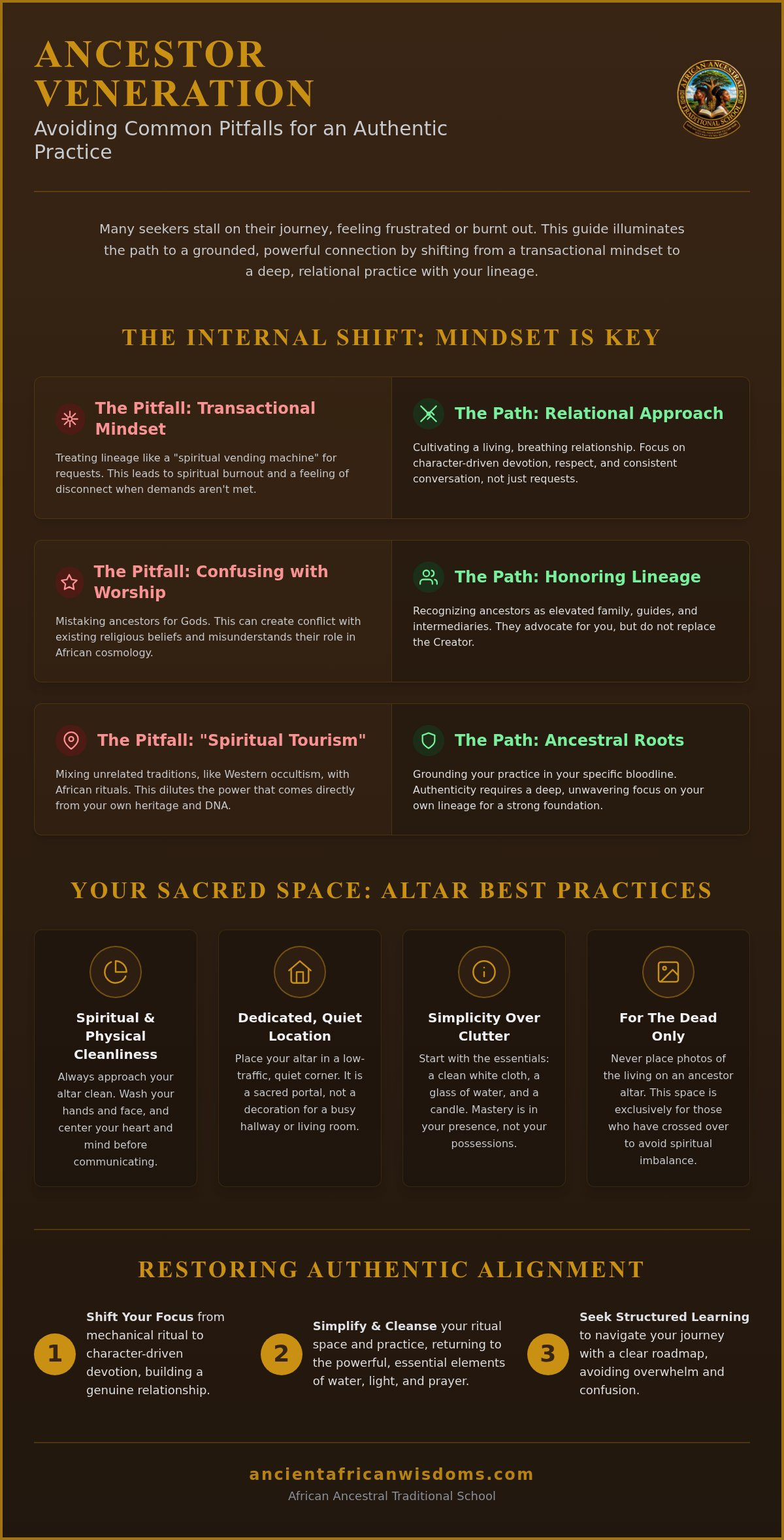
Ancestors are not Gods. They are your elevated family members and guides. Think of them as wise elders who have crossed the threshold but remain deeply invested in your success and well-being. In African cosmology, they serve as vital intermediaries. They guide us, protect us, and advocate for us, yet they do not replace the Creator. Many people hesitate to start their practice because they fear it contradicts their existing religious beliefs. Once you understand that you're simply continuing a family conversation, that fear usually dissolves. You aren't bowing to an idol; you're pulling up a chair for a grandmother who still has much to teach you. This distinction is vital for maintaining a healthy, balanced spiritual life.
The Trap of "Spiritual Tourism" vs. Ancestral Roots
Authenticity requires a deep, unwavering focus on your specific bloodline and heritage. A frequent error is "spiritual tourism," where seekers mix unrelated traditions, such as Western occultism, with African ritual. While these systems might look similar on the surface, they carry entirely different weights and intentions. Your power lies in your own DNA, not in borrowed aesthetics. To avoid common mistakes in ancestor veneration, you must stay rooted in your own heritage. Grounding your practice in an African traditional wisdom curriculum helps you move past the "pick and mix" approach. This structure ensures you're building a foundation that can actually support the weight of your history and the strength of your future.
Practical Pitfalls: Common Mistakes in Altar and Ritual Setup
Creating a physical space for your ancestors is a profound act of devotion, yet the technical details often trip up well-meaning practitioners. One of the most common mistakes in ancestor veneration involves neglecting the state of yourself and the environment. You wouldn't invite a respected elder into a cluttered, dusty home; similarly, approaching your altar without physical and spiritual cleanliness creates a barrier to clear communication. Always wash your hands and face, and ensure your heart is settled before you speak. If you feel chaotic or heavy, take a moment to breathe and center yourself first.
Location is just as vital as the items you place upon the surface. Setting up an altar in a high-traffic area, like a hallway or near a television, treats the space as a mere decoration. Your ancestors deserve a quiet corner where their presence is honored and protected from the mundane distractions of daily life. Additionally, beginners often fall into the trap of over-complicating their setup. You don't need elaborate tools or expensive artifacts to begin. Start with the basics: a clean white cloth, a glass of cool water, and a single candle. Mastery comes through the quality of your presence, not the quantity of your items.
Misunderstanding the Altar as a Sacred Portal
An altar isn't a memorial or a decorative shelf. It's a dedicated portal for two-way communication between the physical and spiritual realms. A frequent error is including photos of the living on an ancestor altar. This space is reserved for those who have crossed over; mixing the energies of the living and the dead can cause confusion and spiritual imbalance. If you're practicing at home, following a structured guide on online African ancestral rituals can help you establish these boundaries correctly from the start.
The Error of Inconsistent Libations and Offerings
Libation is the primary act of cooling the earth and opening the way for spiritual dialogue. Many people make the mistake of performing one large, elaborate ritual and then ignoring their altar for weeks. Consistency is far more powerful than intensity. A small, daily offering of fresh water is more effective than a massive feast offered once a year. Be mindful of the items you choose. Offering something an ancestor specifically disliked in life, such as alcohol to someone who struggled with it, shows a lack of research and respect. Building this relationship takes time, and engaging with ancestral spiritual teachings can provide the cultural context needed to avoid these subtle errors.
The Internal Shift: Avoiding Ego-Driven or Transactional Practices
The heart of your practice isn't found in the items on your altar, but in the spirit you bring to it. One of the most common mistakes in ancestor veneration is treating your lineage like a "cosmic vending machine." This transactional approach suggests that if you provide a specific offering, you're entitled to a specific material result. Real connection is a relationship of mutual respect and love, not a business deal. When you approach with an entitled or demanding spirit, you close the very doors you're trying to open. Your ancestors aren't there to serve your ego; they're there to guide your soul toward its highest potential.
Another frequent oversight is neglecting your living elders while claiming to honor the dead. If you're disrespectful to the parents or grandparents still walking this earth, your rituals for the deceased will lack weight. Authentic alignment requires a holistic view of family that spans both sides of the veil. By understanding the asè meaning, or the divine life force that flows through all things, you can better align your intent. Asè is fueled by truth and character, not just by the words you speak at a candle. It's the power to make things happen, and it requires a clean heart to flow effectively.
The Concept of Iwa (Character) in Ancestral Connection
In many African traditions, your Iwa, or character, is your most valuable spiritual asset. Your daily behavior directly affects your standing with your ancestors. If you seek spiritual power but refuse to undergo personal transformation, you're building on sand. You can't separate your ritual life from how you treat your neighbors or manage your integrity. To truly connect, you must align your character with the values of your honorable ancestors. They want to see you reflect the best of the lineage, carrying forward the strength and wisdom they worked so hard to preserve. Transformation is the ultimate offering.
Overlooking the "Elevated" Ancestors vs. Troubled Spirits
Discernment is a vital tool for any practitioner. A dangerous mistake is calling on "all" ancestors without distinction. Not everyone who has passed away is in a position to guide you. Some may have left this world with heavy burdens or unresolved trauma. You should specifically invite the "well-and-bright" or elevated ancestors. These are the ones who have completed their transition and hold the wisdom you need. This is why genealogy is more than a hobby; it's a spiritual act of identification. Researching your roots helps you know exactly who you're speaking to, ensuring your calls reach those who can truly help you grow. Knowing your history is your protection.
Correcting the Path: How to Restore Authentic Ancestral Alignment
If you've realized your practice has drifted, don't feel discouraged. Realizing you've made common mistakes in ancestor veneration is actually a sign of spiritual maturity. It shows your spirit is sensitive to the alignment your lineage requires. To fix the path, start by stripping everything back to the essentials. Remove the complicated rituals and focus on the three pillars: fresh water, a clean light, and a sincere prayer. This simplicity clears the "noise" and allows the connection to reset without the weight of past errors.
Next, perform a thorough spiritual cleansing of your space and your own body. Use salt water or traditional herbs to wash away the stagnant energy of previous confusion. Once the space is clear, commit to a 21-day cycle. During these three weeks, perform a small act of veneration at the same time every day. This creates a rhythmic pulse that the ancestors can recognize. Keep a journal nearby to document your experiences. Note the dreams, sudden insights, or unusual coincidences that occur. Tracking these moments helps you see the asè moving through your life and confirms you're back on the right track.
Developing Consistency Over Intensity
Devotion isn't a sprint; it's a steady walk. A common error is performing a three-hour ritual once a month and then staying silent the rest of the time. Five minutes of daily prayer is far more potent because it builds a living, breathing relationship. It's also vital that you don't stop your practice once life starts to feel "good" again. Consistency during the peaceful seasons ensures you have a strong foundation when challenges eventually arise. A sustainable rhythm fits into your modern schedule and prevents the spiritual burnout that comes from high-pressure, infrequent rituals.
The Role of Community and Mentorship
Searching for answers on social media often leads to deeper confusion and frustration. You'll find conflicting advice that lacks the weight of authentic tradition. Healthy guidance should feel protective and nurturing, helping you navigate your path without fear. True mentorship helps you troubleshoot your specific lineage needs and distinguishes between helpful advice and predatory demands. Joining an African spiritual community membership provides the structured environment needed for this growth. If you're ready to move beyond self-taught experiments and find a steady hand to guide you, explore our Ancestral Spiritual Teachings to begin your structured journey.
Deepening Your Journey Through Structured African Ancestral Education
Recognizing the path is the first step, but walking it safely requires a steady hand and a clear map. Many seekers hit a wall when they try to piece together their practice from scattered, unverified sources. This fragmented approach is often where common mistakes in ancestor veneration take root, as it lacks the cohesive cultural logic that gives rituals their power. The African Ancestral Traditional School provides a structured environment for those ready to move beyond guesswork and self-taught experiments. By offering an online educational journey, we respect traditional boundaries while making ancient wisdom accessible to the global diaspora. You don't have to navigate this reclamation of identity in isolation.
Our curriculum is built on the belief that authentic rituals and cultural preservation are the keys to a healthy spiritual life. We focus on grounding you in the actual traditions of your ancestors, moving away from the "pick and mix" style that often leads to spiritual burnout. This isn't just about learning facts; it's about a total internal shift that aligns your daily life with the wisdom of your lineage. Through our Ancestral Spiritual Teachings, you'll find the tools to build a practice that is both ancient and deeply relevant to your modern reality.
The Benefits of Level-Based Spiritual Growth
Spiritual growth is a long-term journey that shouldn't be rushed or forced. Our tiered learning levels are designed to prevent the mental and spiritual "overload" that often leads to errors in judgment. Level 1 focuses on building the essential foundations of character, spiritual hygiene, and basic communication. This ensures you don't carry foundational mistakes into more advanced levels of study. A curriculum that grows with you allows your asè to develop naturally and safely. These digital courses on African culture provide a powerful way to reconnect with your heritage from wherever you are in the world. This structure offers a sense of safety and progression, mirroring the way tradition was historically passed down through the generations.
Your Invitation to Ancestral Mastery
It's time to move from a place of confusion to a state of calm clarity. When you join our school, you gain access to more than just information; you find a protective space for shared exploration and growth. This community acts as a vital safeguard against the doubt that can stall your progress. You'll learn to distinguish between authentic rituals and the predatory practices that often target new seekers. Mastery isn't about knowing everything at once, but about being a humble and disciplined student of your own history. Your lineage is waiting for you to take this intentional step forward. Explore the African Ancestral Traditional School Levels today and begin your transformation with quiet confidence.
Reclaiming Your Ancestral Heritage with Confidence
Reconnecting with your lineage is a soul-deep journey that requires both patience and precision. By identifying the common mistakes in ancestor veneration, you've already shifted your path from confusion toward authentic alignment. Remember that your ancestors seek a relationship rooted in character and consistency rather than elaborate, one-off rituals. When you approach your altar with a clean heart and a steady rhythm, you create a sacred space where true transformation can occur.
You don't have to navigate this reclamation alone or fear the pitfalls of self-taught practice. Our tiered curriculum is designed by traditional experts to provide you with authentic, practical rituals that fit your modern life. You'll join a supportive global community of diaspora seekers dedicated to preserving our cultural truths. Begin your structured journey at the African Ancestral Traditional School and find the steady hand you need to guide your growth. Your ancestors are ready to meet you; it's time to step forward into the light of your own history with peace and purpose.
Frequently Asked Questions
Is it dangerous to make a mistake during ancestor veneration?
No, it isn't dangerous because your ancestors are your family and they want you to succeed. While some common mistakes in ancestor veneration can lead to spiritual stagnation or a lack of clarity, they aren't meant to result in punishment. Approaching your practice with a sincere heart and a desire to learn creates a natural layer of protection. If you feel uneasy, simply reset your space and start again with the basics.
What should I do if I do not know my ancestors names?
You can still honor your lineage even if names have been lost to time or historical erasure. Address them collectively as the "honorable ancestors of my bloodline" or "the well-and-bright ones whose names I do not yet know." Your intention and DNA serve as the primary link between you and your roots. Over time, as you maintain your practice, you may find that names or specific details begin to reveal themselves through dreams.
Can I practice ancestor veneration if I am a Christian or Muslim?
Yes, you can maintain your religious faith while honoring your lineage because veneration isn't the same as worship. In African cosmology, ancestors are elevated family members and intermediaries, not deities. Many practitioners find that honoring their roots actually deepens their existing spiritual life. It's about acknowledging the continuity of your family and the wisdom they passed down, which aligns with the universal value of honoring your parents and elders.
What is the most common mistake people make with their ancestral altar?
The most frequent error is including photos or items belonging to living people on the ancestral altar. This space should be reserved exclusively for those who have crossed the threshold to keep the energies distinct and balanced. Another common mistake in ancestor veneration is treating the altar as a decorative shelf rather than a living portal. Consistency in your offerings, like fresh water, is more important than having an elaborate but neglected setup.
How do I know if my ancestors are actually hearing me?
You'll often notice subtle shifts in your environment or internal state as your connection strengthens. This might manifest as a sudden sense of peace, vivid dreams, or meaningful coincidences in your daily life. Sometimes, the answer is a door opening that was previously closed or a sudden clarity regarding a family problem. Trust your intuition and document these moments in a journal to track the progression of your ancestral relationship over time.
Can I use a digital photo of my ancestors for my altar?
It's always best to have a physical representation, like a printed photograph or a handwritten name on paper, to anchor the energy in your space. While digital photos are useful for research, a dedicated altar works best with tangible items that you can physically interact with during ritual. If you don't have a photo, a simple glass of water and a white candle are more than enough to establish a powerful connection.
What happens if I forget to perform my daily veneration?
Nothing bad will happen if you miss a day, as your ancestors understand the complexities of modern life. Simply resume your practice the next day with sincerity and a brief acknowledgement of your absence. The goal is to build a long-term relationship, not to follow a rigid checklist out of fear. If you find yourself forgetting often, try to link the practice to a daily habit, like making your morning coffee, to help maintain your rhythm.
Why do I feel drained after doing an ancestral ritual?
Feeling drained often suggests that you haven't properly grounded yourself or that you're calling on spirits who aren't yet well-and-bright. It's important to specifically invite only the elevated ancestors who have the capacity to guide you without taking your energy. Ensure you are physically and spiritually clean before starting, and always close your ritual by centering yourself. Structured learning can help you master the techniques needed to keep your energy balanced and vibrant.


