
What if the quiet unease you feel in modern wellness spaces isn't a lack of devotion, but a sign that you're walking a path built on someone else's history? Many seekers today feel like "spiritual tourists," practicing rituals that lack the weight of their own blood and bone. You might carry a heavy sense of guilt from a colonial religious upbringing or feel a deep, aching confusion because your lineage was intentionally disrupted. If you've felt the urge to begin decolonizing my spiritual practice, know that this internal friction is actually a sacred invitation from those who came before you.
You deserve a connection to the divine that feels like coming home rather than an act of performance. This guide offers a steady hand as you identify colonial influences and begin the rhythmic restoration of your ancestral continuity. We'll explore a clear framework for spiritual reclamation, validate your inherent connection to West African traditions, and walk through practical steps for daily ritual. It's time to move beyond the "cosmic supermarket" and return to the grounded, ancient insights that have always belonged to you.
Key Takeaways
- Identify the "colonial fingerprints" hidden in modern spirituality, such as the universalist trap that often erases specific African cultural truths.
- Understand the shift from individual-centered Western paths to a community-rooted framework where divine power flows through your specific lineage.
- Gain a clear five-step framework for decolonizing my spiritual practice, beginning with a deep audit of inherited beliefs and a search for your ancestral roots.
- Explore how the African Ancestral Traditional School Levels offer a structured, digital path to reclaiming authentic rituals and historical identity.
- Transition from being a "spiritual tourist" to an authentic practitioner by grounding your daily rituals in the weight and continuity of your own heritage.
Understanding the Call to Decolonize Your Spiritual Practice
Decolonizing my spiritual practice begins with a simple, profound realization: your connection to the Divine has been filtered through a lens that wasn't made for you. For many in the diaspora, this journey starts with a sense of "spiritual homelessness." You might find yourself in spaces that offer aesthetic peace but lack the weight of your specific history. This internal friction isn't something to fear. It's a sacred invitation to reclaim a lineage-based worldview that sees the world as alive, interconnected, and deeply personal.
True decolonization is the active removal of these colonial filters. It moves you away from the "cosmic supermarket" approach, where traditions are sampled without responsibility or cultural context. Instead, it invites you to step into a life of rhythmic restoration. You aren't just learning new facts; you're reviving a way of being that honors your specific bloodline. By grounding your path in ancestral veneration practices, you bridge the gap between your modern reality and your historical roots.
The Difference Between Religion and Ancestral Spirituality
Colonial structures often turned internal wisdom into external dogma. In these systems, spiritual power is frequently placed in the hands of an institution rather than the individual. Reclaiming your practice means restoring your personal relationship with the unseen world. You move from "worship," which can feel like a distant and submissive act, toward "veneration" and co-creation. In African ancestral traditions, you aren't just a follower; you're a partner with your ancestors, working together to manifest Asè in the world. This shift transforms your rituals from repetitive duties into vital, living conversations that feed both your soul and your lineage.
Recognizing the 'Unsettled' Spirit
How do you know it's time to begin this work? You might notice that your current practices feel like a performance or that you feel like a "spiritual tourist" even in your own home. These are signs of an unsettled spirit, a part of you that remembers a different way of relating to the earth and the heavens. This "cultural memory" is a powerful tool for your awakening. When you choose the work of decolonizing my spiritual practice, you're performing an act of radical love for your future descendants. You're ensuring they won't have to search as hard as you did to find their way home. It's a disciplined yet nurturing path that requires a steady hand and a patient heart.
Identifying 'Colonial Fingerprints' in Modern Spirituality
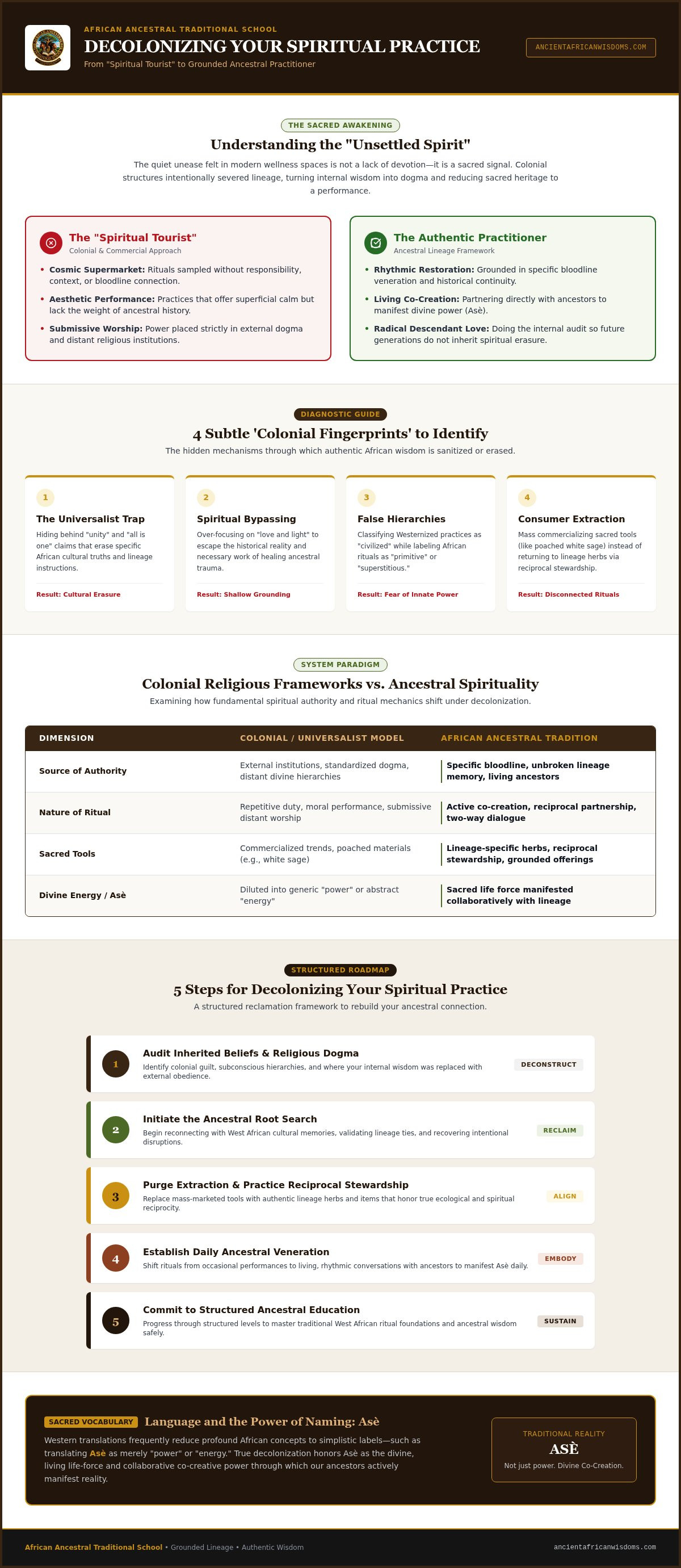
To begin decolonizing my spiritual practice, you must first recognize the subtle "colonial fingerprints" that smudge your current path. These marks aren't always obvious. They often hide behind words like "unity" or "universal truth." While these concepts sound peaceful, they frequently act as a "Universalist Trap" that erases the specific, vibrant truths of African culture. By claiming that everyone is the same, colonial systems effectively silence the unique voices and specific instructions of our ancestors. This erasure is a form of spiritual theft that keeps you from the depth of your own heritage.
You might also notice a persistent hierarchy in many wellness spaces. "Civilized" practices are often those that look Western or sanitized, while traditional African rituals are unfairly labeled as "primitive" or "superstitious." This is a colonial holdover designed to make you fear your own power. Many practitioners use "spiritual bypassing"—the focus on "love and light"—to avoid the uncomfortable but necessary work of healing ancestral trauma. Reclaiming your power requires looking into the shadows of history, not just the sun. This shift is a key part of decolonizing religious frameworks that have historically dismissed indigenous wisdom as inferior or outdated.
Think about the tools you choose for your altar. The mass commercialization of white sage, which is often poached from indigenous lands, is a clear colonial fingerprint. In contrast, returning to the traditional African herbs used by your specific lineage is an act of restoration. It's about moving from a consumer mindset to one of reciprocal stewardship.
Language and the Power of Naming
Western terminology often fails to capture the soulful depth of African concepts. For example, translating asè meaning as simply "power" or "energy" strips away its communal and ancestral weight. Language acts as a sacred container for spiritual power, holding the specific vibrations of those who spoke it before us. When you learn traditional terms for spiritual roles and entities, you aren't just memorizing words; you're realigning your spirit with the frequency of your ancestors. This is why decolonizing my spiritual practice requires us to be intentional about the names we use.
The Myth of the 'Universal' Path
There's a common myth that there's one "universal" path to enlightenment that fits everyone. However, your DNA and lineage carry specific instructions meant only for you. Cherry-picking rituals from different cultures without context is a consumer mindset that keeps you on the surface. To grow, you must move into a student mindset. You aren't a customer at a spiritual buffet; you're a descendant coming home to a specific table. If you feel ready to move beyond these colonial filters, exploring ancestral spiritual teachings can provide the structure you need to build a truly authentic foundation.
Ancestral Veneration vs. New Age Practices: A Comparison
Western spirituality often prioritizes the "I." It asks how a practice can improve your personal life, your mood, or your manifestation. In contrast, African ancestral traditions prioritize the "We." When decolonizing my spiritual practice, you realize that divine power isn't a personal battery you charge for yourself; it's a collective flow that moves through your entire lineage. You aren't an isolated island of energy. You're a link in a chain that stretches back to the beginning of time. This shift changes everything. You no longer manifest just for your own comfort, but venerate for the health of those who came before and those yet to be born.
Lineage-Based Connection vs. Spiritual Tourism
Many modern paths encourage "spiritual tourism," where seekers pick and choose deities like items on a menu. This extraction often leaves colonial fingerprints in modern wellness, treating sacred traditions as commodities for self-improvement. Authentic practice requires a shift from "working with" generic spirits to honoring your own blood. Establishing ancestral veneration for the African diaspora serves as the foundation for this reclamation. It moves you from being a guest in someone else's house to being a steward of your own family's spiritual legacy. You don't need to borrow from others when your own house is full of treasure.
The Role of Asè in Your Practice
In New Age spaces, people often talk about "high vibrations" or "good luck" as if they're random weather patterns. Decolonizing my spiritual practice introduces you to the intentional use of Asè, the divine life force that permeates all things. Instead of waiting for the universe to grant a wish, you learn to direct this force through ritual and character. Because this knowledge is deep, it can't be mastered through a single social media post. This is why structured environments, like the African Ancestral Traditional School Levels, are necessary. They protect you from the pitfalls of "fast-food" spirituality by offering a methodical progression. You learn to handle power with the respect it deserves, ensuring your daily rituals are grounded in truth rather than trend.
How to Decolonize Your Practice: A 5-Step Process
Transitioning from theory to action requires a disciplined and rhythmic approach. To begin decolonizing my spiritual practice, you must first audit your current beliefs. Ask yourself: "Does this ritual feel like a performance, or does it feel like home?" If a practice was taught through a lens of fear or external dogma, it's likely a colonial filter. Second, research your specific lineage using history and DNA as a spiritual compass. Your ancestors aren't abstract concepts; they're specific people with unique traditions that are waiting for you to uncover them.
The third step is creating a dedicated physical space for connection. You can find guidance on the basics through African ancestral rituals online. Fourth, commit to rhythmic study rather than random information gathering. Authentic growth happens in stages, which is why the African Ancestral Traditional School Levels are designed to provide a steady, structured path. Finally, join a community of seekers. Collective reclamation is more powerful than solitary effort because it mirrors the communal nature of our original traditions.
Setting Up Your First Ancestral Altar
Your altar is a bridge between the physical and spiritual worlds. It doesn't need to be elaborate to be effective. Focus on representing the four elements or directions: a bowl of fresh water, a white candle for fire, incense or a feather for air, and a stone or plant for earth. Water is especially important as it acts as a portal for ancestral presence. Don't worry about perfect aesthetics. What matters is the consistency of your presence and the sincerity of your heart. A simple, clean space tended daily is far more powerful than a complex one that is neglected.
The Discipline of Ancestral Communication
Developing the "ear" to hear ancestral guidance is a skill you cultivate over time through meditation and study. It requires you to distinguish between your own ego, which often seeks immediate gratification, and the steady, calm voice of the lineage. The sacred pause is the intentional silence you hold after a petition, allowing the weight of your ancestors' presence to settle before you speak or act. By quieting the noise of modern life, you create the internal room necessary for ancient insights to emerge. If you're ready to move from curiosity to commitment, explore the African Ancestral Traditional School Levels to begin your structured journey.
Reclaiming Your Heritage Through Structured Ancestral Education
Self-study has limits. While books and articles can provide a wealth of information, they often lack the nuanced, rhythmic guidance that only comes from a structured environment. Decolonizing my spiritual practice is more than an intellectual exercise; it's a deep unlearning of colonial filters that requires a steady hand. A wise, patient mentor acts as a mirror, helping you see where your ego might be leading you astray and where your ancestors are truly speaking. By moving beyond "random" discovery, you ensure that your growth is both safe and authentic.
The African Ancestral Traditional School Levels serve as a modern bridge for the global diaspora. These digital courses offer a way to maintain sacred traditions without the need for physical travel, making ancient wisdom accessible to anyone with a sincere heart. This structured approach protects the integrity of the teachings while allowing you to integrate them into your modern life. This is where African spiritual community membership becomes vital. It surrounds you with a collective of seekers, ensuring you don't have to navigate the complexities of reclamation in isolation.
The Journey Through Learning Levels
Foundational knowledge must always precede advanced rituals. In West African traditions, you cannot build a roof before you have laid the stones for the floor. A curriculum rooted in authentic wisdom focuses first on character, the concept of Asè, and the history of the lineage. This methodical progression helps you move from being a "seeker" who samples various ideas to a "student" who masters a specific path. You can expect a curriculum that values your pace, offering a disciplined yet nurturing environment where every lesson builds upon the last. This structure ensures that when you do engage in ritual, you do so with a full understanding of the spiritual laws at play.
Your Place in the Global Diaspora Movement
Your personal journey toward decolonizing my spiritual practice is a vital thread in a much larger tapestry. Every time you choose to honor your specific bloodline over a generic, commercialized path, you contribute to the collective healing of the diaspora. You're helping to repair the disruptions caused by history, one ritual at a time. We invite you to join a community that values your heritage as much as you do. Your next step is simple: embark on your first level of study. By committing to this path, you aren't just changing your own life; you're creating a legacy of spiritual safety and authenticity for all the generations that will follow you.
Step Into Your Ancestral Continuity
Reclaiming your heritage is a journey of rhythmic restoration rather than a single event. By identifying the colonial filters in your current path and shifting toward a community-rooted framework, you've already begun the vital work of decolonizing my spiritual practice. You've learned that your ancestors aren't distant myths; they're a living presence waiting for you to honor the bloodline that connects you to ancient West African truths. This transition from seeker to student is an act of radical love for both your past and your future descendants.
You don't have to navigate this transition alone. A steady hand is available to help you bridge the gap between modern life and your historical roots. Begin your journey of reclamation with our African Ancestral Traditional School Levels to access a structured digital curriculum designed for the modern diaspora. Through wise mentorship and a vibrant global community of practitioners, you can build a foundation that is both disciplined and deeply nurturing. Your ancestors have been calling; it's time to answer with clarity, authenticity, and a heart ready to come home.
Frequently Asked Questions
Is decolonizing my spiritual practice the same as cultural appropriation?
No, decolonizing my spiritual practice is an act of restoration rather than appropriation. Cultural appropriation involves extracting rituals from a tradition you have no ancestral or communal tie to, often for personal gain. Decolonization is the sacred process of returning to the specific African traditions that belong to your own bloodline. You aren't taking something new; you're reclaiming a heritage that was intentionally disrupted. It's a path of homecoming that honors your specific lineage.
Can I practice African ancestral spirituality if I don't know my specific tribe?
Yes, you can absolutely begin your practice even if your specific ethnic group is currently unknown. Many members of the diaspora start by connecting with the collective "ancestors of the blood" or by focusing on universal West African concepts like Asè. As you progress through the African Ancestral Traditional School Levels, your research and spiritual work often reveal more specific details. The sincere intention to reconnect is the first step toward uncovering your roots.
Do I have to give up my current religion to decolonize my practice?
You don't necessarily have to abandon your current religion, but you must audit the colonial filters within it. Many practitioners find that ancestral spirituality provides the "roots" their current faith lacks, while others find they naturally move toward a traditional path. The goal is to ensure your connection to the Divine is no longer filtered through external dogma or fear. Over time, you might find that prioritizing authentic ancestral spiritual teachings feels more like home.
What is the first ritual I should perform to start decolonizing?
The first practical step is typically setting up a simple ancestral altar to serve as a bridge for communication. You can start with a clean surface, a bowl of fresh water, and a white candle to represent fire and clarity. This ritual isn't about complex aesthetics; it's about the consistency of your presence. Spending time at your altar daily helps you begin decolonizing my spiritual practice by creating a rhythmic connection that bypasses modern, commercialized wellness trends.
How do I know if the spirits I am connecting with are actually my ancestors?
Discernment is a skill developed through structured study and character building. True ancestors will never ask you to perform acts that violate your moral character or harm your community. They speak with a calm, steady voice that focuses on lineage continuity and healing. By following the African Ancestral Traditional School Levels, you learn specific protocols for identification. This structured education helps you distinguish between the guiding voice of your bloodline and the projections of your own ego.
Is it safe to practice African rituals without an in-person initiation?
It is safe to practice ancestral veneration and foundational rituals without in-person initiation. While certain specialized roles require specific ceremonies, the act of honoring your own ancestors is a universal right. The key is to focus on authentic, open practices rather than attempting closed ceremonies without proper guidance. Digital courses on African culture provide the necessary safety and structure. These programs offer a way to build a respectful, effective practice while staying grounded in spiritual law.
What are the common mistakes beginners make when decolonizing their practice?
One common mistake is treating the path like a "cosmic supermarket" by cherry-picking rituals without cultural context. Beginners also frequently rush the process, seeking advanced power before building a strong character foundation. Another error is neglecting the community aspect of the tradition in favor of a Western, individualistic approach. Avoiding these pitfalls requires a shift from a consumer mindset to a student mindset. Structured learning levels help ensure you build your practice on a foundation of truth.
How long does the decolonization process typically take?
Decolonization is a lifelong journey of restoration rather than a destination with a fixed end date. Because colonial influences are deeply embedded in modern life, unlearning them requires consistent, rhythmic effort. You might see significant internal shifts within a few months of dedicated study, but the work of reclaiming your heritage continues as you grow. This is why having access to a vibrant global community is so important. It provides the long-term support needed to maintain your practice.


