
The 42 laws of Ma’at are 42 affirmative declarations associated with truth, order, harmony, morality, and justice in ancient Egyptian belief. Understanding what the 42 laws of Ma’at are means looking beyond a simple list of rules: they express ideals for how a person should live in relation to others and the natural world. In the Papyrus of Ani, Chapter 125 places these declarations within a journey through the Duat, the realm of the dead.
It’s natural to read the word “laws” as a formal legal code, but Ma’at also describes a moral and cosmic order that shaped ideas of justice in Kemet. This guide explains the declarations’ meaning, their connection to Kemet’s rule of law, and the judgment in the Hall of Two Truths, where the deceased person’s heart was weighed against Ma’at’s feather. You’ll also see how the Papyrus of Ani presents this passage and how modern positive rewordings carry some of its ideals into reflection today.
Key Takeaways
- Distinguish Ma’at’s wider moral and cosmic principles from the idea of a simple written law code.
- Look beyond the wording of the declarations to the values they express about conduct and responsibility.
- Follow how the Duat judgment gives the declarations meaning within an ancient Egyptian view of the afterlife.
- Read the Papyrus of Ani as a text that places the declarations within a larger ritual and spiritual journey.
Maat and Kemet rule of law
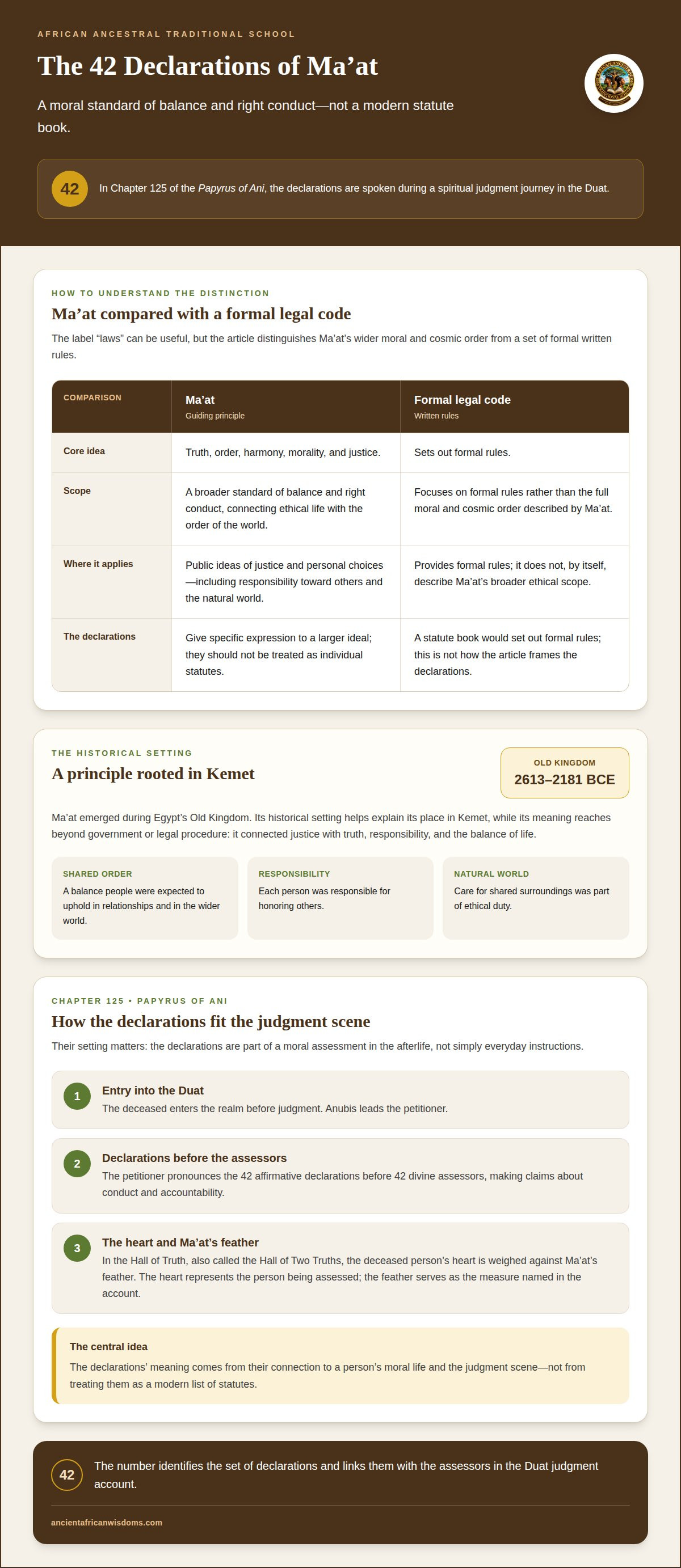
In ancient Egyptian belief, Ma’at brought together truth, order, harmony, law, morality, and justice. These ideals described a balance people were expected to uphold in relationships and in the wider world. Ma’at emerged during Egypt’s Old Kingdom, dated 2613-2181 BCE. This period provides historical context, but Ma’at is not simply another name for a single written law code. It was a guiding principle that connected ethical conduct with the order of life.
In Kemet, Ma’at connected justice with truth and responsibility. Justice was not separate from how people lived: ancient Egyptians believed each person was responsible for honoring others and the natural world. Acting fairly toward another person and caring for shared surroundings are practical examples of those duties. Ma’at therefore informed both public ideas of justice and personal choices.
This distinction helps explain why the 42 declarations shouldn’t be read as a modern legal code. A legal code sets out formal rules; Ma’at offered a broader standard of balance and right conduct. Its values could shape how people understood justice without making every declaration a statute. Truthfulness, for instance, connects a person’s words with the wider ideal of order. The principle invites consideration of how an action affects others, rather than focusing only on whether a rule was broken.
To understand Ma’at’s place in Kemet, consider these ideas together: shared order, responsibility toward others, and care for the natural world. The concept’s historical setting and ethical meaning help explain why it reaches beyond government or legal procedure. This context also clarifies the declarations’ role: they give specific expression to a larger ideal, explored in the following sections through the Duat and the Papyrus of Ani.
The 42 affirmative declarations
The 42 declarations express ethical claims associated with a person’s conduct. In Chapter 125 of the Papyrus of Ani, a petitioner pronounces declarations after being led by Anubis into the Duat. Their setting matters: they belong to a scene of moral assessment, not simply a list of everyday instructions. Each declaration can be approached as a statement about how a person’s actions relate to justice, truth, and other living beings. The number 42 identifies this set of declarations in the account.
How do the 42 laws of Ma’at differ from the Ten Commandments? They come from different religious traditions and appear in different contexts. The Ma’at declarations are presented in an ancient Egyptian afterlife judgment scene, while the Ten Commandments belong to another religious framework. They shouldn’t be treated as interchangeable lists, even where readers notice shared ethical concerns such as responsible conduct.
Why are they called the 42 laws of Ma’at? “Laws” is a familiar label for declarations expressing standards of right conduct, while Ma’at names the principle associated with truth, order, and justice. The label can be useful, but it shouldn’t imply that the declarations are a modern statute book. Their presentation in Chapter 125 connects them to a spiritual judgment, where a person’s moral life carries weight.
What do the 42 laws of Ma’at mean in modern spiritual practice? They can prompt reflection on how choices affect other people and the natural world. For example, a modern positive rewording includes caring for the earth and keeping the waters pure. That wording is a contemporary way to express an ideal, rather than a direct quotation from an ancient declaration. If you’re asking what these principles can mean in a living tradition, Ancestral Spiritual Teachings offer a path for exploring African spirituality and its practices with care. Read the declarations as prompts for responsibility, not as a substitute for their historical setting.
The Duat and the Hall of Two Truths
In the afterlife account, the Duat is the realm the deceased enters before judgment. The 42 assessors are divine figures before whom the deceased makes declarations about their conduct.
The Afterlife Judgment
The afterlife judgment is a scene in which the deceased’s heart is weighed against Ma’at’s feather in the Hall of Truth, also called the Hall of Two Truths. In Chapter 125 of the Papyrus of Ani, Anubis leads the petitioner into the Duat to pronounce affirmative declarations. The scene matters because it frames moral worth as central to the deceased person’s judgment.
The heart and feather provide the judgment’s defining image. The heart represents the person whose life is being assessed, while Ma’at’s feather serves as the measure named in the account. This is more than a spoken recitation: the weighing makes the declarations part of a larger judgment about a person’s moral life. The Hall’s two names refer to the same setting.
The Assessors' Role
The 42 assessors are the divine judges addressed during the deceased person’s declarations. They matter because the petitioner’s statements are directed to an assembly, not offered as private reflections. The number connects the assessors with the 42 declarations, joining spoken claims about conduct to the judgment scene in the Duat.
In that setting, Anubis guides the petitioner, and the assessors hear the declarations. Each statement presents the deceased as accountable for their actions. The scene links personal conduct with a formal encounter before divine figures. It also explains why the declarations shouldn’t be separated from the afterlife narrative: their purpose in Chapter 125 is bound to the judgment.
The Hall of Two Truths helps show how Ma’at’s principles take narrative form. The heart’s weighing gives moral worth a visible measure, while the declarations give the petitioner a voice. Together, these elements shape the account’s movement from entering the Duat to facing judgment. The passage presents accountability as a spiritual matter, not simply a list of rules for conduct.
The Papyrus of Ani
The Papyrus of Ani places the 42 affirmative declarations within a larger account of the afterlife. Chapter 125 gives them a setting and a speaker, helping readers understand their role in the text rather than treating them as a detached list.
In this chapter, Anubis leads a petitioner into the Duat, where the petitioner pronounces declarations. The question “what are the 42 laws of Ma'at?” is best approached through that scene: the words belong to a spiritual encounter and judgment. Their meaning is connected to the petitioner’s place in the account, not only to a modern summary of each statement.
Readers asking what the 42 laws of Ma'at are can use Chapter 125 as a point of reference. The petitioner speaks before assessors, and the declarations become part of a larger narrative. That context helps distinguish the text’s presentation from a contemporary adaptation or personal reflection inspired by its ideals.
English translations may phrase a declaration differently. A change in wording does not by itself mean the declaration’s underlying meaning has changed; it may reflect the translator’s choices. Keep the source and translation in view when comparing versions or quoting a declaration.
Read Chapter 125 with attention to who speaks, where the scene unfolds, and how the declarations serve the passage. This approach keeps the text’s ritual and spiritual setting in view while supporting careful study. If you’d like to continue exploring African spiritual traditions alongside this text, explore ancestral spiritual teachings as a way to deepen your study.
African Ancestral Traditional School
African Ancestral Traditional School offers a way to continue studying Ma’at within broader African spiritual and cultural learning. If you want to explore how ancestral teachings relate to the declarations, its digital courses and African Ancestral Traditional School Levels provide a structured learning path. Community Access also creates space to learn alongside others.
Further study can be useful when the historical account raises questions about spiritual practice, heritage, or how to carry learning into daily life. Ancient African Wisdoms offers guided digital learning that connects study with African ancestral traditions, while keeping the focus broader than one ancient text. Explore the courses when you’re ready to continue learning with care and continuity.
For information about continuing your learning, contact African Ancestral Traditional School.
Carry the Teaching Into Your Next Step
Learning what the 42 laws of Ma’at are can open a wider path of reflection. Consider what the 42 laws of Ma’at mean to your own study, and let that question guide your next steps in understanding African spiritual heritage. Approach the subject with patience, allowing historical learning and personal reflection to grow together.
If you’re ready to explore African spiritual and cultural traditions further, Ancient African Wisdoms offers a structured place to deepen your learning. Consider what you’d like to understand next, then explore the courses at a pace that feels grounded and sincere.
Contact African Ancestral Traditional School to continue your exploration with care and curiosity.
Frequently Asked Questions
What are the 42 Negative Confessions of Ma’at?
The 42 Negative Confessions are statements in which a deceased person declares they did not commit particular wrongs. To understand what the 42 laws of Ma’at are, notice that “negative” describes the form of these denials, not a harmful teaching. The statements belong to an afterlife judgment context, so they’re best read as claims made by the deceased rather than as everyday instructions.
What is the source of the 42 laws of Ma’at in ancient Egyptian texts?
Chapter 125 of the Papyrus of Ani is a key textual source for the declarations discussed here. It places them in an afterlife scene and identifies the petitioner’s role in speaking them. When reading a translation, pay attention to its wording and context rather than assuming every English version uses identical phrasing. That distinction helps keep the ancient text separate from later summaries.
What are all 42 declarations in the Papyrus of Ani?
The Papyrus of Ani presents a sequence of 42 declarations in Chapter 125, but their English wording can differ between translations. If you’re asking what the 42 laws of Ma’at are, keep one translation together as a text instead of combining lines from different versions. A modern restatement, such as a reflection on caring for the earth, should be recognized as an adaptation, not an ancient quotation.
How did the 42 declarations relate to the weighing of the heart ceremony?
The declarations accompanied the deceased person’s judgment, which included weighing the heart against Ma’at’s feather. They were spoken claims about conduct, while the weighing represented the assessment of moral worth. Keeping those roles distinct makes the scene easier to understand: the declarations give the petitioner a voice, and the weighing supplies the judgment’s central symbolic measure.
Are the 42 laws of Ma’at historically established as a formal moral code?
They’re understood as declarations associated with Ma’at’s ideals, rather than as a formally established legal code. The word “laws” can suggest a statute book, but the Papyrus of Ani presents these statements within a spiritual judgment account. That context supports a careful distinction between moral declarations and a comprehensive set of laws governing every part of ancient Egyptian life.
Who were the 42 assessors in the ancient Egyptian afterlife judgment?
They were divine judges whom the deceased addressed while making declarations about their conduct in the Duat.


