
A family can honor its ancestors without following one universal ritual. If you’re wondering how to explain ancestral veneration to family, describe it as remembering and honoring those who came before, and keeping their stories and legacy present. It doesn’t mean treating every ancestor as perfect or putting them on a pedestal.
Families already remember loved ones in different ways. Those differences are part of the story: traditions reflect culture, spiritual beliefs, and personal customs, while shared remembrance can still help relatives feel connected.
This guide explains ancestral veneration and offers practical ways to discuss it with family. You’ll learn how birthdays and death anniversaries can become occasions for remembrance, and how practices differ across cultures, from shared meals and family stories to distinct rituals. Use what helps you speak with care, and leave room for different beliefs as you explore your family’s heritage.
Key Takeaways
- Explain ancestral veneration as honoring and remembering those who came before, without treating them as perfect or placing them on a pedestal.
- Use birthdays, death anniversaries, and family gatherings as thoughtful occasions to share stories and remember loved ones.
- Explore how remembrance practices differ across cultures, and approach each tradition with care and respect.
- When family members hold different beliefs, begin with shared memories and make space for each person’s perspective.
What is Ancestral Veneration?
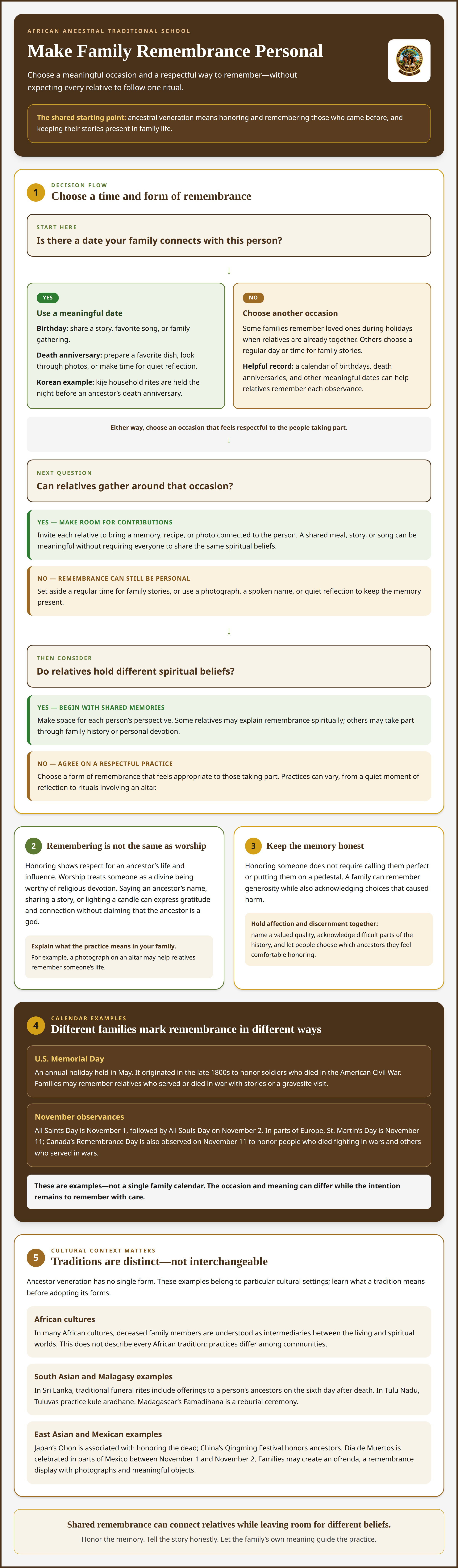
Ancestral veneration means honoring and remembering those who came before, while keeping their stories present in family life. Practices vary across cultures, from a quiet moment of reflection to rituals involving altars.
Honoring Rather Than Worshipping Ancestors
Honoring ancestors means showing respect for their lives and influence, while worshipping treats them as divine beings worthy of religious devotion. The distinction matters when explaining the practice to family, because remembrance doesn’t automatically mean worship. A family might speak an ancestor’s name, share a story, or light a candle during a ritual. These acts can express gratitude and connection without claiming that the ancestor is a god.
Beliefs differ across cultures, so explain what a practice means in your family rather than assuming every tradition uses the same language. For example, you might say that a photograph on an altar helps relatives remember someone’s life. A specific explanation can make the practice easier to discuss than a broad label alone.
Remembering Ancestors Without Idealizing Them
Honoring an ancestor doesn’t require calling them perfect or putting them on a pedestal. A family can remember a grandparent’s generosity while also acknowledging choices that caused harm. Respect need not erase descendants’ experiences. It also leaves room for people to choose which ancestors they feel comfortable honoring, rather than treating remembrance as an obligation to everyone in the family line.
For example, relatives might share a great-grandparent’s migration story while discussing how their actions affected later generations. Keep the memory honest: name a valued quality, acknowledge difficult parts of the history, and avoid presenting one person as the measure of the whole family. Remembrance can hold both affection and discernment.
Memorial Day and Honoring War Dead
In the United States, Memorial Day is an annual holiday held in May. It originated in the late 1800s as a way to honor soldiers who died in the American Civil War. Families may use the day to remember relatives who served or died in war, through shared stories or a visit to a gravesite. This public observance offers a familiar example of honoring the dead without requiring every family to share the same spiritual beliefs.
When explaining ancestral veneration, you can use Memorial Day to distinguish remembrance from worship: honoring someone’s memory can be meaningful in itself. A candle, a spoken name, or a family story can express respect and keep the past present.
Remembering birthdays and death anniversaries
A birthday or death anniversary can bring relatives together to remember someone by name. Marking a loved one’s birthday may also honor the ancestors whose lives made that person’s existence possible. A family gathering, favorite song, or story can be meaningful without requiring everyone to share the same spiritual beliefs. Choose a practice that feels respectful to those taking part.
For a death anniversary, a family might prepare a loved one’s favorite dish, look through photos, or set aside time for quiet reflection. In Korea, kije household rites are held the night before an ancestor’s death anniversary. This example shows how cultural tradition can shape when a family gathers. Keeping a calendar of birthdays, death anniversaries, and other meaningful dates can help relatives remember each observance.
There’s no single calendar for ancestral remembrance. Some families gather during holidays when loved ones are already together; others choose a regular day or time for family stories. In Catholic observances, All Saints Day falls on November 1, followed by All Souls Day on November 2. In parts of Europe, St. Martin’s Day also falls on November 11, while Canada’s Remembrance Day is observed on November 11 to honor people who died fighting in wars and others who served in wars.
These occasions can prompt a family to consider what remembrance means to them. A photograph on an ancestor altar, a shared meal, or a spoken name can make memory part of everyday life. Relatives who understand remembrance spiritually can explain that meaning in their own words; others may take part through family history or personal devotion. The form can differ while the intention remains to remember with care.
To make a family observance more personal, invite each relative to contribute a memory, recipe, or photo connected to the person being honored. For a gentle starting point, explore ways to deepen ancestral remembrance and let your family’s traditions guide the gathering.
Ancestor-veneration practices across cultures
Ancestor veneration has no single form; each tradition carries its own sacred meanings. In many African cultures, deceased family members are understood as intermediaries between the living and spiritual worlds. This belief can shape how relatives seek guidance and remember earlier generations. It does not describe every African tradition, and practices differ among communities.
In Sri Lanka, traditional funeral rites include offerings to a person’s ancestors on the sixth day after death. In Tulu Nadu, Tuluvas practice kule aradhane, a form of ancestor veneration. Madagascar’s Famadihana is a reburial ceremony. These examples show how remembrance may be connected to funeral customs, family relationships, or specific ceremonies. They are not interchangeable: each belongs to a distinct cultural setting.
Other traditions mark remembrance through annual observances. Japan’s Obon is a custom associated with honoring the dead, while China’s Qingming Festival honors ancestors. In parts of Mexico, Día de Muertos is celebrated between November 1 and November 2. Families may create an ofrenda, or remembrance display, with photographs and meaningful objects. The objects and rituals carry meaning within their cultural context, so learn about a tradition before adopting its forms.
Some practices center on a household space or family gathering. Korea’s jesa includes an altar for ancestors, while families in different cultures may share food or drink, speak ancestors’ names, or tell their stories. A glass of fresh water or a family recipe can make remembrance tangible. These gestures can connect the living with those who came before, but their meaning depends on the tradition and the people observing it.
To discuss cultural practices respectfully, identify their origins and avoid presenting one custom as universal. Courses on African spirituality, culture and tradition can provide a structured way to learn about African heritage and its distinct practices.
How can I discuss ancestral veneration with family members who have different religious beliefs?
Begin with what the practice means to you, rather than telling relatives what they should believe. You could say, “I’m learning ways to remember our ancestors and understand their influence on our family.” This explains your intention without asking a Christian, Muslim, Jewish, or nonreligious relative to adopt your spiritual beliefs. Keep the first conversation grounded in shared family history, such as a grandparent’s name, values, or stories.
Use plain language to explain what you mean by veneration. Clarify whether you’re talking about honoring ancestors through remembrance, prayer, offerings, or another practice. Don’t assume a relative understands a ritual as you do. Describe the action and its meaning in your own words, then invite them to share how it feels to them. A calm exchange gives everyone room to ask questions without turning the discussion into a debate.
Separate participation from respect. Your sister might prefer to hear a family story rather than join a spiritual observance; your father might want to remember a relative privately. Agree on a shared activity, such as collecting family photographs or recording an elder’s memories, while letting each person choose how involved to be. If someone raises a concern, listen first and ask what feels uncomfortable. Respecting boundaries helps preserve trust between relatives.
Keep the conversation grounded in specific memories. Mention a relative’s recipe, song, or act of care, then explain why remembering that person matters to you. Avoid presenting one family custom as universal or using ancestry to pressure anyone. You might say, “You don’t have to share my beliefs to help me preserve this story.” That makes room for connection without requiring agreement.
If you want to build a deeper understanding before discussing these ideas, explore respectful learning about ancestral traditions and bring clear, thoughtful language into your family conversations.
African Ancestral Traditional School
African Ancestral Traditional School offers a place to deepen your understanding of African spirituality, culture, and tradition. If you’re exploring ancestral remembrance or seeking language for family conversations, its structured courses and teachings can help you continue learning with care. African Ancestral Traditional School Levels provide a learning pathway, while Community Access connects learners exploring heritage. Spiritual Rituals are also part of its offerings.
Turn to these teachings when you want to move beyond a general explanation and study African ancestral traditions in greater depth. Learning can help you consider how remembrance fits your beliefs and family context, without assuming every relative must participate in the same way.
Contact African Ancestral Traditional School to explore learning that supports your path.
Carry the Conversation Forward
Let your next step reflect what you hope your family will understand, rather than a need to resolve every difference at once. A thoughtful way to explain ancestral veneration to family is to state your intention clearly: perhaps you want to preserve a story, understand your heritage, or make space for personal reflection. That clarity can help you choose words that feel honest and considerate.
You might also write down what you’re still learning. Returning to those questions over time can deepen your understanding and help you speak with greater care. Family conversations don’t need to end in agreement to be worthwhile; listening and sharing honestly can open a path to future connection.
If you’re ready to continue your learning, take the next step with African Ancestral Traditional School. Approach your heritage with patience, and let each thoughtful conversation make room for deeper understanding.
Frequently Asked Questions
What does ancestral veneration mean?
Ancestral veneration is a way of relating to those who came before through remembrance, respect, or spiritual practice. Its meaning depends on the family and tradition. For one person, it may mean preserving a relative’s stories; for another, it may include a spiritual observance. It doesn’t require believing every ancestor was virtuous or that every family member must participate.
How is ancestral veneration practiced in different cultures and religions?
Practices vary, and similar gestures can carry different meanings across communities. For example, traditional funeral rites in Sri Lanka include offerings to a person’s ancestors on the sixth day after death. Elsewhere, remembrance may involve speaking names, sharing food, or maintaining a household space. Treat each custom as part of its own cultural context rather than assuming one practice represents all traditions.
How can I explain ancestral veneration to family members respectfully?
Start by explaining your intention and asking relatives how they understand the practice. You might say, “I’d like to preserve our family stories, and I’m learning about remembrance traditions.” Then listen without expecting agreement. If a relative prefers not to join a spiritual observance, suggest a shared alternative, such as recording an elder’s memories or organizing family photographs together.
What is the difference between ancestral veneration, ancestor worship, and remembering deceased relatives?
These terms describe different relationships, though people may use them differently. Ancestral veneration centers on honoring or connecting with ancestors; ancestor worship describes religious devotion to them. Remembering deceased relatives can be cultural, personal, or spiritual without involving worship. To avoid confusion, explain the specific action you mean, such as telling a family story, rather than relying on a label alone.
What are common ancestral veneration rituals, offerings, and home altar practices?
Practices can include speaking ancestors’ names, sharing food or drink, and placing photographs or meaningful objects in an altar space. Some people refresh a glass of water there; others use a candle as part of remembrance. Customs differ, so these are examples, not universal instructions. Offerings are handled according to the tradition being followed, and some practices advise leaving them uneaten.
How can someone begin ancestral veneration in a culturally respectful way?
Begin with your family history: ask relatives about names, stories, recipes, and customs they remember. Learn a tradition’s origins and meaning before adopting its rituals, and avoid presenting another community’s sacred practice as your own. You can also choose which ancestors you feel comfortable honoring. A thoughtful first step might be recording a relative’s story with their permission.


