
You don’t need a complete family tree to begin honoring those who came before you. Learning how to honor ancestors you don’t know can start with gratitude, remembrance, and a simple act of care. Ancestral veneration means recognizing the dead and their place in the lives and lineage that continue. It doesn’t require worship or excusing harm an ancestor may have caused. You can approach the practice respectfully while keeping the boundaries that feel right to you.
Wanting to remember people whose names and stories have been lost is understandable. You can begin without pretending to know more than you do. This guide explores practical ways to create a place for remembrance, honor unknown ancestors through personal reflection, and use candles and rituals with intention. You’ll also find ways to express gratitude while staying grounded in your values and mindful of cultural traditions. A quiet moment of reflection can matter even before you know the names behind it.
Key Takeaways
- Create a simple sacred space with thoughtful items that represent remembrance, even when you don’t know your ancestors’ names.
- Explore family history at a pace that feels supportive, and let personal healing include clear boundaries around inherited harm.
- Honor unknown ancestors through gratitude, stories shared by elders, or quiet moments of reflection.
- Use candles and rituals with intention, choosing practices that feel respectful and aligned with your values.
1. Creating a physical place to honor ancestors
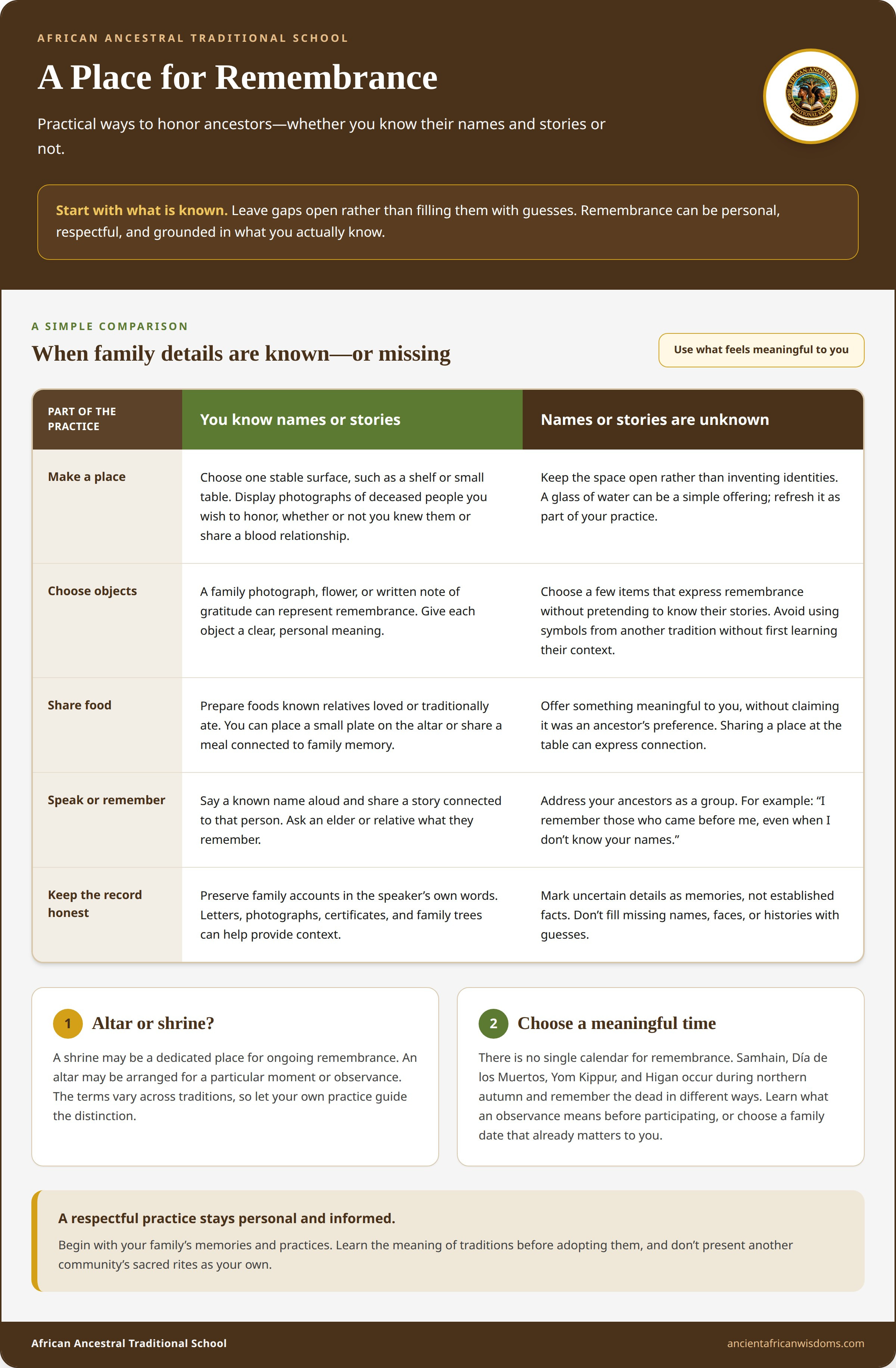
Choose one stable surface, such as a shelf or small table, as a place for remembrance. An ancestor altar can hold photographs of deceased people you wish to honor, whether or not you knew them or share a blood relationship. If names and faces are unknown, leave the space open rather than inventing identities. A glass of water can serve as a simple offering that you refresh as part of your practice.
Choose a few meaningful objects rather than items meant to imitate a culture you haven’t learned about. A family photograph, flower, or written note of gratitude can represent remembrance. Keep the arrangement personal, with a clear meaning for each object. If a symbol belongs to a tradition outside your own, learn its context before using it.
A shrine may serve as a dedicated place for ongoing remembrance, while an altar may be arranged for a particular moment or observance. These terms differ across traditions, so let your own practice guide the distinction. For example, you might keep family photographs and water on a small shelf, then add flowers or a handwritten message when you pause to honor your ancestors.
Food can make remembrance tangible. Prepare a meal with foods your known relatives loved or traditionally ate, then place a small plate on the altar. If you don’t know their preferences, offer something meaningful to you without claiming it was theirs. Sharing a place at the table can express connection even when names and stories are unknown.
To honor ancestors while respecting cultures you’re not part of, begin with your own family’s memories and practices. Learn the meaning and context of traditions before adopting them, and don’t present another community’s sacred rites as your own.
There isn’t one calendar for ancestral remembrance. Samhain, Día de los Muertos, Yom Kippur, and Higan take place during northern autumn and include remembrance of the dead in different ways. Learn what each observance means before participating. You can also choose a family date that already holds meaning.
2. Healing the family lineage through personal healing
Begin family-history research with records close at hand: letters, photographs, certificates, and family trees. Ask an elder about relatives’ names, migrations, work, and everyday customs. Record what they remember, including uncertainty, instead of filling gaps with guesses. Genealogy websites can help organize names and dates, while family conversations may preserve details official records don’t show. Together, these sources can give unknown ancestors context and help you understand traditions passed through generations.
Notice which family patterns you want to continue and which you want to change. You can acknowledge an ancestor’s humanity alongside the harm they caused; recognition doesn’t require forgiveness or reconciliation. If abuse or other severe ancestral harm affects you, seek support from a trauma-informed therapist or counselor. You don’t have to force a conversation, forgiveness, or spiritual practice before you feel ready and supported. Choosing not to repeat harmful behavior can itself be a meaningful way to honor future generations connected to your lineage.
Family food can carry memory through practical, repeatable acts. Ask relatives to describe a dish they learned from a parent or grandparent, including its ingredients, method, and the occasions when it was served. If a relative remembers making stew for family gatherings, prepare it together and write down the recipe in their words. If a recipe or its history is unknown, don’t present a new dish as an inherited tradition. Instead, cook something you value and name it as your own expression of care.
Pair research with one deliberate act: preserve a family recipe, share a relative’s story, or dedicate a helpful action to those who came before you. For grounded study of African heritage and spiritual traditions, explore courses on African Spirituality, Culture and Tradition. Learning can help you approach lineage with context, discernment, and respect while making space for healing.
3. Honoring ancestors whose names and stories are unknown
You can offer gratitude without knowing a name, photograph, or family story. One way to begin honoring ancestors you don't know is to speak plainly: “I remember those who came before me, even when I don’t know your names.” This acknowledges what you don’t know without filling gaps with imagined details. If you know one name, say it aloud and share a story connected to that person. If no names are known, direct your words to your ancestors as a group.
Invite an elder or relative to share what they remember, then preserve each account in their own words. A song, phrase, or tradition passed between generations can carry meaning even when its original source is unknown. For example, note who taught a family lullaby and when relatives remember hearing it. Mark uncertain details clearly as family memories, not established facts, so later generations can understand what is known.
If you were adopted or separated from your biological family, you can honor the people who raised, cared for, or shaped you, whether or not they were blood relatives. You can also express gratitude to unknown biological ancestors without knowing their names or stories. Your practice doesn’t require choosing one family connection over another.
A cemetery visit can offer a place for remembrance, even if you don’t know where your ancestors are buried. Leave water or flowers as a simple gesture, and focus on reflection rather than claiming a connection to a particular grave. You might sit quietly and consider what you hope to carry forward, such as kindness or a family craft. If you’re still considering how to honor ancestors you don't know, meditation can offer a quiet moment to invite spiritual ancestors to draw near only in love, then return your attention to the present.
4. Candle magic and formal ancestral rituals
A candle can mark a deliberate moment of connection with the ancestors represented in your practice. Set an intention before lighting it, such as remembering unknown people whose lives made yours possible. Speak a few words of gratitude, sit in quiet reflection, then close the ritual by saying the moment is complete. Keep your words simple and sincere; meaningful rituals don’t need elaborate objects.
A Dumb Supper offers one formal example: in this neo-pagan tradition, participants share a silent meal and set a place for departed loved ones. You might adapt the basic idea by eating quietly and remembering those who came before you. Keep the practice clearly your own rather than presenting a tradition from another community as universal.
Let your offerings reflect what you know and the tradition you follow. Water, flowers, or a small portion of food can be thoughtful choices. Avoid offering alcohol unless you know the ancestor enjoyed it. When honoring unknown ancestors, choose something modest that expresses gratitude without claiming it belonged to them.
Traditions carry distinct beliefs. In Shinto, the dead are understood to persist as kami, or divine spirits, and rituals may honor them for blessings, guidance, or protection. That context matters: don’t assume the same meaning applies to your practice. Some people choose Monday or Saturday, or a dark or new moon, for ancestral work; others choose a personally meaningful day.
To create a respectful ritual, avoid copying sacred rites without understanding their cultural meaning, promising results, or trying to connect with ancestors who harmed you. Let intention, knowledge, and clear boundaries shape the practice. If you want structured guidance as you develop your approach, continue learning about ancestral rituals.
African Ancestral Traditional School
For readers seeking deeper context for ancestral remembrance, Ancient African Wisdoms offers a structured learning path focused on African spiritual traditions and practices. Its four learning levels move from foundational teachings toward practical application. Level One, Roots, includes five foundation courses, each eight weeks long, covering African worldview, Igbo Odinani, ancestors, African cosmology, and Igbo classical philosophy and logic.
If you want structured guidance as you continue learning about lineage, spiritual practice, and cultural heritage, these teachings offer a natural next step. Community Access also gives learners a space to connect as they explore ancestral knowledge. Consider this learning when you’re ready to move beyond a personal ritual and deepen your understanding of the traditions behind it.
For questions about learning with African Ancestral Traditional School, contact the school.
Let remembrance become part of your ongoing path
You don’t need to uncover every name or story before taking the next step. Let your practice grow through attention: notice which values you want to carry forward, what questions remain, and what relationship with your heritage feels honest. Learning how to honor ancestors you don’t know can be an ongoing act of reflection, shaped by what you learn and the choices you make today.
If you’re ready to explore African ancestral knowledge with guidance, contact African Ancestral Traditional School. A conversation can help you consider a meaningful direction for your learning and spiritual practice.
Move at a pace that respects your boundaries and the histories behind your traditions. Each thoughtful step can deepen your sense of connection across generations.
Frequently Asked Questions
What is Ancestral Veneration?
Ancestral veneration means recognizing and remembering deceased ancestors as part of one’s family, community, or spiritual life. Its meaning and customs differ across traditions. For some, it includes ritual offerings or prayer; for others, remembrance may be personal and quiet. It doesn’t require believing ancestors are perfect or treating remembrance as worship.
What are simple ways to honor unknown ancestors?
Dedicate a positive action to those who came before you, such as supporting a cause that reflects values you hope your family carried. You could also learn a craft associated with your heritage and record what you discover for relatives or future generations. These acts give remembrance a practical expression without requiring knowledge of specific names or biographies.
How can you create an ancestor altar without family photos or names?
Choose an object that represents your intention, such as a handwritten note of gratitude or a simple keepsake from your own life. Arrange it in a quiet place and use the space for reflection, not to make a claim about a particular ancestor. You can add family details if you learn them later, while leaving unknown identities unnamed.
Are there secular ways to remember unknown ancestors?
Yes. Preserve family documents, write down memories relatives share, or contribute time to a cause in memory of those who came before you. You might also continue a useful skill or craft associated with your heritage. These actions can honor family influence and carry values forward without requiring spiritual beliefs or ritual practice.
What are respectful ways to honor ancestors who may have caused harm?
You can acknowledge an ancestor’s place in your history without praising their conduct or forgiving them. Choose what, if anything, you want to carry forward, and name harmful behavior honestly in family records or reflection. You may choose to focus remembrance on those affected instead. You’re not required to seek spiritual contact or make an ancestor central to your practice.


