
What if astrology is understood not only through the sky, but through a wider relationship between nature, ancestors, and destiny? An African spiritual view on astrology is not one continent-wide system: some traditions describe 12 signs, while others use 13 or more. In Yoruba Ifa tradition, Orunmila is associated with destiny.
If zodiac signs feel familiar but don’t capture the depth of African spiritual traditions, it’s understandable to feel that something is missing. These perspectives connect the heavens with cultural knowledge, relationships with ancestors, and ideas about a person’s path.
This article explores how ancestors and the heavens may inform spiritual understanding, why Orunmila is associated with destiny, and how traditions differ across communities. It also considers their cultural and historical roots, so you can approach them with curiosity and respect rather than treating Africa’s many spiritual perspectives as one uniform system.
Key Takeaways
- Understand how ancestral relationships and celestial movements can work together in spiritual interpretations of life paths.
- Discover how Orunmila and the 256 sacred Odu Ifa connect Yoruba tradition with questions of destiny.
- Learn why birth dates can offer a starting point for exploring a sign, while cultural context shapes its meaning.
- Trace how African spiritual perspectives on the heavens are linked to cultural memory and historical traditions.
Ancestors and celestial movements
Ancestors are family members understood to remain spiritually connected with the living. In many African traditions, they are regarded as intermediaries between physical and spiritual realms. This relationship places lineage within a wider understanding of identity. An African spiritual view on astrology may include ancestral guidance when interpreting a life path, rather than treating a celestial sign as a complete answer. Wisdom is considered through connection, memory, and the circumstances of a person’s life.
Celestial movements are changes in the positions or appearance of heavenly bodies. In Yoruba spiritual perspectives, celestial events may influence nature and human behavior, while existing alongside other spiritual and natural relationships. An African spiritual view on astrology does not necessarily separate the visible sky from everyday life: observations of the heavens may be considered in relation to conduct, environment, and spiritual guidance. This perspective connects the sky with life on Earth.
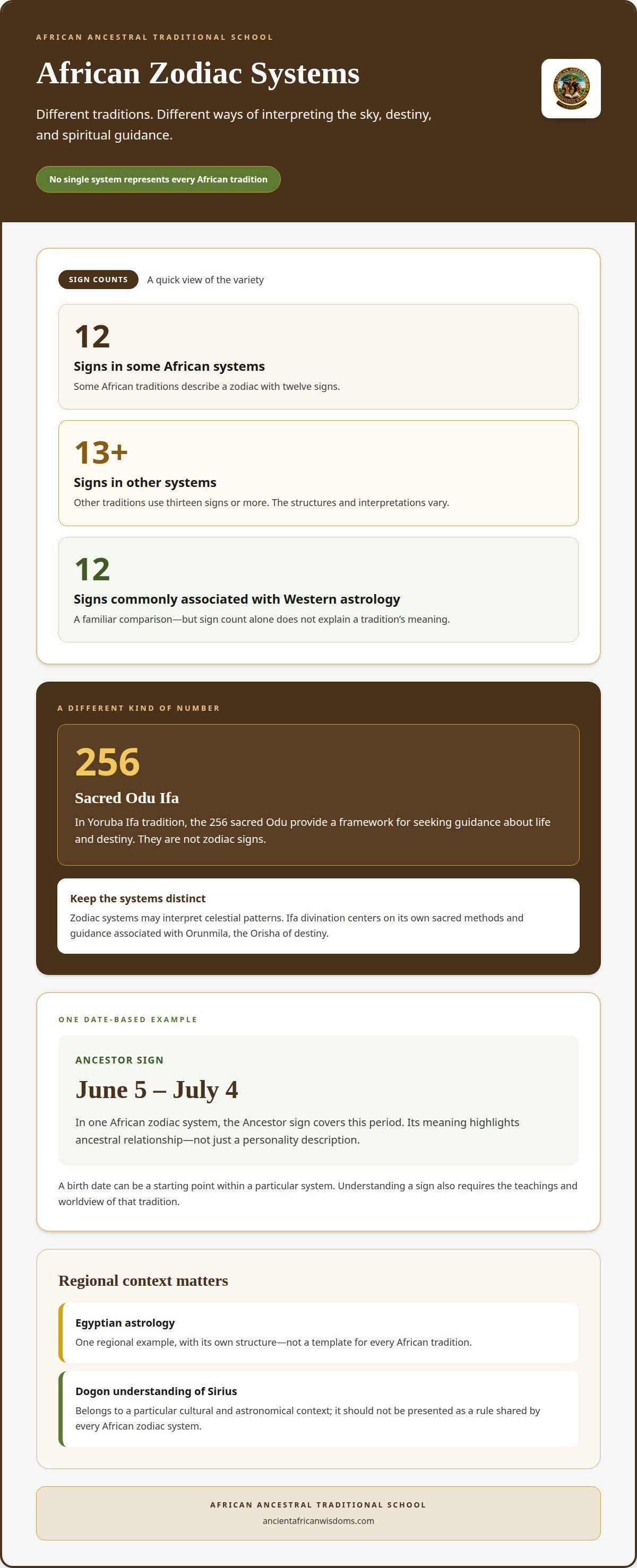
Ancestral guidance is spiritual counsel connected with lineage and a person’s sense of identity. In one African zodiac system, the Ancestor sign covers June 5th to July 4th. That example shows how an astrological sign can carry a relationship-centered meaning, not only a description of personality. A birth date can offer a starting point for identifying a sign within a particular system; understanding its significance also calls for attention to that tradition’s teachings and worldview.
Ancestor rituals and offerings are practices specific to particular traditions, expressing remembrance or spiritual relationship. Their forms and meanings vary, so a practice from one community should not be presented as universal across Africa. To understand an offering, consider its place in that tradition and the relationship it honors. This keeps the focus on meaning and context, rather than treating a ritual as a technique for predicting an outcome.
Ethical living means bringing spiritual insight into everyday choices. When ancestral guidance informs a life path, its meaning can include how someone treats family, community, and the natural world. For instance, a person might reflect on whether a decision shows care and responsibility, rather than asking only what a sign predicts. This makes astrology part of an ongoing relationship with tradition, where celestial interpretations, ancestral wisdom, and daily conduct can be considered together.
Orunmila as a deity of destiny
Orunmila is the Orisha associated with destiny in traditional Ifa. In Yoruba spiritual thought, destiny concerns a person’s life path, not simply a prediction. Orunmila is therefore a point of reference for reflecting on direction, choices, and personal ability. The focus goes beyond assigning a personality label based on a birth date. Instead, a person’s path is considered within a spiritual tradition shaped by relationships, responsibilities, and the forces of nature.
Ifa is a Yoruba divination tradition that offers a way to seek spiritual guidance. Its teachings include 256 sacred Odu Ifa. These Odu provide a framework for understanding questions about life and destiny; they are not the same as zodiac signs. The distinction matters: a zodiac system may interpret celestial patterns, while divination seeks guidance through a tradition’s own sacred methods. Both can address meaning, but they do so through different practices and understandings.
Divination is a practice of seeking insight through spiritual signs or methods within a tradition. In African spiritual practices, it should not be treated as another name for astrology. Astrology commonly considers celestial movements, while Yoruba Ifa divination centers on its sacred system and guidance associated with Orunmila. Someone facing a life choice, for example, may seek divinatory guidance rather than an interpretation based only on the sky. The method and cultural setting shape the meaning.
Destiny, in this context, can be understood as a path that calls for discernment and action. Orunmila’s association with destiny invites reflection on how choices meet spiritual guidance, rather than suggesting that energies or celestial forces remove personal responsibility. This ancient tradition is best approached through its own teachings, with attention to Yoruba context and the meanings carried by Ifa. For a deeper study of these ideas, explore ancestral spiritual teachings that connect African spirituality with cultural tradition.
Regional differences among African zodiac systems
A zodiac is a system that connects signs with dates or other interpretive patterns. African cultural astrology has no single shared structure: some systems use 12 signs, while others use 13 or more. The sign names, meanings, and methods of interpretation vary, so a system from one region should not stand for the whole continent.
African astrology differs from Western astrology in its diversity and spiritual framing. Western astrology is commonly associated with twelve zodiac signs; African cultural systems may also include nature, ancestors, or other spiritual elements. A sign may offer insight into traits, but its meaning depends on the tradition that gives it context. The number of signs alone cannot explain how a system interprets someone’s life or actions.
Egyptian astrology is one example of a regional system with its own structure. This example shows why a single fixed count cannot represent every African tradition. Some systems associate signs with elements or other symbolic meanings. These examples illustrate different ways that signs and natural symbolism can be organized.
The Dogon tradition’s understanding of Sirius belongs to a particular cultural and astronomical context. It should be discussed as Dogon knowledge, not treated as a rule shared by every African zodiac system. This distinction preserves the community-specific meaning of Sirius and avoids broad claims about African traditions as a whole.
For a balanced comparison, first identify the specific community and system being discussed. Then consider its sign count, symbols, and interpretive purpose. Different systems may use zodiac structures, and their meanings can vary by tradition. Keeping those details together helps readers distinguish regional traditions without flattening them into one model.
These differences also shape how signs are used. A birth date may help identify a sign within a particular system, but the interpretation comes from that system’s own symbolism. Read each sign in its cultural setting rather than automatically transferring traits or predictions from Western astrology. This respects both a shared interest in the heavens and distinct traditions of interpretation.
African astrology's cultural and historical origins
Cultural origins are the beliefs and histories that shape how a community interprets the heavens. In Yoruba tradition, Oludumare is described as the creator force who brought the heavens into existence. This understanding places the sky within a spiritual account of creation, not only a system for describing personality. It also shows why celestial knowledge can be shaped by a community’s ideas about nature, harmony, and human responsibility.
A stellar calendar is a way of organizing time through observations of stars. Accounts of African history describe people in the Nile Valley and Great Lakes region devising a stellar calendar between 10,000 and 6,000 BC. These dates belong to accounts of early sky knowledge and should be read as historical claims, not as a single origin date for every African tradition. A solar-calendar era is another way to mark time, and one account places its beginning at 4,000 BC. These examples point to varied relationships between celestial observation and timekeeping.
Yoruba Ifa is a divination tradition whose sacred corpus includes 256 Odu Ifa. Its place in this history helps distinguish spiritual knowledge from a zodiac chart alone. A reader exploring African astrology can therefore ask which community, teaching, or historical account gives a practice meaning. That step helps avoid treating the continent’s many traditions as one uninterrupted system.
Christianity and Islam have influenced African views on astrology in varied ways, as communities interpret celestial practices through different religious teachings. Some people keep spiritual traditions distinct, while others understand them alongside their faith. No single response represents all African communities.
One risk of relying on astrology is treating a sign as a fixed verdict about personality or future actions. A careful approach treats interpretation as one perspective while keeping personal judgment and ethical choices in view.
The clearest takeaway is that African astrology’s history is plural: creation accounts, calendars, and spiritual systems each carry distinct meanings. To explore these roots through courses on African culture and tradition, continue with structured learning that keeps cultural context at the center.
African Ancestral Traditional School: Courses on African Spirituality, Culture and Tradition
African Ancestral Traditional School offers structured learning for those ready to explore African spirituality, culture, and tradition beyond a brief introduction. Its courses and school levels offer a path for studying ancestral teachings in greater depth and cultural context.
These teachings can help when you want to understand how spiritual ideas connect with heritage, rather than treating a zodiac sign as a complete account of destiny. Community access also offers space to connect with others as you continue learning. The focus is education and shared exploration, not a promised spiritual outcome.
If you’re ready to continue your learning, contact African Ancestral Traditional School.
Carry Your Curiosity Into Deeper Study
An African spiritual view on astrology becomes more meaningful when approached with patience, cultural humility, and a willingness to learn beyond familiar zodiac frameworks. Consider a thoughtful question as your next step: which tradition are you exploring, and what teachings give its symbols meaning? Studying in context helps avoid assumptions while leaving room to reflect on how spiritual ideas relate to your life.
African Ancestral Traditional School offers ancestral spiritual teachings for those ready to continue learning. Community access can also support connection with others on a similar path. Take your time, stay open to what you discover, and let learning deepen your relationship with heritage.
Contact African Ancestral Traditional School to take your next step in study. Your journey can begin with one sincere question.
Frequently Asked Questions
How do traditional African religions view astrology?
There is no single shared view across African traditional religions; understandings differ among communities and teachings. In a Yoruba context, celestial events may be considered alongside spiritual and natural relationships, rather than as a stand-alone explanation for a person’s life. Someone exploring a sign can ask which tradition gives it meaning and how that interpretation relates to choices and responsibilities.
What role do stars and planets play in African spiritual traditions?
Stars and other celestial movements can offer signs for interpreting relationships between the heavens, nature, and human life. In the Yoruba spiritual perspective described here, celestial events may influence nature and human behavior, but they do not necessarily provide a complete personal forecast. Ask whether a teaching treats the sky as part of a wider spiritual understanding or as the sole source of guidance.
Which African cultures have traditional systems of astrology or celestial divination?
Examples include Egyptian astrology and Yoruba Ifa divination, which are distinct traditions and should not be treated as interchangeable. The Dogon tradition is also discussed in connection with Sirius and astronomy, but that alone does not make it a zodiac system. When learning about a specific culture, identify the practice accurately: astrology, divination, and astronomical knowledge can relate to the sky in different ways.
Do African spiritual traditions use birth charts or zodiac signs?
Some African zodiac systems connect a birth date with a sign, but that does not mean every tradition uses a Western-style birth chart. Do not assume a chart mapping planets and other details unless the specific tradition describes that method. If someone is given a sign based on a birthday, a useful next step is to learn the cultural meanings attached to it.


