
A person can study both Ifá and Vodun, but the traditions have distinct teachings and paths. The differences between Orisha, Vodun, and Ifa begin with what each name describes: Orisha are revered divine beings in Yoruba spiritual traditions, Vodun is associated with the Fon and Ewe peoples and the Lwa or Loa, and Ifá is a Yoruba sacred divination tradition.
It’s understandable to notice connections among these paths. They share deep West African roots and histories of exchange, but their spiritual frameworks and practices aren’t interchangeable. Understanding where they meet and where they differ can help you explore with care and a clearer sense of context.
This guide traces Ifá’s Yoruba origins and explains how Orisha traditions differ from Vodun’s spiritual framework, which includes the Lwa or Loa. It also explores what it means to study Ifá and Vodun while respecting the teachings of each tradition. These distinctions offer a grounded starting point for understanding living spiritual paths.
Key Takeaways
- Trace Ifá to Yoruba traditions in West Africa and learn how its divination system carries spiritual teachings.
- Understand why Orisha and Lwa or Loa belong to different spiritual frameworks, even where histories connect.
- Explore how ritual practices reflect each tradition’s own relationships with spiritual beings and community.
- Consider how someone may learn both Ifá and Vodun while honoring their distinct teachings and paths.
Ifá's West African origins
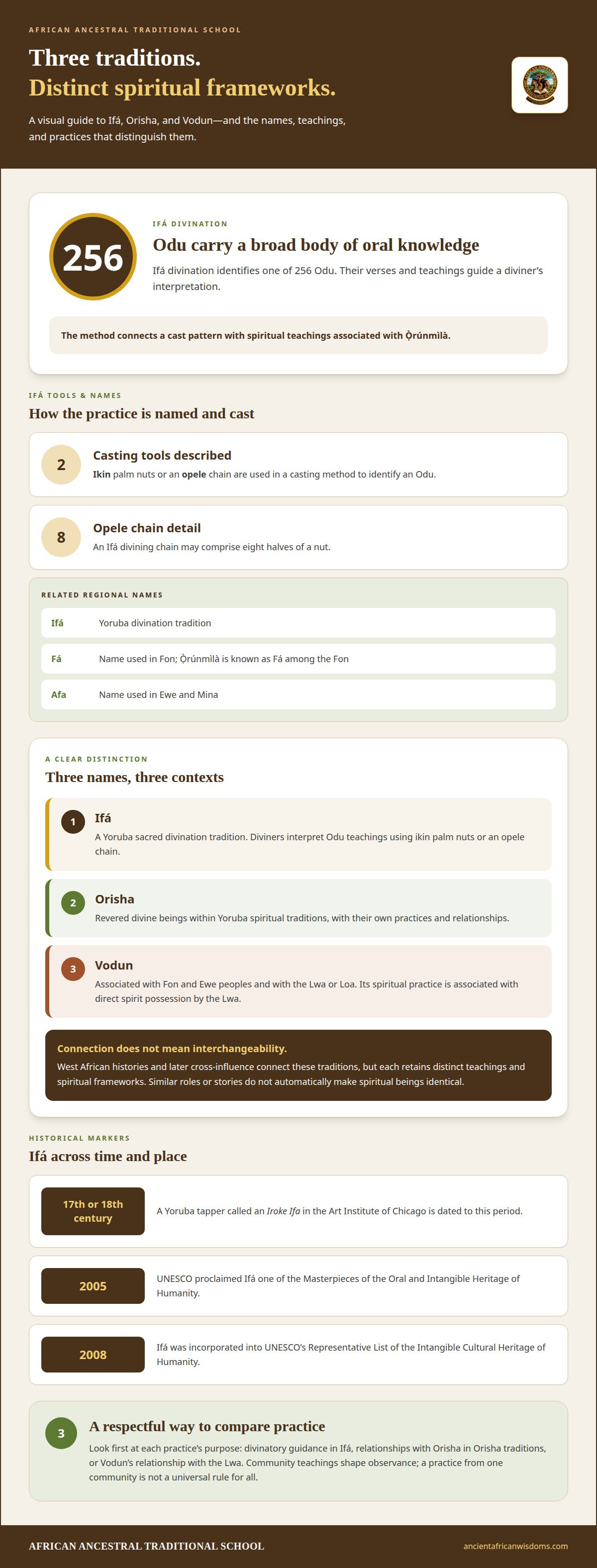
Ifá originated among the Yoruba peoples of West Africa. In Yorubaland, diviners interpret Ifá to access the teachings associated with Ọ̀rúnmìlà. Ifá is called Fá in Fon and Afa in Ewe and Mina. Among the Fon, Ọ̀rúnmìlà is known as Fá. The differences between Orisha, Vodun, and Ifa become clearer when you recognize that these names belong to related but distinct cultural settings.
Ifá divination draws on knowledge organized into 256 Odu. Practitioners use ikin palm nuts or an opele chain in a casting method to identify an Odu. Its verses and teachings guide interpretation. An Ifá divining chain may comprise eight halves of a nut. These tools connect the act of divination with a broad body of oral knowledge.
Objects and recognition also document Ifá’s history. A Yoruba tapper, called an Iroke Ifa, in the Art Institute of Chicago is dated to the 17th or 18th century. UNESCO proclaimed Ifá one of the Masterpieces of the Oral and Intangible Heritage of Humanity in 2005. According to UNESCO, it was incorporated into the Representative List of the Intangible Cultural Heritage of Humanity in 2008. The differences between Orisha, Vodun, and Ifa also make more sense when each tradition is understood in its own historical context.
How did the African diaspora shape these traditions and their variations? West African histories traveled with communities to the Americas, where Ifá and Vodun encountered new social and religious settings. Later cross-influence shaped variations, while the traditions retained distinct identities.
| Tradition or name | West African connection | Key distinction |
|---|---|---|
| Ifá | Yoruba | Divination and Odu teachings |
| Fá | Fon | Fon name associated with Ifá |
| Afa | Ewe and Mina | Regional name for the practice |
Start with what each term names: Ifá is a Yoruba divination tradition, while Fá and Afa are related regional names.
Orisha and Lwa/Loa pantheons
Orisha are revered divine beings within Yoruba spiritual traditions. Vodun has its own spiritual framework and practices. These terms describe distinct traditions, not one shared pantheon. Understanding the differences between Orisha, Vodun, and Ifa starts with recognizing what each name refers to, rather than treating the beings as interchangeable.
West African coastal histories and later cross-influence in the Americas connect these traditions, but connection doesn’t erase their distinct teachings. Orisha belongs to Yoruba spiritual contexts, while Lwa or Loa is associated with Vodun. A similar role or story in one tradition doesn’t automatically make two spiritual beings identical. The differences between Orisha, Vodun, and Ifa become clearest when names are understood in their own cultural settings.
Divination also helps distinguish their frameworks. Ifá divination uses ikin palm nuts or an opele chain to generate one of 256 Odu. Vodun is associated with direct spirit possession by the Lwa, a different emphasis from Ifá’s divinatory method. Orisha traditions have their own practices and relationships with revered beings; they shouldn’t be reduced to either method.
These traditions are practiced in West Africa and across diaspora communities, including in the United States. Ifá ceremonies took place in Miami in 1978, overseen by Nigerian babalawo Ifayẹmi Elébùìbọn Awise of Osogbo. In 2024, the Church of Ifá was described as active in Nigeria and Benin, with around 2000 followers in Lagos, Porto-Novo, and Cotonou. These examples point to distinct traditions with histories across regions, not one unified practice.
To deepen your understanding of these spiritual frameworks, explore courses on African Spirituality, Culture and Tradition. Compare each tradition through its own names, teachings, and relationships, rather than assuming that shared history makes its spiritual beings interchangeable.
What rituals, offerings, and ceremonies are common in each tradition?
Rituals in Ifá, Vodun, and Orisha traditions express distinct relationships with spiritual knowledge and beings. Shared West African history doesn’t make their ceremonies identical. The purpose of a practice, the community’s lineage, and the tradition’s teachings all matter. A practice associated with one community shouldn’t be presented as a rule for every community.
In Ifá, divination is central. During a consultation, a diviner interprets a cast pattern through the teachings of Odu, connecting ritual action with guidance and knowledge. The ceremony’s meaning depends on that interpretation, not on a generic ritual formula. This helps distinguish Ifá’s divinatory purpose from practices centered primarily on spirit presence or devotion.
Vodun is associated with the Fon and Ewe peoples and with the Lwa or Loa. Its spiritual practice centers on direct spirit possession by the Lwa, as distinct from Ifá’s divination. A ceremony involving this relationship shouldn’t be treated as interchangeable with an Ifá consultation. The traditions’ shared coastal histories do not erase their different spiritual frameworks.
Orisha traditions focus on relationships with Orisha, revered divine beings. A ritual or offering should be understood through the particular Orisha and the teachings of the community observing it. Don’t assume that one ceremony or offering applies across every Orisha tradition. The name of a spiritual being alone doesn’t explain the full meaning of a practice.
To compare ceremonies respectfully, consider their purpose before their outward form. Does the practice center on divinatory guidance, a relationship with an Orisha, or Vodun’s relationship with the Lwa? Then consider how community teachings shape the observance. These distinctions offer a clearer guide than treating offerings as a universal checklist.
Specific offerings and ceremonial details belong within their traditions and communities. A general comparison can explain broad purposes, but it shouldn’t turn sacred practices into instructions detached from their context. Focus on the meaning each tradition gives its rituals, and recognize that local teachings shape how they are carried out.
Roles of priests, diviners, and initiates in traditions
In Ifá, a diviner interprets the signs produced during a consultation and relates them to Odu teachings. An Ifá initiate is called a babaláwo in Yoruba and a bokɔnɔ in Fon. These titles reflect different linguistic and cultural settings, not a single role shared uniformly across West Africa. The diviner’s work centers on interpreting Ifá knowledge, not simply predicting events.
This interpretive role connects the consultation to Ọ̀rúnmìlà, whose teachings are accessed through divination in Yorubaland. The diviner explains the spiritual context to make the result meaningful. The person seeking guidance and the trained diviner have different responsibilities: one seeks understanding, while the other interprets the divination within the tradition.
In Vodun, priests and priestesses serve their communities within spiritual relationships that include the Lwa or Loa. Their roles belong to Vodun’s own practices and teachings. Because Vodun is associated with Fon and Ewe peoples, titles and responsibilities can reflect community and lineage. The term bokɔnɔ is used for an Ifá initiate in Fon, but that does not make every Vodun leader an Ifá diviner.
Orisha traditions also include religious leaders who guide worship and help maintain relationships with Orisha. Their responsibilities are shaped by their community’s teachings, not by a universal job description. An initiate, a priest, and a diviner are not interchangeable terms. Ifá divination, for example, has a specific interpretive role, while service connected to Orisha belongs to its own framework.
These distinctions help answer whether someone can learn both Ifá and Vodun: the traditions are distinct, and learning both means honoring their separate roles and teachings. A title alone doesn’t establish identical training or authority across traditions. To build a grounded understanding of these roles, explore African spirituality courses and continue learning with care for each tradition’s context.
African Ancestral Traditional School
African Ancestral Traditional School offers structured learning about African spiritual traditions. If the differences between Ifá, Orisha, and Vodun have raised further questions, its school levels and ancestral spiritual teachings provide a path to deeper study of African spirituality, culture, and tradition.
This learning path is for those ready to explore ancestral teachings within a learning community, beyond brief definitions. Community access supports connection with others, and spiritual rituals are part of the school’s offerings. These resources encourage ongoing learning about African heritage without treating distinct traditions as interchangeable.
To continue your learning, explore the African Ancestral Traditional School’s online programs.
Carry your learning forward
A deeper understanding of the differences between Orisha, Vodun, and Ifa can be a starting point, not a final answer. Continue with patient study: notice which questions remain, learn the language and context of each tradition, and approach its teachings with respect. The care you bring to learning matters as much as the information you gather.
As you continue, make room for reflection and for knowledge held within living communities. Distinctions become clearer through sustained learning, not by forcing separate paths into one explanation. Keep exploring at a pace that honors both your curiosity and the depth of these traditions.
For a next step in your learning journey, contact African Ancestral Traditional School. Let your questions guide you toward a grounded connection with ancestral knowledge.
Frequently Asked Questions
Can someone practice both Ifa and Vodun?
Yes, someone can learn about or practice both while recognizing that each has its own teachings and community context. A practical starting point is to study each tradition on its own terms, rather than blending names or practices because they seem similar. Pay attention to how each community understands spiritual responsibilities, learning, and lineage.
Do Ifa and Vodun share any of the same spirits?
Don’t assume that a spirit in Ifá has an identical counterpart in Vodun. Their histories are connected through West African coastal contact and later exchange in the Americas, but their spiritual frameworks remain distinct. Similar names, associations, or stories may reflect regional relationships or historical influence. To understand a specific figure, consider the tradition and community in which that figure is honored.
Is Santeria the same as Ifa?
No. Santería, also known as Lucumí, is an Afro-Cuban religious tradition shaped by Yoruba heritage, while Ifá refers to a Yoruba divination tradition. Their histories and practices can be connected, but the terms don’t mean the same thing. Someone discussing Santería may mean a broader religious tradition, not specifically Ifá divination or its trained practitioners.
Is Voodoo the same religion as Ifa?
No. Ifá is a Yoruba tradition centered on divination, while “Voodoo” is a spelling often used in English for distinct traditions, including Haitian Vodou and Louisiana Voodoo. The names may sound related, but that doesn’t make these traditions identical to Ifá. First identify which tradition a speaker means before comparing its beliefs or practices.
Why do people confuse Ifa and Voodoo so often?
People may confuse them because both are associated with African spiritual heritage and have histories shaped by diaspora. English-language discussions also use varied spellings, including Ifá, Vodun, Vodou, and Voodoo, which can blur important distinctions. To clarify a conversation, identify whether it refers to Yoruba divination, a Fon or Ewe tradition, or a specific diaspora religion.
What are the historical origins of Orisha, Vodun, and Ifa traditions?
Orisha traditions and Ifá have Yoruba roots in West Africa, while Vodun is associated with Fon and Ewe peoples. These traditions developed within distinct cultural settings and have histories of contact along the West African coast. Diaspora communities carried and adapted spiritual traditions across the Americas. To understand a particular practice, place it within its community’s history rather than treating all three as one tradition.


