
Ancestors are not always portrayed as deities; their spiritual place depends on the tradition and the story. African folklore and its spiritual lessons offer a way to explore how the living relate to those who came before and how spiritual presence can shape a community’s understanding of the world. A revered ancestor and a divine being may hold distinct roles within a tale.
It’s understandable to wonder where reverence ends and divinity begins. Folktales carry traditions and customs across generations, while their characters and choices give spiritual ideas meaning. They can also offer lessons about integrity, courage, responsibility, and the bonds that connect people to family and community.
Here, you’ll explore stories from Nigeria, Tanzania, and the Democratic Republic of Congo, with attention to ancestors, talking animals, spiritual beings, and divine help. As you follow these tales, notice how each story presents spiritual power and what the characters’ actions teach about living well.
Key Takeaways
- Explore how folktales carry cultural memory and offer lessons that speak across generations.
- Understand why ancestors may be revered without being portrayed as deities in every tradition.
- Notice how animals’ human-like choices reveal ideas about character, responsibility, and community.
- See how spiritual beings and divine help shape a story’s view of power, guidance, and human action.
Illustrated folktales from Nigeria, Tanzania, and the Democratic Republic of Congo
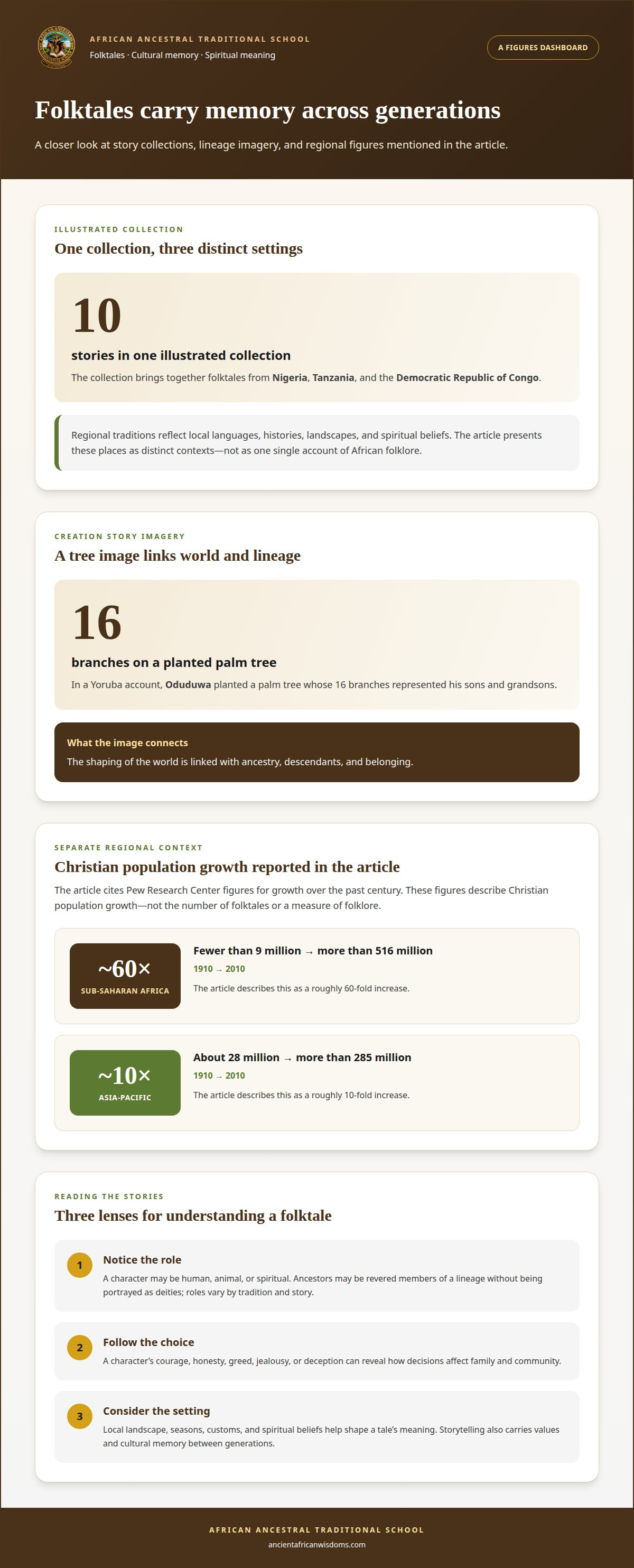
Folktales carry traditions and customs across generations, using memorable characters to explore spiritual ideas and human choices. One illustrated collection brings together 10 stories from Nigeria, Tanzania, and the Democratic Republic of Congo.
Folktale Characters
Folktale characters may be human, animal, or spiritual figures whose choices shape a story’s meaning. A protagonist might show courage or honesty, while an antagonist may embody greed, jealousy, or deception. In a village setting, these contrasting roles help children consider consequences. They also invite readers to look beyond a simple hero or villain and consider how each character’s actions affect the community.
Moral Lessons for Young People
Folktales provide moral education by turning values into choices young people can hear, remember, and discuss. A story might contrast honesty with deception, then reveal how a character’s actions affect family or community. Elders have used tales to teach young people the moral expectations of their societies. Shared storytelling gives children examples to reflect on, connecting personal conduct with responsibilities passed from one generation to the next.
Regional Folktale Traditions
African folklore is community-held stories and customs that carry beliefs across generations. West, East, Central, and Southern African traditions reflect local languages, histories, landscapes, and spiritual beliefs; Nigeria, Tanzania, and the Democratic Republic of Congo illustrate distinct contexts. Pew Research Center reports the fastest Christian growth over the past century occurred in sub-Saharan Africa and Asia-Pacific. Sub-Saharan Africa saw a roughly 60-fold increase, from fewer than 9 million in 1910 to more than 516 million in 2010. Asia-Pacific saw a roughly 10-fold increase, from about 28 million in 1910 to more than 285 million in 2010.
Creation Myths and Their Meanings
Creation myths use accounts of the world’s beginnings to express ideas about ancestry, order, and belonging. In a Yoruba account, Oduduwa planted a palm tree with 16 branches representing his sons and grandsons. This image connects the shaping of the world with lineage and descendants. Modern writers and filmmakers also adapt folklore’s origin themes and moral conflicts, carrying familiar ideas into contemporary literature, film, and popular culture.
GAZETTE: Are ancestors considered deities in the traditional African cosmology?
Ancestors are not automatically considered deities across African traditions. Some communities honor them as members of the lineage who remain spiritually significant, while divine beings may hold distinct roles. These ideas vary by region, culture, and spiritual worldview, so one account cannot represent every tradition. In a folktale, notice whether an ancestor offers guidance, receives reverence, or acts as a creator; those roles help clarify how the story understands spiritual presence.
Oral storytelling carries these understandings across generations. In the traditional practice called Tales by Moonlight, adults gathered children around a village fire after the day’s work to share stories. The setting made listening a community experience, while a remembered character or event helped carry teachings beyond that evening. As stories pass between generations, storytellers preserve values and cultural memory while shaping details for their audience.
African religious traditions are varied, not one system with a single account of ancestors. A story from one community may describe ancestral guidance differently from a story elsewhere; its meaning depends on the cultural setting and the relationships among the living, ancestors, and spiritual beings. Notice who tells the story, who receives respect, and what actions follow. This offers a more careful interpretation than treating one tale as a rule for an entire region.
Traditional worldviews and science ask different kinds of questions. Science investigates observable processes, while a folktale may express spiritual meaning, kinship, or communal responsibility through narrative. These approaches are not interchangeable. A story about an ancestor’s guidance, for example, can reveal how a community understands duty and belonging without serving as a scientific explanation of natural events. Read African folklore and its spiritual lessons with attention to both the story’s meaning and the tradition that gives it context.
Animals with human attributes
African folktales often give animals and birds human attributes. A bird may speak or sing, while an animal may display honesty, greed, or jealousy. These characters aren’t simply people in fur or feathers. Their familiar forms place human choices within the living world. A talking creature can challenge a listener’s assumptions, while its actions reveal the consequences of a decision.
Consider what changes when a story gives an animal a human voice. A speaking bird might carry a warning, share knowledge, or expose another character’s deception. An honest creature can contrast with a greedy or jealous figure. These roles make abstract qualities visible through action. Follow what each character says, what it chooses, and how other beings respond.
Animals also belong to stories shaped by their surroundings. African folktales may refer to dry and rainy seasons and their effects on vegetation and animal life. This detail makes the landscape part of the narrative, not just a backdrop. Notice how changing conditions affect the animals’ choices, then consider how the tale connects human conduct with care, need, and life in a shared environment.
To interpret an animal character, trace three things: its human-like trait, its choice, and the outcome. If a tale presents a creature as jealous, for example, identify what that jealousy prompts it to do. Then notice how the result affects other characters or the community. This keeps the lesson rooted in the story instead of assuming every animal means the same thing across diverse traditions. Different tellings may shape a character differently, so attend to the words, actions, and consequences in the particular tale. Animal voices invite reflection, while their choices help readers examine values through a memorable encounter.
Spiritual beings and divine help
African spiritual beliefs shape how folktales portray sacred authority, help, and relationships between people and the unseen. Symbols and teachings vary by culture, so read a crown or spirit within the particular story rather than treating it as a universal sign.
In one account of a Yoruba kingdom, rulers were considered divine kings, and their veiled crowns signified sacred powers. The crown represents more than political leadership in that story: it connects rule with spiritual authority. This shows how an object can carry layered meaning. Ask who wears the symbol, what role they hold, and how the tale presents their responsibilities.
Divine help in a folktale may come through guidance, protection, or an intervention that changes what a character can do. To understand its meaning, follow the sequence: identify the need, notice who or what responds, then consider the result. If a character receives help after acting wisely, the story may connect spiritual support with responsibility rather than present it as effortless rescue. The character’s response matters, too.
Symbols drawn from nature can also give spiritual teachings a visible form. A crown, a tree, or a change in the natural world may help a story express authority, continuity, or dependence on forces beyond one person. The symbol’s meaning, however, belongs to its narrative and culture. Consider how the characters interpret it, and whether it guides their choices, marks a sacred role, or signals change in their community.
Read spiritual beings as part of a story’s relationships, not as interchangeable figures. An ancestor, a ruler with sacred authority, and a divine helper can serve different purposes in the same tale. African folklore and its spiritual lessons become clearer when you attend to each being’s actions and the consequences that follow. To continue exploring these teachings, study ancestral spiritual wisdom.
African Ancestral Traditional School: Courses on African Spirituality, Culture and Tradition
African Ancestral Traditional School offers courses on African spirituality, culture, and tradition for readers ready to deepen their understanding beyond individual folktales. These courses connect cultural stories with broader ancestral teachings, helping learners explore how spiritual beliefs and traditions inform one another.
For a more structured learning path, African Ancestral Traditional School Levels offer progression through teachings, while Community Access connects learners exploring African heritage. These options suit those ready to study African spirituality and culture in greater depth, beyond interpreting a single story.
For a considered next step in exploring ancestral traditions, contact African Ancestral Traditional School.
Carry the stories into your own learning
Let a folktale be a starting point for reflection, not a final answer. As you continue learning, consider which values its characters embody and how those teachings relate to your own sense of heritage. Approach each story with respect for the culture that carries it, and leave room for its meaning to deepen over time.
If you’re ready to continue learning, African Ancestral Traditional School offers a path through African Ancestral Traditional School Levels, Ancestral Spiritual Teachings, and Community Access. These offerings support sustained exploration beyond reading a single tale. African folklore and its spiritual lessons can prompt thoughtful questions about identity, lineage, and the wisdom you choose to carry forward.
Contact African Ancestral Traditional School to take a considered next step. Keep learning with patience, curiosity, and care for the traditions that give each story its meaning.
Frequently Asked Questions
GAZETTE: How have ancestors played a role in traditional societies?
In some traditional societies, ancestors are remembered as part of family and community continuity. Their role may include serving as examples of valued conduct or remaining spiritually significant to descendants. Beliefs and practices differ across communities, so don’t assume an ancestor’s place from one story alone. Notice how a particular tale describes lineage, remembrance, and obligations among the living.
GAZETTE: How would you define indigenous African religions?
Indigenous African religions are diverse spiritual traditions rooted in African communities, histories, and cultural practices. They don’t form one uniform system: beliefs about ancestors, divine beings, ritual, and the natural world vary across peoples and regions. A careful definition therefore leaves room for difference. In reading a story, identify the tradition and cultural setting it names before applying broader labels.
What are common themes and characters in African folktales?
Common themes include the consequences of choices, relationships between generations, and responsibilities within a community. Characters may include human protagonists, trickster figures, talking animals, ancestors, or spiritual beings. A story’s setting can matter as much as its cast: a village gathering, a changing season, or a journey may shape the conflict. Compare each character’s motives with the outcome.
What spiritual lessons do African folktales teach?
African folktales can encourage integrity, honesty, courage, and care for others. The teaching often emerges through what characters do and what follows, rather than through a direct instruction. A tale about a broken promise, for instance, may prompt discussion about trust and responsibility. Read the ending closely, then consider how the lesson relates to the characters’ relationships and community.
What lessons do Anansi stories teach about wisdom and consequences?
Anansi stories often feature a clever character whose plans reveal both the value and limits of wit. The lesson isn’t simply that cleverness is good or bad; the outcome depends on how it’s used. Follow Anansi’s goal, the choices made to reach it, and who bears the consequences. This helps distinguish resourcefulness from selfishness or deception.
How do African folktales explain nature, morality, and community responsibilities?
African folktales connect these ideas by placing human choices within a living world and a network of relationships. A story shaped by rain, drought, plants, or animals can show how conditions affect daily life. Its moral meaning may also emerge in how characters share resources, keep promises, or respond to others’ needs. The particular tale and culture determine the emphasis.


