
A kola nut is more than a ceremonial gesture. In West African traditions, it can express respect, welcome, and a sacred bond. The spiritual significance of kola nut offerings is especially visible in Igbo practice, where sharing the nut can mark hospitality and connection, and its parts may carry distinct ritual meanings.
If you already recognize kola as a sign of welcome, you’re right to sense that its meaning reaches further. According to SAGE Publications, kola is given to show respect and as a sacred offering. Its symbolism isn’t identical across every community, so understanding the tradition means paying attention to its context and the people who carry it forward.
This guide explores how kola nut represents life, unity, charity, and love, and why the number of cotyledons can matter in some Igbo traditions. You’ll also learn how kola is presented and shared, and how these customs connect everyday hospitality with spiritual remembrance. Understanding the context helps reveal the offering as more than an object or gesture: it is an expression of relationship and heritage.
Key Takeaways
- Understand how kola nut can serve as both a sacred offering and a gesture of respect, while recognizing that customs vary across communities.
- Explore how sharing kola can express welcome, unity, and goodwill, and what those meanings reveal about relationships.
- Follow the stages of an Igbo welcome, from presenting kola to sharing it among those gathered.
- Discover why cotyledon patterns hold distinct meanings in some Igbo traditions, and how they deepen the ritual’s symbolism.
Kola nut as a sacred offering and cultural symbol in West Africa
Kola may be offered in prayer, with its handling shaped by each community. It is also given to show respect.
Offering Kola Nut in Prayer
Offering kola in prayer makes the nut part of a spoken act of reverence and relationship. In Igbo practice, prayers may accompany the breaking of kola and express hopes for well-being or blessing. A guest may keep a piece as a sign of acceptance, linking the offering to a shared relationship. The nut is not simply presented; it becomes part of a meaningful exchange.
Roles in Breaking and Offering Kola Nut
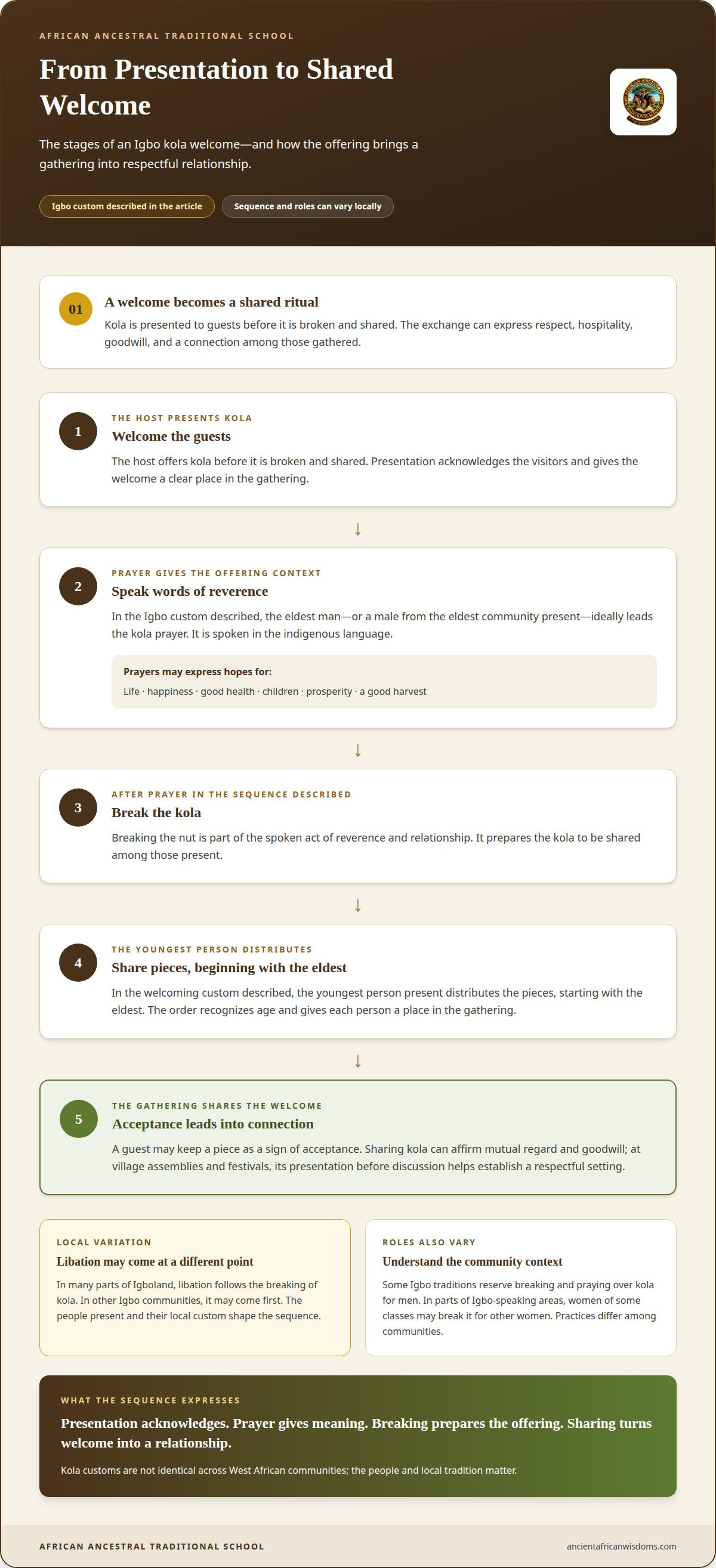
In the Igbo custom described here, the eldest man or a male from the eldest community present ideally leads the kola prayer. The prayer is spoken in the indigenous language, and the nut is then broken. In many parts of Igboland, libation follows the breaking; in other Igbo communities, it may come first. The sequence depends on the people present and their local custom.
Cultural Differences in Kola Nut Practices
Igbo, Yoruba, and other West African communities should not be treated as one ritual system. Kola can serve as a respectful offering, while the prayer, handling, and order of actions vary by community. The Igbo examples here include prayer in an indigenous language and differing libation sequences. Kola trees have also been planted on graves and used in puberty rituals in West Africa, illustrating the range of cultural settings.
Spiritual and Medicinal Uses
Spiritual use gives kola a role in prayer or offering; chewing it for a bodily purpose is a different use. A Portuguese explorer in 1587 observed people chewing kola to relieve thirst and improve water’s taste. In Santería, bitter kola nuts are sometimes offered to orishas and used for spiritual cleansing and protection. They may be placed in a room’s four corners or used in cleansing baths. These examples distinguish ritual meaning from practical use without treating them as interchangeable.
Kola nut as a symbol of life, unity, hospitality, charity, and love
In Igbo tradition, sharing kola can express goodwill between people. Prayers around it may speak of life, happiness, health, children, prosperity, and a good harvest.
Unity and Social Cooperation
Shared kola can represent a covenant of peaceful relations between those who partake. In the Igbo belief described here, neither party should consider harming the other after sharing it. The exchange affirms mutual regard and encourages people to live together in good faith. Its meaning lies not only in the nut, but also in the commitment expressed through sharing.
Hospitality and Shared Kola Nut
In Igbo hospitality, offering kola welcomes a guest into a relationship with the household or gathering. The host acknowledges the visitor, and sharing makes the welcome communal rather than private. Each participant has a place in the exchange. This practice shows how hospitality can carry spiritual and social meaning at once, connecting a guest’s welcome with respect among those present.
What blessings or messages are associated with sharing kola nut? Igbo prayers may ask for life, happiness, good health, children, prosperity, and a good harvest. These blessings speak to individual well-being and the flourishing of a household or community. Their place in prayer gives the offering a purpose beyond courtesy, connecting hopes for the future with those gathered.
Charity and love emerge through the act of giving and receiving, rather than through a single fixed meaning. A shared piece can acknowledge another person’s dignity and affirm goodwill between participants. To explore how African traditions carry such meanings across spiritual practice and culture, consider courses on African spirituality and culture.
Igbo kola nut presentation and welcoming rituals
In Igbo gatherings, kola welcomes guests and marks the start of shared discussion. Its presentation gives the ritual a clear place in community life.
Welcoming Guests with Kola Nut
In the Igbo custom described here, a host presents kola to guests before it is broken and shared. The youngest person present distributes the pieces, beginning with the eldest. This sequence recognizes age and gives each person a place in the gathering. At village assemblies and festivals, presenting kola before discussion helps establish a respectful setting.
The order is meaningful: presentation comes first, followed by prayer, breaking, and distribution. In Chinua Achebe’s Things Fall Apart, chapter 3 depicts kola being presented during a visit to Nwakibie. The scene offers a literary example of how receiving a guest and beginning a conversation can be joined through kola. It also shows why the gesture is more than a decorative formality.
Kola Nut in Life-Cycle Ceremonies
Kola can appear at significant communal occasions, including traditional marriages, village assemblies, and festivals. In these settings, its presentation before discussion helps welcome participants and frame the gathering. According to the BBC, kola trees were planted on graves and used as part of puberty rituals in West Africa. These examples connect kola with life transitions and remembrance, though practices differ among communities.
Are there spiritual taboos or risks associated with kola nut rituals? Some Igbo traditions reserve breaking and praying over kola for men, while women of some classes in parts of Igbo-speaking areas may break it for other women. This variation makes local custom essential to understanding the practice. In the example described here, kola is presented before discussions at traditional marriages, though the exact ritual can differ by community.
Kola nut cotyledons and ritual significance
In some Igbo traditions, the number of cotyledons, or sections, shapes how a kola nut is understood. These meanings connect the nut with human relationships, ancestors, and divine blessing, but they belong to particular traditions, not a universal code.
Examples of interpretations include:
- One cotyledon: This kola is not eaten.
- Two cotyledons: Described in this tradition as a “dumb kola,” it is not eaten.
- Three cotyledons: This kola is associated with valiant people.
- Four cotyledons: It symbolizes peace and blessing.
- Five cotyledons: It represents increase in procreation, protection, and good luck.
- Six cotyledons: It indicates communion with ancestors; the smallest section is set aside for them.
- Seven cotyledons: It signals a good omen and symbolizes prosperity.
These associations help explain why the pattern may matter during a ritual. A three-part kola, for example, has a different interpretation from one with six sections. Meaning is not simply a matter of counting; each number belongs to a cultural understanding that gives the nut its place in prayer and communal life.
The type of kola also matters. Oji Igbo has multiple cotyledons, while Oji Awusa has two. In Igbo gatherings, kola may also provide an occasion to raise complaints about troublesome community members. In Ohafia, relatives emphasize libation before breaking the nut, illustrating how local practice shapes its use. Together, these examples show how the spiritual significance of kola nut is shaped by its form, interpretation, and ritual context.
Explore African spiritual rituals and teachings to deepen your understanding of the traditions surrounding kola.
African Ancestral Traditional School: Courses on African Spirituality, Culture and Tradition
Ancient African Wisdoms offers courses in African spirituality, culture, and tradition for readers who want to continue learning about kola nut customs. Its Ancestral Spiritual Teachings and progressive learning levels can help students build a broader understanding of African heritage and spiritual practice.
For a structured way to study tradition, Ancient African Wisdoms offers a guided learning path through African spirituality, culture, and heritage. Community access lets learners connect as they study together. The teachings place rituals such as kola sharing in a wider cultural context while respecting the distinct meanings held by different traditions.
For a next step in your learning, contact African Ancestral Traditional School.
Carry Your Learning Forward
Let this exploration be a beginning, not a final definition. The spiritual significance of kola nut becomes clearer when approached with patience, attention to cultural context, and respect for the people who keep these traditions alive. As you learn, leave room for differences between communities rather than expecting one explanation to apply to every practice.
You might reflect on what a shared offering asks of those present: care, responsibility, or a renewed sense of belonging. That reflection can connect inherited teachings with choices in daily life. Learning is most meaningful when it grows through listening and thoughtful study, rather than treating sacred customs as symbols detached from their communities.
If you’re ready to continue exploring African spiritual traditions, take a gentle next step and contact African Ancestral Traditional School. Keep your curiosity open, and let each lesson deepen your connection to heritage.
Frequently Asked Questions
What is the spiritual significance of kola nut in West African traditions?
Kola can express respect, welcome, and a sacred relationship, with meanings shaped by the community and occasion. In Igbo traditions, prayers may connect its offering with hopes for health, prosperity, children, or a good harvest. Its significance is both spiritual and social: it can mark a relationship between people while honoring beliefs that extend beyond the gathering.
How is kola nut used in Igbo spiritual ceremonies and rituals?
In Igbo settings, kola may open a gathering, accompanied by prayer and followed by sharing. The sequence and leadership can vary by community. In Ohafia, for example, libation is emphasized before the nut is broken. This local variation matters: the ceremony’s meaning comes from the actions and customs observed, not from a single procedure for every Igbo community.
What do the lobes or cotyledons of a kola nut symbolize?
In some Igbo traditions, cotyledon patterns carry distinct meanings rather than one shared interpretation. A three-cotyledon kola is associated with valiant people. A six-cotyledon kola is linked with communion with ancestors, and its smallest section may be set aside for them. Other patterns also carry particular meanings in these traditions. These interpretations are culturally specific, so a number should not be assumed to mean the same thing everywhere.
How is kola nut used in prayer, divination, and offerings?
Kola is used as an offering in prayer, and some traditions interpret its cotyledon pattern symbolically. These practices should not be treated as a universal divination method: the nut’s meaning depends on local teachings and ritual context. Prayer may accompany an offering, while the pattern may carry a separate cultural association. Respectful interpretation begins by distinguishing these roles.
What is the role of kola nut in hospitality and community gatherings?
Kola can frame a gathering by recognizing guests and giving participants a shared part in the occasion. In Igbo settings, it may be presented before discussions at traditional marriages, village assemblies, and festivals. The welcome is more than an exchange between host and visitor: sharing can signal goodwill among those assembled and create a respectful setting for conversation.
What are the traditional rules for presenting, breaking, and sharing kola nut?
In the Igbo custom described here, kola is presented to guests, broken after prayer, and shared, with the eldest receiving first. The youngest person present distributes the pieces. Leadership and the order of related actions can differ across communities, so these details illustrate particular customs rather than universal rules. The people gathered and their local tradition shape how the ritual proceeds.


