
A river or lake can be more than a setting in African spiritual traditions. It may be understood as a place of presence, protection, and relationship. To understand what water spirits in African traditions are, begin with the varied beliefs that connect spiritual beings to water and the life it sustains. The U.S. Government Publishing Office describes nature spirits in many Indigenous African religions as inhabiting water and other environments, protecting people, and providing necessities such as water, sun, and wildlife.
Powerful names and stories are often a first introduction to these traditions. Yet water spirits are not understood in the same way across African cultures. Their meanings come into focus through local histories, ceremonies, and responsibilities toward sacred places.
This guide explores how spiritual practice and storytelling meet, from the reverence surrounding Lake Fundudzi to accounts of Mami Wata and Nyami Nyami of the Zambezi River. It also considers how offerings and ceremonies can express respect, and why these traditions should be approached with care for the communities that carry them.
Key Takeaways
- Understand how water spirits can be connected with protection, essential resources, and relationships between people and the natural world.
- Explore how Lake Fundudzi folklore expresses respect for a sacred place through beliefs about taking water, wood, or objects from its surroundings.
- Learn why Mami Wata’s stories and imagery take different forms across communities, rather than representing one uniform tradition.
- Discover how Tonga accounts connect Nyami Nyami with the Zambezi River and the history of dam construction.
- Compare regional traditions with care, keeping each spirit’s cultural setting and community meaning in view.
African spirits and traditional ceremonies
In many Indigenous African religions, water spirits are understood through relationships between people, the natural world, and spiritual presence. The U.S. Army Training and Doctrine Command describes nature spirits, including water spirits, as protectors that provide life’s essentials. The U.S. Government Publishing Office similarly notes that spirits may inhabit water and other environments, protect people from harm, and provide necessities such as water, sun, and wildlife. Their roles may include safeguarding a community, sustaining life, and making respectful conduct toward particular places spiritually significant.
Ceremonies give these relationships a lived expression. Offerings may acknowledge spirits or ancestors, while prayers and ritual actions can express respect, gratitude, or a request for blessing. Libation, the offering of a drink to ancestors or spirits, is practiced across the African Diaspora. In Nigeria, ogogoro is used in traditional ceremonies, including to offer blessings at weddings. These examples show that ritual meaning depends on the occasion and community, not simply on the presence of a sacred drink or body of water.
The Osun-Osogbo sacred grove shows how a place, a deity, and communal worship can come together. UNESCO places the grove 250 km from Lagos, Nigeria, and records 40 shrines, sculptures, and artworks honouring Osun. The grove also contains over 400 plant species, making its natural setting part of the sacred landscape. UNESCO states that the city of Osun-Osogbo was founded 400 years ago. Worship at the grove includes daily, weekly, and monthly observances, as well as annual festivals, joining repeated acts of devotion with larger gatherings.
Christianity, Islam, and colonialism have influenced how some African communities practise, explain, or publicly express older spiritual traditions. The effects vary by place and history: people may maintain inherited ceremonies, reinterpret beliefs through another faith, or encounter traditions presented through colonial accounts. These influences do not follow one shared timeline or lead to one outcome, so a story from Osogbo cannot represent every African community.
To avoid generalizing, name the specific community and place connected with a story, such as Osun and the Osun-Osogbo grove. Distinguish a community’s sacred belief from a folktale retold for entertainment, and don’t present one spirit as universal. Local custodians and community-held accounts provide essential context for understanding a ceremony’s meaning.
Approach each account as part of a particular relationship with land, water, ancestors, and community. The Osun grove offers one example; other traditions have their own histories and practices. Keeping these distinctions clear helps readers learn respectfully, without flattening living traditions into a single story.
Lake Fundudzi folklore
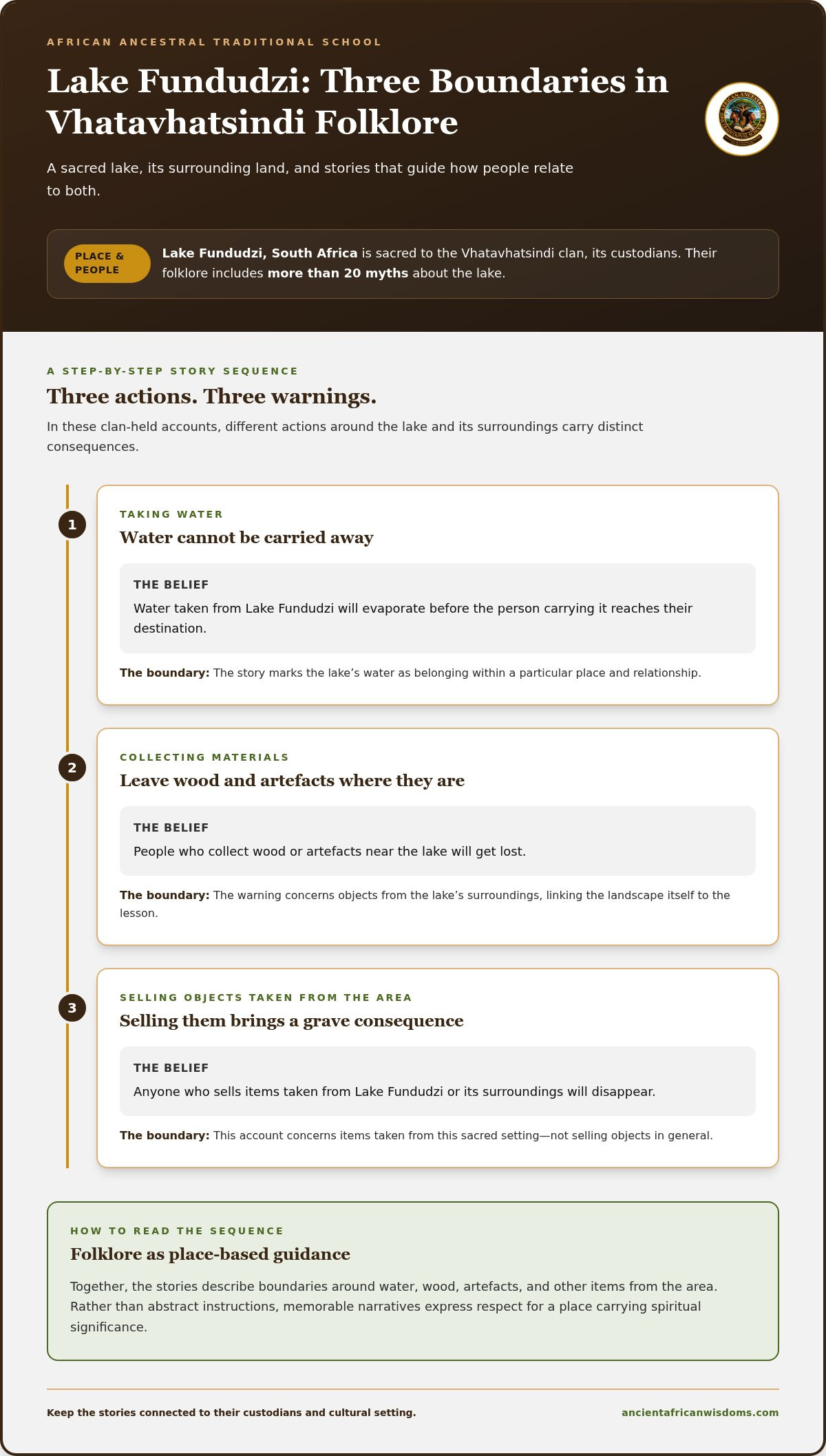
Lake Fundudzi is a sacred place in South Africa associated with the Vhatavhatsindi clan, its custodians. The clan’s folklore includes more than 20 myths about the lake. These accounts describe more than unusual events; they express how people should relate to a place carrying spiritual significance. In this tradition, the lake is not simply scenery or a source of materials. Its stories guide conduct around its waters and surrounding land.
One belief holds that water taken from Lake Fundudzi will evaporate before the person carrying it reaches their destination. The account establishes a clear boundary: taking water away does not succeed. Rather than treating this as a practical prediction, readers can understand it as part of a story that marks the lake as sacred. The journey away from the shore becomes a reminder that the water belongs within a particular place and relationship.
Other stories concern wood and artefacts near Lake Fundudzi. The Vhatavhatsindi clan believes that people who collect these items will get lost. This consequence links gathering objects with losing one’s way, making the landscape part of the lesson. The warning applies to materials from the lake’s surroundings, not just to water. Together, these accounts describe boundaries around both the lake and the things found nearby.
Another belief says that anyone who sells items taken from Lake Fundudzi or its surroundings will disappear. This story adds a further warning: removing an object is forbidden, and selling it brings a grave consequence. The distinction matters. The account concerns items taken from this sacred setting, not trade or selling objects in general.
Together, the Lake Fundudzi stories form a connected set of teachings: water cannot be carried away, wood and artefacts should not be collected, and objects from the area should not be sold. Each example describes a different action and consequence. This structure shows how folklore can communicate respect for a place through memorable narratives, rather than abstract instructions alone.
The Vhatavhatsindi clan’s role as custodian is central to understanding these accounts. Their more than 20 myths give the lake a specific cultural context, so the stories should not be detached from the community that carries them. When sharing the folklore, name Lake Fundudzi and the Vhatavhatsindi clan, and distinguish these beliefs from traditions belonging to other communities. That care preserves the stories’ local meaning.
Mami Wata
Readers asking, “What are water spirits in African traditions?” may encounter Mami Wata as one example, but her meaning is not uniform. Her name, stories, and representations vary across communities and cultural settings.
Regional and Ethnic Differences
Mami Wata is a varied spiritual figure, not one fixed character shared identically across African traditions. Communities understand and represent her through their own histories and beliefs. An image or story from one setting cannot explain every community’s relationship with Mami Wata. Read each account in its cultural context, rather than treating the name as a complete explanation of local tradition.
Attributed Qualities and Powers
Stories and devotional contexts may associate Mami Wata with beauty, attraction, prosperity, healing, or spiritual power. Other accounts emphasize respect, obligations, or consequences connected with encounters. These qualities are not a universal checklist for every community. The question “What are water spirits in African traditions?” has no single answer, and the qualities attributed to Mami Wata show why context matters. Distinguish a particular account from claims about all traditions.
Stories and Symbols
Mami Wata stories may center on encounters between humans and a powerful water presence, exploring themes such as desire, gifts, commitments, and transformation. Artistic depictions may show a woman near water, a mirror, a comb, or a snake. These images can suggest beauty, self-regard, mystery, or spiritual authority, but their interpretation depends on context. Avoid assigning a fixed meaning to a symbol without considering the community and story in which it appears.
Mami Wata also appears in contemporary religious practice and popular culture. Some people approach her as a spiritual presence, while artists and storytellers adapt her image in creative works. A painting, performance, or story does not by itself explain its creator’s beliefs. Consider whether a particular work presents Mami Wata as sacred, cultural, or fictional, and keep those uses distinct.
When you encounter an account of Mami Wata, ask who is telling it and what role the spirit plays in that telling. A story about a gift or commitment, for example, may carry meaning beyond its dramatic events. The question “What are water spirits in African traditions?” is best explored through specific stories and settings, not assumptions based on one image. This approach leaves room for the diverse meanings communities give Mami Wata.
Nyami Nyami and the Zambezi River
Nyami Nyami belongs to Tonga belief and is closely connected with the Zambezi River. Stories about this spirit bring spiritual meaning into conversation with a major change to the river: dam construction. Understanding the account means holding together the historical events people experienced and the spiritual interpretation through which Tonga communities understood them.
During the 1950s, floods in the Zambezi valley delayed construction of the dam and caused the deaths of 80 construction workers. In Tonga belief, these events showed that Nyami Nyami was displeased and had taken revenge. The account connects the disruption of construction with the spirit’s relationship to the river. The floods were not treated only as obstacles to a building project, but as events with spiritual significance.
This connection gives the story its weight. A river can sustain life and shape how people understand their surroundings, while a dam intervenes in its course. In the Nyami Nyami account, the conflict between construction and the river expresses spiritual displeasure. The story links a visible event, flooding, with a community’s understanding of an unseen presence.
Keep the distinction between history and belief clear. The floods, delayed construction, and deaths of 80 workers are events described in the account. The explanation that Nyami Nyami acted from displeasure and revenge belongs to Tonga belief. Presenting these parts distinctly respects both the historical record and the spiritual meaning carried by the story, without reducing one to the other.
Nyami Nyami’s story also shows why local context matters when discussing water spirits. This is a Tonga account tied to the Zambezi, not a general explanation for every African tradition or every flood. The spirit’s meaning emerges through the relationship between a particular community, a particular river, and a specific moment of change. Without those details, the story becomes harder to understand.
As you read the Nyami Nyami account, note who holds the belief, where the story unfolds, and what event gives it meaning. Here, Tonga belief interprets floods during dam construction in the Zambezi valley as a response from Nyami Nyami. This careful reading preserves the difference between a community’s spiritual understanding and a claim that the story applies universally.
This distinction keeps the account intelligible without reducing its spiritual meaning to construction alone. In Tonga belief, floods that delayed dam construction and killed workers showed that Nyami Nyami was displeased and had taken revenge. This is the account’s interpretation of those events, not a separate description of what the floods physically did. The river, construction, and spirit’s response belong together within the story, while the events and the belief about their cause remain distinct.
Reading the story this way leaves room for both dimensions: construction was delayed and workers died, while Tonga belief understood these events as expressing Nyami Nyami’s displeasure. The account’s force comes from the relationship between a change to the river and the meaning assigned to it. Keeping that relationship in view avoids treating the spirit as merely a symbol or the floods as merely a practical interruption.
How do water spirits differ across African regions and ethnic traditions?
Water-spirit traditions differ in their names, community histories, sacred places, and stories. Lake Fundudzi, Mami Wata, and Nyami Nyami are distinct examples, not one shared template. Comparing them shows how a spirit’s meaning emerges from a particular relationship between people, water, and place.
At Lake Fundudzi in South Africa, the Vhatavhatsindi clan’s folklore centers on the lake and conduct in its surroundings. Stories about carrying away water, collecting wood or artefacts, and selling items connect spiritual meaning with specific actions at that place. The community’s role as custodian is essential to understanding these accounts.
Nyami Nyami belongs to Tonga belief and is associated with the Zambezi River. The story links the spirit with floods during dam construction in the 1950s, which delayed the work and caused the deaths of 80 construction workers. Tonga belief interprets the events as Nyami Nyami’s displeasure and revenge. This account differs from Lake Fundudzi folklore because it connects a river spirit with a particular historical disruption.
Mami Wata offers a different example. Unlike accounts rooted in one named lake or river discussed here, Mami Wata appears across different African communities and cultural expressions. Her stories and representations need to be read in context, rather than treated as identical everywhere. The name alone does not tell you how a specific community understands her.
These examples show that traditions can differ in several concrete ways:
- Place: Lake Fundudzi and the Zambezi River anchor stories in distinct landscapes.
- Community: Vhatavhatsindi and Tonga traditions carry their own histories and interpretations.
- Narrative: Fundudzi folklore emphasizes conduct around a sacred lake, while the Nyami Nyami account interprets floods and dam construction.
- Representation: Mami Wata appears through varied stories and cultural expressions.
Use these distinctions when reading or sharing a water-spirit story. Name the community and location, then separate a community’s belief from a broader comparison. For example, describe the Nyami Nyami account as Tonga belief connected with the Zambezi, rather than applying its interpretation to every river spirit. Likewise, present the Vhatavhatsindi stories as belonging to Lake Fundudzi, not as universal rules for sacred waters.
To deepen your understanding, explore learning about African spiritual traditions with attention to each tradition’s own setting and meaning.
Libation, the practice of offering drinks to ancestors or spirits, has roots across the African Diaspora and has been upheld as a tradition and religious offering in ancient Egypt, Greece, and Israel. This wider context can complement regional water-spirit traditions without collapsing their differences. The existence of libation does not establish that every community’s stories involve such an offering or that people understand offerings in the same way. Clear distinctions allow comparison to illuminate shared themes while preserving the specific meanings attached to a place, community, and its beliefs.
African Ancestral Traditional School: African Ancestral Traditional School Levels
For readers who want to explore African spirituality, culture, and tradition beyond individual stories, African Ancestral Traditional School offers structured online learning. Its levels provide a progressive path for study, while its ancestral spiritual teachings help learners engage with inherited knowledge in context.
This learning path may suit you if you want to understand how spiritual beliefs connect with cultural practice and community life. Community access offers space to learn alongside others, and spiritual rituals are part of the school’s teachings. Together, these offerings support a more grounded exploration of ancestral traditions without treating distinct communities as one.
Continue your learning at ancientafricanwisdoms.com.
Carry Your Learning Into a Deeper Practice
As you continue exploring what water spirits are in African traditions, let each story invite careful learning rather than a sweeping answer. Consider how spiritual knowledge is carried, how community shapes interpretation, and how ancestral teachings connect with daily life. That curiosity can become a steady path of study, grounded in respect for the traditions and people behind each account.
African Ancestral Traditional School offers structured levels, ancestral spiritual teachings, and community access for learners ready to continue exploring African spirituality, culture, and tradition. Choose a learning path that suits your interests and gives you room to grow through study and shared reflection.
Explore learning with African Ancestral Traditional School, and take your next step with care and confidence.
Frequently Asked Questions
What are water spirits in African traditional religions?
Water spirits are spiritual beings connected with water in particular African religious traditions, though their identities and roles vary by community. Some accounts describe distinct spiritual presences; others connect water’s significance with broader beliefs about nature, ancestors, or sacred places. To understand a specific tradition, look to the community’s own names, stories, and teachings. That context is more helpful than assuming every water spirit has the same nature.
What are common names for African water spirits, such as Mami Wata?
Mami Wata and Nyami Nyami are names associated with African water-spirit traditions, while Osun is honored at the Osun-Osogbo sacred grove. These names do not label interchangeable figures: each belongs to its own cultural and spiritual setting. If you encounter a name in a book, artwork, or conversation, note the community and place being discussed. This distinction helps you understand whether a source describes a living belief, a story, or a cultural representation.
How are water spirits honored or approached in African traditions?
Approaches depend on the specific community and spirit, so learn the local context rather than copying a ceremony. An offering or prayer meaningful in one tradition should not be treated as universal practice. For example, when studying a sacred lake’s stories, learn who holds responsibility for that place and what its traditions teach about respectful conduct. Listening to community knowledge keeps spiritual practices connected to their meaning and avoids turning them into generic rituals.


