
Up to 80 percent of people in Africa rely at least in part on traditional medicine as their primary means of healthcare. African traditional healing is broader than the use of remedies: it can also include spiritual understanding, ancestral relationships, and care rooted in community life. The two ideas overlap, but they aren't interchangeable.
It makes sense to ask where medicine ends and healing begins, especially when practices differ across cultures and communities. This guide explains African traditional healing, how practitioners work, and why family ties, community, and cultural continuity matter.
You’ll also learn how approaches vary across regions and what can shape access to traditional care. Read with respect for the many living traditions included under this broad term, and consider how knowledge can be carried forward without losing sight of its roots.
Key Takeaways
- Separate medicinal remedies from broader healing approaches, which may also involve spiritual understanding and relationships with ancestors.
- Recognize that practitioners can have different roles, from herbal specialists to diviners, and their methods reflect distinct traditions.
- Understand how access to traditional treatments can depend on local knowledge, community networks, and the availability of healing resources.
- Notice how shared practices and community-led knowledge preservation help carry cultural traditions across generations.
- Explore regional differences with care: practices and beliefs vary, so avoid treating African traditions as one uniform system.
And how different are these from African traditional medicine?
They overlap, but African traditional medicine often refers specifically to health practices and remedies. African traditional healing can also include spiritual meaning, ancestral relationships, and community care.
Traditional Medicine Across African Healthcare
Traditional medicine is a longstanding part of healthcare across African communities, alongside conventional services. Traditional medicine has been integral to African life for thousands of years, and up to 80 percent of people in Africa rely at least partly on it as their primary means of healthcare. For readers, this context shows why it isn't simply an alternative chosen outside healthcare systems. Its role can reflect cultural knowledge, local access, and a community’s understanding of illness.
Integration differs by country. Ghana, Nigeria, and South Africa have established regulatory bodies and traditional medicine policies. These frameworks aim to connect traditional healing with national health systems, while differences in practitioner standards, remedy evaluation, and healthcare structures shape how that connection works.
Regional and Cultural Variation
African traditional medicine is not one uniform system; practices and beliefs reflect distinct cultures and local knowledge. Ghana, Nigeria, and South Africa illustrate variation in healthcare policy, while communities differ in how they understand illness, use herbal remedies, or seek spiritual support. A practice meaningful in one tradition should not be assumed to represent another.
Regional context also shapes how knowledge is passed on and used. Remedy ingredients and preparation may depend on local plants and inherited practices, while a healer’s role can reflect community beliefs. Understanding these differences helps readers approach African traditions with respect rather than treating them as one alternative method.
Holistic Healing and Spirituality
Holistic approaches may bring together herbal remedies, spiritual understanding, and social relationships when interpreting illness. Care, in this view, can address bodily concerns while also considering a person’s connection to family, ancestors, and community. The broader purpose may include restoring social or spiritual balance, not only easing a physical symptom.
What scientific evidence supports commonly used African traditional remedies? Evidence varies by remedy, and attempts to assess some traditional African medicines through clinical trials have not reached phase III. Traditional use and clinical evidence are different forms of knowledge, not interchangeable proof of effectiveness.
What are the risks and side effects of African traditional medicines? Risks depend on the remedy, its preparation, and how it is used alongside other care. Specific ingredients and use matter: a remedy’s traditional role alone does not establish its safety for every person or situation.
Traditional and Conventional Medicine
Traditional and conventional medicine are distinct approaches that can coexist within African healthcare. According to the World Health Organization, resolutions and guidelines have encouraged progressive, mutual collaboration between them since 1978. This matters because collaboration can make space for traditional knowledge while keeping attention on evaluation, safety, and communication across care practices.
Integration also faces practical barriers. Differences in practitioner training, remedy assessment, and healthcare systems can complicate cooperation. Ghana, Nigeria, and South Africa have established policies and regulatory bodies, but a policy framework alone does not resolve every difference in practice. The key distinction is that traditional medicine may be part of healthcare, while methods and evidence remain specific to each remedy and tradition.
Traditional Health Practitioners and healing methods
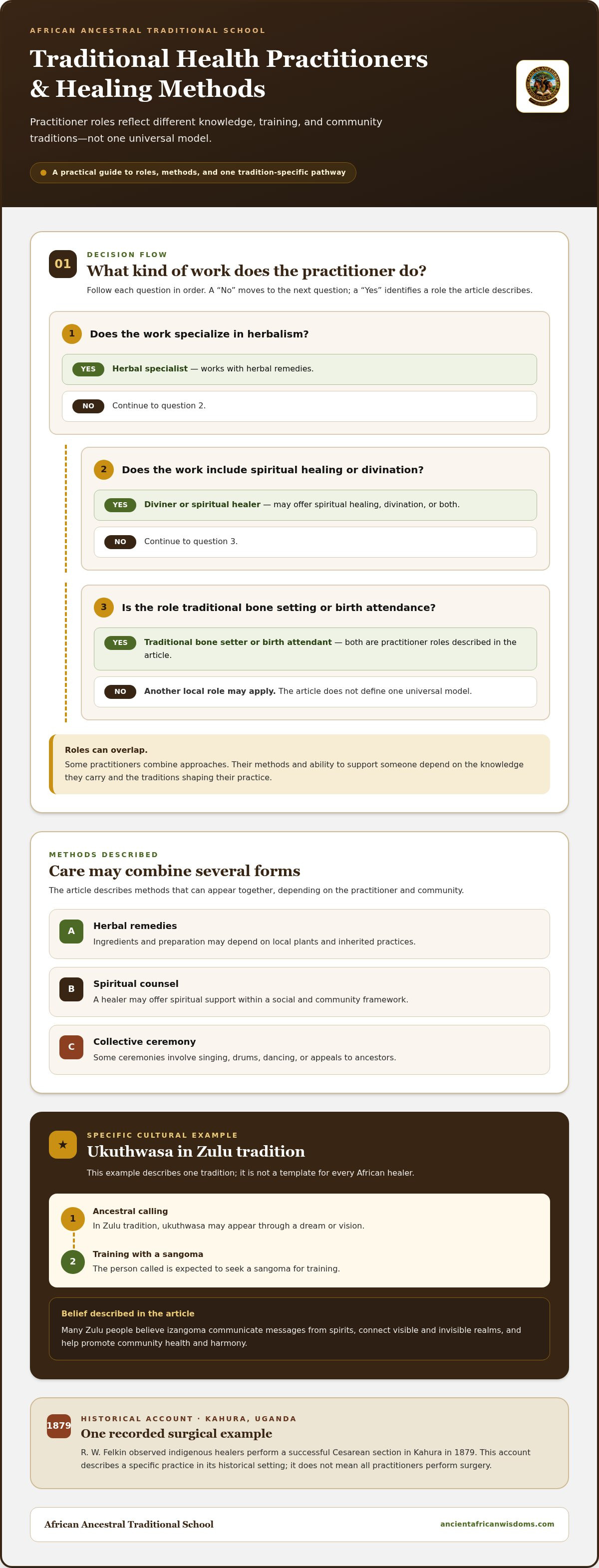
Traditional practitioners have varied roles, shaped by their training and community traditions. Some specialize in herbalism, others in spiritual healing as diviners, and some combine approaches. Traditional bone setters and birth attendants also practice. A healer’s methods and ability to support someone depend on the knowledge they carry, not on one universal model of practice.
In Zulu tradition, ukuthwasa is an ancestral calling that may appear through a dream or vision. The person called is expected to seek a sangoma for training. Many Zulu people believe izangoma communicate messages from spirits, connect visible and invisible realms, and help promote community health and harmony. This is one tradition, not a template for every African healer.
Healing methods can include herbs, spiritual counsel, and collective ceremony. Some ceremonies involve singing, drums, dancing, or appeals to ancestors. A historical account offers another example: R. W. Felkin observed indigenous healers perform a successful Cesarean section in Kahura, Uganda, in 1879. The account shows a specific practice in its historical setting; it doesn't establish that all practitioners perform surgery.
In some communities, illness may be understood through social interaction as well as physical experience. Religion may shape daily life, influencing how people interpret distress and seek support. A healer may therefore provide care within a spiritual and social framework. This can offer culturally meaningful support, particularly around family or community concerns, but it does not mean every mental health condition is treated or resolved through ritual.
Access and affordability depend on local availability, the practitioner’s methods, and the resources needed for care. A 2009 estimate for South Africa reported 500 traditional healers per 100,000 people, compared with 77 medical doctors per 100,000 people. A Durban herbal trade market attracts between 700,000 and 900,000 traders per year from South Africa, Zimbabwe, and Mozambique. These figures point to a substantial network of traditional practice and trade, but don't establish individual treatment costs.
Integration with formal healthcare depends on practitioner standards, remedy safety and quality evaluation, and links to national systems. Between 2025 and 2026, African efforts increasingly focused on these areas. The World Health Organization adopted its Global Traditional Medicine Strategy 2025-2034 in 2025. Collaboration can support respectful exchange, while clear communication helps prevent traditional and conventional care from working at cross-purposes.
Affordability and availability of traditional treatments
Access depends on where a person lives, which practitioners serve the community, and what resources a treatment requires. Herbal remedies rely on plant knowledge and access to ingredients; spiritual practices depend on cultural knowledge and relationships. Practical burdens may include travel, preparation, and time, not only the treatment itself. These factors help explain why affordability differs across communities and countries, even when people share a belief in traditional care.
Local supply shapes what is available. Traditional South African medicine, for example, includes uses for several named plants. Anredera cordifolia leaves are used as a poultice for swollen feet, while its sap is used for rashes associated with contact with dirty water. Emex australis root is prepared as a decoction for stomach complaints. These are descriptions of traditional use, not proof that a remedy effectively treats disease.
Preparation also affects access. A cold-water infusion of Rumex sagittatus roots is used as a body wash associated with cleansing misfortune, while Schinus molle leaves are used in decoctions or steaming for fever and influenza. These methods require different ingredients and preparation from a spiritual ceremony or practitioner consultation. Combining practices can therefore involve distinct resources, and the tradition guiding the treatment shapes what a person seeks.
Availability can change when the natural resources behind remedies become scarce. Excessive harvesting of medicinal plants in Africa can pose an ecological risk by leading to plant extinction. This connects access to stewardship: when a plant becomes harder to find, knowledge of its preparation cannot restore the supply. Plant conservation and the continued transmission of knowledge are linked parts of preserving access.
Markets and community knowledge also influence how people encounter treatments. Someone may learn about a remedy through family or local practice, while access to a practitioner depends on proximity and the kind of support sought. Herbal trade can connect regions, but it does not make every plant or practitioner equally accessible everywhere. Key factors include local availability, preparation needs, distance, and whether care involves one method or several.
These differences matter when comparing traditional care with conventional services. A remedy’s familiar place in a community does not establish its safety or effectiveness for a particular person. Traditional uses of Anredera cordifolia or Schinus molle are cultural descriptions, not instructions for self-treatment. Understanding the specific method, ingredients, and purpose shows how access is shaped without confusing availability or belief with clinical evidence.
Community connection and cultural continuity
Traditional healing knowledge can live in relationships, not only in remedies or individual consultations. Sharing meals, for example, can foster mutual care and strengthen social bonds. Care in this setting may connect people with family and community, giving healing cultural meaning beyond one person’s symptoms. Community ties shape how knowledge is remembered, shared, and understood.
A shared meal can also create space for stories and practical knowledge to pass between generations. A family might discuss which plants have a place in local tradition or how a healing practice relates to community beliefs. These conversations do not replace formal education or clinical evidence; they show how cultural understanding travels through everyday interactions as well as formal teaching.
Community-led initiatives help document traditional knowledge and pass it on. Some use digital platforms and mobile health tools to make records and learning accessible through technology. Documentation can preserve names, preparation knowledge, and cultural context. That context matters: a record of a plant’s traditional use is different from evidence that it treats a disease.
Digital records can support continuity when knowledge is shared with care. A useful record can identify a practice, describe its cultural setting, and distinguish traditional belief from clinical findings. Mobile tools may help communities preserve knowledge that might otherwise remain in spoken exchanges. Yet a digital account cannot represent every tradition, and recording a practice does not make it universal across cultures.
Plants make this distinction especially clear. Knowledge about a plant can include its place in local culture, how communities discuss it, and what traditional use means to them. Preserving that cultural account supports education, but claims about medical effects require separate scientific assessment. This distinction respects inherited knowledge without presenting cultural memory as proof of safety or effectiveness.
Community continuity also depends on who can participate in learning. Local conversations, shared meals, and community-led records each offer different ways to encounter knowledge. One person may learn through family discussion, while another uses a digital resource. These paths can complement one another when they retain cultural context rather than reducing a tradition to a list of remedies.
The clearest takeaway is to treat African healing traditions as living cultural knowledge, not a single archive or method. Shared meals can strengthen social bonds, community initiatives can document knowledge, and digital tools can help carry it forward. Together, these examples show that cultural continuity rests on relationships and responsible preservation, while leaving room for distinct traditions and evidence-based evaluation.
How do African traditional healing practices vary across regions and cultures?
There is no single African healing system. Practices reflect distinct cultures, spiritual understandings, local knowledge, and community histories. Examples from Ethiopia, Morocco, Ghana, and Zulu traditions show how varied these approaches can be. They offer a glimpse, not a complete account of each culture.
Some traditions connect healing with bodywork and everyday cultural practices. Ethiopian coffee ceremonies, Moroccan hammams, and Ghanaian shea butter massages are described as traditional massage and bodywork practices. Their forms differ, from a shared coffee ceremony to bathing traditions or massage. Setting and meaning matter: a practice may carry social or cultural significance alongside its physical aspects.
Zulu beliefs offer a different example. The concept of amadhlozi distinguishes two classes of disembodied spirits. That distinction belongs to a particular cultural framework and should not be applied to other African traditions. A Zulu myth featuring a shapeshifting snake with seven heads likewise reflects a distinct narrative tradition, not a continent-wide belief.
Healing practices can differ in both method and purpose. One community may emphasize plant knowledge, while another places greater weight on spiritual interpretation, bodywork, or shared ceremony. Even within a tradition, a practitioner’s role and a person’s reason for seeking help can shape the encounter. Naming the region and tradition gives readers a clearer picture than using “African” as if it described one uniform practice.
Language and context help preserve these differences. Terms such as amadhlozi carry meaning within Zulu tradition, and loose translation can blur distinctions. Likewise, describing a Moroccan hammam or Ethiopian coffee ceremony simply as a treatment can omit its cultural setting. Readers can approach examples with care by considering which community a practice belongs to and what role it serves there.
These examples show why cultural learning benefits from regional specificity. Ethiopia, Morocco, Ghana, and Zulu communities each offer distinct reference points, but none represents the whole continent. A thoughtful account identifies the tradition, describes the practice, and avoids turning a local example into a universal rule. This keeps ancestral knowledge connected to the people and histories that carry it.
To continue exploring these distinct cultural contexts, explore courses on African culture as part of a respectful learning journey.
African Ancestral Traditional School: African Ancestral Traditional School Levels
African Ancestral Traditional School offers structured learning for readers who want to explore African spiritual traditions and cultural knowledge further. Its African Ancestral Traditional School Levels provide a path through ancestral teachings, while Community Access creates space to learn alongside others.
Turn to this learning when you want to move beyond a general overview and explore teachings in cultural context. Spiritual Rituals are also among the school’s offerings, alongside Ancestral Spiritual Teachings. Learning and practice provide ways to engage with tradition without treating diverse cultures as one system.
If you’d like to continue your learning, visit African Ancestral Traditional School.
Carry your learning forward with care
Let curiosity, respect, and attention to the traditions that speak to you guide your next step. African traditional healing encompasses many distinct cultural paths, so deeper learning can help you understand teachings in context and reflect on how they connect with your heritage. Learn gradually, distinguish spiritual education from medical care, and approach ancestral knowledge with humility.
African Ancestral Traditional School offers African Ancestral Traditional School Levels, Ancestral Spiritual Teachings, and Community Access. These learning pathways may suit you if you want a structured way to explore African spirituality and culture alongside a community. As you study African traditional healing, keep cultural context at the center of your questions.
Take the next step when you feel ready to continue your study. Contact African Ancestral Traditional School to explore a learning path that feels meaningful to you. Keep asking thoughtful questions, honor the roots of the knowledge you encounter, and let understanding grow at a steady pace.
Frequently Asked Questions
What is African traditional healing?
It refers to diverse approaches to wellbeing rooted in African cultural knowledge, spiritual beliefs, and community traditions. Care can mean addressing physical concerns alongside social or spiritual needs. It is not one uniform system, and a practice from one community should not be assumed to represent another. To understand a specific tradition, consider its cultural setting and the role the practice serves there.
What are common African traditional healing practices and remedies?
Practices vary by community and may include herbal preparations, spiritual rituals, bodywork, or foods believed to have medicinal properties. In some traditions, foods are part of healing rituals, joining nourishment with cultural or spiritual meaning. These examples describe different kinds of practice, not a universal list. Traditional use and clinical evidence are separate considerations, so cultural significance alone does not establish effectiveness.
What roles do traditional healers play in African communities?
Traditional healers may offer knowledge, interpretation, or support shaped by their training and community tradition. Their role can involve helping people understand an experience within a cultural or spiritual framework, rather than focusing only on physical symptoms. Roles differ: a practitioner may center their approach on herbal knowledge, divination, or another area. The title “healer” alone does not explain someone’s training or the care they provide.
What is the role of spirituality and ancestors in African traditional healing?
In some traditions, ancestors are understood as part of a continuing relationship between the living and spiritual realms. Some healers use bones, shells, or stones to communicate with ancestors or spiritual entities. The meaning of these practices depends on the tradition in which they occur. They are spiritual and cultural practices, not clinical tests, and their interpretations should not be treated as medical diagnoses.
Can African traditional remedies interact with prescription medications?
Yes, an interaction is possible, and the exact ingredients and preparation matter. If you use a traditional remedy alongside prescription medication, share its name and ingredient information with your prescriber or pharmacist. Do not assume a remedy is compatible simply because it has a longstanding traditional use. Keep prescribed treatment unchanged unless the professional responsible for your care advises otherwise.
How is African traditional healing regulated in the United States?
In the United States, the applicable regulatory questions depend on the activity, not just the cultural label. Spiritual education, an herbal product, and medical treatment are different activities and should not be treated as interchangeable. A tradition’s name alone does not establish professional licensing, product standards, or clinical approval. Distinguish cultural or spiritual practice from a claim to diagnose, prevent, or treat a medical condition.
How does African traditional healing compare with conventional medicine?
Conventional medicine generally approaches health through clinical assessment and medical treatment, while traditional practices may also emphasize cultural, social, or spiritual meaning. The approaches can have different purposes and evidence bases. If you draw on both, keep those differences clear: a ritual’s cultural importance does not demonstrate a remedy’s clinical effect, and traditional practice should not replace medical care for a health condition.


