
There is no single African teaching about the soul. African concepts of the soul differ across communities: among Zulu and Xhosa traditions, umoya connects breath with the life force that animates the body, while Akan thought distinguishes spiritual aspects with different roles and destinies. Across these traditions, the soul may be understood through its bond with the body, its continuity after death, or its return through reincarnation.
It’s natural to seek one clear definition of African concepts of the soul, especially when ideas about soul and spirit are often treated as universal. In reality, meanings vary by tradition: breath may signal life, ancestral presence may connect generations, and ideas about the relationship between body and spirit may shape identity and destiny.
This introduction explores differences among African traditions with care. It looks at how breath and life force are understood, how reincarnation and immortality appear in some beliefs, and what these perspectives reveal about the soul’s relationship to the body.
Key Takeaways
- Explore how ideas of breath and life force connect the body with spirit in different African traditions.
- Notice how reincarnation and ancestral presence can express continuity between generations.
- Compare perspectives on the soul-body relationship, including Yoruba ideas of destiny and purpose.
- Distinguish the roles of Akan spiritual concepts in shaping identity, character, and a person’s path.
- Approach each teaching within its cultural context rather than treating African traditions as one shared belief system.
African traditional religious views of the soul and spirit
African traditions describe spirit and life through distinct ideas, not one shared doctrine. Akan concepts such as ntorɔ and kraa show how lineage, character, and spiritual continuity can be connected.
Ntorɔ and Paternal Spiritual Inheritance
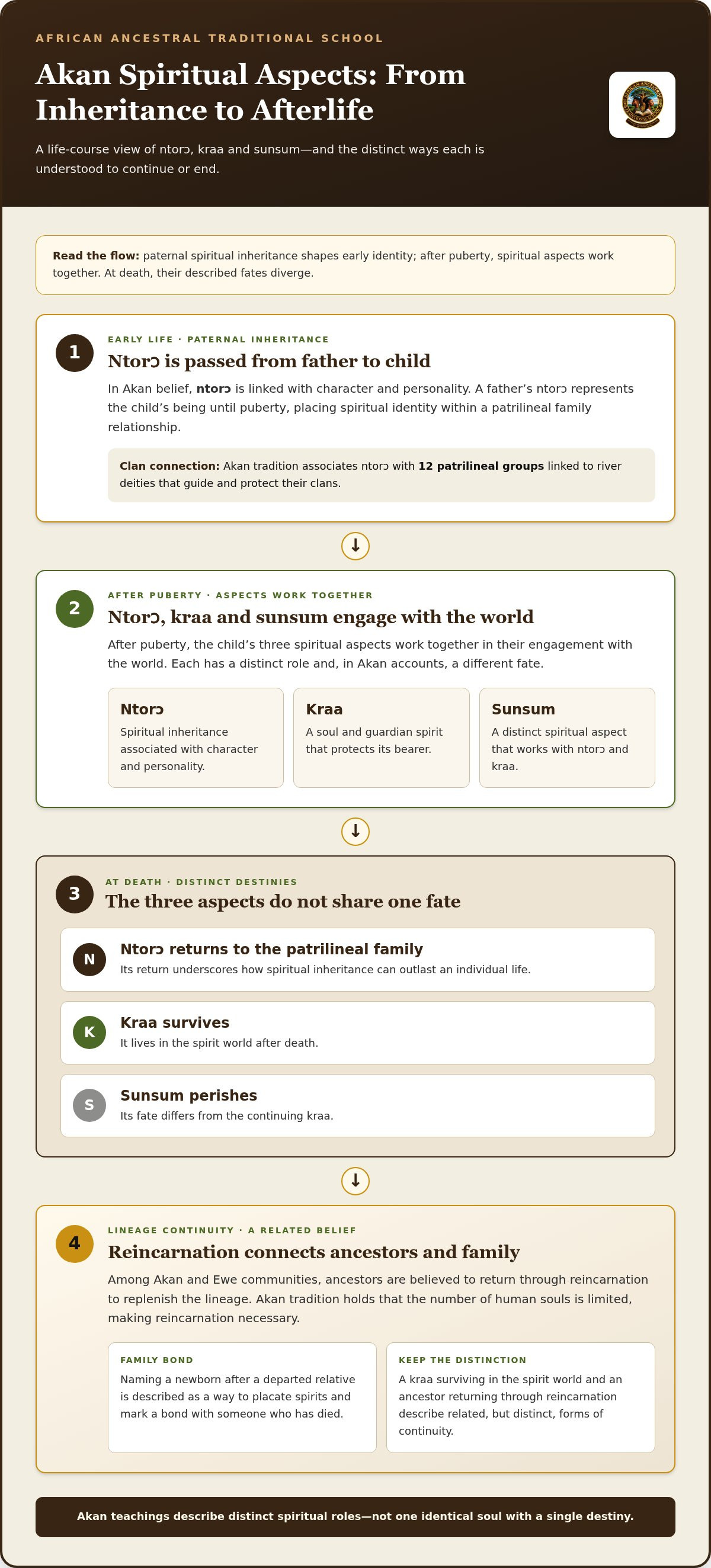
In Akan belief, ntorɔ is a spiritual aspect passed from father to child and linked with character and personality. This inheritance places identity within a patrilineal relationship, rather than treating a person as spiritually separate from family. A father’s ntorɔ represents the child’s being until puberty; afterward, the child’s ntorɔ, kraa, and sunsum work together in their engagement with the world.
Akan tradition associates ntorɔ with twelve patrilineal groups linked to river deities that guide and protect their clans. At death, a person’s ntorɔ returns to the patrilineal family, underscoring how spiritual inheritance can outlast an individual life.
Kraa as Soul and Guardian Spirit
In Akan belief, kraa is a spiritual soul that partly exists as a separate being and protects its bearer as a guardian spirit. Its role connects personal spiritual care with life beyond the body: unlike sunsum, which perishes at death, kraa survives and lives in the spirit world. This distinction shows why Akan accounts describe a person through several spiritual aspects, each with a different fate.
Yoruba beliefs describe ori as a higher destiny and eternal soul, carrying a person’s purpose from heaven to earth; emi is commonly understood as the life-giving spirit. These ideas provide a comparison, not an equivalent set of terms for Akan kraa.
Spiritual Purity and Materiality
Spiritual purity concerns a person’s relationship with sacred life, while materiality concerns the body and tangible world. Akan tradition associates kradware with washing or purifying the soul, showing how spiritual well-being can be expressed through ritual action. This practice makes the soul-body relationship more than an abstract question: spiritual condition can be addressed through actions with a physical form.
Ancient Egyptian ka and ba also distinguish aspects of a person, but they are not direct equivalents of Akan concepts. Ka is associated with vital essence, while ba represents an aspect able to move between the living world and the afterlife.
Akan and Ewe Spiritual Beliefs
Akan and Ewe traditions include beliefs that ancestors may return through reincarnation to replenish the lineage. This understanding connects death with family continuity, while Akan belief distinguishes the surviving kraa from the sunsum that perishes. These differences matter: “soul” can describe distinct spiritual roles, rather than one identical entity across traditions.
Christianity and Islam have shaped African spiritual life through their teachings and practices, and people may interpret inherited ideas alongside either faith. Neither influence makes African traditions uniform or erases every local understanding of spirit and ancestry.
A common misconception is that all African communities share one belief about the soul, or that every spirit is simply a ghost. Akan distinctions among ntorɔ, kraa, and sunsum show why each concept needs its cultural context.
Immortality and reincarnation
In some African traditions, death changes a person’s relationship with family rather than bringing it to a complete end. Akan tradition holds that the number of human souls is limited, making reincarnation necessary. This belief links an individual’s return with the continuity of the lineage. It does not simply claim that everyone lives forever in the same form; different spiritual aspects may have different destinies.
Among Akan and Ewe communities, ancestors are believed to return through reincarnation to replenish the lineage. This addresses how ancestors relate to the soul after death: ancestral presence can continue through a return to the family, as well as through existence in the spirit world. The belief connects life, death, and kinship across generations.
Naming a newborn after a departed relative is described as a way to placate spirits. A name can mark a bond between the child and someone who has died. This recognizes continuity without assuming that every newborn is an exact copy of an ancestor. Its meaning belongs within the community’s understanding of family and spiritual return.
Ideas about the afterlife also differ across African traditions. In Akan belief, the kraa survives death in the spirit world, while the sunsum perishes. This distinction illustrates why immortality and reincarnation need not mean the same thing: one spiritual aspect may continue after death, while another account emphasizes a return to the lineage.
Among the Luba, ancestral spirits form a chain connecting humans to God. In the African cultures described here, ancestral spirits have more power than humans but less than God. This places ancestors within a spiritual order, rather than treating them as identical to the divine. Their continuing significance rests on their position between human life and God.
The spirit world is considered as real as the world of the living among Ghanaian ethnic groups. A 1999 survey conducted by Opoky Onyinah included 1201 participants across Ghana and concerned belief in the traditional spirit-world. This context helps explain why ancestors can be understood as present and consequential, rather than only as memories of deceased relatives.
Reincarnation and ancestral existence can express related but distinct forms of continuity. The Akan and Ewe account of ancestors returning to replenish the lineage focuses on renewed life within family bonds. The Luba chain instead describes ancestors’ place in a relationship linking humans with God. Reading each belief in its cultural setting reveals how spiritual survival can connect a person to lineage, community, and the sacred.
Transcendental Wisdom and the soul-body relationship
Yoruba and Baganda teachings show how spiritual identity can relate to destiny, bodily life, and ancestral belonging. These traditions use different concepts, so “soul,” “spirit,” and “life force” should not be treated as interchangeable labels.
Across African traditions, distinctions depend on the community and the role a concept describes. Yoruba ori carries a person’s purpose from heaven to earth, while Baganda Mwoyo is described as a soul that leaves the body at death. The body is the person’s living, physical form; spiritual terms describe aspects such as purpose, life, or continuing ancestral connection.
For the Yoruba, ori is a higher destiny and eternal soul, joining a person’s purpose in heaven with their life on earth. This idea frames identity through purpose, not only the body’s physical existence. It also gives choices and conduct spiritual significance: a person’s earthly path can be understood in relation to a purpose carried from heaven.
Baganda cosmology describes Mwoyo as leaving the body at death and joining the ancestors if the person lived well. This account links the soul’s fate to conduct and belonging among ancestors. It distinguishes bodily death from the continuation of a spiritual relationship, while making a person’s way of life relevant to that transition.
The Acholi concept pii adwong describes the great water or energy that sustains life. Compared with Yoruba ori, it shows why life force and soul should not automatically mean the same thing. One idea concerns sustaining energy; the other concerns destiny and purpose. These terms offer distinct ways to describe how life, personhood, and the sacred connect.
Banyarwanda cosmology names Imana as God and Bazimu as spirits of the dead within the non-material world. The distinction places divine being and deceased spirits within a shared spiritual landscape without making them identical. The Luba conception also describes ancestral spirits in a chain connecting humans to God, showing another way to understand spiritual relationships beyond the body.
Philosophy of mind names three major dualist theories about mind and body: interactionism, parallelism, and epiphenomenalism. These are philosophical models, not summaries of African traditions. Comparing them can help readers notice the questions different traditions address: whether spirit sustains life, carries destiny, or continues through ancestral connection.
Read Yoruba ori, Baganda Mwoyo, and Acholi pii adwong within their own cultural settings. Their distinct meanings clarify how soul, spirit, life force, and body may relate without collapsing into one universal account.
Akan theological reflections on the soul
Akan thought describes Okra as a divine spark given by Nyame, or God. This teaching places a sacred origin within human life and connects personhood with the divine. It offers one way to understand the soul, but not a complete account of every spiritual dimension. Akan teachings also consider destiny, character, and responsibility, showing how spiritual identity relates to choices in daily life.
Destiny matters, but it does not remove free will in Akan thought. A person’s character and choices can affect how their destiny unfolds, and people remain responsible for their actions. This brings purpose and agency together: destiny gives life direction, while conduct shapes how a person lives it. Spiritual reflection therefore considers not only what is destined, but how one responds.
Akan teachings hold that listening to elders’ advice can help a person fulfil their destiny. Elders’ counsel therefore has practical significance, linking inherited wisdom with personal decisions. For readers exploring Akan theology, this offers a way to approach destiny as something lived through attention, character, and relationships, rather than as an outcome detached from human action.
Libation prayers in Akan tradition address the Supreme God, the earth goddess, and ancestral spirits. The prayer’s recipients show how Akan spiritual life can recognize divine, earthly, and ancestral relationships together. Veneration of departed ancestors is a major characteristic of traditional religions in Ghana. In this setting, ancestors are part of a living spiritual framework, not simply figures recalled as family history.
These teachings can be considered together without treating them as identical. Okra points to the divine spark from Nyame; destiny connects a person’s life with purpose; and responsibility keeps choices meaningful. Listening to elders gives that responsibility a communal dimension, while libation acknowledges sacred relationships. Together, these ideas present Akan reflections on the soul as connected to God, conduct, elders, and ancestors.
These terms enrich reflection on the soul without being interchangeable. In Akan belief, sunsum is an individual spirit derived from the father at conception and associated with a person's distinctive personality, character, intelligence, and psychological attributes. This range of attributes helps explain what marks a person as an individual: the account connects spirit not only with character, but also with intelligence and psychological attributes. Its derivation from the father at conception is part of the description, alongside these personal associations.
In Akan belief, ntorɔ is a spiritual-genetic aspect transmitted from father to child through semen and associated with the child's character and personality. This description emphasizes transmission from father to child and the aspect’s relationship to character and personality. Sunsum and ntorɔ therefore contribute different terms and descriptions to an account of personhood: one is described as an individual spirit, the other as a spiritual-genetic aspect. Both relate to personal qualities, while remaining distinct. Read alongside reflection on Okra, these concepts allow for more than one account of spiritual identity without collapsing their meanings into a single term. They also draw attention to the particular attributes associated with each concept, rather than treating every aspect of the soul as identical.
Honhom or ahomee as breath
In Akan discussions, honhom or ahomee connects breath with spirit. Breath is tangible: it moves through the body and signals living presence. Its spiritual meaning goes beyond that physical sign, inviting a distinction between bodily breath and the life or spirit associated with it. This connection helps explain why breath can carry sacred meaning without defining the soul completely.
Other traditions also use breath-related language to describe spiritual life. Among Zulu and Xhosa communities, umoya means breath or wind and describes the life force animating the body. The Shona of Zimbabwe use mweya for the animating spirit. These examples show a recurring association between breath, movement, and life, while the meanings remain rooted in each community’s tradition.
The distinction matters because breath, spirit, and soul need not mean the same thing. Breath can be observed in the body; a spiritual concept can describe the life force or personal essence understood through tradition. In Akan belief, for example, kraa survives death, while sunsum perishes. This difference shows why breath-related language should not flatten distinct accounts of spiritual identity.
Hebrew ruach also means breath, wind, or spirit, illustrating how one word can carry connected meanings. This comparison does not make Hebrew and Akan teachings identical. Instead, it offers a useful way to read: when a tradition links breath with spirit, consider whether it describes bodily vitality, an animating force, or a spiritual aspect with its own fate. The surrounding beliefs clarify the relationship.
For Akan readers, honhom or ahomee as breath invites reflection on how embodied life and spiritual meaning meet. The comparison with umoya and mweya reveals a shared theme, but not one universal doctrine. Attend to each term’s cultural setting and its relationship to other ideas of spirit and soul. Continue exploring ancestral wisdom through these connected traditions.
African Ancestral Traditional School: African Ancestral Traditional School Levels
African Ancestral Traditional School offers structured African Ancestral Traditional School Levels for learners ready to deepen their understanding of African spirituality, culture, and tradition. After exploring how different communities understand breath, spirit, and ancestral continuity, learners can continue their study through Ancestral Spiritual Teachings.
Choose the school’s structured learning path when you want more than isolated explanations. Community Access brings shared exploration into the learning experience, while Spiritual Rituals are part of the school’s teachings. Each offering provides a different way to engage with ancestral traditions and their meaning.
Continue your cultural and spiritual study at a pace that suits you. Visit African Ancestral Traditional School to explore its teachings and learning levels.
Carry Your Learning Into a Deeper Practice
Let these teachings be a starting point for listening more closely to your own heritage. As you continue learning, consider which questions call for deeper study and how cultural knowledge can shape your connection with lineage and community. African concepts of the soul are more than ideas to compare; they invite thoughtful engagement with the traditions that give them meaning.
African Ancestral Traditional School offers African Ancestral Traditional School Levels and Ancestral Spiritual Teachings for continued study, alongside Community Access for shared learning. These offerings support exploration of African spirituality, culture, and tradition with care and curiosity.
Choose the path that feels meaningful for your next step, whether that means building your understanding or learning alongside a community. Contact African Ancestral Traditional School to continue your journey. Your connection to ancestral wisdom can keep growing, one considered step at a time.
Frequently Asked Questions
What are common African concepts of the soul?
African concepts of the soul include ideas of animating spirit, personal destiny, ancestral connection, and spiritual continuity. Terms and meanings differ by community, so consider what each concept explains: a person’s life, character, purpose, or relationship with ancestors. For example, ask whether a teaching describes the living person, what continues after death, or how spiritual identity connects with family.
How do Akan beliefs describe the soul and spiritual personhood?
Akan beliefs describe spiritual personhood through distinct aspects rather than one all-purpose idea. When studying them, notice how each aspect relates to family inheritance, character, protection, and personal choices. This framework also connects spiritual life with everyday conduct: Akan teachings say people remain responsible for their actions, and listening to elders can help them fulfil their destiny. Personhood is therefore relational as well as individual.
What do African traditions teach about the soul's journey after death?
African traditions describe different possible relationships between the dead and the living, including ancestral presence and reincarnation. Burial practices also matter in some accounts: rites are performed so the dead may find peace and not return to haunt the living. In an Igbo belief described here, a person who dies without children to perform burial rituals may become a wandering ghost. Such accounts distinguish restless spirits from honored ancestors.
How do beliefs about the soul vary across African regions and ethnic groups?
Beliefs vary according to the concepts communities use and the spiritual relationships they emphasize. For example, Mende accounts place Ngewo as the Supreme Being, with ancestral and non-ancestral spirits below. Banyarwanda cosmology names Imana as God and Bazimu as spirits of the dead. These are different spiritual frameworks, not interchangeable versions of one system. Compare terms within their own cultural settings before drawing connections.
How do ancient Egyptian concepts of the soul, such as ka and ba, compare with other African traditions?
Ancient Egyptian ka is associated with vital essence, while ba is an aspect that can move between the living world and the afterlife. Like Akan concepts, they distinguish aspects of a person, but they are not direct equivalents of Akan terms such as kraa or sunsum.


