
What if destiny isn’t a fixed script, but a path shaped by both what you inherit and what you choose? It’s natural to wonder how spiritual purpose can coexist with free will, effort, and everyday decisions. The African understanding of destiny offers no single answer: African cultures have distinct teachings, not one unified belief system.
Some Yoruba traditions discuss ideas such as Ori and Ayanmo, while Akan teachings include Nkrabea. These concepts have their own contexts and interpretations. They shouldn’t be treated as interchangeable or reduced to fate alone. This guide considers how purpose, personal action, character, and responsibility may relate within particular traditions. It also offers ways to reflect carefully, find culturally grounded explanations, and continue learning without claiming a tradition as your own. Begin with curiosity, humility, and room for different perspectives.
Key Takeaways
- The African understanding of destiny varies across cultural traditions. Explore each teaching in context rather than treating them as one belief system.
- Consider how destiny and personal agency may relate. Inherited purpose need not make everyday choices and effort meaningless.
- Use reflection to explore your values, responsibilities, inherited teachings, and choices available to you now, not to predict a fixed future.
- For deeper learning, explore structured online education in African spirituality, culture, and tradition, with tiered learning levels and community access.
What Does African Understanding of Destiny Mean?
Questions about destiny often arise when you’re seeking purpose, direction, or a connection to heritage. The answer depends on the tradition you’re exploring. The African understanding of destiny is not one teaching shared in the same way across an entire continent. Approach it through specific cultural and philosophical traditions, each with its own language, history, and understanding of a person’s place in life.
A concise working definition: Destiny is a culturally situated understanding of life’s path, interpreted within a particular tradition. Its meaning varies across African societies and cannot be reduced to one pan-African doctrine. This definition is a starting point for study, not a forecast of what must happen to an individual.
Destiny as a path through life
The image of a path can make the idea easier to approach. It suggests direction, a relationship between a person and a larger order, or a way to consider life’s purpose. But it is a metaphor, not a universal formula. Traditions explain that relationship differently, so don’t mistake the image for a shared doctrine.
Destiny is also distinct from a personal goal or plan, which someone may set and revise. It is not simply luck, a label for every unexpected event, or proof that life follows a guaranteed sequence. To understand the idea in a particular context, look for sources grounded in that culture rather than assuming one general explanation applies everywhere.
Why there is no single African definition
African societies have diverse spiritual and philosophical traditions shaped by distinct histories, languages, and communities. A concept explained within one tradition can offer insight into that context, but it cannot represent the beliefs of all African peoples. A broader guide to African spirituality can help situate this diversity. To explore a particular teaching, look for sources focused on that tradition.
This distinction matters because a simplified account can turn a living tradition into a universal slogan. Even the familiar English word “destiny” may not capture the full meaning of a concept expressed in another language. Translation offers a doorway, but interpretation also depends on cultural context, who is explaining the teaching, and the questions being considered.
As you read, ask: Which community or tradition is being discussed? Is the writer explaining a specific teaching or making a broad claim about Africa as a whole? These questions help distinguish careful explanation from overgeneralization.
Here, destiny means a philosophical and spiritual way of thinking about life’s direction within a particular cultural framework. It does not mean a reader can know in advance which events will occur. The examples below are distinct accounts, not interchangeable proof of one African view.
How Akan and Yoruba Accounts Place Destiny in Cultural Context
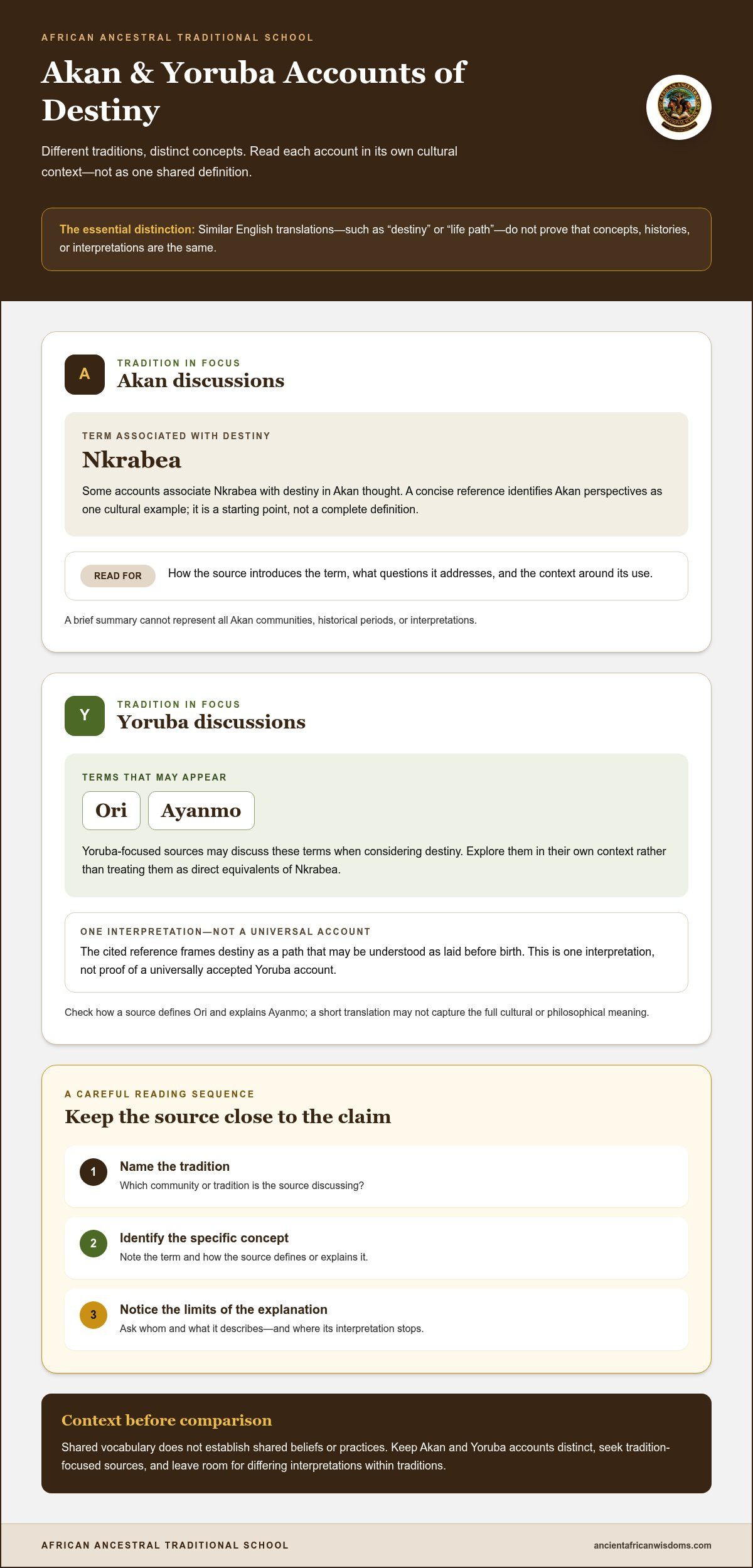
Akan and Yoruba discussions offer examples of how destiny is considered within particular cultural settings. They are not interchangeable, and neither represents every African tradition. Similar English translations, such as “destiny” or “life path,” can make ideas sound alike while obscuring their distinct concepts, histories, and interpretations.
Keep the source close to the claim. When summarizing an idea, identify the tradition, the specific concept, and the source supporting the explanation. African cosmology and heritage can help situate the discussion, but a broad overview is not a substitute for sources focused on Akan or Yoruba thought.
Reading destiny references in Akan contexts
Nkrabea is a term associated with destiny in some accounts of Akan thought. A concise Sage reference entry identifies Akan perspectives as one cultural example in its discussion of destiny. A brief summary, however, cannot stand for all Akan communities, historical periods, or interpretations. Treat the term as a starting point for inquiry, not a complete definition.
When reading an Akan-focused source, note how it introduces the term and what questions it addresses. Does it discuss a person’s life course, spiritual beliefs, or another aspect of existence? The surrounding explanation matters. Translating a word as “destiny” alone doesn’t establish that it means a fixed script or has the same implications as a similar term elsewhere.
Reading destiny references in Yoruba contexts
Yoruba discussions may refer to Ori or Ayanmo when considering destiny. Explore these terms through Yoruba-focused sources rather than treating them as direct equivalents of Nkrabea. The Sage reference entry names Yoruba accounts among its examples and frames destiny as a path that may be understood as laid before birth. That is one interpretation, not proof of a universally accepted Yoruba account.
When a source discusses Ori, check how it defines the concept and what role it gives it in the argument. A short translation may not capture its full cultural or philosophical meaning. Likewise, a summary that mentions Ayanmo needs context to explain how the author relates it to destiny.
These distinctions make the African understanding of destiny clearer by keeping each account rooted in its setting. Shared vocabulary does not demonstrate shared beliefs or practices. A respectful comparison asks what each source says, whom and what it describes, and where its interpretation stops. It also leaves room for disagreement within traditions, rather than turning one scholar’s explanation into a final answer for a whole people.
To continue learning, explore structured African ancestral teachings alongside tradition-specific scholarship, keeping each teaching in its cultural context.
Does Destiny Mean Everything Is Fixed? Understanding Choice and Effort
No. Destiny should not automatically be equated with fatalism, the belief that a person’s actions make no difference because every outcome is fixed. Some accounts describe a path associated with a person before birth while also allowing for effort in how that path is lived. This doesn’t mean people control every circumstance or that effort guarantees a desired result.
A Sage reference entry offers one interpretation: it describes destiny as a path laid before birth while emphasizing that a person may work each day to realize it. Read this as the entry’s framing, not as a universal statement about Akan, Yoruba, or all African traditions. It shows how destiny and action can be discussed together, rather than assuming one cancels out the other.
How effort can matter within a destiny framework
In the Sage entry’s account, daily effort is part of working out a destiny, not necessarily an attempt to escape or defeat it. A person’s choices and conduct may matter within a larger understanding of life’s path. That is different from saying effort can make events unfold in a particular way.
As a general explanation, agency means having meaningful choices and responsibilities, even when outcomes also depend on circumstances beyond your control. You may study, care for family, seek help, or change direction without being able to guarantee success or prevent hardship. This distinction keeps spiritual reflection from becoming a promise of control.
| View | What it suggests | How to qualify it |
|---|---|---|
| Fatalistic assumption | Every event is fixed, so choices and effort are pointless. | This is not the only way destiny is interpreted. |
| Nuanced interpretation | A path may be understood alongside meaningful choices and daily effort. | Agency matters, but it does not guarantee a chosen outcome. |
| Source-specific qualification | The Sage entry connects a pre-birth path with effort to realize it. | This is one summary’s interpretation, not universal consensus. |
What destiny does not establish on its own
A destiny framework alone doesn’t prove that every event has a predetermined spiritual explanation. Nor does it show that a person’s hardship was deserved, chosen, or inevitable. Be cautious of interpretations that use spiritual language to blame someone for suffering or discourage them from seeking practical support.
Responsibility still matters. A belief in destiny need not excuse harm or erase the consequences of choices. At the same time, recognizing responsibility doesn’t mean a person controls everything that happens to them. Holding both ideas together makes the African understanding of destiny less like a rigid script and more like a question explored through specific teachings, ethical action, and lived experience.
When reading an account, ask what its source says about effort, choice, and the limits of human control. Keep those answers tied to that source and tradition. This leaves room for personal agency without turning spiritual teaching into a guarantee, prediction, or judgment about someone’s life.
Reflecting on Destiny Without Treating It as a Prediction
Reflection can bring ideas about destiny into conversation with present-day life, but it can’t reveal a guaranteed future. The prompts below support personal learning; they are not a traditional ritual or universal spiritual prescription. Use them to notice what matters to you while distinguishing your own thoughts from claims about what ancestors, spirits, or a particular tradition has decided.
Questions that connect purpose with daily choices
Start with what you can consider honestly: the values you want your choices to express, the responsibilities that feel meaningful, and the actions available to you now. Write your answers privately or sit with one question. There’s no single correct response, and reflection doesn’t establish what a spiritual tradition says about your destiny.
- Which values do I hope to show through how I treat others and meet everyday responsibilities?
- What responsibilities to family or community feel meaningful to me, and which ones need thoughtful boundaries?
- What choice can I make now that reflects the person I hope to become?
- What do I know from reliable sources, and what am I interpreting for myself?
That last distinction is especially useful. A personal sense of purpose may guide you, but it isn’t proof that ancestors or spirits have selected a particular job, relationship, or life event for you. Let reflection open questions rather than turn uncertainty into prediction.
Approaching ancestral teachings with care
When learning about a tradition, seek explanations rooted in the specific community and context being discussed. Notice who is speaking, which sources they rely on, and whether they distinguish their interpretation from a shared teaching. Learning about ancestral veneration and diaspora heritage can add context without assuming everyone has the same experience.
Access to family histories and lineage knowledge differs across diaspora experiences. Some people inherit stories and teachings directly; others have incomplete records, disrupted connections, or unanswered questions. None of these circumstances requires you to claim a lineage or rush toward certainty. Approach what you know with care, and be honest about what remains unknown.
Keep two strands of reflection separate: what you learn from a tradition-specific source, and what you personally value or choose. This helps you respect cultural teachings without turning them into a prediction about your life. If you want to study these subjects in greater depth, African ancestral spirituality courses can be one learning resource.
For structured learning in African spirituality, culture, and tradition, explore online ancestral teachings and continue at a pace that leaves room for context, questions, and reflection.
Continue Exploring Destiny Through Structured African Ancestral Learning
You don’t need to enroll in a course to take meaning from this guide. Continued study is an option for readers who want to spend more time with African spirituality, culture, tradition, and ancestral teachings. Because beliefs about destiny belong to particular cultural contexts, further learning can help you follow a concept beyond a brief overview and understand the perspectives around it.
What structured digital learning can add
The African Ancestral Traditional School offers online education in African spirituality, culture, and tradition through structured digital courses. Tiered learning levels provide a pathway for ongoing study, and community access gives learners a space to connect. These features make it possible to return to ideas over time. They don’t promise a particular spiritual outcome or replace careful attention to the traditions being studied.
Sequenced study can help place a concept within a wider body of teaching instead of leaving it as an isolated definition. For example, when exploring destiny, consider how a source presents the idea, which cultural setting it describes, and how it explains related teachings. Revisiting those connections supports a more thoughtful understanding while leaving room for questions and interpretation.
For a broader look at structured study of ancestral teachings, the African ancestral spirituality course guide offers additional context. Treat any learning resource as a place to continue asking careful questions, not as a single source that speaks for every African tradition.
A gentle next step for curious learners
If you want to explore cultural and ancestral teachings further, consider what you hope to learn. You might begin with a broad interest in African culture or focus on a particular tradition and its sources. The school’s tiered learning levels support ongoing study, while online community access offers a shared learning setting. Choose a pace that feels considered, and leave room to reflect as your understanding develops.
Structured study can complement reading, listening, and reflection; it isn’t a requirement for understanding the ideas introduced here. Keep cultural distinctions in view and let questions guide your next steps. A single article can open a door, while learning over time can reveal more of the context surrounding a teaching.
Ready to continue exploring African spirituality, culture, and ancestral teachings through structured online study? Explore African ancestral learning.
Let Your Learning Continue with Care
Carry your questions forward with patience. As you encounter teachings about purpose and destiny, notice what each source says, whose tradition it reflects, and where your own interpretation begins. This practice makes room for personal reflection while respecting knowledge held within particular communities.
The African understanding of destiny isn’t a single answer to apply to every life. Treat it as an invitation to learn thoughtfully, consider the choices before you, and stay open to perspectives that may deepen or challenge your first impressions. You don’t need to resolve every question at once. Curiosity, humility, and steady study can all be part of the journey.
Continue exploring African ancestral teachings through the African Ancestral Traditional School. Explore its structured online learning at your own pace, with care for the traditions you encounter and confidence in the questions you bring.
Frequently Asked Questions
Is African understanding of destiny the same across all African cultures?
No. African understanding of destiny varies, and no single explanation represents every African society. To assess a claim, check whether it names the community, tradition, and source it draws on. Akan and Yoruba discussions, for example, offer distinct cultural contexts, not a template for the continent. If an explanation makes a sweeping claim without specifying its scope, treat it as incomplete rather than universal.
Can a person make choices if destiny is part of their spiritual worldview?
Yes, some interpretations allow meaningful choice and effort alongside destiny. A Sage encyclopedia summary describes working each day to realize a path, while cautioning against equating destiny with fatalism. This is one interpretation, not a rule for every tradition. In practical terms, a person might weigh a decision carefully, act on their responsibilities, and accept that effort doesn’t guarantee a particular result.
What is the difference between destiny and fate in African traditions?
There’s no single distinction that applies across African traditions, because writers use English words like “destiny” and “fate” differently. One author may use them almost interchangeably, while another may describe destiny as a path that still involves agency. Before comparing the terms, note how a source defines each one and which cultural context it discusses. An English dictionary definition is not a substitute for a traditional teaching.
Does African destiny mean that hardship is predetermined?
No. The idea of destiny alone doesn’t establish that a person’s hardship was chosen, deserved, or inevitable. A general statement about life’s path cannot explain why a particular person experienced loss or difficulty. Avoid using spiritual language to assign blame or discourage someone from seeking practical support. Focus on what a reliable, culturally grounded source actually says, and leave room for circumstances and differing interpretations.
How can someone explore African teachings about destiny if they don’t know their ancestry?
You can begin learning without claiming a lineage or speaking on behalf of a tradition. Choose material that identifies the community and context it discusses, then keep notes separating the source’s teaching from your own questions. An unknown or disrupted family history doesn’t prevent cultural education, but it calls for humility about personal connection. Begin with listening and careful reading, not assumptions about inherited authority.
Is destiny the same as spiritual purpose?
Not necessarily. “Purpose” may describe the meaning or values someone seeks to express, while “destiny” can carry a specific spiritual meaning within a tradition. Wanting to serve one’s community, for example, may be a personal purpose, but that desire alone doesn’t establish a traditional teaching about destiny. When a source uses either term, check its definition and cultural setting before applying a modern self-development meaning.


