
What if ancestors are not only remembered, but also understood as part of an ongoing relationship between the living and the past? If you’ve asked, “What is the role of ancestors in African spirituality?”, you’re not alone. Accounts can sound contradictory: ancestors may be described as sources of guidance and protection, yet also as guardians of moral responsibilities whose displeasure can carry consequences.
These ideas don’t point to one belief shared by every African community. Traditions differ across regions, families, and lineages, including in how ancestors are honored and how people understand their relationship to the divine. Ancestor veneration, in many contexts, isn’t simply another word for worship. The distinction matters when learning from sources that flatten diverse traditions into a single story.
This article explores common ways ancestors may shape memory, belonging, ethical responsibility, and spiritual life, while recognizing meaningful differences between communities. It offers a starting point for understanding why ancestors can be revered and approached with care, and why tradition-specific knowledge matters. As you read, notice who is speaking, which community their account represents, and whether they are describing a belief, a practice, or a personal interpretation.
Key Takeaways
- What is the role of ancestors in African spirituality? Explore how they may shape lineage, memory, identity, and responsibility, while recognizing that beliefs vary.
- Consider how moral examples and intergenerational continuity can connect the past with choices in the present.
- Understand why geography, language, family lineage, and religious history contribute to distinct traditions.
- Examine beliefs about ancestral protection or punishment as tradition-specific teachings, not universal claims about spiritual intervention.
- Build a respectful learning path by identifying a tradition, examining sources, and distinguishing cultural education from community-specific practice.
What Is the Role of Ancestors in African Spirituality?
Ancestors may remain spiritually and socially significant to their descendants, shaping how people understand family, community, memory, and responsibility. In some traditions, the relationship is understood as active and spiritual; in others, ancestors are honored chiefly through remembrance, inherited values, or family customs. The question, “What is the role of ancestors in African spirituality?” therefore has no single answer that fits every community.
Ancestral remembrance is a recurring theme in some African spiritual traditions, not a uniform doctrine shared by every African people. The phrase African spirituality is a broad umbrella, not the name of one system with identical teachings. Beliefs and practices differ across peoples, languages, families, lineages, and religious histories. Some people hold traditional beliefs alongside Christianity or Islam, while others do not. Traditional African religions often emphasize ancestor veneration. That overview can introduce the topic, but it should not stand in for the teachings of a specific community.
Who may be regarded as an ancestor?
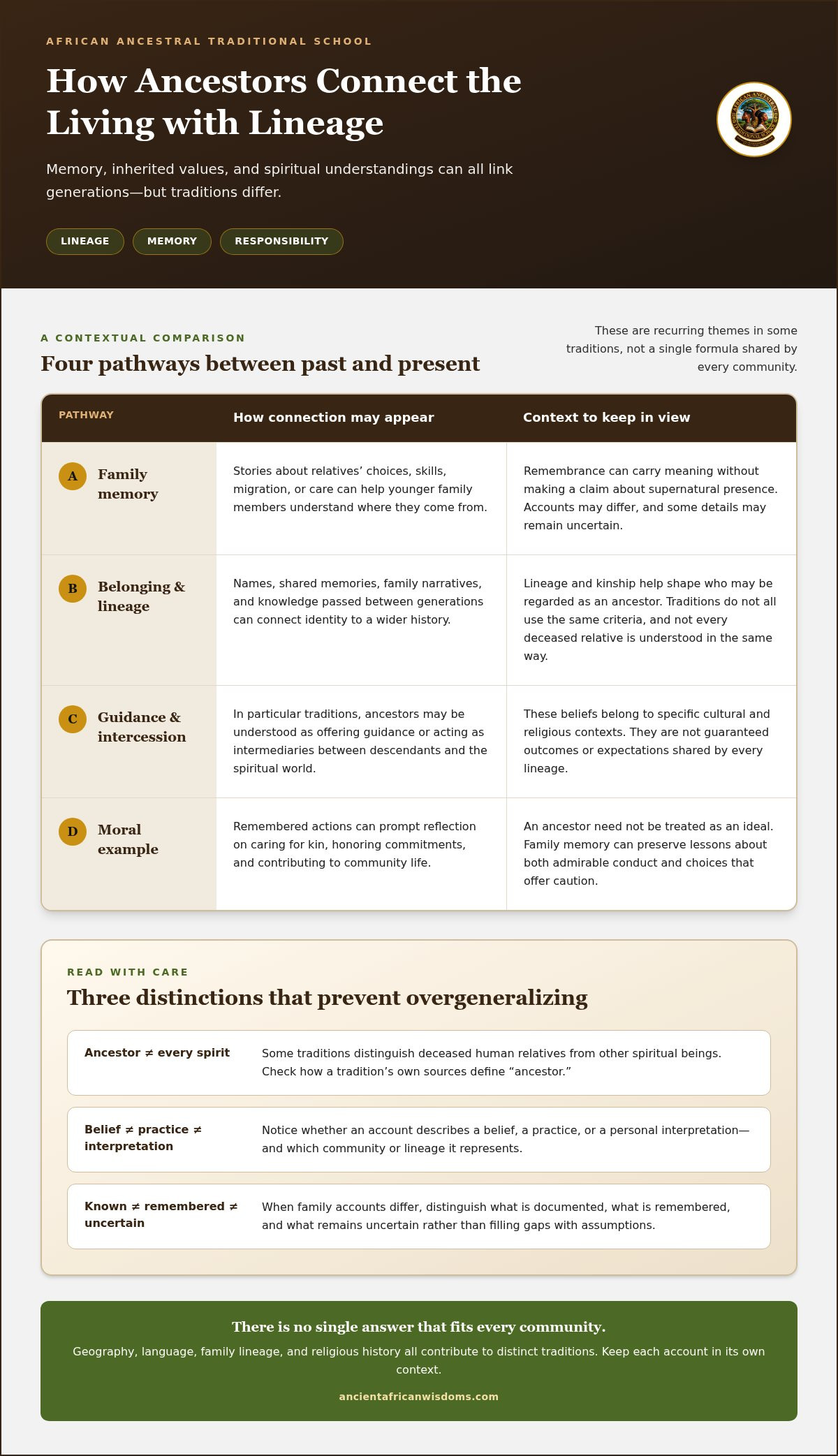
The meaning of ancestor can be shaped by kinship, lineage, and community memory. A person may be remembered as an ancestor because of their place in a family line, their enduring influence, or the way a community carries their story forward. Traditions don’t all use the same criteria or categories, so don’t assume that every deceased relative is regarded in the same way.
Some traditions distinguish deceased human relatives from other spiritual beings, even when both are understood as part of a wider spiritual world. When reading about a tradition, check how its own sources define “ancestor” and whether they distinguish ancestors from other spiritual beings. This avoids treating the term as a general label for every spirit or sacred presence.
Why ancestors remain part of present-day spiritual life
Continuity between generations is a recurring theme, though not a universal formula. Family stories, names, values, and shared memories can connect a person’s identity to a wider history. Remembering an elder, for instance, may keep their counsel or example present in family life without implying that every community understands the memory as spiritual communication.
This connection can also place personal choices within a larger story: what has been received, what is carried forward, and what responsibilities may accompany belonging. For a wider foundation, explore African spirituality and ancestral wisdom, while keeping each tradition’s own context in view.
As you continue learning, note who is speaking, which community or lineage their account represents, and whether they are describing a belief, a practice, or a personal interpretation. These checks help you identify the scope of a claim instead of treating one account as universal. They also make it easier to recognize both recurring themes and the histories that make traditions distinct.
How Ancestors May Connect the Living with Lineage and Spiritual Continuity
Ancestors may connect descendants with a history that reaches beyond one lifetime. In some traditions, this relationship is understood spiritually; it can also be carried through family stories, shared values, and knowledge passed between generations. Asking “What is the role of ancestors in African spirituality?” invites more than one answer because communities understand lineage and spiritual connection in distinct ways.
Memory is one thread in that connection. Stories about a relative’s choices, skills, migration, or care for others can help younger family members understand where they come from and what their community has lived through. Remembrance can carry meaning without making a claim about supernatural presence.
Ancestors, family memory, and belonging
Family narratives can preserve more than names and dates. They may pass on a sense of belonging, practical knowledge, and accounts of relationships that shaped a household or community. A story about how relatives supported one another through hardship, for example, can offer insight into shared values as well as family history.
Not everyone has a complete record of their ancestry, and cultural learning doesn’t depend on having one. Oral accounts, community memory, and careful attention to what is known can all help a person reflect on identity without filling gaps with assumptions. When accounts differ, distinguish what is documented, what is remembered, and what remains uncertain.
Guidance, intercession, and moral example
In particular traditions, ancestors may be understood as offering guidance or acting as intermediaries between descendants and the spiritual world. These beliefs belong to specific cultural and religious contexts. They are not guaranteed outcomes or expectations shared by every lineage. Understandings of spiritual mediation differ, so broad claims about what ancestors “always” do can obscure the teachings and experience of particular communities.
Moral example is another way the past can inform present choices. Remembered actions may help descendants consider how to care for kin, honor commitments, or contribute to community life. This need not mean that every ancestor is held up as an ideal; family memory can preserve lessons about both admirable conduct and mistakes.
Ancestral continuity is not only a bond with those who came before; in some traditions, it also carries responsibilities for those living now. That idea links remembrance to action, while leaving room for communities to define those responsibilities differently. For broader context on the beliefs and values that shape these connections, explore African worldview and ancestral wisdom.
If you’d like to study these ideas over time, consider exploring structured courses in African spirituality and tradition as one path for continued learning.
Why Ancestors’ Roles Differ Across African Spiritual Traditions
There isn’t one shared account of ancestors across the continent. Geography shapes which communities live alongside one another and how customs develop; language carries concepts that may not translate neatly into English. Lineage matters, too. Families and communities can preserve distinct accounts of who is honored, how relationships are understood, and what responsibilities accompany them.
Religious history adds another layer. Traditions change through generations and may interact with other religious frameworks, including Christianity and Islam. Within a community, people may also differ in how they explain or practice inherited beliefs. These differences aren’t errors to be smoothed away. They are part of the history and living context through which spiritual knowledge is understood.
Shared themes do not mean identical beliefs
Remembrance and connection between generations appear as recurring themes in some traditions, but shared themes don’t prove shared doctrine. One community may describe an ongoing spiritual relationship with ancestors; another may place more emphasis on family memory, inherited values, or particular forms of remembrance. Practices and meanings belong to their specific contexts, rather than to a single organized religion called “African spirituality.”
So, what is the role of ancestors in African spirituality? The most careful answer is that it depends on the tradition, community, and lineage being discussed. One community’s account cannot stand in for all African spiritual traditions. Broad summaries can introduce a topic, but they should not erase the voices and histories behind specific teachings.
How to read tradition-specific examples responsibly
When a source names a particular community, keep that name attached to the belief it describes. Look for context around terminology, translation, and history, and notice whether a writer is discussing a documented teaching, a local practice, or a personal interpretation. Avoid carrying a claim from one group into another without evidence.
This care matters especially when reading about Yoruba, Igbo, Akan, or other traditions. A term or account associated with one lineage may not represent every community within that larger identity. For a wider foundation on how beliefs and understandings of the cosmos can be framed, explore African cosmology and its origins.
A comparison can be useful when each example is clearly sourced and attributed. Without reliable, tradition-specific sources, though, a table risks making distinct beliefs look interchangeable. It’s better to explain why a comparison is limited than to fill in details from assumption. When comparing accounts, record the community named, the source’s context, and whether the statement describes a local teaching or a broader interpretation. These details help keep the comparison accurate.
Approach the subject with both openness and precision. Notice recurring ideas, then leave room for differences in language, history, and lived practice. That balance lets you learn from shared themes without turning them into a universal rule.
Do Ancestors Protect or Punish the Living? Understanding the Nuance
Accounts of ancestral influence can include protection, blessing, correction, or consequences, but that doesn’t mean every African tradition describes ancestors in the same way. Nor should these ideas be reduced to a simple choice between loving guardians and frightening enforcers. A teaching has meaning within its own cultural setting, where relationships, obligations, and spiritual understandings shape how it is interpreted.
Accounts of ancestral agency depend on the tradition being described and the source telling it. A written account may record what a community teaches or what particular people believe; it cannot, by itself, independently verify that a spiritual intervention occurred. Holding both points together allows respectful attention to belief without presenting spiritual claims as proven fact.
Protection, blessing, and discipline in context
In some tradition-specific accounts, ancestors are described as sources of protection or blessing for descendants. Other accounts connect ancestral displeasure with misfortune or illness, particularly where a story teaches that family or communal responsibilities have been neglected. These descriptions shouldn’t be treated as a single rule for African spiritual traditions, or as proof that a difficult event is punishment.
Context matters. A narrative about consequences may express ethical teaching, affirm the importance of kinship, or explain how people understand social order. To read it responsibly, look for the community, lineage, and source behind the account. If a source doesn’t identify those details, don’t assume its description applies everywhere. Practices and teachings also shouldn’t be turned into universal requirements or threats.
Respectful learning without fear or overclaiming
Curiosity is a steadier guide than fear. A generalized online claim that ancestors will punish someone, guarantee protection, or respond in a particular way isn’t enough to establish what a specific community believes. Look for clear attribution, cultural and historical context, and a distinction between a community’s teaching and the writer’s interpretation.
Respect can involve learning how a tradition speaks about responsibility and remembrance without assuming that every person must follow the same practice. It also means avoiding promises of contact, healing, protection, or a particular spiritual outcome. If a teaching feels unfamiliar, pause and consider what role it plays in its original context before drawing conclusions.
As you read, consider three questions: Whose belief is being described? Is the source reporting a teaching, a personal experience, or an interpretation? Does it distinguish spiritual understanding from independently verifiable evidence? These questions help separate careful explanation from sensational claims, while leaving space for people to hold beliefs that matter deeply to them.
To explore these ideas through structured study of African spirituality, culture, and tradition, learn through African spirituality courses.
How to Keep Learning About Ancestors in African Spirituality
Learning begins with a better question than “What do all African traditions teach?” Try asking which community, lineage, or historical setting a source describes. This shift makes room for shared themes while protecting the differences that give each tradition its meaning. It also helps separate cultural education, which builds understanding, from instructions for practices that belong within a particular community.
A steady learning path can help you explore the subject with care:
- Identify the tradition. Notice whether a source names a people, community, lineage, or region, rather than making claims about Africa as a whole.
- Examine the source. Look for historical context, community perspectives, and clear explanations of cultural terms.
- Compare perspectives carefully. Ask what is shared and what belongs specifically to the source’s tradition or interpretation.
- Reflect before applying. Treat what you learn as an invitation to understand, not as authority to speak for a community or adopt its practices.
A respectful starting point for further study
Begin with named traditions and sources that explain whose knowledge they present. Pay attention to how terminology is translated and whether historical context or community voices are included. If an account is broad or unclear about its scope, hold it lightly instead of assuming it represents everyone. You can learn with respect without claiming authority over a tradition or needing a complete family record.
Continue learning through structured education
Structured online courses offer one way to study African spirituality, culture, and tradition over time, rather than relying on disconnected summaries. Tiered learning levels provide a path for building understanding step by step, while community access creates space to learn alongside others. The African Ancestral Traditional School offers digital courses in African ancestral wisdom, culture, tradition, and spiritual rituals. Education can deepen cultural knowledge, but it doesn’t guarantee a spiritual outcome or replace the authority and guidance of a specific community.
Keep your learning grounded in patience: return to sources, notice what they can and can’t tell you, and make room for perspectives that differ. This approach supports a fuller understanding without turning one account into a universal rule. As your knowledge grows, you can continue exploring the history and meaning behind ancestral traditions while respecting the boundaries around community-specific practices.
If you’re ready to continue your study, explore the African Ancestral Traditional School and its structured online learning in African spirituality, culture, and tradition.
Carry Your Learning Forward with Care
The question “What is the role of ancestors in African spirituality?” can become a starting point for deeper learning, not a reason to expect one answer to fit every tradition. Let curiosity guide you toward careful study, and let humility remind you that understanding grows through attention, context, and time.
A structured course can provide a steady path for learning about African spirituality, culture, and tradition. The African Ancestral Traditional School offers tiered learning levels and community access for students exploring these teachings alongside others, without promising a particular spiritual outcome.
Explore structured African ancestral teachings through the African Ancestral Traditional School and continue your learning with patience and respect.
Frequently Asked Questions
Can ancestors be considered spiritual guides in every African tradition?
No. Some traditions describe ancestors as guides or intermediaries, while others understand their roles differently or emphasize other forms of remembrance and relationship. If you encounter a teaching about receiving guidance, look for the community or lineage it comes from and how its members explain the idea. A source describing a belief doesn’t establish that spiritual guidance is guaranteed or expected in every tradition.
Is honoring ancestors the same as worshipping them?
Not necessarily. “Honoring,” “venerating,” and “worshipping” can carry different meanings depending on the tradition and how people use those words. Some communities distinguish respect for ancestors from worship of a deity, while other communities may organize spiritual categories differently. Rather than assigning one definition to everyone, notice the terms a specific community uses and how its members describe the relationships and practices involved.
Can someone learn about African ancestors without knowing their family lineage?
Yes. Studying African spiritual traditions and tracing your own genealogy are related but separate activities. You can learn about a community’s history without claiming descent from it or presenting yourself as an authority. Family records may be incomplete or difficult to access, especially for people whose families experienced displacement or diaspora. Treat gaps with care: they don’t prevent cultural learning, but they also shouldn’t be filled with unsupported identity claims.
Do ancestors communicate with descendants through dreams?
Some people or traditions may interpret dreams as spiritually meaningful, but a dream doesn’t automatically prove ancestral communication. If a dream feels significant, you might record what happened, consider its personal and emotional context, and learn how the relevant community understands dreams. Avoid treating one interpretation as universal or making major decisions based only on a generalized online claim. The meaning may be spiritual for some, while others interpret dreams differently.
Can a person honor ancestors from outside their own family?
There’s no universal rule. Customs and boundaries differ, so learning about a respected historical figure is not necessarily the same as joining a rite tied to a particular lineage. For example, reading about someone’s contributions can be approached as cultural or historical study, while a community-specific observance may have its own protocols. Learn the context before participating, and don’t assume practices are interchangeable across traditions.
Are ancestors always understood as deceased family members?
No single definition applies across African traditions. Some teachings focus on family forebears, while others may describe ancestors through broader community or lineage relationships. The word can also be used differently by scholars, practitioners, or families. If a source gives a particular definition, note who is using it and in what setting before applying it elsewhere. That distinction can prevent a local explanation from becoming a false universal rule.
Why do African spiritual traditions describe ancestors differently?
Differences reflect distinct histories, languages, community structures, lineages, and religious practices. Even where ideas such as remembrance overlap, the teachings and terms attached to them may not. So, what is the role of ancestors in African spirituality? The answer depends on which tradition and source you’re studying. Treat a single online guide as an introduction, then look for community-specific accounts rather than assuming it represents the full range of African spiritual thought.


