
African spiritual initiation is not a single, universal ceremony. Its forms and meanings differ across communities. In some African societies, initiation helps young people enter adult roles, learn community values and responsibilities, and connect ritual life with ancestors and the spirit world. These rites can mark a new place within family and community while keeping inherited knowledge alive.
Initiation is more than a private spiritual experience. It can also be a way for a community to teach, welcome, and guide younger members. In many traditions, ancestors are understood as respected elders who remain connected to family and community, forming part of this wider sense of belonging.
This guide explains how initiation can transmit cultural knowledge, prepare young people for adulthood, and give meaning to life transitions through ritual. It also considers how traditions vary and change, so you can explore the subject with care without treating Africa’s many spiritual paths as one.
Key Takeaways
- Understand initiation as a community process that can pass cultural values, responsibilities, and knowledge to younger generations.
- Recognize how indigenous education can prepare young people for adult roles through instruction shaped by their community.
- Explore how rituals mark transitions and create meaning, while their forms differ across cultures and traditions.
- Consider how Balanta initiation practices reflect a living tradition shaped by cultural change.
- For continued learning, explore African Ancestral Traditional School Levels, Ancestral Spiritual Teachings, and Community Access.
Community knowledge and cultural transmission
Initiation can pass on shared knowledge through teaching, ritual, and participation in community life. Socialization, marriage, and mourning each show how ritual can guide relationships and responsibilities.
Ritual Communication and Social Cohesion
Rituals communicate shared values through actions, words, and participation, helping community members recognize their connections and obligations. A ceremony welcoming a young person into a new social role, for example, makes the transition visible to others. Its meaning is collective, not only personal, as community members affirm the responsibilities that accompany the change.
Community Uses of Initiation Rites
Communities use initiation rites to teach social rules, moral instruction, traditional law, and sacred knowledge. A rite may prepare young people to join age grades and contribute to community life. Rituals also take place around marriage and after a family member’s death, helping people respond together to changes in family relationships. These examples show how initiation sits within a wider network of communal practices.
Identity and Community Belonging
Initiation can connect personal identity with a recognized place in the community. Learning its values and responsibilities helps a young person understand how their choices affect others. Entry into an age grade, for instance, can mark a shift from being guided by others to taking on social duties. Belonging is expressed through participation as well as personal belief.
Eldership and Community Wisdom
An elder is not simply an older person. An elder has lived purposefully and serves as a model for the community. Elders can pass on knowledge by explaining customs, interpreting responsibilities, and guiding younger people through transitions. Their example connects instruction with lived conduct. For anyone exploring initiation, this distinction shows why community wisdom depends on experience and service, not age alone.
Visitors should follow the host community’s protocols: seek permission before attending, follow guidance on appropriate conduct, and avoid photographing or sharing restricted teachings. Practices differ, so respect the boundaries set for each ceremony.
African spiritual initiation has no single meaning across African religions and traditions. In some communities, it marks entry into adulthood or an age grade; elsewhere, rites may relate to other life stages and community responsibilities.
An initiation’s duration depends on the tradition, the teachings, and the transition being marked. Offerings also vary by tradition. In the Ezza practice described here, wine, yam, cola-nuts, and dry meat are brought to a girl’s parents.
Risks depend on the rite. Practices involving bodily procedures can carry physical risks, while coercion or exclusion can cause psychological and social harm. Understanding a rite’s expectations and boundaries helps clarify what participation entails.
In the United States, look for a community with accountable elders, clear teaching boundaries, and transparent expectations for participation. A respectful learning relationship helps you understand which knowledge is shared publicly and how consent is treated.
Indigenous education and preparation for adulthood
In some communities, adulthood initiation is part of Indigenous education, preparing young people for adult responsibilities. Its meaning and practices differ among traditions, so no single pathway represents the continent.
Initiation and the Transition to Adulthood
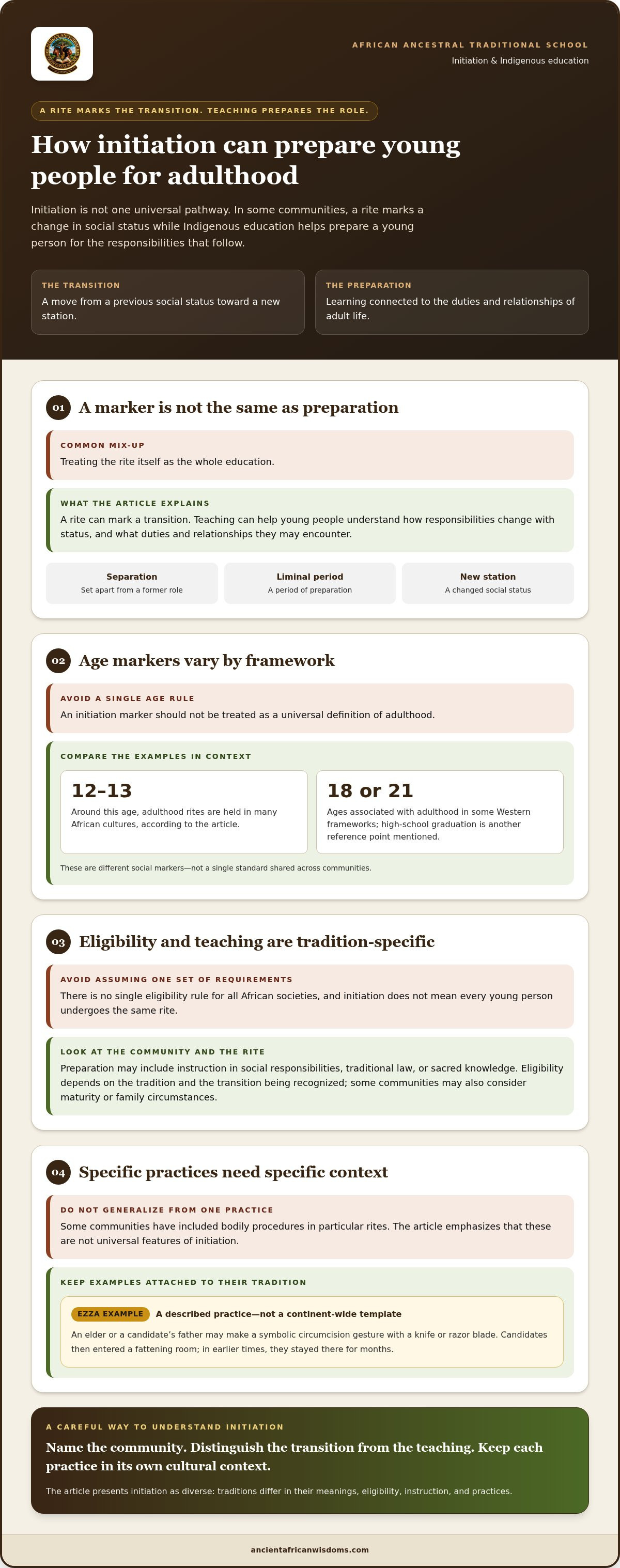
Adulthood initiation is a rite marking movement from a previous social status toward a new station. In the transition, separation can set an individual or group apart from their former role, while a liminal period prepares them for what follows. In many African cultures, adulthood rites are held around ages 12-13. This community marker differs from Western frameworks that associate adulthood with age 18 or 21, or high-school graduation.
Preparation can include learning how responsibilities change with status. In the sub-Saharan societies discussed by Jean-Marie Hyacinthe Quenum, Indigenous education prepared people for adult life. This education was not limited to formal lessons; it connected learning with the duties and relationships young people would encounter. The distinction is useful: a rite may mark a transition, while teaching prepares someone to live the new role.
Eligibility Rules and Preparation
Eligibility depends on the community’s tradition and the transition being recognized; there is no single rule for all African societies. Preparation may include instruction in social responsibilities, traditional law, or sacred knowledge. Some puberty rites include such teachings, while particular communities may consider maturity or family circumstances when determining participation. Identifying the community and rite helps clarify expectations without treating one practice as universal.
Practices also differ by gender and society. Some communities have included circumcision or subincision in boys’ rites, and clitoridectomy in girls’ rites. These are not universal features of initiation. Describing them as specific cultural practices, rather than requirements, matters because “initiation” covers diverse traditions and does not mean every young person undergoes the same rite.
A described Ezza practice illustrates how preparation can involve community roles and symbolic actions. An elder or a candidate’s father may make a symbolic circumcision gesture with a knife or razor blade. Candidates then entered a fattening room, where they stayed for months in earlier times. These details belong to the Ezza context, not to African rites generally. They show how a transition could combine ritual action, family involvement, and a distinct period of preparation.
To explore these traditions with cultural context, continue with learning about African heritage.
In a rite of passage, separation means detaching an individual or group from a previous status. In the Ezza circumcision rite described here, camwood is rubbed on the candidate, and fresh palm leaves are tied around the waist, ankles, and arms for protection from evil spirits. These actions and objects belong to this particular practice; they are not requirements for other communities or rites.
In the Ezza practice described here, when a girl is judged mature for circumcision, her husband takes wine, yam, cola-nuts, and dry meat to her parents, and a sacrifice is offered to her female goddess or her mother’s goddess. The account includes the candidate’s maturity as well as actions involving family and spiritual observance.
Rituals as symbolic and transformative actions
Rituals can mark a life transition, respond to a crisis, or restore harmony. Their meaning becomes clearer when considered within the particular community and stage of life involved.
Life-Cycle Rituals
Life-cycle rituals accompany transitions such as birth, adulthood, marriage, eldership, and ancestorship. They help families and communities recognize changes in a person’s relationships and responsibilities. Birth rites, for example, may include a naming ceremony to welcome an infant. Marriage rites can join two families and acknowledge the couple’s shared path. These examples show how ritual meaning develops across a lifetime.
In some communities, families and community members consult a diviner about an infant’s mission and life path. This practice places a child’s birth within a wider spiritual and family story. It also shows why naming and birth rituals can mean more than choosing a name: they may connect the child to community understandings of identity and purpose.
Rituals may also respond to illness, drought, death, or war. In African cosmology, ritual activity can help restore harmony after a crisis. A shared observance gives people a way to acknowledge disruption and respond together. Rituals may be corporate, domestic, or personal, depending on who participates and where they take place. Their role is not limited to celebration; they can help communities face difficult moments.
Stages and Practices of Initiation
Initiation often involves separation from a previous status and a transitional period of preparation for a new station. The broader life-cycle system includes rites of birth, adulthood, marriage, eldership, and ancestorship. This framework helps readers understand initiation as a range of possible transitions, rather than one ceremony with a universal sequence. Practices and meanings differ between societies.
Birth naming, adulthood initiation, and marriage rites illustrate different points along this continuum. In the Ezza marriage preparations described here, the Ugvu Ogirinya rite and ritual bathing begin in a barn regarded as sacred. The setting and actions give the transition a shared, symbolic form. They also show why a practice should be understood in its own cultural context, not treated as a standard step in every African tradition.
Seasonal and cyclical rituals do not form one uniform category across African societies. These examples show that ritual timing and purpose relate to the event or transition being marked. A rite surrounding socialization differs from one following a death or preparing for a marriage. Considering who participates, what change is recognized, and how the ritual responds helps explain its significance without reducing diverse traditions to one pattern.
To understand common stages, consider the transition being marked, such as birth, adulthood, marriage, eldership, or ancestorship. Depending on the tradition, practices may include separation from an earlier status, preparation for a new station, naming, ritual bathing, or community observance.
Changing initiation rites among the Balanta of Guinea-Bissau
The Balanta of Guinea-Bissau offer a focused example for considering how initiation traditions relate to change. A careful account distinguishes a community’s particular rites from broader African examples instead of treating them as interchangeable.
To describe change responsibly, compare a rite’s purpose, participants, teachings, and place in community life. Ask what transition it marks, who guides participants, and what knowledge is passed on. These questions help distinguish changes in a practice’s form from changes in its meaning. They also prevent practices associated with another community, such as the Ezza, from being attributed to the Balanta.
Across African communities and diaspora traditions, initiation practices vary by community and tradition. Rites may prepare young people for adulthood, mark another life transition, or connect participants with spiritual teachings. A diaspora community may encounter different settings for cultural learning, but that alone does not establish that its rites match those practiced in Guinea-Bissau.
Initiation rites arise in distinct contexts, not within one unified African religion. The research examples include adulthood rites in some sub-Saharan African societies, Ezza practices, and Egyptian initiation rites linked with communion with God in the afterlife. These examples illustrate diversity; they do not establish a shared ceremony or explain Balanta customs.
Change can be examined through grounded comparisons. Consider whether a rite still marks the same transition, whether elders continue to guide its teachings, and whether its social role remains recognizable. An adulthood rite, for example, can be compared with marriage or birth rites, but each marks a different passage. Comparing their purposes is more useful than assuming every ritual changes in the same way.
Community language matters, too. A rite’s meaning depends on how participants and elders describe its responsibilities, sacred knowledge, and place in family life. If a practice’s setting changes, that alone does not show whether its teachings or community meaning have changed. Understanding Balanta initiation therefore requires attention to Balanta voices and distinctions, not conclusions borrowed from Ezza, Egyptian, or other traditions.
For readers exploring African heritage, the central lesson is to keep examples in their proper context. Name the community, identify the life transition, and distinguish a documented practice from a broad comparison. This approach respects the Balanta context and shows how initiation can be studied amid changing traditions without presenting one African or diaspora experience as universal.
In accounts of African life-cycle rites, adulthood initiation is distinct from marriage rites, which are described as joining two families and the missions of the couple. Rites of passage also transmit a community’s cultural values and beliefs to younger generations. Adulthood rites teach young initiates social rules, taboos, moral instruction, and social responsibility.
In some societies, boys’ initiation rites may involve circumcision or subincision, while clitoridectomy is described as a practice performed on girls in some societies as part of initiation rites. These descriptions do not show that any of these practices belongs to Balanta initiation. Keeping examples within their stated scope distinguishes general comparisons from claims about a particular community, whose customs require specific evidence and community accounts.
Ancestors and the spirit world
In many African traditions, ancestors are respected elders who have died and remain connected to family and community. This understanding gives African spiritual initiation a wider frame: it can situate someone within a lineage that includes the living and the departed. Details differ across communities, so one tradition’s account should not stand for every African spiritual path.
The connection with ancestors can shape how people understand responsibility and continuity. A young person entering a new social role may learn that their conduct affects family and community, not only their individual standing. In this view, inherited knowledge links generations: elders pass teachings to younger people, while ancestors remain part of the family’s spiritual understanding. The key is to recognize this as a relationship, not one shared ritual.
Belief in a Supreme Being in African traditional religion dates back many thousand years before Christianity arrived in Africa. This places relationships with ancestors within broader religious worlds, rather than treating ancestors as the only spiritual focus. Traditions may understand the Supreme Being, ancestors, and other spiritual forces differently. Their relationships depend on each community’s teachings and practices.
Initiation rites can give these beliefs a place in life transitions. African spiritual initiation may connect a person’s changing status with family memory, community teachings, and spiritual responsibilities. A rite may, for example, position a young person within a wider social order. Ancestors may be part of its meaning, but their exact role varies. Do not assume every initiation involves the same spiritual beings or practices relating to ancestors.
Egyptian initiation rites offer a distinct example: they are linked to the pursuit of communion with God in the afterlife. This shows that initiation can address spiritual destiny beyond community status alone. The example belongs in its Egyptian context, not as a generalization about all African societies. Comparison is useful only when differences remain clear.
Rituals may also help communities respond to illness, drought, death, and war. They may be corporate, domestic, or personal, depending on who participates and the setting. A family observance after a death, for example, may give relatives a shared way to mark their loss. In traditions where ancestors remain part of family life, such events can connect grief, remembrance, and spiritual continuity.
To approach teachings about ancestors respectfully, begin by identifying the specific community and teaching. Distinguish public explanations from knowledge held within a family or tradition, and avoid presenting one account as universal. Consider how a rite relates to lineage, responsibility, and the spirit world. This care preserves cultural distinctions while making room for meaningful learning.
Continue exploring ancestral wisdom and spiritual teachings to deepen your understanding of how lineage and spiritual life can connect.
African Ancestral Traditional School: African Ancestral Traditional School Levels
African Ancestral Traditional School offers structured learning for readers who want to deepen their understanding of African spirituality, culture, and tradition. Its African Ancestral Traditional School Levels provide a path through ancestral teachings, while Community Access connects learners as they explore cultural heritage.
Turn to this learning when you want to study traditions beyond a single article and build understanding over time. Ancestral Spiritual Teachings and Spiritual Rituals support that exploration through the school’s educational offerings. Guided learning offers a way to engage with these subjects without treating diverse initiation practices as one universal ceremony.
If you’d like to continue exploring African heritage and ancestral teachings, visit African Ancestral Traditional School.
Carry Your Learning Forward
Let curiosity and respect guide your next step. As you continue exploring African spiritual initiation, notice which questions draw you toward family history, community responsibility, or the relationship between ancestors and the living. Those questions can help you choose what to study next and remind you that each tradition has its own context and boundaries.
Learning does not claim belonging or authority. It means listening carefully, naming the tradition you are studying, and making space for knowledge to deepen over time. African Ancestral Traditional School offers a path for continued study through African Ancestral Traditional School Levels, Ancestral Spiritual Teachings, and Community Access.
If you’re ready to continue this learning journey, contact African Ancestral Traditional School. Take your next step with patience, and let each new understanding strengthen your connection to heritage and community.
Frequently Asked Questions
What roles do elders, priests, and initiates have in the process?
Roles depend on the community and rite. Elders may guide learning and model expected conduct; where a tradition has priests or ritual specialists, they may lead particular sacred practices or explain their meaning. Initiates are not simply observers: they participate, listen, and learn the responsibilities attached to the transition. For example, a family may involve an elder in preparing a young person for a new community role.


