
African traditional priests and priestesses serve their communities through customary duties, divination, prayer, sacrifice, and spiritual leadership. Their responsibilities vary across cultures: some uphold a divinity’s customs, consult ancestors, or lead worship, while others interpret divination or guide community rites. In traditions such as Ifa and Igbo religion, these roles draw on distinct systems of knowledge and authority.
It’s natural to picture a priest or priestess mainly as a ceremony leader. Yet their work may also connect families with ancestors, preserve sacred customs, and help communities mark important occasions.
This article explores how these roles take shape, from divination and intercession to political and community leadership. It also explains how responsibilities differ across traditions, including Ifa and Igbo religious practice, so you can approach the subject with respect for its depth and diversity.
Key Takeaways
- Priestly duties vary by community and tradition, from tending a family shrine to preserving the customs of a divinity.
- Divination can involve distinct forms of training and methods, including interpreting patterns cast with bones or beads.
- Through prayer and sacrifice at shrines, priests may serve as intermediaries between people and deities.
- Religious authority can also shape community life, including leadership tied to lineage, village guardianship, or political roles.
- Explore how Ifa priesthood and Igbo elders’ responsibilities reflect different paths of spiritual knowledge and community service.
Customary duties and divination
Customary duties connect sacred knowledge with family and community life. Divination offers a culturally specific way to seek guidance.
Priests, Priestesses, Diviners, and Healers
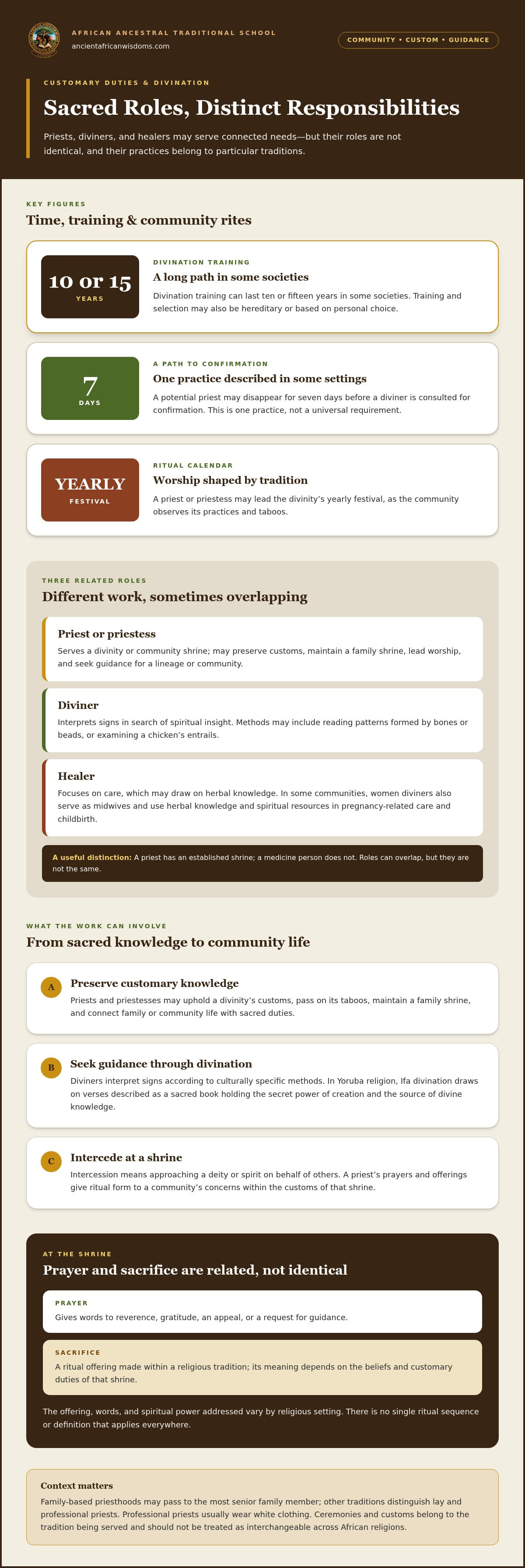
A priest or priestess serves a divinity or community shrine, while a diviner interprets signs in search of spiritual insight. A healer focuses on care, which may draw on herbal knowledge. These roles can overlap, but they are not identical. One distinction between a priest and a medicine person concerns the shrine: a priest has an established shrine, while a medicine person does not.
Diviners may use bones or beads, interpreting the patterns formed when the objects fall. Some examine a chicken’s entrails for information. Training or selection may be hereditary or based on personal choice, with no age or sex barrier. In some societies, divination training can last ten or fifteen years. In some communities, women diviners also serve as midwives, drawing on herbal knowledge and spiritual resources in pregnancy-related care and childbirth.
Customary Roles and Duties
Traditional priests and priestesses preserve a divinity’s customs, pass on its taboos, and act as intermediaries between people and the spiritual world. Their duties may include maintaining a family shrine, leading worship, and seeking guidance for a lineage or community. In some family-based priesthoods, the family head officiates at the ancestral shrine and consults ancestors on behalf of the family or clan.
Priesthood may be hereditary or professional, and some traditions distinguish lay priests from professional priests. In the family-based practice described here, the role passes to the family’s most senior person. In other settings, a potential priest may disappear for seven days before a diviner is consulted for confirmation. Training for a professional priesthood may last several years; professional priests usually wear white clothing.
Rituals and Ceremonies
Priests and priestesses conduct rites that honor a divinity, uphold customary obligations, and bring people together in worship. They may lead the divinity’s yearly festival, when the community observes its practices and taboos. The form of worship belongs to the tradition being served, so ceremonies should not be treated as interchangeable across African religions.
What roles do traditional African priests and priestesses serve? They preserve sacred customs, consult ancestors or divinities, and lead worship and community rites. What rituals and ceremonies do they conduct? These may include shrine worship, prayers, sacrifices, ancestral consultation, and annual festivals. In Yoruba religion, Ifa divination draws on verses described as a sacred book holding the secret power of creation and the source of divine knowledge. Diviners interpret those verses to seek guidance for people and communities.
Intercession and sacrifice
Intercession means approaching a deity or spirit on behalf of others. In African traditional religions, priests serve particular gods or spirits and mediate between those powers and their communities. Their role gives people a recognized way to bring prayers and concerns to a shrine. A priest’s authority comes from the tradition and spiritual relationship they serve, not from a single role shared across every culture.
Sacrifice is a ritual offering made within a religious tradition. Priests offer sacrifices and say prayers at shrines, directing these acts toward the deity or spirit they serve. The offering and prayers give ritual form to a community’s devotion and requests. Practices differ, so the meaning of an offering depends on the beliefs and customary duties of that shrine.
Intercession can be understood as a relationship involving the person or community seeking support, the priest carrying out the rite, and the spiritual power being addressed. At a shrine, the priest’s prayers and sacrifice express the community’s concern within its accepted religious practice. This role is more than leading a gathering: the priest also acts as an intermediary between people and a deity or spirit.
The purpose of an offering is shaped by the community’s tradition and the reason for approaching the shrine. A prayer may express gratitude, ask for guidance, or accompany a request for spiritual support. These are possible intentions, not a universal ritual sequence. The form of sacrifice, the words used, and the deity addressed belong to the particular religious setting.
The important distinction is that sacrifice and prayer are related but not identical acts. Prayer gives words to reverence or appeal; sacrifice provides a ritual offering. A priest may perform both at a shrine, combining spoken devotion with a customary act. The community’s beliefs explain who receives the offering and what the rite means; there is no single definition that applies everywhere.
This practice also has communal significance. When a priest serves a particular spirit or god, the shrine becomes a setting for shared religious duties. The priest’s intercession connects individual concerns with the community’s inherited relationship to that spiritual power. Since this connection depends on the tradition, understanding a rite begins with its deity, shrine, and customary purpose.
Study these practices with attention to their cultural context, rather than treating every African tradition as one system. A structured course in African spirituality, culture, and tradition can help deepen that learning.
Igbo Onyishi set the community's religious calendar in consultation with the council and ensure sacrifices are made at appropriate times. This connects the timing of sacrifices with the community's calendar and the council's guidance.
Some African traditional diviners use bones or beads, interpreting the patterns formed when the objects fall to seek information. This is distinct from the offerings and prayers performed at a shrine.
Religious and political leadership
Religious leadership is authority exercised through a community’s sacred institutions. In African traditions, a priest may serve a lineage group’s ancestral cult, a secret society, or a guardian spirit linked to a compound or village. These affiliations shape whom the priest serves and which customs guide the role. Leadership therefore grows from a specific community relationship, not from one uniform office.
Among the Yoruba, the Ooni of Ile-Ife is regarded as both a political and spiritual head. His role can connect public leadership with religious responsibility. This example shows how political authority and sacred knowledge can meet in one recognized figure. It does not mean every Yoruba priest holds the same political position or has the same duties.
Among the Fon, Da Ayido Hwedo, the high priest of Vodon, is also the Fon people’s political leader. This example likewise brings spiritual and political authority together. The role belongs to a particular people and tradition, so it should not be generalized as a model for all African communities. Comparing the Ooni of Ile-Ife with Da Ayido Hwedo reveals distinct forms of leadership.
In some traditions, a priest’s authority is also expressed in royal ceremonies. The priest installs the king, marking the ruler’s entry into office through a religious rite. When the king dies, the priest performs the burial rites. These duties connect political transitions with sacred customs. The priest’s role extends beyond worship, helping the community recognize a ruler’s accession and death.
Both men and women may be eligible for priesthood. This matters because religious authority is not reserved for men across African traditions. The particular duties and path into priesthood depend on the community. In a family-based priesthood, for example, the role passes to the family’s most senior person, linking authority with lineage and customary succession.
Rainmakers illustrate another way spiritual knowledge may serve public needs. In agrarian societies, they use herbal and magical knowledge to seek sufficient rainfall or stop rain when flooding threatens. Some African rainmakers may burn wood to influence the environment and affect the weather. Communities may also call on them to seek suitable conditions for outdoor events, including coronations, funerals, and weddings.
These examples show how leadership can respond to sacred duties and shared concerns. The Ooni of Ile-Ife and Da Ayido Hwedo represent distinct political and spiritual roles, while rainmakers address weather concerns important to community events. To understand a priestly office, identify the community served, the spiritual institution involved, and the specific public responsibility. These details show how authority is grounded in each tradition.
Ifa priesthood and self-realisation
Ifa priesthood is one path of service within Yoruba religious practice. It connects sacred knowledge with spiritual formation and responsibility. The verses used in Ifa divination are described as a source of divine knowledge and the secret power of creation. Becoming a priest or diviner therefore involves learning within a tradition, not simply adopting a title.
What are the different types of African traditional priests and priestesses? Some traditions distinguish lay priests from professional priests, while others include diviners and priests serving ancestral cults or guardian spirits. Both men and women may be eligible for priesthood, and duties depend on the spiritual institution and community served.
Selection is the customary process through which a person enters a spiritual role. Entry may be hereditary or follow a prospective diviner’s personal decision. In some non-hereditary priesthoods, a potential priest may disappear for seven days before a diviner is consulted for confirmation. Professional priest-elects may train for several years, while divination training can last ten or fifteen years in some African societies.
How are African traditional priests and priestesses chosen and initiated? The path varies: family inheritance, personal decision, diviner confirmation, and sustained training are all described routes. Diviner selection has no age or sex barrier. These examples show why initiation should not be reduced to one sequence shared by every tradition.
Self-realisation describes a person’s understanding of identity and spiritual direction. Echezona Obiagbaosogu spent 17 years as a Catholic priest before leaving that priesthood for African Traditional Religion. He also said he performed some African Traditional Religion rites while serving as a Catholic priest. Chekwube Okwunwendu was 45 years old when described as undergoing a spiritual transformation. Their accounts illustrate different personal journeys, not a universal route into priesthood.
Christianity and Islam became part of Nigeria’s religious history through distinct routes. Christianity arrived with Portuguese explorers in the 15th century and established firm roots in the 19th century through British missionaries. Islam entered through trade routes in the 11th century, while the Sokoto Caliphate rose in the 19th century as Islam spread through northern Nigeria. Colonialism also altered the political and social setting in which traditional institutions operated, though experiences varied by region.
How have African traditional priesthoods changed through Christianity, Islam, and colonialism? These histories brought religious and political change, but they don’t describe one uniform transformation across Africa. In Nigeria, Pew Research Center reported that, as of 2015, Muslims made up 50% of the population, Christians 48.1%, and people adhering to other or no religious affiliations around 2%.
Are African traditional priests and priestesses active in the United States, and where? Yes, traditional African religious practices are active in the United States, including in diaspora communities; no single location represents every tradition. Local practice and community affiliation shape where people encounter these spiritual roles.
Igbo elders and religious duties
The Onyishi is the oldest member of an Igbo council of elders and holds religious authority. This position links seniority with responsibility for the community’s religious calendar. The Onyishi works in consultation with the council, so calendar decisions involve collective counsel rather than an elder acting alone. This example shows how religious leadership can be grounded in community structure.
The religious calendar is the schedule of observances and sacrifices recognized by a community. Among the Igbo, the Onyishi sets this calendar with the council’s advice. The schedule identifies appropriate times for religious duties. By coordinating the calendar with other elders, the Onyishi links sacred observance to shared community decisions and inherited practice.
Ensuring sacrifices take place at appropriate times is a specific duty of the Igbo Onyishi. The calendar gives the council and community a reference for when those obligations fall due. The Onyishi’s role is therefore more than holding a respected title: it includes helping maintain the timing of religious practice within the community’s customary order.
Consultation means considering the council’s views before setting the calendar. For an Igbo Onyishi, this ties religious authority to deliberation with other elders. The council’s involvement places the timing of sacrifices within community practice. It also distinguishes the Onyishi’s responsibility from an individual act of worship.
How do priestly roles vary across African religions and ethnic groups? They reflect distinct community structures and sacred duties. Among the Igbo, the Onyishi combines elder status with religious authority and responsibility for the calendar. Elsewhere, a priest may serve a lineage’s ancestral cult, secret society, or guardian spirit associated with a compound or village.
This contrast matters when learning about African religious leadership. The Igbo example centers on the oldest council member, consultation, and a religious calendar. Other traditions may organize authority around a lineage, society, shrine, or guardian spirit. Understanding each role through its community and responsibilities is more accurate than assuming one model applies across ethnic groups.
To understand the Onyishi’s duties, consider the relationship between three elements: the elder’s authority, the council’s consultation, and the calendar’s timing. Then consider how appropriate sacrifice times fit into that structure. This approach keeps attention on the responsibilities described for Igbo elders, without treating them as interchangeable with duties in other traditions.
Explore these distinctions further through courses on African culture, and deepen your understanding of how community customs shape religious roles.
The practical significance of this duty lies in coordinating the community’s religious calendar with the timing of sacrifices. The Onyishi does not decide in isolation: the council is part of the consultation that guides the calendar. Setting the schedule and ensuring sacrifices occur at appropriate times are connected responsibilities. The role combines deliberation about timing with attention to carrying out religious duties within a shared community framework.
African Ancestral Traditional School: African Ancestral Traditional School Levels
African Ancestral Traditional School offers structured levels for learning about African spirituality, culture, and tradition. After exploring priestly roles across Ifa and Igbo practice, you can continue studying ancestral teachings through a guided learning path.
The school’s Ancestral Spiritual Teachings, Spiritual Rituals, and Community Access support continued learning and connection. These offerings can help you deepen your understanding beyond an overview and engage with African heritage through ongoing study.
You’re welcome to visit ancientafricanwisdoms.com and explore a learning path that feels meaningful to you.
Carry Your Learning Forward
Learning about African traditional priests and priestesses can be a beginning, not a finished answer. Let what you’ve learned prompt deeper reflection on heritage, responsibility, and traditions that resonate with your path. Approach each teaching with patience: meaningful understanding develops through continued study and connection.
African Ancestral Traditional School offers African Ancestral Traditional School Levels, Ancestral Spiritual Teachings, and Community Access for those ready to continue learning. These offerings provide a path from initial curiosity to more structured engagement with African spiritual heritage.
Take the next step at your own pace. Explore African Ancestral Traditional School and choose a way to keep learning that feels right for you. May your continued study bring a deeper sense of connection to the wisdom and traditions you’re seeking.
Frequently Asked Questions
What training and duties do traditional African priests and priestesses have?
Training and duties depend on the tradition, community, and spiritual role. A person may enter through family inheritance, personal choice, or a community’s selection process, then learn the knowledge and practices connected with that role. For example, a prospective diviner may study interpretation methods, while a shrine priest learns the customs and obligations of the shrine they serve. These paths are culturally specific, not a standardized course of training.
What spiritual authority and community responsibilities do African priests and priestesses hold?
Traditional priests and priestesses hold authority within the religious relationships their communities recognize, not over all African traditions. Their responsibilities may connect a family, lineage, or village with a particular deity, spirit, or ancestral institution. A family’s spiritual duties, for example, differ from a village guardian’s role. Understanding that scope shows how these leaders support community continuity while serving distinct traditions and responsibilities.


