
In many Indigenous African traditions, spirituality isn’t separate from religion; it’s woven into religious life. The difference between African spirituality and religion is often a difference of emphasis: spirituality describes a lived relationship with the sacred, while religion includes shared beliefs, practices, and traditions through which that relationship is expressed. These ideas overlap, and African traditions vary across communities.
It’s understandable to look for a clear dividing line, especially when spirituality is described as personal and religion as communal or organized. In Indigenous African contexts, however, faith may be expressed through community life, ancestral remembrance, ritual, and oral teaching rather than divided into separate categories.
Here, you’ll learn how Indigenous African religions connect spirituality with ancestors, cultural identity, community, and oral tradition. You’ll also see why there is no single African religious system or central text, and how beliefs and practices vary while sustaining connections across generations.
Key Takeaways
- Understand how ancestors may be honored as protectors or mediators without being treated as supreme creators.
- Explore how shared practices and community life can carry cultural identity across generations.
- Recognize how spiritual meaning may connect everyday life with nature, relationships, and wellbeing.
- Learn how stories, proverbs, songs, and rituals preserve teachings across traditions without a single central text.
GAZETTE: Are ancestors considered deities in the traditional African cosmology?
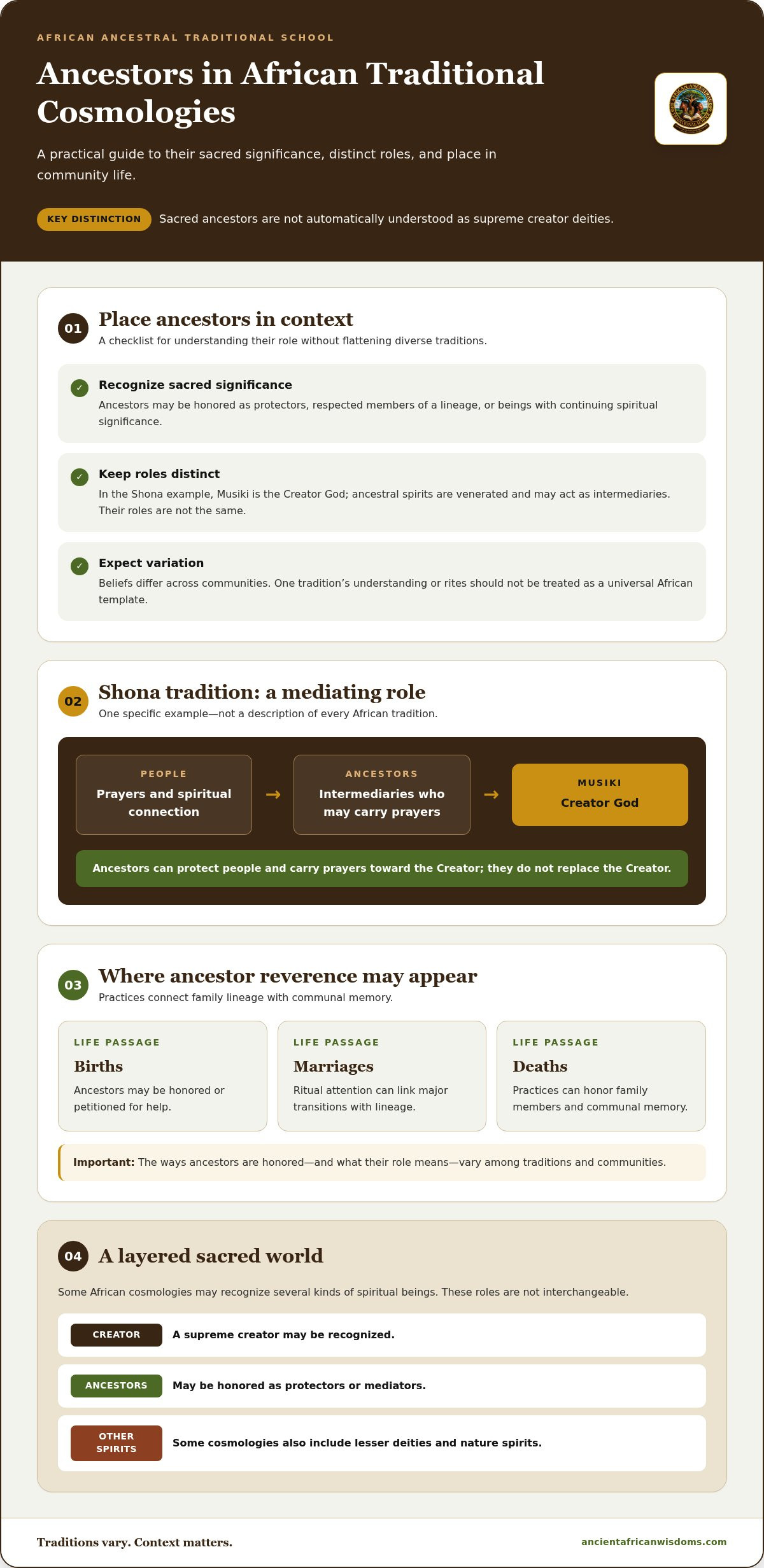
Ancestors may hold sacred importance without being understood as supreme deities. In Shona tradition, ancestors can protect people and carry prayers to Musiki, the Creator God.
Ancestors as Mediators
In some traditions, ancestors are understood as mediators who carry prayers toward a creator rather than replace that creator. In Shona African Traditional Religion, ancestors serve as intermediaries between people and Musiki. This belief helps explain how spiritual relationships can include both reverence for ancestors and devotion to a higher power. Christianity differs in this respect: it regards Jesus as the only mediator between God and humanity.
Ancestor Reverence and Common Beliefs
Ancestor reverence means honoring deceased family members and recognizing their continuing spiritual significance. In African traditions, people may honor or petition ancestors for help during births, marriages, and deaths. These practices connect major life passages with lineage and communal memory. Beliefs vary, so ancestor reverence does not mean every community follows the same rites or understands ancestors in the same way.
What beliefs about ancestors are common in African spiritual traditions? Ancestors may be regarded as protectors, honored members of a lineage, or mediators who carry prayers. Their place exists within broader cosmologies that may also recognize a supreme creator, lesser deities, and nature spirits.
This layered understanding matters: ancestors are not automatically equivalent to creator deities. In Shona belief, Musiki is the Creator God, while ancestral spirits are venerated, appeased, and serve as mediators. Their roles are distinct, even within one sacred worldview.
What are common misconceptions about African spirituality? One misconception is that African traditions share a single belief system or treat ancestors as gods in the same way. Traditions vary, and the Shona example shows how a creator, ancestral beings, and other spirits can have distinct roles in creation and spiritual life.
Community, cultural identity, and religious practice
Indigenous African religions are beliefs and practices rooted in African communities and carried through ritual, oral teaching, and shared life. Their traditions are diverse, so a ceremony in one community should not be treated as a template for all. Practices reflect local histories, relationships, and cultural values.
Rituals give communities ways to mark important transitions and express shared beliefs. Elders help pass knowledge and guide practices, while healers may support people through spiritual or communal concerns. Their roles vary across traditions. In Olupona’s Nigerian community, the Ero age-grade festival is for men around 70 years of age, showing how a practice can connect age, social responsibility, and community identity.
Community practices can also carry cultural identity across generations. Oyotunji Village in Beaufort County, South Carolina, practices an African indigenous religion that combines Yoruba and Ewe-Fon spiritual practices. This example shows how African traditions continue in diaspora settings, shaped by communities sustaining cultural and religious connections. Cuban Regla de Ocha, Haitian Vodou, and Brazilian Candomble are other African diaspora religions, each with its own history and practices.
African traditional religions and Christianity both emphasize moral conduct, community support, and belief in a higher power. Shared values do not make their teachings identical. Rather, they show how different religious traditions can encourage care for others and responsible living. African traditional religions also evolve with the communities that practice them while maintaining values such as respect for elders, communal responsibility, and harmony with nature.
What roles do rituals, healers, and elders play in African spirituality? Rituals express shared beliefs and help mark communal life; healers may address spiritual concerns, and elders help preserve and pass on cultural knowledge. These roles vary by tradition and community.
To explore how cultural teachings connect with lived practice, consider courses on African culture. Learning through specific community examples can help you understand what traditions share, and where their meanings differ.
Indigenous African religions and worldviews
Indigenous African worldviews connect spiritual beliefs with community, nature, and everyday life. The difference between African spirituality and religion can depend on whether we mean personal spiritual connection or a community’s shared traditions.
Regional and Ethnic Variation
African traditional religions vary across communities, shaped by distinct histories, languages, and practices. Indigenous practices vary in prominence across African communities, and some beliefs and practices appear across the continent. Shona traditions, for example, use names including Musiki, Samasimba, and Wedenga for God. This variation matters: an introduction to one tradition cannot represent every African worldview.
How do African traditional religions vary across regions and ethnic groups? Communities hold distinct beliefs, names, rituals, and teachings shaped by their histories and surroundings. Shona concepts offer one example, not a universal template for African traditions.
Meaning of African Spirituality
African spirituality describes how people relate to sacred powers through cultural beliefs and daily experience. Understanding the difference between African spirituality and religion helps distinguish lived spiritual connection from shared religious traditions, while recognizing that the two can overlap. In some communities, spiritual meaning may inform farming, marriage, childbirth, and understandings of sickness.
What does African spirituality mean? It refers to spiritual beliefs and practices rooted in African communities and traditions. For example, Shona beliefs may connect people with Musiki, ancestral beings, and spirits associated with natural places.
Nature can hold spiritual significance in these worldviews. Trees, rivers, mountains, and groves may be sacred places. Shona traditions also associate spirits with caves and forests, shaping how people understand their relationship with the land.
Illness, too, may have different interpretations. In African traditional religions, it may be understood as a medical concern, a spiritual imbalance, or ancestral displeasure. Its meaning depends on the tradition’s worldview.
African Indigenous religions also took root beyond the continent through the African diaspora, largely due to the slave trade beginning in the 15th century. Cuban Regla de Ocha, Haitian Vodou, and Brazilian Candomble reflect distinct diaspora traditions.
Oral transmission and the absence of a single holy book
African traditional religions do not share one central text or founder. Across the continent, communities preserve spiritual knowledge through oral teaching, ritual, and inherited practice. Understanding a tradition therefore involves more than searching for written scripture: its teachings may live in words and actions shared across generations.
Myths and proverbs carry explanations of the sacred, while songs and rituals help communities remember and express those teachings. An elder’s account, a proverb used to guide conduct, or a song performed during a ceremony can each hold knowledge. These forms connect belief with language, memory, and community life.
Oral transmission is more than reciting words. A teaching gains meaning through its setting, audience, and use. A proverb shared to guide a family decision, for example, may communicate a value differently from the same saying in a ceremonial context. Learning how a tradition uses its teachings helps readers understand both the words and their place in community life.
Shona oral poetry about totems offers a specific example. This poetry expresses honor and gratitude toward animals or spirits for God’s deeds. Its words connect community identity with spiritual understanding, showing how oral expression can carry cultural memory as well as religious meaning.
Rituals also keep teachings present through shared action. A song, spoken story, or repeated practice can bring younger and older generations together around inherited knowledge. Each community has its own ways of remembering, so a teaching from one tradition should not be treated as a universal account of African religion.
To deepen your understanding, notice who shares a teaching, the story or practice around it, and how the community interprets it. Continue exploring African heritage through the traditions that keep ancestral knowledge alive.
African Ancestral Traditional School: African Ancestral Traditional School Levels
African Ancestral Traditional School offers structured digital courses on African spirituality, culture, and tradition through its school levels. The curriculum provides a path for learning beyond a general introduction, exploring ancestral spiritual teachings and rituals as part of a guided study of heritage.
This learning path is suited to those who want to study these teachings with structure and connect with others on a similar path. Community access offers a space to learn alongside others while exploring heritage and spiritual practice. Choose a learning path that helps you engage thoughtfully with the traditions discussed here.
You’re welcome to visit ancientafricanwisdoms.com to learn more.
Let Curiosity Become a Grounded Practice
Understanding the difference between African spirituality and religion can be a starting point, not a final answer. Continue with patient learning: notice which questions draw you toward your heritage, and make room for the voices and traditions that can deepen your understanding. You do not need to resolve every question at once. Listen, reflect, and keep learning with care.
If you’re ready to continue, African Ancestral Traditional School offers structured digital learning through its school levels, ancestral spiritual teachings, and community access. Explore the courses to deepen your study of African spirituality and cultural heritage.
Explore learning with African Ancestral Traditional School, and take the next step with openness and respect.
Frequently Asked Questions
GAZETTE: How would you define indigenous African religions?
Indigenous African religions are diverse traditions rooted in the histories and communities of the continent. The term describes distinct systems of belief and practice, not one uniform faith. To understand a ceremony or teaching, consider the specific people, language, and setting involved. A practice associated with one ethnic community, for example, should not automatically be treated as representative of another.
How Is African Traditional Religion Different From Christianity?
African traditional religions encompass varied community traditions, while Christianity is a monotheistic religion centered on Jesus Christ and the Bible. Some African traditions understand ancestors as mediators, whereas Christianity centers mediation between God and humanity on Jesus. These contrasts describe broad theological differences, not every person’s lived practice. Comparing particular teachings and communities gives a clearer picture than treating either tradition as uniform.
What does religion mean in African contexts?
In African contexts, religion can describe an understanding of sacred relationships and responsibilities within community life. It may connect spiritual beliefs with family obligations, moral choices, ceremonies, and a community’s relationship to place. The term is broad, so its meaning becomes clearer through a particular tradition’s language and practices. Consider what a belief means to the people who carry it.
How does African spirituality differ from organized religion?
African spirituality often emphasizes lived connection with sacred realities, while “organized religion” usually refers to formal institutions, shared doctrines, or established leadership. These ideas are not mutually exclusive: communal traditions can have recognized practices and teachers, while organized faiths also include personal spiritual experience. The distinction can be a useful starting point, but it should not imply that African traditions lack structure or community authority.
How do African spiritual traditions understand the divine and nature?
Many African spiritual traditions understand the divine through relationships among a creator, spiritual beings, people, and the natural world. A river, grove, or mountain may hold sacred meaning within a community’s cosmology, but that does not automatically mean the natural feature itself is worshipped as a god. Its significance is best understood through the tradition’s teachings and the community’s understanding of that place.
Can African spirituality coexist with Christianity or Islam?
Some people and communities maintain connections to African heritage while also identifying as Christian or Muslim. How they combine beliefs or practices varies, particularly where teachings about ancestors, worship, or spiritual authority differ. A useful starting point is to distinguish cultural belonging from specific religious commitments, then consider how each practice is understood by the person or community. These traditions do not have one experience shared by everyone.


