
Knowledge does not live only in books. African indigenous knowledge systems are distinct bodies of knowledge developed, tested, and applied by African communities, not one uniform tradition shared across the continent. They include practical and philosophical ways of understanding health, relationships, agriculture, and the natural world.
You may recognize this knowledge in family teachings, community practices, and close attention to the land. Its value lies not only in what people know, but also in how that understanding is kept alive, adapted, and shared across generations.
This article explains what African Indigenous knowledge means and how oral tradition, observation, imitation, and practice help pass it on. It also explores how this knowledge informs perspectives on health and relationships, farming, and forestry, and why distinct traditions need to be understood in their own contexts.
Key Takeaways
- Understand how ideas about health can include relationships, community ties, and the work of restoring balance.
- Recognize that African traditions hold many distinct systems of knowledge, shaped by communities and their own ways of learning.
- Notice how oral teaching, observation, and practice help knowledge move between generations and adapt over time.
- Explore how local farming and forest-care practices connect everyday livelihoods with the health of the land.
African perspectives on health and relationships
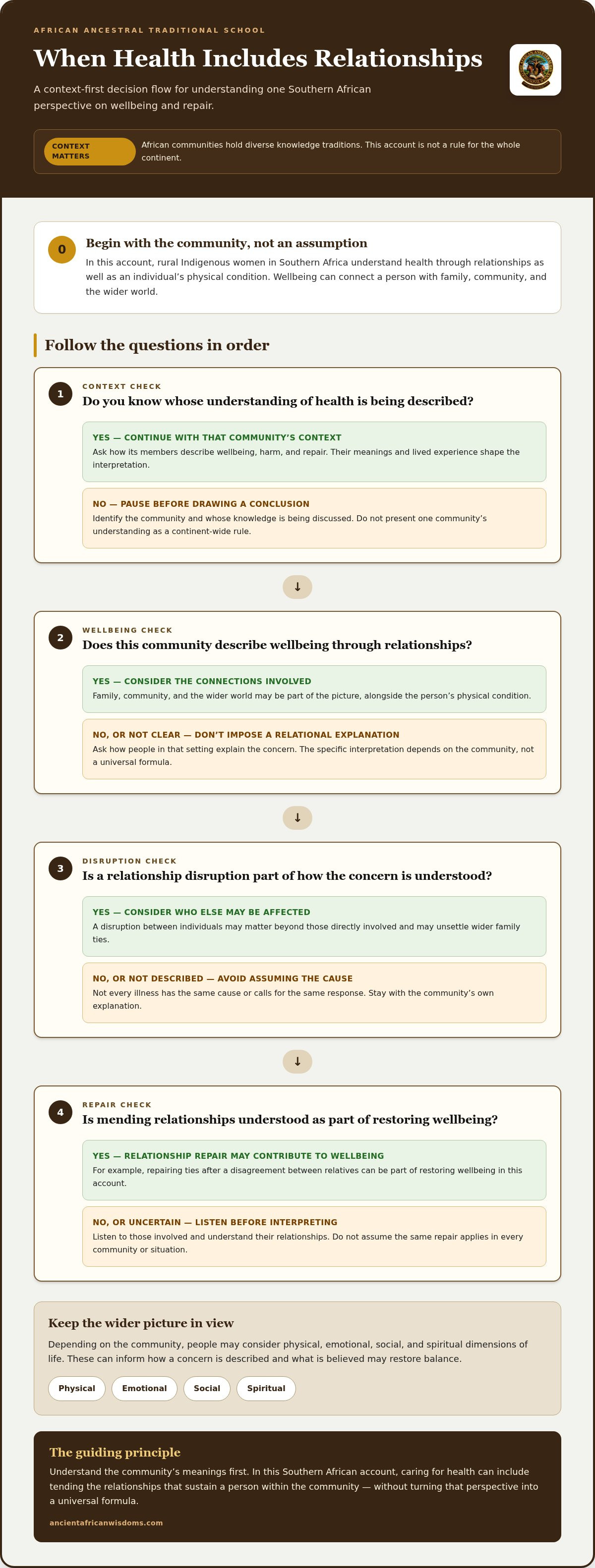
For rural Indigenous women in Southern Africa, health can be understood through relationships, not only an individual’s physical condition. In this perspective, wellbeing is connected to relationships with family, community, and the wider world. A disruption in one relationship may therefore matter beyond the individuals directly involved. This offers an example of how African knowledge traditions can frame health through social connection.
In this account, restoring health involves mending broken relationships. Consider a disagreement between relatives: its effects may reach beyond the people in conflict and unsettle wider family ties. Repairing those ties can be part of restoring wellbeing. This example shows why listening to those involved and understanding their relationships matters when interpreting a community’s approach. It does not mean every illness has the same cause or calls for the same response.
Health knowledge is also rooted in particular cultural settings. African communities are diverse, so one community’s understanding should not be presented as a rule for the entire continent. That distinction matters when studying these perspectives: the community’s meanings and context shape what health, harm, and repair signify. African indigenous knowledge systems are best understood as varied bodies of knowledge, not a single shared practice.
Relationships may be considered alongside the physical, emotional, social, and spiritual dimensions of life. These dimensions can inform how people describe a problem and what they believe may restore balance. For example, a community may discuss a concern in terms of its effects on family connections as well as the person experiencing it. The specific interpretation depends on that community’s knowledge and lived experience, not a universal formula.
Approach these perspectives with care. Ask whose knowledge is being described, which community it comes from, and how its members explain the relationship between wellbeing and repair. This attention helps prevent a broad label from erasing local differences. It also reveals a central insight in this Southern African account: caring for health can include tending the relationships that sustain a person within the community.
Characteristics of African indigenous knowledge
African knowledge traditions are diverse, shaped by communities, and connected to practical and philosophical life. Their features help explain how they differ across contexts.
Knowledge Characteristics
African Indigenous knowledge is knowledge communities generate, test, and apply through their own methods and approaches. It forms a network of distinct systems, not one uniform tradition shared by every African community.
These systems can include technological, economic, philosophical, educational, and governance knowledge. For example, precolonial African governance institutions used norms, customs, and taboos to hold political leaders accountable. Recognizing this breadth helps readers look beyond the narrow idea that knowledge consists only of formal science or written records.
Colonialism sidelined Indigenous knowledge and promoted Western knowledge systems, contributing to dependence on Western frameworks and neglect of Indigenous traditions. Preserving knowledge today means addressing that legacy through policies, research capacity, investment, documentation, and local inclusion. These challenges matter because knowledge can be marginalized when communities have little influence over how it is valued or recorded.
Comparison with Western Scientific Knowledge
African Indigenous knowledge and Western scientific knowledge can differ in how communities develop, test, organize, and apply what they know. African communities have used their own methodologies, often grounded in local experience and context. Western science, meanwhile, is not a single method or viewpoint.
This contrast should not be treated as a contest in which one system replaces the other. Each can offer insight, and their methods may complement one another when questions are explored with care. The key is to ask how knowledge was produced, whose context it reflects, and who has the authority to interpret it.
Protection of Knowledge and Intellectual Property
Ethical and legal protections depend on national legislation and respect for the communities whose knowledge is involved. Article 8(j) of the Convention on Biological Diversity calls on contracting parties to respect and maintain relevant knowledge, innovations, and practices of Indigenous and local communities, subject to national legislation; Article 10(c) is relevant to integrating traditional knowledge into environmental policy.
African countries protect knowledge through national approaches, not one uniform rule for the entire continent. South Africa’s National IKS Policy identifies the promotion of Indigenous knowledge systems in higher education as a priority. Documentation and use also need community involvement and local inclusion, so preservation does not separate knowledge from the people and context that give it meaning.
Community-based and intergenerational knowledge transmission
In African communities, knowledge is rooted in shared life, oral tradition, and collective memory. It can pass between generations through spoken teaching, imitation, and demonstration. A young person may learn a practice by watching an experienced community member, then repeating it in daily life. This learning takes place beyond formal institutions and written records, growing through relationships, participation, and attention to how knowledge is used in its community.
Practice matters. Indigenous knowledge is often experiential and learned through repetition, so understanding develops as a person observes, tries, and refines an action. Demonstrations can convey details that are difficult to express in words alone. Oral teaching can preserve meanings, explanations, and values alongside practical skills. Together, these ways of passing on knowledge make learning active: learners participate rather than simply receive information.
Transmission does not mean knowledge stays unchanged. It can adapt as communities respond to changing circumstances while remaining widely shared within the community. The Batwa community in Uganda has used intergenerational knowledge transfer to support youth employment. This example shows how knowledge shared between generations can have practical value in young people’s lives, and how community relationships can connect learning with opportunity.
Language and storytelling can carry knowledge across time. Biesele estimated that the Ju|’hoan language and mythology could preserve knowledge for up to one hundred and fifty years. This example highlights how cultural expression can retain shared understandings over an extended period. It also reminds us that preservation involves more than recording facts: language, context, and the community practices surrounding knowledge matter too.
To understand how a tradition continues, notice who teaches, how learners participate, and where repetition happens. Compare spoken instruction with learning by imitation, for example, and consider how each supports memory and skill. These questions reveal knowledge as a living practice, sustained through community participation and renewed as each generation learns, applies, and shares it.
Indigenous knowledge in agriculture and forestry
African farming practices show how close observation can guide decisions about crops, soil, pests, and seasonal conditions. In the farming practice described for Africa, farmers may sequentially plant 6-10 crop species on the same plot of land. This approach can diversify what grows in one place and reflects practical knowledge of crops and cultivation. The choice and sequence depend on local conditions and community experience.
In Ghana, intercropping and bush-fallowing are identified as main Indigenous farming practices. Intercropping places different crops together, while bush-fallowing allows land to rest before cultivation resumes. These examples show how knowledge can shape planting arrangements and land use. Farmers’ observations and local circumstances inform how practices are applied, so they should not be treated as identical across regions.
Other examples respond directly to cultivation challenges. In tropical regions, Indigenous farmers use plant derivatives to control insects. This practice draws on knowledge of locally available plants and their uses. It shows how communities connect the plants around them with the needs of their fields. The plants used and methods of application depend on local knowledge and the conditions farmers face.
Community practices also help care for forests. Safeguarding sacred forests has contributed to environmental preservation and climate adaptation in different regions of Africa. These protected places show how cultural values and environmental care can work together. The practice does more than set land aside: it sustains a relationship between communities and forests while preserving areas that support ecological resilience.
Examples of African Indigenous knowledge initiatives include Ghanaian intercropping and bush-fallowing, plant-based insect control in tropical farming, and safeguarding sacred forests. Together, these practices demonstrate knowledge applied to cultivation, pest management, and forest care. To keep exploring the cultural roots behind practical traditions, continue learning about African traditional knowledge.
African Ancestral Traditional School: African Ancestral Traditional School Levels
African Ancestral Traditional School offers structured digital learning through its African Ancestral Traditional School Levels. If this introduction to Indigenous knowledge has inspired you to explore African heritage further, these levels offer a learning path focused on African spirituality, culture, and tradition.
Continue your studies through Ancestral Spiritual Teachings and explore Spiritual Rituals as part of that learning. Community Access offers a place to connect with others as you deepen your understanding. These offerings suit readers seeking ongoing study of ancestral traditions, rather than a general overview alone.
Take the next step at ancientafricanwisdoms.com.
Carry the Learning Forward
Let curiosity become a steady practice. As you explore African indigenous knowledge systems, approach each tradition with respect for its community, history, and living context. Listen carefully, notice whose voices are represented, and allow your understanding to deepen through continued learning.
If you want to take the next step, African Ancestral Traditional School offers African Ancestral Traditional School Levels and Ancestral Spiritual Teachings for continued study. Community Access creates space to connect with others as you explore African heritage and tradition. Choose a path that feels meaningful to your learning, and move forward with patience and care.
Contact African Ancestral Traditional School to continue your learning journey. May each step bring greater understanding, connection, and respect for the wisdom carried across generations.
Frequently Asked Questions
What Is Indigenous Knowledge?
Indigenous knowledge is understanding developed within a community through experience, practice, and shared learning. It can guide everyday decisions, from how people relate to their surroundings to how they approach community responsibilities. Its meaning depends on the people and place involved. To understand a particular teaching, consider who carries it, how it is learned, and the circumstances in which the community applies it.
What Are African Indigenous Knowledge Systems?
African Indigenous knowledge systems are diverse knowledge traditions developed and used by African communities. They are not one continent-wide body of teachings: meanings and methods vary between communities. The term can include ways of understanding society, learning, livelihoods, and the environment. Read it as a network of distinct traditions, and consider the specific community and context before applying a broad description.
What Are the Main Characteristics and Forms of African Indigenous Knowledge?
These systems include practical skills, ideas, values, and ways of organizing community life. Knowledge may be developed and tested through community methods, then adapted as circumstances change. Governance traditions, for example, can use customs and shared expectations to hold leaders accountable. These characteristics show that knowledge can guide practical decisions and collective responsibilities, not just explain the natural world.
How Is African Indigenous Knowledge Transmitted Across Generations?
Knowledge passes through spoken teaching, observation, imitation, and participation in community life. A learner may hear an explanation, watch a practice, then try it with guidance and repetition. How this happens depends on the knowledge being shared and the community’s customs. Learning can also adapt as new generations apply inherited understanding to changing circumstances, keeping transmission active rather than preserving words unchanged.
What Roles Do Elders, Oral Traditions, and Community Practices Play in Preserving It?
Elders and other knowledge holders can share teachings, explain their context, and guide younger learners as they participate. Oral traditions carry meaning through spoken accounts, while community practices let learners observe how knowledge is used. Preservation therefore involves more than recording a statement. It also means respecting who holds the knowledge, how it is taught, and the community relationships that sustain its use.
How Is Indigenous Knowledge Used in African Agriculture, Medicine, and Environmental Management?
In agriculture and environmental care, examples include intercropping in Ghana, plant derivatives for insect control in tropical farming, and safeguarding sacred forests. Knowledge traditions also shape how some communities understand health and wellbeing. Medical practices vary by community, so examples should be understood in their cultural context, not treated as universal medical guidance. These traditions are not a substitute for professional medical care.


