
Ọfọ carries moral weight in Igbo cosmology: it represents truth, justice, and ancestral authority. Its holder is expected to act with integrity and fairness, making Ọfọ a guide to responsibility as well as a sign of spiritual connection. This is a useful starting point for understanding Igbo tradition.
If you’ve wondered how sacred symbols connect to everyday life, you’re not alone. These ideas can be difficult to untangle until you see how they relate to one another.
Explore the meaning of Ọfọ, how sacred animals and nso taboos express spiritual and communal values, and how Eke, Orie, Afo, and Nkwo shape the Igbo calendar. Along the way, you’ll encounter beliefs that connect people, ancestors, the spirit world, and the land.
Key Takeaways
- Explore how spiritual practitioners and sacred animals, including the python in some communities, connect the human and spirit worlds.
- Understand how nso taboos and protective markers such as omu express communal care and respect for land.
- Learn how Eke, Orie, Afo, and Nkwo structure market life and connect with wider cosmological ideas.
- Trace the roles of chi, Ala, and Ikenga to see how spiritual beliefs shape ideas of creation, morality, and personal agency.
Sacred animals and spiritual powers
In some Igbo communities, the python is associated with Idemili, a deity whose sacred presence shapes how people regard the animal. This relationship reflects a wider view in which animals can carry spiritual significance, rather than serving merely as symbols. Beliefs vary across communities, so the meaning of a sacred animal is understood within its own tradition.
Dibia mediate between the human and spirit worlds, interpreting messages and serving as healers, teachers, diviners, or community advisors. Through divination and oracles, they help people understand spiritual concerns and possible ways to negotiate with alusi. They are believed to have the power to identify these spiritual forces and ways to placate them. Their work may relate to water, fire, or vegetation, with each element shaping a distinct spiritual path.
Spiritual calling is also associated with Agwu. Ekwerem Agwu describes this calling in discussions of Igbo spiritual practice, connecting a person’s path with divination and service. This places spiritual responsibility within a relationship to the spirit world, rather than treating it as a role chosen casually.
In the tradition described, Nri priests use Otunsi to remove abominations and restore the land’s purity. Ndi Egede were sent by Chukwu Okike after abomination entered the world, carrying Otunsi to cleanse it. This account connects spiritual authority with communal repair: cleansing addresses harm to the land, not only individual concerns.
Anya Nzu means wearing white chalk around the eyes to signify sacred vision beyond the physical realm. Alcohol, meanwhile, may be used in offerings to bless, create, invoke, release, or destroy, depending on intention. Together, these practices show how material substances can carry spiritual meaning through their purpose and use. In Igbo cosmology, ritual actions connect visible objects with unseen responsibilities, while their meaning depends on context, intention, and tradition.
Oji Ikenga is a three-lobed kolanut associated with Ikenga, willpower, and masculine energy. Oji Asaa is a seven-lobed kolanut associated with perfection and spiritual potency.
Nso and personal or communal taboos
Nso refers to a taboo or prohibited act, and its meaning depends on the tradition and community. In Igbo life, a taboo can mark a boundary around a person, place, or shared resource. It is more than a private preference: customary beliefs may connect certain actions with harm to the community or land, giving people a reason to respect restrictions together.
Some Igbo forests are protected by customary laws, beliefs, and taboos. In these places, entering the forest, felling trees, and gathering fruit are forbidden. These restrictions limit interference with a sacred landscape and preserve it from everyday use. The forest is therefore both a spiritual place and a communal resource. Respecting its boundaries also supports soil stability and helps prevent erosion.
Omu offers a visible sign of protection. Placing omu on property, land, or an object marks it as protected and warns others not to interfere. The marker makes an unseen boundary recognizable. For example, omu on land communicates that the space is under protection, while omu on an object signals that it should remain untouched. Its meaning comes from the customary understanding shared by those who see it.
These practices show how taboo can guide conduct without separating spiritual belief from daily responsibility. A protected forest calls for restraint; omu asks others to respect a specific boundary. Both examples connect individual choices with wider communal values. They also remind readers that customs may vary between Igbo communities, so a practice should be understood in its local setting rather than treated as universal. For a deeper study of Igbo spiritual traditions, consider how such boundaries express respect for land and community.
Here, the customary rule sets clear limits on use: entering the protected forest, felling trees, and gathering fruit are forbidden. These restrictions give practical form to a shared boundary, clarifying which actions conflict with the forest’s protected status. Their significance extends beyond any single prohibited act: together, they restrict access and the taking of resources. In this way, a taboo shapes everyday conduct, linking respect for customary protection with restraint in the forest.
The four market days and cosmological correspondences
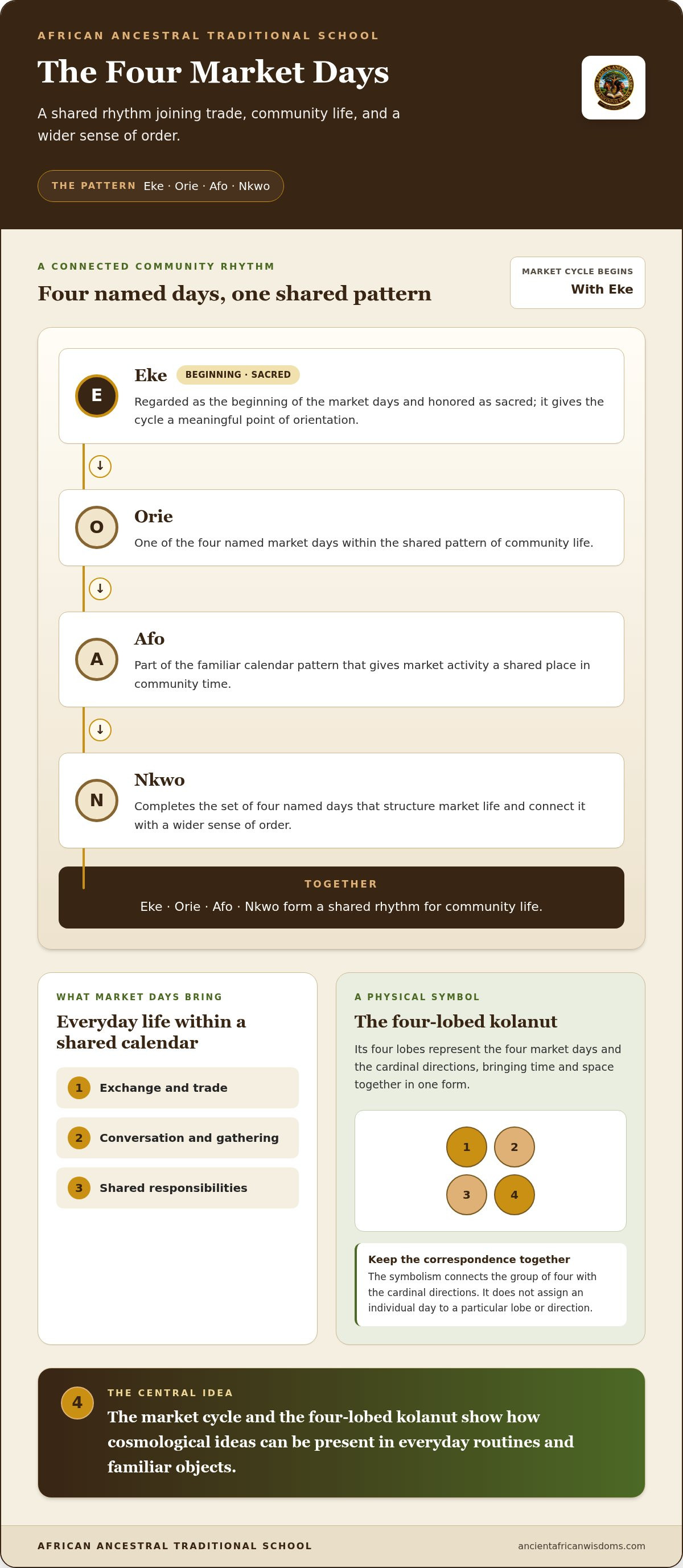
Igbo tradition recognizes four market days: Eke, Orie, Afo, and Nkwo. These names mark more than occasions for trade. Together, they provide a shared rhythm for community life, joining practical exchange with a wider sense of order. Eke is regarded as the beginning of the market days and honored as sacred. Its place at the start gives the cycle a meaningful point of orientation.
Each named day places market activity within a familiar pattern. A market day can bring people together for exchange, conversation, and shared responsibilities. Eke, Orie, Afo, and Nkwo therefore carry cultural meaning as well as practical importance. Understanding this pattern shows how ordinary routines can reflect a community’s wider view of time and relationships.
The four-lobed kolanut makes this relationship visible through a familiar ritual object. In the tradition described, its four lobes represent the four market days and the cardinal directions. The nut brings time and space together in one form. Its shape serves as a compact reminder that the community’s calendar and orientation within the world belong to a connected order.
This correspondence does not mean that each lobe should be assigned a particular market day or direction. The established meaning is the shared group of four, Eke, Orie, Afo, and Nkwo, alongside the cardinal directions. Keeping this distinction clear avoids adding a mapping the symbolism does not provide. The four-lobed nut expresses the relationship through its complete form.
Together, the market cycle and kolanut show how cosmological ideas appear in everyday settings. Eke’s sacred standing marks the cycle’s beginning, while the four-lobed nut gathers its pattern into a physical symbol. These connections show how Igbo communities can link trade, orientation, and sacred meaning without separating daily life from spiritual order.
Igbo cosmology
Igbo spiritual life connects people, ancestors, deities, and the land, with local traditions shaping how those relationships are understood. Creation, moral responsibility, and spiritual identity offer a framework for seeing how these connections fit together.
Beliefs Across Communities and Christian Influence
Igbo beliefs vary across communities, so no single local account represents every tradition. Among northern Igbo people, Ikenga is an Arusi associated with the right hand and success. Christianity has influenced Igbo religious life, but its relationship with inherited practices differs among individuals and communities. This context matters when considering how traditions continue, change, or coexist. The phrase Igbo cosmology describes a broad field of beliefs, not one fixed account followed identically everywhere.
Ala and Other Deities
Ala is the earth deity and custodian of public morality, connecting the land with shared standards of conduct. Other spiritual forces, called alusi, have distinct identities and relationships with people. Ikenga imagery can represent chi, ancestors, the right hand, and power, with prayer and sacrifice linked to spiritual activation. These examples show how Igbo cosmology allows for different spiritual roles rather than assigning every concern to one deity.
Chi and Personal Destiny
Chi is a personified, unique manifestation of creative essence, and each act of creation is associated with an individual chi. This belief connects personal identity with creation, rather than explaining human origins through Chukwu alone. In the story of nza, the bird taunts his chi, then a hawk carries him away. The story also illustrates how chi may act indirectly through a nearby enemy, shaping ideas about agency and consequence.
Reincarnation and Ancestral Continuity
Reincarnation concerns the relationship between life, death, and continuity, understood within Igbo beliefs about ancestors. Igbo cosmology also connects people with ancestors through symbols such as Ikenga, which may represent ancestral presence alongside personal power. These ideas invite reflection on how lineage and spiritual identity relate, without assuming that every Igbo community describes return after death in precisely the same way.
African Ancestral Traditional School: African Ancestral Traditional School Levels
African Ancestral Traditional School offers structured learning for readers who want to explore African spiritual traditions beyond this introduction. Its African Ancestral Traditional School Levels and Ancestral Spiritual Teachings provide a path to study cultural knowledge in greater depth.
Turn to these teachings when you want to connect ideas such as chi, Ala, sacred symbols, and communal practice within a broader tradition. Community Access offers a place to learn alongside others, while Spiritual Rituals are included in the school’s teachings.
Continue your learning through the school’s African spirituality and culture courses. Visit ancientafricanwisdoms.com to explore the next step in your study.
Carry Your Learning Forward
Let curiosity and care guide your next step. Igbo cosmology invites reflection not only on inherited ideas, but also on how cultural knowledge shapes identity, relationships, and responsibility. Approach each teaching with respect for its community and history, and let thoughtful questions guide your learning.
As you continue exploring Igbo cosmology, consider what you hope to understand more deeply and how that learning may connect with your own heritage. Patient study makes room for different perspectives and helps you engage with tradition in a grounded, meaningful way.
If you’re ready to continue, connect with African Ancestral Traditional School. Take the next step at a pace that feels right, and let your learning grow with purpose.
Frequently Asked Questions
What is Ofo in Igbo Tradition?
Ọfọ is a sacred symbol of truth, justice, and ancestral authority in Igbo tradition. Its significance also rests on the conduct expected of its holder, so it represents moral responsibility rather than status alone. For example, when considering an account involving Ọfọ, notice how it connects authority with fairness and integrity. Local context matters when interpreting its use.
What are the core beliefs and structure of Igbo cosmology?
Core ideas connect human life with chi, ancestors, deities, and the natural world. They do not form one identical system across all Igbo communities; local traditions shape how concepts are understood. For instance, one account may focus on Ala’s moral role, while another emphasizes a person’s relationship with chi. Reading these ideas together reveals a connected worldview without erasing its differences.
Who is Chukwu in Igbo cosmology?
Chukwu is named in Igbo spiritual accounts, including the name Chukwu Okike. Accounts are less specific about Chukwu’s role in creating humans than some other creation traditions. One explanation describes each act of creation as the work of an individual chi, a unique manifestation of creative essence. This distinction helps readers avoid assuming that every Igbo account describes creation in the same way.
What is the Igbo concept of the spirit world and ancestors?
The spirit world is understood through relationships among people, chi, ancestors, and alusi, rather than as an isolated idea. Dibia may mediate between human and spirit worlds, while Ikenga imagery can connect a person with ancestors and spiritual power. These beliefs help explain why a ritual object or spiritual concern may carry meaning beyond its visible form.


