
The visible world is only one part of Yoruba cosmology. Its framework also includes an invisible realm where Olodumare, the Orisha, and ancestors hold important spiritual roles. Ancestors are understood to continue guiding the living, while Èṣù serves as an intermediary between heaven and earth. Orisha connect spiritual power with forces of nature and aspects of human life.
It is natural to focus first on the deities and their stories. Yet the relationships among ancestors, mediators and mediums, and Orisha show how this spiritual order connects the unseen with everyday life. Understanding those relationships makes the tradition easier to grasp as a connected whole rather than a collection of separate beliefs.
This guide explores ancestors, mediators and mediums, and the connections between Orisha and nature. It also introduces the visible and invisible planes that shape this worldview, offering a clear starting point for learning with care and respect.
Key Takeaways
- Explore how ancestors are understood to remain connected with the living, and how Ifa divination uses 256 possible patterns, according to UNESCO.
- Understand how Esu serves as an intermediary and how mediums can embody spiritual presence in some traditions.
- Trace the connections between Orisha, natural forces, and human qualities through examples such as Oshun, Shango, and Yemoja.
- Follow the creation story’s account of how dry land emerged at Ile Ife and how visible and invisible realms shape the spiritual order.
The place of ancestors in Yoruba cosmology
Ancestors connect family memory with spiritual life, shaping how descendants understand duty, identity, and continuity. Their role becomes clearer through festivals, stories, and Ifá practice.
Ancestors’ Influence on Descendants
Ancestors are deceased members of a lineage who are believed to continue guiding, protecting, and influencing the living. Descendants may see personal choices as part of an ongoing family story, rather than as isolated events. Yoruba cosmology distinguishes ọ̀run, the invisible spiritual plane, from ayé, the visible world where people live. The realms are connected, so ancestral influence remains meaningful in everyday life.
Egúnngún Festivals and Ancestors
Egúngún festivals honor ancestors through masked dances, songs, and offerings, making remembrance a shared communal practice. In accounts of the human soul, orí is inner consciousness and guidance, while the outer head is called orí òde. Breath is described as immortal and originating from God. These ideas help explain how spiritual life connects the individual, ancestors, and community.
Glorified and Family Ancestors
Family ancestors are remembered through their place in a particular lineage, while glorified ancestors are honored as figures whose significance extends beyond one household. This distinction shows how remembrance can be both intimate and communal. Yoruba traditions also traveled across the diaspora, with key elements enduring in Brazil, Cuba, Haiti, and Trinidad. In the United States, Santería arrived with Puerto Ricans in the forties and fifties, then with Cuban refugees in the sixties.
Ancestors as Sources of Power
Ancestors are understood as sources of spiritual support, with remembrance and offerings expressing a continuing bond between descendants and the departed. Ifá also provides a way to interpret spiritual guidance through divination. A babalawo uses sacred palm-nuts and a divination chain to identify an odu’s signature. UNESCO describes 256 possible Ifá divination patterns. These patterns connect interpretation with an established body of stories and knowledge, while a priest’s role places that knowledge within a living tradition.
Mediators and mediums in African traditional religion
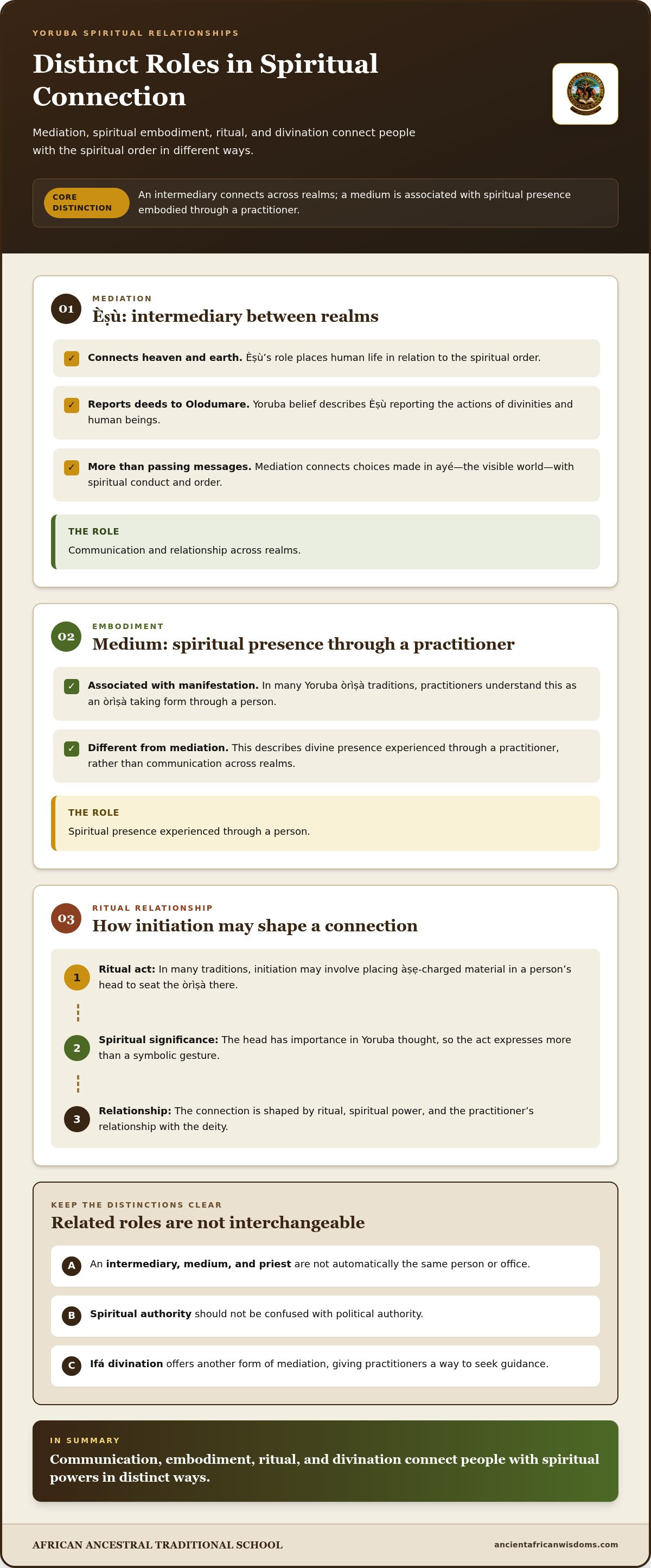
In Yoruba traditions, mediators and mediums connect human life with spiritual powers, but their roles differ. Èṣù is an intermediary between heaven and earth, while spirit manifestation describes an òrìṣà becoming embodied in a practitioner.
Èṣù has a distinct responsibility: Yoruba belief describes him reporting the deeds of divinities and human beings to Olodumare. His role in mediation goes beyond simply passing messages. It places human action and divine conduct in relationship, connecting choices made in ayé with the spiritual order. Èṣù is therefore central to understanding how communication between realms can shape character, destiny, and the wisdom people seek.
A medium, by contrast, is associated with the embodiment of a spiritual presence. In many Yoruba òrìṣà traditions, practitioners understand this manifestation as an òrìṣà taking form through a person. This differs from Èṣù’s intermediary role: one describes communication across realms, while the other describes divine presence experienced through a practitioner. Keeping the distinction in mind helps readers avoid treating every spiritual role in African traditions as interchangeable.
Ritual can prepare a relationship between a practitioner and an òrìṣà. In many traditions, initiation may involve placing àṣẹ-charged material in a person’s head to seat the òrìṣà there. The head has spiritual significance in Yoruba thought, so this act means more than a symbolic gesture. It expresses a connection shaped by ritual, spiritual power, and the practitioner’s relationship with the deity.
These roles call for careful interpretation. An intermediary, a medium, and a priest are not automatically the same person or office, and spiritual authority should not be confused with political authority. Ifá offers another form of mediation, giving practitioners a way to seek guidance through divination. Together, these examples show how communication, embodiment, and ritual can connect people with deities while retaining distinct meanings and responsibilities.
Orisha and nature
Orisha are divinities created by Olodumare to serve creation and oversee the world. Their connections with natural forces and human qualities show how spiritual thought relates to daily life.
Offerings and rituals connect practitioners with an orisha’s àṣẹ, or spiritual power, while festivals express those relationships through shared cultural experience. These practices help people encounter divine influence through nature, movement, and community.
Rituals and Offerings for Orishas
Rituals and offerings are ways people seek to experience an orisha’s àṣẹ and honor its presence. In Yoruba traditions, this connection matters because spiritual power is understood to shape a person over time. For Òrìṣàńlá, snail-shell liquid and the snail’s slow movement are associated with àṣẹ, linking a ritual element to qualities found in nature.
Specific relationships make the tradition more tangible. Oshun is associated with rivers, love, and fertility; Yemoja with the oceans and protection of children. These connections do not reduce either orisha to a natural feature. Instead, they show how divine presence and human concerns can be understood together. An offering or ritual can express respect for spiritual forces and the qualities they represent.
Festivals Connecting People and Orishas
Festivals connect people with orishas through collective ritual, music, dance, and movement. Ṣàngó’s tradition, for example, uses drumming and dance to produce, channel, and evoke energy associated with thunder and lightning. These shared experiences make spiritual relationships present through cultural practice, rather than leaving them only in stories or private thought.
Nature also shapes how festival movement carries meaning. Ọya is associated with tornadoes and storm winds, and her tradition carries the àṣẹ of swirling winds and unpredictable change. Such examples invite a careful reading of performance: sound and movement can express qualities linked to an orisha, not simply entertain an audience. To explore these connections in context, consider learning about African spiritual traditions.
What is the Yoruba creation story and how was the world formed?
Yoruba creation accounts place Olodumare at the heart of creation and describe a world with visible and invisible planes. In Ifá theology, Oduduwa creates dry land from water at Ile Ife. The story links the shaping of the physical world with sacred place and spiritual order, giving Ile Ife a central role in accounts of how existence began.
The creation story is about more than land emerging from water. It presents a relationship between Olodumare, the principal force of creation, and the beings involved in shaping the world. Obatala appears as a creator figure associated with wisdom and purity. These roles show how divine responsibility and the formation of human life belong within a wider sacred structure.
Ile Ife is locally called “Ifẹ̀ Ọ̀ọ́dáyé,” meaning “cradle of existence.” The name expresses the city’s significance in Yoruba accounts of origins. Rather than treating place as mere background, the story connects the emergence of dry land with a location of spiritual and cultural meaning. This connection helps explain why Ile Ife is central to these creation traditions.
The visible plane is the world people encounter, while the invisible plane is associated with spiritual beings and forces. In Yoruba religious thought, Olodumare, deities, and ancestors inhabit the invisible realm; humans and animals inhabit the visible one. These planes form a connected universe, not separate worlds without relationship. This framework shows how creation stories link human life with divine order.
Read the account as a sequence: Olodumare is the principal creative force, Oduduwa brings dry land from water at Ile Ife, and Obatala represents wisdom and purity. To deepen your understanding of these origins, explore African spirituality courses.
African Ancestral Traditional School: African Ancestral Traditional School Levels
African Ancestral Traditional School offers structured learning for readers ready to explore African spiritual teachings, culture, and tradition beyond this introduction. Its African Ancestral Traditional School Levels provide a path for continued study, while Ancestral Spiritual Teachings help learners deepen their understanding of heritage and spiritual frameworks.
These courses are a next step for learners who want to study ancestors’ roles, the relationship between Orisha and nature, and Yoruba creation accounts in greater depth. Community Access supports connection with others exploring African cultural heritage, and Spiritual Rituals are among the school’s offerings.
For a thoughtful next step in your learning, visit ancientafricanwisdoms.com.
Carry your learning forward
A thoughtful next step is patient study. Return to the ideas that sparked your curiosity, consider how they connect with your questions, and learn from cultural context as well as written explanations. Yoruba cosmology offers more to explore than a single introduction can contain. Continued learning grows through attention, reflection, and respect for the traditions being studied.
If you’re ready to continue that journey, connect with African Ancestral Traditional School and explore a learning path that feels meaningful to you. Take your time, stay curious, and let each new insight deepen your understanding.
Frequently Asked Questions
What are the main concepts of Yoruba cosmology?
The main concepts include a connected visible and invisible universe, human destiny, spiritual relationships, and responsibilities to family and community. Notice how each idea relates to the others: a person’s inner direction informs conduct, while ritual and inherited teachings give meaning to relationships with spiritual forces. This interconnected view is central to understanding the tradition.
Who are Olodumare, the orishas, and the oriṣa in Yoruba belief?
Olodumare is understood as the Supreme God and principal force of creation. Orishas are divinities created to serve creation and oversee the world. “Orisha” and “òrìṣà” are different spellings of the same term, while “orishas” is its common English plural. These words do not name separate levels of divinity; they describe distinct roles within a spiritual order.
What are the roles of ancestors and the living in Yoruba cosmology?
Ancestors are remembered as continuing spiritual relations, while the living carry family memory forward through their choices, respect, and community life. A descendant might speak an ancestor’s name while recalling a story or value associated with them. Remembrance practices may also include lighting a candle or pouring a libation. Such gestures connect personal reflection with continuity between generations.
How does Yoruba cosmology differ from Yoruba religion and from related traditions such as Santería?
Yoruba cosmology is a spiritual framework encompassing visible and invisible realms, Olodumare, Orisha, and ancestors. Yoruba religious practices include rituals and Ifá divination within this worldview. Related diaspora traditions, such as Santería, preserve key elements of Yoruba traditions.
What is the role of the human soul, including èmí, orí, and ẹ̀mí, in Yoruba belief?
Orí is inner consciousness and guidance, while orí òde is the outer head. Rituals performed on the outer head are understood to affect the inner one. Breath is described as immortal and originating from God.
How has Yoruba cosmology changed or been practiced in the United States and the diaspora?
Yoruba traditions, rites, beliefs, music, and myths survived in Brazil, Cuba, Haiti, and Trinidad, with Lucumí, Candomblé, and Vodun preserving key elements. In the United States, Santería arrived with Puerto Ricans in the forties and fifties, and with Cuban refugees in the sixties.


