
The living, the ancestors, and the divine belong to one connected world. In Akan cosmology, Nyame is the creator, abosom are spirits or lower deities who assist people and receive power from the creator, and ancestors remain part of their descendants’ lives after death. Some Akan beliefs also hold that a soul may be reincarnated within its family or lineage.
It makes sense to seek a clear picture of how these relationships fit together, especially when unfamiliar terms make the tradition feel difficult to approach. This guide explains the roles of Nyame and the abosom, why people make offerings and pour libations, and how Akan beliefs describe the realm of the dead and reincarnation. It also explores how spiritual life, family lineage, and ancestral care connect within this worldview.
Key Takeaways
- Understand how Nyame, ancestral spirits, and abosom relate within Akan spiritual life.
- Learn how prayer, libations, and offerings can express remembrance and connection with ancestors and spirits.
- Explore how abosom are understood as intermediaries who assist people and receive power from the creator.
- Discover how Akan beliefs describe life after death and the possibility of reincarnation within a family or lineage.
Offerings to ancestors and spirits
In Akan cosmology, offerings and prayer express continuing relationships among the living, ancestors, and spirits. Some people pray daily and pour libations, offering liquid as they address ancestors or spiritual beings. These acts may seek advice, support, healing, or the favor of abosom. Their meaning lies not only in the offering itself, but also in remembrance, care, and respectful communication.
Ancestors remain connected to their descendants after death. In Akan tradition, they are regarded as guides and a first line of defense in life. Asamando is the realm of the dead, where ancestors retain vitality through the living community’s memory and interaction. Remembering family members and honoring their place in the lineage sustains a bond across generations.
How does Akan cosmology compare with other West African religious traditions? Akan beliefs share themes found in other traditions, including respect for ancestors and spiritual intermediaries, but names, practices, and teachings differ among communities. Libation and remembrance of ancestors are understood specifically through Akan relationships among family, ancestors, and abosom.
The Akan understanding of a person includes spiritual dimensions such as kra and sunsum. Kra is commonly associated with life and a divine element, while sunsum relates to a person’s spiritual character or presence. Mogya connects a person to the mother’s bloodline; ntoro refers to a spiritual element received from the father. Together, these concepts describe identity through spiritual and family ties.
The Golden Stool, or Sika Dwa Kofi, holds sacred meaning in Asante tradition as a symbol of the Asante people’s collective soul and unity. Its significance is both communal and spiritual: it represents the continuity of the people, rather than serving as an ordinary seat for a ruler.
Akan cosmological beliefs also place rituals, festivals, and life-cycle ceremonies within relationships with ancestors and spirits. Libation can mark an occasion by addressing the spiritual community, while family rites connect an individual’s passage through life with lineage. The meaning of each ceremony depends on the community and the spiritual relationships it honors.
The relationship between abosom and the creator god
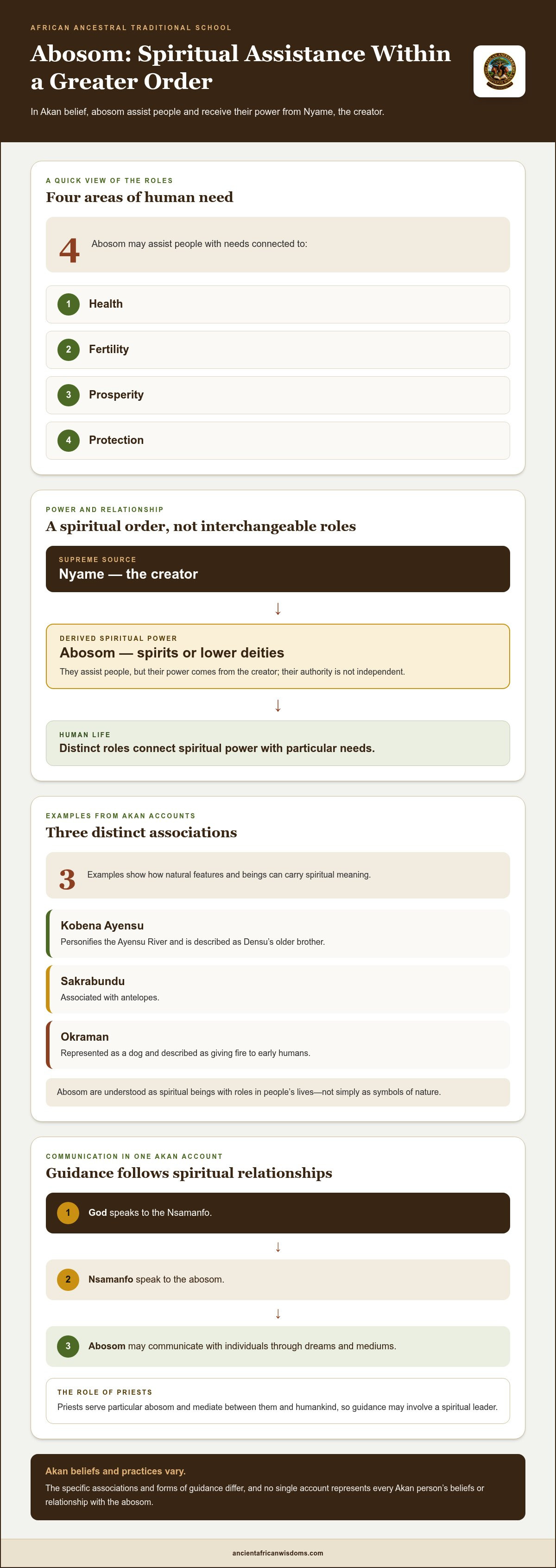
In Akan belief, abosom are spirits or lower deities who assist people on earth. They receive their power from the creator god, so their spiritual authority is understood as derived, not independent. Their roles connect divine power with particular needs and aspects of human life, including health, fertility, prosperity, and protection. This places the abosom within a wider spiritual order.
Nature offers recognizable examples. Kobena Ayensu personifies the Ayensu River and is described as Densu’s older brother. Sakrabundu is associated with antelopes, while Okraman is represented as a dog and described as giving fire to early humans. These distinct associations show how rivers, animals, and fire can carry spiritual meaning in Akan accounts. Abosom are not simply symbols of nature; they are understood as spiritual beings with roles in people’s lives.
Communication also follows spiritual relationships. In one Akan account, God speaks to the Nsamanfo, who speak to the abosom. The abosom, in turn, may communicate with individuals through dreams and mediums. Priests serve particular abosom and mediate between them and humankind. This helps explain why guidance may involve a spiritual leader, rather than being treated solely as an individual’s private interpretation.
What roles do the abosom play in Akan religion? They assist people with needs such as health, fertility, prosperity, and protection, while serving as intermediaries connected to the creator. Their specific associations and forms of guidance differ, as the examples of Kobena Ayensu and Okraman illustrate.
Christianity, Islam, and modern life can shape how individuals understand or practice Akan traditions. Experiences vary, so no single account represents every Akan person’s beliefs or relationship with the abosom.
To explore these relationships with cultural context, consider Ancestral Spiritual Teachings. A careful study of Akan traditions can help distinguish the roles of the creator, abosom, priests, and spiritual guidance without reducing them to interchangeable ideas.
Nyame as supreme being and creator
Nyame is understood as the supreme being and creator in Akan religious thought. The name belongs to a broader way of describing divine power and its relationship to human life. Rather than placing spiritual beings on an equal footing, this understanding positions the creator above the abosom. The abosom receive their power from the creator and serve people through distinct roles. This helps explain why devotion to spiritual intermediaries does not replace belief in a supreme source.
Akan accounts also use Onyankompon, Odomonkoma, and Nyame to describe aspects of God. Onyankompon is the male aspect, Odomonkoma the creative aspect, and Nyame the female aspect involved with human affairs. These names express dimensions of divine presence, including creation and engagement with people. They belong to Akan religious thought and should not automatically be mapped onto categories from other faiths. Together, they offer a way to speak about divine power and its varied qualities.
Nyame’s place in religious life has also been expressed through organized worship. In Kumasi, a large temple and priesthood devoted to the direct worship of Nyame were documented up until the 1920s. This example shows that devotion to Nyame could have its own dedicated institutions, alongside relationships with abosom and ancestral spirits. It also reminds readers that Akan religious practice includes specific histories and forms, not only broad ideas about a creator.
For readers, the distinction between Nyame and the abosom clarifies how divine authority relates to spiritual assistance. Nyame is the supreme creator; the abosom are distinct beings whose power derives from that source. A river-associated spirit such as Kobena Ayensu illustrates how spiritual roles may connect with particular features of life and nature. Keeping these relationships in view makes Akan teachings easier to understand without collapsing the creator, spirits, and ancestors into one category.
The realm of the dead and reincarnation
In Akan belief, death marks a transition from earthly life to a spiritual plane. Accounts describe the soul entering this realm and undergoing judgment and purification. This passage places death within a continuing spiritual order, rather than treating it as the end of a person’s existence. Asamando, the realm of the dead, is part of this understanding, connecting ideas about the afterlife with the continuing presence of ancestors.
Judgment and purification describe stages in the soul’s passage after death. They suggest that the spiritual plane has meaning and structure, though these beliefs do not establish one detailed account shared by every Akan community. Keep that distinction in mind: the central idea is a transition involving the soul, while explanations of its journey may vary. The afterlife is understood through spiritual relationships, not simply as a distant place.
Some Akan beliefs also hold that a soul may return through reincarnation, often within the same family or lineage. This possibility links generations: a descendant may be understood in relation to someone who lived before. Reincarnation is not presented as every person’s fate. It is one belief within a wider picture that includes the soul’s passage after death and the ancestors’ place in family life.
These ideas can seem to pull in different directions. If ancestors remain present in the lives of descendants, how can a soul also be reincarnated? Akan traditions include varied understandings, so the concepts should not be forced into one universal sequence. Ancestorhood emphasizes a continuing bond with the living, while reincarnation describes a possible return within a lineage. Both give spiritual significance to family continuity.
Read these teachings as connected beliefs rather than as one rigid formula. Asamando names the realm of the dead; judgment and purification describe aspects of the soul’s passage; reincarnation offers one account of return. Together, these concepts frame death, ancestry, and family lineage as related parts of Akan spiritual thought, while allowing for differences in how communities understand the soul’s journey.
African Ancestral Traditional School: African Ancestral Traditional School Levels
African Ancestral Traditional School offers structured learning through its school levels for readers ready to deepen their study. After exploring Nyame, the abosom, ancestors, and the afterlife, you may want a broader foundation in African spiritual traditions and cultural context.
Ancestral Spiritual Teachings and courses on African spirituality, culture, and tradition support continued learning, while Community Access offers a setting to connect with others studying this heritage. Spiritual rituals are also part of the school’s offerings. These learning pathways may suit you if you want to move beyond an overview and engage with the teachings in a more sustained way.
Explore African Ancestral Traditional School at ancientafricanwisdoms.com when you’re ready to continue your learning.
Carry Your Learning Forward
Let this exploration be a starting point for thoughtful study, not a final word on a living tradition. As you continue learning about Akan cosmology, consider how teachings are carried through family, community, language, and practice. Returning to a concept over time can deepen your understanding and help you approach sacred ideas with care.
You might note the questions that stay with you, such as how spiritual teachings connect with your own sense of heritage or belonging. Let curiosity guide your next steps, while respecting that traditions hold layers of meaning and cannot be fully understood through a brief overview.
If you’re ready to continue exploring African ancestral traditions through structured learning, connect with African Ancestral Traditional School. Take the next step at your own pace, with openness to learning and a steady respect for the wisdom you encounter.
Frequently Asked Questions
What are the main beliefs and concepts in Akan spiritual thought?
Akan cosmology connects the creator, spiritual beings, human life, and family lineage. Its concepts include Nyame and other names expressing aspects of God, abosom with particular spiritual roles, and ancestors who remain significant to descendants. Ideas about the soul also include kra, sunsum, mogya, and ntoro. These terms describe different dimensions of spiritual identity and kinship, rather than a single interchangeable force.
Who is Nyame in Akan cosmology, and what is Nyame's relationship to the universe?
Nyame is the supreme creator in Akan belief, and divine power is understood in relation to this source. The creator is also described through names expressing different aspects: Onyankompon as male, Odomonkoma as creative, and Nyame as female and involved with human affairs. This language presents creation and engagement with human life as connected qualities of divine presence, not separate gods competing for authority.
What is the role of ancestors (nsamanfo) in Akan cosmology and daily life?
Nsamanfo, or ancestors, link family memory with spiritual life. Their place in a lineage can shape how descendants remember relatives and understand inherited identity. For example, a family may speak of an ancestor as a continuing presence when reflecting on shared history or values. This relationship is not only about the past; it places care for family memory within a living connection between generations.
How do Akan creation stories explain the origin of the world and humanity?
Akan cosmology places the creator at the origin of existence, while creation accounts may express this through different teachings and traditions. The divine names Onyankompon, Odomankoma, and Nyame offer ways to describe aspects of God, including creativity. Rather than assuming one complete story represents every Akan community, approach these accounts in their cultural setting and attend to the names and meanings each teaching emphasizes.
What roles do nature, sacred groves, and animals have in Akan cosmology?
Nature and animals can carry spiritual associations in Akan belief. For instance, Amii is a mouse abosom worshipped in Tanoboase, a village in Techiman. This example shows how an animal may be connected with a specific spiritual being and place. Sacred groves, where present in cultural practice, should be understood within their local traditions, rather than assigned one universal meaning across all Akan communities.


