
Destiny does not have to mean surrendering your choices. In Akan thought, nkrabea is a life path assigned before birth, but wisdom, good deeds, and personal responsibility shape how a person lives it. African concepts of destiny vary across traditions, yet they can bring spiritual purpose and human agency together.
It’s natural to wonder how a path can be given in advance while your decisions still matter. Akan teachings offer one way to understand this balance: destiny provides direction, while conscious choices and perseverance help bring it to life.
Explore how Akan beliefs connect destiny with free will and responsibility, then consider how broader African conceptions place a person within spiritual and community relationships. This guide also distinguishes destiny from fatalism and introduces Yoruba ideas that offer another perspective.
Key Takeaways
- Understand how destiny can offer direction without making a person powerless; effort and everyday decisions still matter.
- See why Akan understandings connect an individual’s path with community roles, support, and shared responsibility.
- Explore how Yoruba ideas of ayanmo and ori relate a preordained path to a person’s spiritual essence and character.
- Approach African traditions as distinct perspectives, not one single account of destiny, and continue learning through structured cultural and spiritual teachings.
Akan beliefs about destiny
Akan communities, found primarily in Ghana and Ivory Coast, understand destiny through nkrabea. Nkrabea is a life path Nyame assigns before birth. It gives a person spiritual direction without making every event a fixed script. Akan thought also recognizes ancestors and minor deities as guides along that path, placing individual life within a spiritual order.
Across African traditions, ancestors may guide how people understand their paths, while divination can offer spiritual counsel. In Yoruba practice, for example, people may seek guidance through orisha and Ifa divination.
Akan moral expectations give this spiritual direction a practical dimension. Wisdom and good deeds are understood to help people meet challenges and move toward their destiny. Daily conduct matters: a compassionate choice or patient response can express a commitment to living wisely. Destiny is not simply a promise of success, nor does it excuse harmful behavior. The emphasis is on how people use their judgment within the life they have been given.
Community life can also reveal how a person’s path takes shape. An occupation or community role may express an individual’s destiny while supporting social balance. Work that serves others, for example, can carry meaning beyond personal achievement. A person’s contribution and the community’s wellbeing are connected, so a path is understood through relationships as well as individual purpose.
Hardship is part of this understanding, too. Akan beliefs treat adversity as part of a person’s journey and value resilience and patience in facing it. A difficult period does not automatically mean someone has lost their path. Perseverance and wise action help a person respond to what life brings. This view recognizes challenges without making effort meaningless.
Consider nkrabea as a direction shaped through spiritual guidance, moral conduct, and participation in community life. Nyame assigns the path, while ancestors and minor deities may guide the journey. A person’s choices, work, and response to adversity give that path lived expression. Together, these ideas make Akan destiny a matter of both spiritual purpose and responsible action.
Free will and personal responsibility
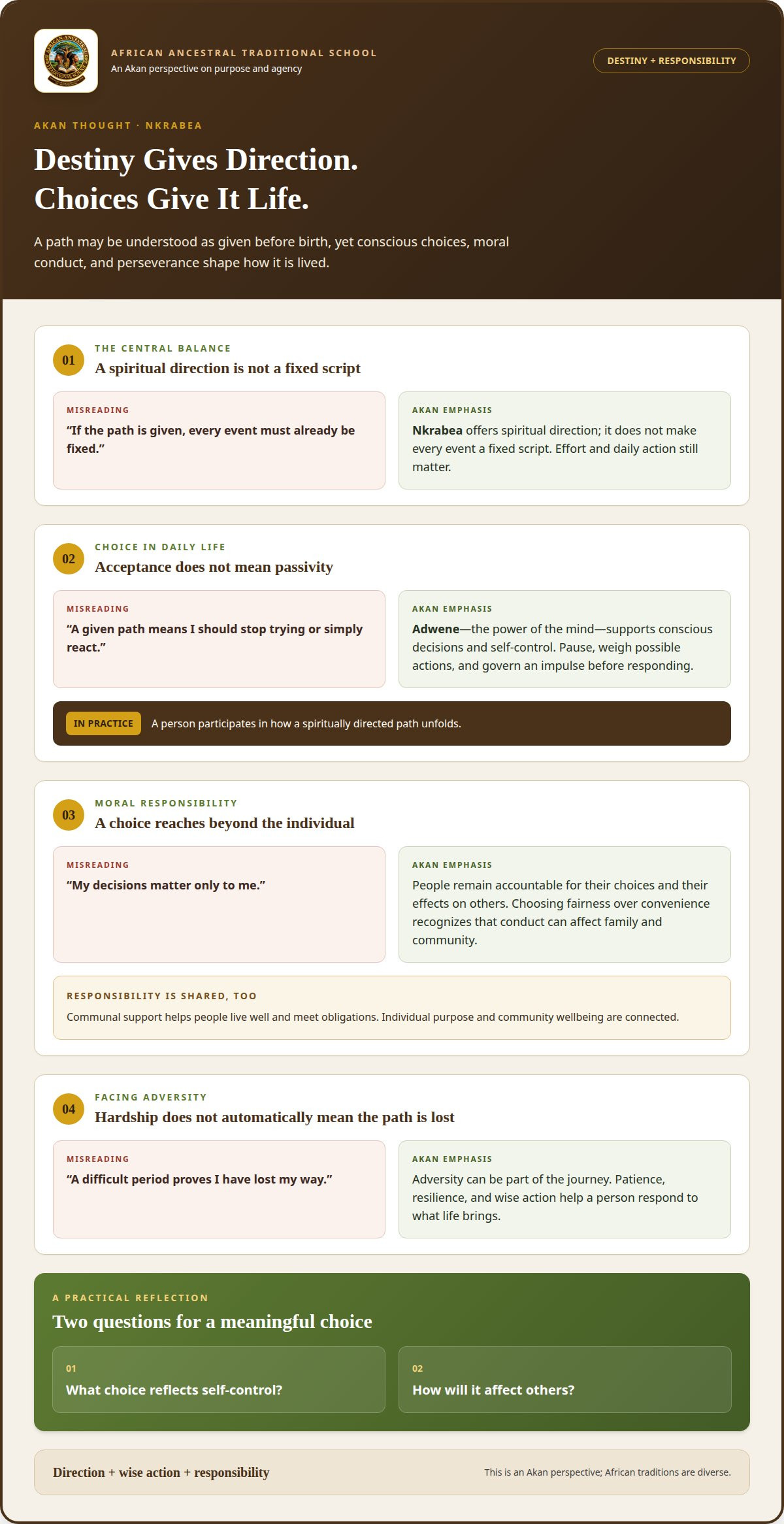
Traditional African views can hold destiny and choice together: a person may accept a given path without surrendering agency. In Akan thought, conscious decisions and self-control shape how that path is lived.
Free Will and Choice
Free will is the ability to make meaningful choices while living within a destiny understood as given. In the African religious understanding described here, a person can accept destiny rather than try to outmaneuver it. Acceptance does not mean passivity. When facing a difficult choice, for example, someone can consider which action aligns with their responsibilities and then act deliberately.
Akan thought names adwene, the power of the mind, as the capacity for conscious decisions and self-control. This gives choice a practical place in daily life: pause, weigh possible actions, and govern an impulse before responding. A path may have spiritual direction, yet the person still participates in how it unfolds. Effort matters, so destiny is not a reason to stop trying.
Moral Responsibility
Moral responsibility means being accountable for choices and their effects on others. Akan beliefs join destiny with personal responsibility, so a person’s actions remain meaningful even when their path is understood as preordained. This matters in decisions that affect family or community. Choosing fairness over convenience, for instance, recognizes that personal conduct reaches beyond private ambition.
This outlook also makes responsibility shared rather than purely individual. Akan thought emphasizes communal support, with people helping one another live well and meet obligations. A person can consider two questions: “What choice reflects self-control?” and “How will it affect others?” These questions turn spiritual belief into a guide for conduct, without suggesting every hardship results from someone’s choices.
To deepen this reflection, explore structured teachings on African spirituality, where cultural context can help connect belief with practice.
African conceptions of destiny
African traditions describe destiny through spiritual relationships, human effort, and community, not one uniform doctrine. The distinctions below help separate related ideas without treating diverse traditions as identical.
Destiny, Fate, and Providence
Destiny describes a life path understood as spiritually shaped, while fate often suggests an unchangeable outcome; providence refers to divine guidance or care. These terms help readers notice different emphases, rather than assume every African tradition uses them alike. Among Akan and Yoruba people, destiny is not understood as fatalism. Effort and daily action still matter in living out a path.
Ayanmo and Ori
In Yoruba thought, ayanmo is a divinely preordained path connected to ori, a person’s spiritual essence and guide. This connection frames destiny as both direction and a relationship with one’s inner spiritual nature. Yoruba philosophy also values iwa pele, or good character, as a way to keep actions in harmony with that path. Character gives purpose practical expression.
Christian and Islamic Influence
Christianity and Islam add religious frameworks for considering divine will, human choice, and moral life within African societies. People may interpret destiny through these faiths alongside inherited cultural understandings. There is no single shared position: beliefs vary across communities and individuals. Consider the specific tradition and setting before treating one account of destiny as representative of the continent.
Common Misconceptions
A common misconception is that African destiny means passive acceptance or that effort cannot change anything. Yet the African understanding described here calls for daily work toward a path designed before birth, and Gbadegesin’s account emphasizes that effort matters. Another mistake is reducing destiny to romance or the futility of working. These assumptions overlook spiritual and communal dimensions, including the Igbo worldview’s three interconnected worlds: ancestral, living, and yet unborn.
How do Yoruba concepts of destiny, ayanmo and ori, work?
Yoruba thought connects a divinely shaped path with a person’s spiritual essence. Ayanmo and ori describe related parts of this understanding, while character influences how someone lives their path.
Ayanmo is understood as a divinely preordained path chosen before birth in consultation with spiritual entities. It gives life direction, but does not mean every decision or experience is predetermined. A person still acts within that path, and daily conduct helps shape how it unfolds. This distinction makes room for both spiritual purpose and human participation.
Ori is a person’s spiritual essence and guide, connected to ayanmo. Rather than treating destiny as only an external instruction, this relationship places guidance within the person’s spiritual nature. One way to understand the connection is through direction and alignment: ayanmo describes the path, while ori relates to the inner guide associated with it. The concepts are linked, not interchangeable.
Yoruba tradition also emphasizes iwa pele, or good character. Cultivating iwa pele helps a person keep their actions in harmony with their divine path. When considering a difficult choice, someone might ask whether an action reflects good character, not only whether it brings immediate gain. This principle brings destiny into ordinary decisions, relationships, and responsibilities.
Yoruba people may also seek spiritual guidance through consultation with the orisha and Ifa divination. These practices offer ways to seek insight while considering one’s path; they do not remove personal responsibility. Together, ayanmo, ori, iwa pele, and spiritual consultation form a connected framework: a path is divinely shaped, guidance is sought, and character informs action.
To study these ideas in their cultural and spiritual context, explore courses on African spirituality and tradition.
African Ancestral Traditional School: African Ancestral Traditional School Levels
African Ancestral Traditional School offers structured learning levels for exploring African spirituality, culture, and tradition. If Akan or Yoruba ideas of destiny have raised questions about how spiritual teachings connect with daily life, these courses offer a way to continue learning with cultural context.
Through African Ancestral Traditional School Levels, students can engage with Ancestral Spiritual Teachings and explore Spiritual Rituals. Community Access also provides a space to connect with others while studying. This learning can help you place concepts such as nkrabea, ayanmo, and ori within broader traditions, rather than treating them as isolated terms.
Consider this path when you want sustained study beyond a brief introduction, or when you’re ready to explore African heritage through organized digital learning. Visit ancientafricanwisdoms.com to learn more.
Carry Your Reflection Into Further Learning
Let your next step begin with curiosity rather than a demand for certainty. As you consider African concepts of destiny, reflect on what shapes your choices, how your actions affect others, and which teachings you want to understand more deeply. These questions can guide continued learning without asking one tradition to speak for every community.
Give yourself room to study cultural teachings with care and context. Returning to a concept over time can reveal new connections between spiritual understanding and the responsibilities you carry in everyday life. Learning is part of the journey, not a test you need to pass.
If you’re ready to continue exploring African heritage through structured study, contact African Ancestral Traditional School. Take the next step at your own pace, with openness to what deeper learning may bring.
Frequently Asked Questions
What does destiny mean in different African philosophical traditions?
Destiny can describe a spiritually shaped life path, but traditions explain its meaning differently. Akan thought uses nkrabea, while Yoruba thought connects ayanmo with ori. An Igbo-African worldview places human life within relationships among ancestral, living, and yet-unborn worlds. These ideas offer distinct ways to consider purpose, spiritual relationships, and community, rather than one definition shared across Africa.
How do Akan ideas of destiny and the soul relate to free will?
Akan thought connects a path assigned by Nyame with adwene, the power of the mind to make conscious decisions and exercise self-control. For example, someone deciding whether to act honestly can see that choice as part of living responsibly, rather than assuming destiny determines the action. This perspective links spiritual direction with deliberate conduct without making every choice a fixed outcome.
How do African concepts of destiny vary across regions and ethnic groups?
These traditions vary in the spiritual relationships and responsibilities they emphasize. In an Akan frame, destiny relates to Nyame and communal roles; Yoruba thought highlights alignment with ori and good character. An Igbo-African worldview describes existence through connected ancestral, living, and yet-unborn worlds. Comparing these traditions means noticing their different terms and relationships, rather than treating one community’s teaching as a template for all.
How do contemporary African philosophers interpret destiny and free will?
Gbadegesin’s account of African thought emphasizes that people are not helpless regarding destiny because effort matters. This offers a way to discuss agency without rejecting spiritual purpose: people work toward their path through their actions. For readers, the key question is how responsibility operates within a larger spiritual and communal setting. Philosophical interpretations can examine both personal effort and relationships beyond the individual.


