
The past can guide you without becoming a rulebook. Ancestral wisdom can help you understand how family stories, inherited patterns, and cultural teachings shape your sense of belonging and the choices you make today. Its value lies not in repeating every tradition unquestioningly, but in reflecting on what supports a grounded, meaningful life.
You may feel that your roots hold insight, even if some stories or connections are difficult to access. Exploring them can bring clarity, strengthen your sense of identity, and help you notice which patterns you want to carry forward or change.
Here, you’ll learn how family and community knowledge can inform spiritual growth, how to approach Indigenous traditions with respect for their distinct origins, and how to bring ancestral teachings into daily life. You’ll also find practical ways to listen, reflect, and move forward with care.
Key Takeaways
- Start with family stories, everyday traditions, and community knowledge to find meaningful connections to your roots.
- Notice recurring family patterns with compassion, and consider what you want to carry forward or change.
- Bring inherited teachings into daily life through small, thoughtful practices that fit your values and circumstances.
- Approach Indigenous traditions with humility, honoring their cultural origins and the communities that sustain them.
Family and community wisdom lineage
Your lineage can include biological relatives, adoptive family, and chosen kin. Each may offer stories, skills, and ways of belonging, even when family records are incomplete. Start with someone you trust and ask about a remembered meal, song, or family turning point. Record the name, place, and meaning of each story, and distinguish personal memory from details you can document. This makes ancestral wisdom personal without treating every inherited belief as a rule.
Look for practices carried through daily life, not only formal ceremonies. In Black communities, ancestral healing practices can include music, art, dance, storytelling, herbal remedies, and communal rituals. Church gatherings and drum circles are examples of shared ritual. Ask an elder what a song, dish, or gathering meant to their family. Then consider how the practice brought people together, rather than reducing it to a symbol. These conversations reveal cultural heritage through lived experience.
Mentorship can give these conversations a steady shape. Invite an elder, cultural teacher, or trusted community member to share a skill or explain a family tradition. Bring specific questions, such as how a recipe changed across generations or when a particular song is sung. A retreat can provide focused time for reflection, journaling, and learning alongside others. Choose a purpose beforehand, such as exploring family stories or developing a regular practice. Community brings shared memories and perspectives beyond one household.
Turn what you learn into a respectful, manageable practice. You might cook a relative’s dish, learn a heritage song, or gather chosen family to share stories. Ask permission before recording or retelling someone else’s experience, especially when it holds private meaning. Keep a family notebook of names, places, and questions to revisit. Notice which teachings support care, connection, and responsibility in your life today. This reflection helps you honor your lineage while deciding what to carry forward.
Ancestral trauma and family patterns
Family patterns may carry learned responses to hardship, silence, conflict, or care. In Black communities, trauma has been described as passing across generations. That doesn’t mean every descendant shares the same experience. Instead, it calls for careful attention to how family history may shape present reactions. A household that once faced scarcity, for example, may teach children to avoid risk even after circumstances change. Notice the pattern without assigning blame.
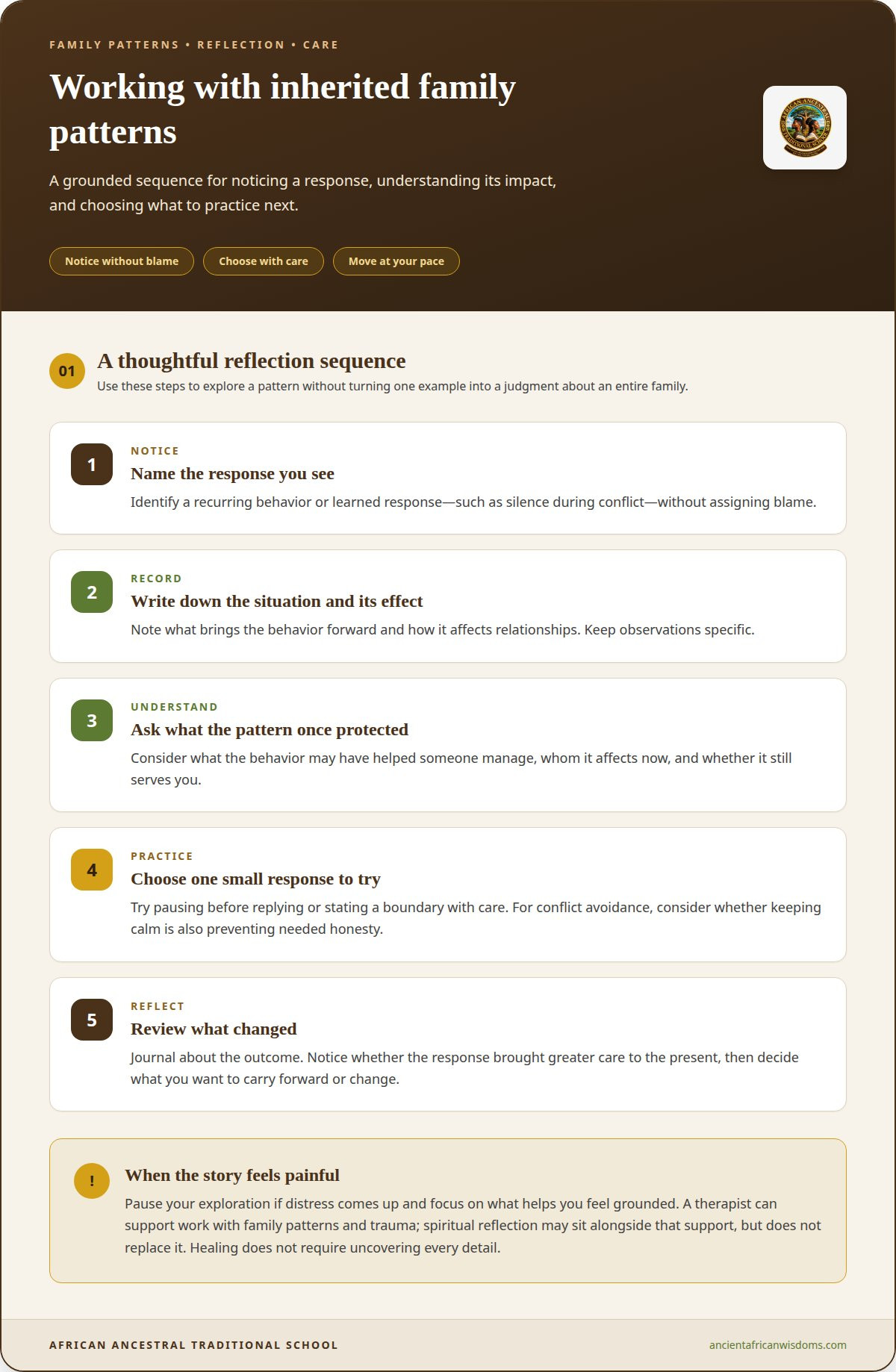
Resmaa Menakem is cited as describing trauma as something that can appear in personality traits and shape culture. Consider a family where anger ends difficult conversations. Children may learn to stay quiet, while adults may mistake silence for peace. Naming the response helps separate an inherited habit from a chosen value. Ask what the behavior once protected, whom it affects now, and what healthier response could replace it.
Try a simple reflection before changing a family pattern. Write down the behavior, the situation that brings it forward, and its effect on relationships. For instance, consider whether avoiding conflict preserves calm or prevents needed honesty. Then choose one small response to practice, such as pausing before replying or stating a boundary with care. Review the outcome in a journal. Keep your observations specific instead of turning one example into a judgment about an entire family.
Some patterns are connected to painful experiences that may feel difficult to approach alone. A therapist can support people working through family patterns and trauma. Spiritual reflection may sit alongside that support, but it doesn’t replace it. If a family story brings up distress, pause your exploration and focus on what helps you feel grounded. You can also learn from trusted elders while respecting their boundaries. Healing doesn’t require uncovering every detail; it can begin with choosing a response that brings greater care to the present.
Bringing ancient wisdom into modern life
Ancestral Wisdom becomes practical when a teaching shapes an everyday choice. Begin with one value from your family or cultural tradition, such as hospitality, patience, or care for elders. Choose a daily moment to practice it. You might welcome a neighbor with a meal or pause before answering during conflict. Reflect afterward: did the action express the teaching, or did it feel forced? This keeps inherited insight connected to your needs today.
Modern schedules can draw attention away from the natural rhythms that sustained earlier generations. Ken Breniman describes this disconnection as a challenge of contemporary routines. Observe your own patterns before changing them. Note when work, screens, meals, and rest fill your day. Then create a small pause, such as sitting quietly before breakfast or taking a walk without a device. Treat it as attentive practice, not a substitute for traditions you haven’t learned.
Anger, too, calls for deliberate practice. Lorena Saavedra Smith encourages people to move through anger in ways that help create a better world for their grandchildren. When frustration rises, name what happened and what matters to you. Choose a response that protects dignity without passing harm onward. For example, take time to settle before a difficult conversation, then speak about the action and its impact. This brings future generations into today’s decisions.
Build a modest rhythm you can sustain. Choose one practice, such as a quiet moment of remembrance, a meal prepared with care, or time outdoors. Give it a clear place in your routine, then notice what it asks of you. Does it deepen attention, encourage responsibility, or connect you with a teaching? Adapt the practice with respect for its origins. A living tradition isn’t a shortcut; it calls for learning, reflection, and care in how you carry it forward.
Indigenous teachings and ancestral traditions
Indigenous traditions are distinct, rooted in specific peoples, places, and relationships. Treating them as one shared body of practice can erase those differences. Ofelia Nibari advises returning to oral traditions and letting children hear stories. Listening to a story from its community of origin helps preserve its context instead of turning it into a general spiritual lesson. Ask who holds the knowledge, what responsibilities accompany it, and whether it is shared publicly.
Misrepresenting ancestral wisdom can flatten a living tradition into a symbol or separate its meaning from its people. Cultural appropriation includes taking sacred spiritual practices from another cultural group without authorization to teach or perform those rituals publicly. Before sharing a practice, learn its context and respect the boundaries set by the people who sustain it. Don’t present another community’s sacred teachings as your own.
Protect and credit knowledge by naming its source community or teacher when they permit attribution, preserving its context, and following their guidance about what may be shared. Treat oral traditions with care: don’t record, publish, or teach a story simply because you heard it. Ofelia Nibari also encourages caring for the Earth as for one’s own soul, linking knowledge with responsibility rather than possession.
Approach nature with humility. Lorena Saavedra Smith encourages people to consider whether they’re meeting the natural world respectfully or seeking to dominate it. For example, before using a plant in a personal practice, learn whether that knowledge belongs to a specific tradition and whether it is appropriate to share. Humility means being willing to listen, change course, and leave teachings in their original context.
Traditions can also help challenge narratives that contribute to spiritual oppression. Ofelia Nibari advises disrupting those narratives and returning to community-held stories. Reflect on whose voice is centered, whose knowledge is missing, and what care requires in practice. For grounded study of African spirituality, culture, and tradition, explore ancestral teachings with attention to their cultural roots.
African Ancestral Traditional School: African Ancestral Traditional School Levels
African Ancestral Traditional School offers structured digital courses in African spirituality, culture, and tradition through its African Ancestral Traditional School Levels. If you’re ready to deepen personal reflection through organized study, these levels offer a path for continued learning. Ancestral Spiritual Teachings and Spiritual Rituals connect study with cultural practice, while Community Access lets learners connect as they explore African heritage. Choose this path to build understanding through teachings and coursework, rather than treating traditions as detached ideas. Visit African Ancestral Traditional School online to explore its learning offerings.
Carry the Teachings Forward With Care
Choose a next step that feels manageable and meaningful enough to shape how you live. Consider one question: Which inherited teaching deserves deeper study? What responsibility comes with practicing it? How can your choices honor those who came before while caring for those who follow? Write your answers, then revisit them as your understanding grows. Ancestral Wisdom can guide reflection when it leads to respectful action, not merely an idea you admire. Give yourself room to learn, reconsider, and act with humility.
If you’re ready for a structured next step, connect with African Ancestral Traditional School and explore a learning path that fits your questions and values. Share what you hope to understand more deeply, and begin with an open mind. Contact African Ancestral Traditional School to start the conversation. Let curiosity guide you, and let Ancestral Wisdom inspire care in each step forward.
Frequently Asked Questions
What will this mean for my life?
It can help you make present-day choices with greater awareness of your history and values. Before repeating a family expectation, for example, consider whether it still serves your relationships or goals. You might also use a story, song, or inherited skill as a prompt for reflection. Its meaning is personal: learning offers context, while you decide how to apply it.
What does “ancestral wisdom” mean?
Ancestral wisdom is knowledge, values, and practices carried across generations within families and communities. It can include practical skills, spiritual understandings, stories about belonging, and lessons shaped by shared experience. The term doesn’t describe one universal belief system. Its meaning depends on the people and tradition involved, so ask whose knowledge you’re learning and what responsibilities come with it.
What are examples of ancestral wisdom across cultures?
Examples depend on a community’s history and traditions. In Black communities, healing practices may include music, art, dance, storytelling, herbal remedies, and communal rituals. Oral storytelling is also one way Indigenous knowledge can be shared across generations. These examples aren’t interchangeable or exhaustive; each practice has its own context. Learn about a specific tradition through its history and the people who carry it.
How has ancestral wisdom been passed down through generations?
Knowledge can travel through spoken stories, repeated practices, and skills taught within families and communities. A child might learn a heritage language through conversation, hear a family story retold at gatherings, or observe how relatives prepare a traditional dish. Religious traditions, folk music, and craft skills can also carry memory. Each generation may preserve, interpret, or adapt what it receives.
What role does ancestral wisdom play in Indigenous communities?
Indigenous teachings can hold cultural knowledge, guide relationships with the land, and support community continuity. Their forms and meanings differ among Indigenous peoples, so no single explanation applies to every community. Oral traditions are one way knowledge and stories are carried. Approach specific teachings with respect for their source, and don’t treat them as general material detached from the people and place that sustain them.
How can someone learn about their own family’s ancestral wisdom?
Begin with a question about your family, such as which language relatives spoke or which traditions mattered at home. Talk with willing relatives, record what they share with permission, and note which details are memories or family accounts. You can also explore genealogy, heritage language, music, or religious traditions. Keep a record of names and unanswered questions, then follow one thread at a time.


