
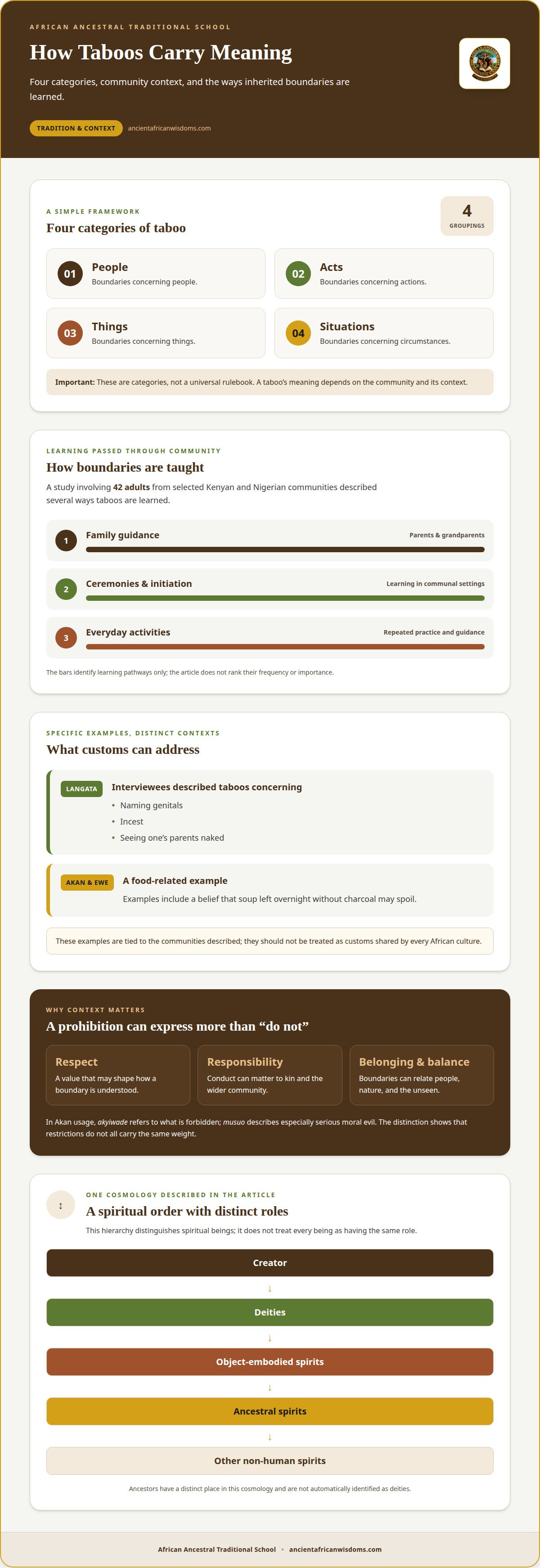
Ancestors are honored in many African spiritual traditions, but they aren’t necessarily regarded as deities. In the cosmology described here, ancestral spirits occupy a distinct place in a wider spiritual order, and understanding spiritual taboos in African culture means recognizing how these boundaries help sustain relationships among people, nature, and the unseen. Taboos are often grouped into four categories: people, acts, things, and situations.
It’s understandable to see a taboo as simply a prohibition, especially when its meaning isn’t immediately clear. Within a tradition, however, a taboo may express teachings about respect, responsibility, belonging, and spiritual balance. Its meaning depends on the community and context, so one custom shouldn’t be treated as a rule shared by every African culture.
This article explores how some indigenous African religions understand ancestors, spiritual communication through dreams, visions, and divination, and the reasons certain boundaries matter. Consider how each practice relates to the values and relationships that give it meaning.
Key Takeaways
- Understand how indigenous African traditions describe the relationship between God, divinities, spirits, and mystical power.
- Learn why ancestors hold a distinct place in spiritual cosmology and how communities may understand responses to taboo-breaking.
- Recognize dreams, visions, divination, and ordeals as forms of spiritual communication in some traditions.
- Explore how the meaning of a taboo depends on its cultural and moral context, then deepen your learning through structured courses on African spirituality, culture, and tradition.
GAZETTE: How would you define indigenous African religions?
Indigenous African religions encompass diverse traditions that connect humanity, nature, and the unseen. Colonialism, Christianity, Islam, and urbanization have influenced how communities practice and interpret spiritual taboos, with different effects in different places.
Traditional Beliefs and Spiritual Beings
These religions include beliefs about God, divinities, spirits, and mystical power within a connected spiritual world. A traditional restriction may therefore express relationships among people, nature, and the unseen, rather than function as a rule without context. Understanding spiritual taboos in African culture starts with noticing how beliefs shape the meaning of an act or ritual.
Spiritual Hierarchy and Religious Values
A spiritual hierarchy describes how different beings are understood in relation to one another. In the cosmology described here, the Creator stands above deities, object-embodied spirits, ancestral spirits, and other non-human spirits. This order helps distinguish spiritual roles rather than treating every being as identical. It also frames values such as respect and responsibility within a broader worldview.
Origins and Significance of Taboos
Taboos are prohibitions whose meanings arise from spiritual, moral, or communal beliefs. In Akan usage, akyiwade refers to what is forbidden, while musuo describes especially serious moral evil. This distinction shows that restrictions don’t all carry the same weight. Understanding spiritual taboos in African culture means considering the values and relationships a prohibition is understood to protect.
Religious Practices in Modern Africa
Indigenous religious practices continue in varied forms alongside Christianity and Islam, while urban life can change where and how customs are followed. Christian approaches to traditional rituals differ, so no single interpretation represents every Christian community. Colonialism has also reshaped the social and religious contexts in which traditions are practiced. These influences help explain why communities may maintain, adapt, or interpret beliefs and taboos differently.
GAZETTE: Are ancestors considered deities in the traditional African cosmology?
Ancestors aren’t necessarily considered deities: traditional cosmologies may place ancestral spirits in a distinct position among spiritual beings. This distinction helps explain why communities may connect ancestral relationships with moral conduct and observance of taboos.
Ancestors in Traditional Cosmology
In some traditions, ancestors are deceased members of a community who remain spiritually significant to the living. They aren’t automatically the same as deities. In the cosmology described here, the Creator stands above deities, object-embodied spirits, ancestral spirits, and other non-human spirits. This distinction avoids treating every spiritual being as having the same role or status.
Whether ancestors are deities depends on how “deity” is defined within a particular tradition. The hierarchy described here places ancestral spirits below the Creator and deities, rather than identifying them with either. Their significance lies in their place in continuing relationships between the living and the unseen. Communities may understand those relationships through inherited beliefs and customary obligations.
Kinship and Ancestral Relationships
Kinship connects people through family ties, shared obligations, and communal life, giving ancestral relationships meaning beyond private belief. From this perspective, a person’s conduct can affect relatives and the wider community, not just the individual. This communal principle helps explain why a taboo may be treated as a matter of collective responsibility. Its meaning is tied to the relationships a community seeks to preserve.
Accounts of taboo observance identify ancestors, spirits, elders, a chief, or a family father as possible agents of punishment. These roles aren’t interchangeable: an elder or family father represents living authority, while an ancestor belongs to the spiritual realm. The distinction helps clarify how social and spiritual accountability can overlap.
Some respondents also associated taboo-breaking with consequences for families and communities, including famine or harm to children born of incest. These are beliefs about possible consequences, not universal outcomes. They help explain why a taboo may carry weight beyond an individual choice. In this context, ancestral wisdom is connected to continuity, kinship, and communal well-being.
Communication through dreams, visions, divination, and ordeals
Traditional African religious communication may include dreams, visions, vision quests, divination, and ordeals. These practices belong to worldviews in which human life, nature, and the unseen are connected. Their forms and meanings vary among communities, so a dream or ritual shouldn’t be assumed to have one interpretation across Africa.
How are spiritual taboos taught and passed down in African communities? Children may learn them from parents and grandparents, during ceremonies and initiation, and through everyday activities. A study involving 42 adults from selected Kenyan and Nigerian communities described these different paths of learning. Through repeated guidance and communal practice, taboos can carry inherited values into daily choices.
Examples show how specific these customs can be. Langata interviewees described taboos against naming genitals, incest, and seeing one’s parents naked. Akan and Ewe examples include a belief that soup left overnight without charcoal may spoil. These customs touch on speech, kinship, and eating, showing how taboos can shape everyday conduct as well as ritual life.
Breaking a taboo may be understood to affect individuals and their communities. Respondents described possible consequences including famine and harm to children born of incest. Akan examples also identify murder and suicide as serious personal-safety taboos. These beliefs connect individual conduct with shared well-being and show the influence of community values in traditional spiritual life.
Taboos can change as communities respond to new circumstances. The research describes informal discussions at gatherings such as funerals as one way customs may be modified. One respondent said some Luo taboos, including those concerning wife inheritance, were observed less than before amid modern education and concerns about HIV transmission. Such changes show cultural continuity as a living process shaped by community discussion and changing conditions.
How taboos are defined and understood
A taboo is more than a prohibition: its meaning comes from the moral and spiritual relationships it protects. Understanding spiritual taboos in African culture starts by considering the values and community context behind a restriction.
Understanding the Meaning of Taboos
In Akan usage, one term describes what is forbidden, while another refers to especially serious moral evil. This distinction shows that restrictions can carry different degrees of seriousness rather than forming one undivided set of rules. Understanding spiritual taboos in African culture means asking what a rule signifies within its community, rather than judging the prohibition alone. Its meaning may depend on the people, actions, things, or situations involved.
Some taboos are treated as more consequential than others, and community well-being can shape how they’re understood. A rule may be set aside when another moral principle or law carries greater weight. This doesn’t make every custom optional; it shows that communities may weigh obligations against one another.
Misconceptions and Discussion Risks
A common mistake is treating one community’s taboo as a rule shared by all African communities. Local distinctions shouldn’t be assumed to apply everywhere. Visitors can learn respectfully by listening to local people, including elders, and asking about a custom’s meaning without assuming one person speaks for everyone.
Another risk is dismissing taboos as irrational restrictions or reducing them to superstition. Those labels overlook how rules can express character, social responsibility, and spiritual values. Community discussion can shape how customs adapt to changing circumstances; informal conversations at gatherings such as funerals have been described as one way taboos may be reconsidered. Treat each example as local, not universal.
To deepen your understanding of cultural context and spiritual meaning, continue exploring African spiritual teachings.
African Ancestral Traditional School: Courses on African Spirituality, Culture and Tradition
African Ancestral Traditional School offers courses in African spirituality, culture, and tradition for readers ready to deepen their understanding beyond this introduction. The structured digital learning path supports exploration of ancestral beliefs, cultural heritage, and spiritual practices, including the place of taboos within particular traditions.
African Ancestral Traditional School Levels provide a pathway for continued learning, while Ancestral Spiritual Teachings offer further grounding in ancestral knowledge. Community Access also gives learners space to connect with others as they study. Turn to these learning options when you want to explore African spirituality with greater depth and continuity.
If you’d like to continue your learning, contact African Ancestral Traditional School.
Carry Your Learning Forward
Understanding spiritual taboos in African culture is an ongoing practice of listening, learning, and honoring the distinct histories behind each tradition. Let what you’ve learned lead to deeper questions: whose values shape a custom, what relationships does it protect, and how can you approach it with care? These questions make room for learning without assuming one explanation fits every community.
You can continue your learning at a thoughtful, grounded pace. African Ancestral Traditional School offers online courses for those who want to explore African spiritual heritage more deeply and study ancestral knowledge. Explore the learning path when you’re ready to continue.
Begin a conversation with African Ancestral Traditional School and keep moving forward with curiosity and respect.
Frequently Asked Questions
GAZETTE: How have ancestors played a role in traditional societies?
Ancestors may be understood as spiritual agents connected to community expectations and accountability. In accounts from Kenyan and Nigerian communities, respondents also named living elders, a chief, spirits, and a family father as possible agents who could punish taboo-breaking. These roles point to different forms of authority: ancestral influence belongs to spiritual belief, while elders and family leaders also guide conduct within living relationships.
The Different Types of Taboos in Selected African Communities?
One study groups taboos into four categories: people, acts, things, and situations. This framework helps distinguish, for example, a restriction concerning a person from one concerning an object or circumstance. It organizes examples; it isn’t a single code applied across African communities. Local meaning and the relationships a rule protects remain central to interpreting each case.
What Constitutes the Spirit World?
The spirit world refers to the unseen beings and powers recognized within a particular religious worldview. One traditional cosmology places the Creator above deities, object-embodied spirits, ancestral spirits, and other non-human spirits. These categories describe distinct positions in that hierarchy; they shouldn’t be collapsed into one figure or treated as universal beliefs. Some traditions also recognize dreams, visions, divination, or ordeals as forms of spiritual communication.
What does taboo mean in African spiritual traditions?
A taboo is a prohibition with possible spiritual, moral, or communal significance. The English word traces to the Tongan tabu, related to Polynesian tapu and Hawaiian kapu. In Akan usage, akyiwade describes what is forbidden, while musuo refers to especially serious moral evil. A community may weigh a restriction alongside other moral obligations and collective well-being.
How do spiritual taboos vary across African cultures and ethnic groups?
Taboos vary because communities attach restrictions to different relationships, places, and responsibilities. Akan and Ewe examples include prohibitions on farming near watersheds and destroying sacred forests or bushes. A Luo respondent described changes in observance around wife inheritance amid modern education and concerns about HIV transmission. These examples show why a custom from one community shouldn’t be presented as a rule for the whole continent.
What are common examples of spiritual taboos in African societies?
Examples include restrictions on harming or even naming a totem animal or plant, farming near watersheds, and destroying sacred forests. Akan and Ewe accounts also describe selling or leasing land without prior approval from the Chief as an economic taboo. These examples involve different aspects of life, from relationships with nature to community responsibilities around land, and their meaning depends on local tradition.


