
What if that persistent feeling of being "untethered" isn't a modern malaise, but a quiet call from the blood that flows through your veins? You likely feel a deep, magnetic pull toward your heritage, yet you might hesitate because you fear practicing incorrectly or struggle to distinguish spirituality from religion. By understanding African ancestral practices, you can begin to quiet that internal restlessness and stand firmly in your own history. It's common to feel like a seeker standing at the edge of a vast ocean of knowledge, waiting for a steady hand to guide your first steps.
This guide serves as that steady hand, offering a grounded approach to reclaiming your identity with clarity and peace. You'll discover the foundational principles that govern these sacred traditions and learn how to integrate them into your daily life with authentic reverence. We will walk through the core tenets of African cosmology, distinguish ancestral veneration from religious frameworks, and provide practical ways to honor your lineage right where you are. Your journey of reclamation begins with a single, intentional breath toward home.
Key Takeaways
- Discover how ancestral traditions represent a holistic way of life that honors the sacred continuity between your lineage and the unborn.
- Gain a deeper perspective on understanding African ancestral practices by exploring the concept of Asè and the profound interconnectedness of all living things.
- Learn the essential spiritual difference between honoring ancestors as wise intermediaries and the worship of the Supreme Creator.
- Identify simple, practical steps to begin your journey at home by focusing on consistency and sincerity rather than complex tools.
- Explore how a structured, digital curriculum helps you move beyond spiritual grazing toward a disciplined path of identity reclamation.
What is the Essence of African Ancestral Practices?
African ancestral practices are far more than a set of rituals performed in isolation; they represent a holistic way of life that colors every interaction and decision. Unlike modern Western structures that often segment spirituality into a weekly event, these traditions are woven into the very fabric of daily existence. At its core, this path is the intentional reclamation of indigenous wisdom to navigate modern existence. It's about recognizing that you aren't an isolated island, but a vital link in a chain that stretches back through time and forward into the future.
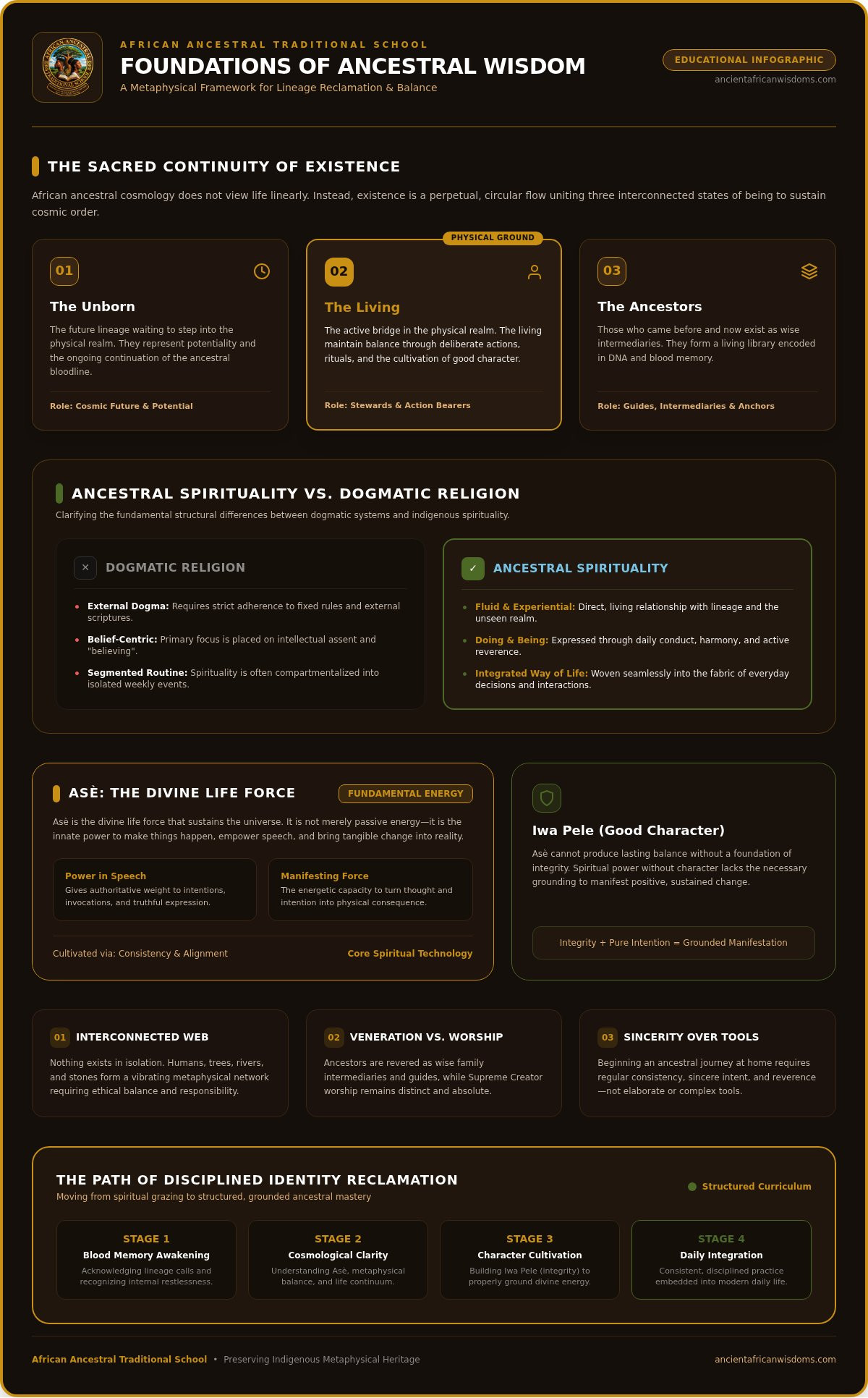
This worldview rests on the profound concept of continuity. In this framework, there's no hard wall between the living, the dead, and the unborn. Instead, life is a circular flow where each group supports the other to maintain cosmic order. Think of these practices as a form of spiritual technology. Just as we use physical tools to build homes, these ancient methods are used to maintain balance within the community and the self. By understanding African ancestral practices, you begin to see how these tools can ground you in a world that often feels chaotic and disconnected.
The Living Connection: Why Lineage Matters
Your lineage is the primary bridge to this ancient wisdom. It isn't just a list of names on a family tree; it's a living library held within your DNA. Many seekers describe a sudden "blood memory" awakening, a sense of knowing something they were never explicitly taught. Reclaiming your identity is the necessary first step because it aligns your internal compass with the frequency of your ancestors. When you honor your specific bloodline, you tap into a reservoir of strength that's uniquely yours. This connection serves as your spiritual anchor, ensuring you don't drift while exploring deeper traditions.
Spirituality vs. Religion: A Crucial Distinction
There's a vital distinction to make between dogmatic religion and ancestral spirituality. While many traditional African religious traditions involve specific cosmologies and moral systems, the focus is often on "doing" and "being" rather than merely "believing." Religion often demands adherence to rigid, external rules and fixed dogmas. In contrast, ancestral spirituality is fluid, personal, and experiential. It's about your direct, living relationship with the unseen world and your own history. Because of this inherent flexibility, these practices don't have to replace your current worldview. Instead, they can inform and deepen it, providing a soulful foundation that respects both your history and your present reality.
The Pillars of Ancestral Wisdom: Worldview and Asè
To truly begin understanding African ancestral practices, you must first shift your perspective from a fragmented view of the world to one of total interconnectedness. In this worldview, nothing exists in isolation. Every tree, stone, river, and person is part of a grand, vibrating web of existence. This holistic nature is often highlighted in Harvard research on indigenous African spirituality, which emphasizes that these systems are not just sets of beliefs, but comprehensive moral and metaphysical frameworks. When you recognize that your actions ripple through this web, you begin to see why indigenous knowledge carries such profound ethical weight. It's a responsibility to maintain balance between yourself, your community, and the natural world.
Understanding Asè: The Divine Life Force
At the center of this interconnected web is a concept known as Asè. You can think of it as the fundamental life force or divine energy that sustains everything in the universe. More than just a passive energy, the asè meaning defines the innate ability to make things happen and bring change into reality. It's the power that empowers your speech and gives weight to your intentions. However, Asè isn't something you simply "have"; it's something you cultivate. This cultivation happens through consistent ritual and, most importantly, through the development of Iwa Pele, or good character. Without integrity and pure intention, spiritual energy lacks the grounding necessary to manifest positive change. If you're ready to explore how to align your own energy with these ancient truths, consider beginning your journey with Ancestral Spiritual Teachings that respect the depth of this power.
African Cosmology: The Map of the Universe
African cosmology provides the map for navigating this energetic landscape. While cultures across the continent vary, most share a common hierarchy of existence. At the summit is the Supreme Creator, the source of all Asè. Below the Creator are the Orishas or various deities, who act as specialized expressions of the Divine. Your ancestors occupy a unique space in this hierarchy, acting as the most immediate bridge between the physical and spiritual realms. They are the guardians of your specific lineage, influencing your physical world daily through guidance and protection. By understanding African ancestral practices, you learn to navigate these layers of existence, moving from a place of confusion to one of structured, sacred alignment.
Ancestor Veneration vs. Worship: Addressing Misconceptions
One of the biggest hurdles in understanding African ancestral practices is the confusion between "worship" and "veneration." In many Western contexts, these terms are used interchangeably, creating a sense of spiritual conflict for those raised in monotheistic religions. Veneration is the act of honoring, respecting, and maintaining a relationship with those who came before you. It's similar to how you might celebrate a late grandparent's birthday or keep their photograph on a mantle. Worship, conversely, is reserved for the Supreme Creator, the source of all life.
Ancestors aren't viewed as gods or replacements for the Divine. Instead, they act as mediators. A scholarly look at African religious worldviews and ancestral mediation shows that ancestors are seen as advocates who understand the human experience because they once lived it. They bridge the gap between our physical needs and the vast, impersonal energy of the Creator. This distinction is crucial for anyone seeking a clear path to understanding African ancestral practices without the weight of religious guilt. An ancestral altar isn't an object of worship; it's a dedicated communication station, a physical focal point that helps you ground your intentions and connect with your lineage.
For many, ancestral veneration for the African diaspora acts as a profound tool for healing. It allows individuals to reclaim a sense of self that was historically disrupted, transforming a feeling of isolation into one of deep belonging. By acknowledging those whose names were lost to history, we begin to repair the broken links in our own identity.
The Role of the Ancestors as Guides
Ancestors serve as spiritual advocates who offer protection and moral guidance. It's helpful to distinguish between "elevated" ancestors, those who lived well and have transitioned into a state of wisdom, and those who may still need healing or prayers from the living. By honoring the elevated ones, you strengthen your own Asè and create a protective shield around your daily life. They act as your first line of defense in the spiritual realm, ensuring your path remains clear and your decisions are rooted in ancient wisdom.
Common Myths Debunked
Several myths often prevent seekers from taking their first steps. Let's look at the facts to clear the path for your journey:
- Myth: You must be "initiated" to speak to your ancestors. Fact: Your ancestors belong to you by blood. Communication is a birthright, not a secret granted by an institution.
- Myth: African spiritual practices are "dark" or "evil." Fact: These traditions focus on balance, character, and community health. They're rooted in the preservation of life and the continuity of the lineage.
- Fact: Ancestral connection is a birthright, not a secret society. You don't need a middleman to start a conversation with your own history. Sincerity and a simple glass of water are often the most powerful tools for connection.
Practical Steps for Your Ancestral Journey at Home
You don't need a hidden temple or elaborate tools to begin your journey of reclamation. The most vital components are your own sincerity and a quiet corner of your home. By understanding African ancestral practices, you recognize that the ancestors aren't seeking material wealth; they're seeking your presence and your heart. You're joining a global community of over 400 million people who maintain these indigenous connections through simple, daily acts. Start exactly where you are today, knowing that your intention carries more weight than any expensive artifact.
Setting Up a Sacred Space
Choose a location that feels respectful and relatively quiet. A simple shelf or a small table is all you need to create a dedicated portal. Place a glass of clear, fresh water at the center to represent spiritual clarity and the cooling of the path for those who came before. Add a white candle to symbolize the light of guidance and a photograph or heirloom that links you to your specific lineage. This space serves as a physical anchor for your spiritual work. To "open the way," sit before your altar and take several intentional breaths. State your name and the names of those you wish to honor. For more specific guidance on these motions, you can consult this resource on African ancestral rituals online.
Daily Veneration Practices
Consistency acts as the fuel for your spiritual growth. The act of pouring a libation, which involves pouring water onto a plant or the earth, is a foundational gesture of respect across many cultures. As you pour the water, speak to your ancestors with the same clarity and reverence you'd offer a respected elder. Tell them about your daily life, your gratitude, and your needs. Silence is just as important as speech. After you've spoken, sit quietly and listen for the subtle responses that often follow. These may arrive as vivid dreams, sudden intuitive hits, or meaningful synchronicities throughout your day. These moments are signs that your Asè is aligning with the wisdom of your bloodline. If you find yourself wanting a more disciplined approach to understanding African ancestral practices, consider exploring our Ancestral Spiritual Teachings for a guided path toward mastery.
Structured Learning: The Path of the African Ancestral Traditional School
As you begin your journey of reclamation, you might feel tempted to gather fragments of information from various sources across the internet. This "spiritual grazing" often leads to more confusion than clarity, leaving you with a collection of rituals but no cohesive foundation. To truly deepen your understanding African ancestral practices, a structured curriculum is essential. It provides a steady, rhythmic progression that mirrors the way traditional knowledge was passed down through generations. The African Ancestral Traditional School offers a digital-first curriculum designed specifically for the diaspora, ensuring that you have access to authentic teachings regardless of your physical location. This methodical approach acts as a bridge, helping you cross from a place of uncertainty to one of quiet confidence.
Why a Structured Curriculum Matters
Relying on a "DIY" approach to spirituality can be precarious without a solid cultural foundation. Without a map, it's easy to misinterpret rituals or overlook the ethical responsibilities they carry. Our structured path begins with Level 1 (Roots), focusing on worldview and identity, before moving through Level 2 (Water) for spiritual perception. By building this foundation in cosmology first, you ensure that later, more advanced rituals in Level 3 (Fire) and Level 4 (Earth) are grounded in truth rather than guesswork. These African ancestral spirituality courses provide the roadmap you need to grow with reverence. Having a mentor to guide you through these tiers ensures that you don't fall into the common pitfalls of spiritual appropriation or historical inaccuracy.
Connecting with a Global Community
Reclaiming your heritage shouldn't be a solitary endeavor. For many in the diaspora, the feeling of cultural isolation is a significant barrier to consistent practice. This is where African spiritual community membership becomes invaluable. It offers a safe space to ask questions, share synchronicities, and find support among others walking the same path of self-discovery. Having a community of seekers and mentors ensures that your growth is both disciplined and nurturing. By understanding African ancestral practices within a collective framework, you bridge the gap between your current reality and your historical roots. This sense of belonging provides the spiritual safety needed to explore your lineage deeply, knowing you're supported by a steady hand and a community of like-minded souls.
Step Into Your Sacred Lineage
You've explored the essence of Asè and the vital distinction between veneration and worship. You now understand that your heritage isn't a static relic of the past, but a living, breathing technology of identity. By understanding African ancestral practices, you align yourself with a lineage that offers both protection and profound purpose. This journey requires patience and sincerity, but you don't have to navigate the path alone. Structured guidance ensures that your first steps are taken with clarity and cultural authenticity, protecting you from the confusion of fragmented information.
If you're ready to move beyond "spiritual grazing" and build a deep, lasting connection to your roots, begin your journey of reclamation with the African Ancestral Traditional School Levels. Our digital curriculum and global community provide the steady hand you need to bridge the gap between your modern life and your ancient roots. Through authentic teachings on rituals and cosmology, you'll find the spiritual safety to explore your identity deeply. Stand tall in your history, knowing that your ancestors are already walking beside you, waiting for you to answer the call.
Frequently Asked Questions
What is the first step in understanding African ancestral practices?
The first step in understanding African ancestral practices is the intentional reclamation of your own identity and lineage. You begin by acknowledging that you are a vital link in a continuous chain of life stretching back through time. This journey starts with a simple shift in perspective, moving from a sense of isolation to one of belonging. Take time to reflect on your family history and set a clear intention to reconnect with your roots.
Do I need to be initiated to connect with my ancestors?
No, you don't need to be initiated to begin a relationship with your own ancestors. This connection is your spiritual birthright, held within your DNA and blood memory from the moment you're born. While advanced rituals may require specific training, the act of honoring your lineage is accessible to everyone. You can start a conversation with your ancestors today using nothing more than a sincere heart and a glass of clear water.
Is African spirituality a religion that requires me to leave my current faith?
African spirituality is a holistic way of life rather than a dogmatic religion, meaning it can often coexist with your current faith. It focuses on "being" and "doing" through character development and ancestral veneration rather than strict adherence to a fixed set of religious rules. Many seekers find that these ancient insights actually deepen their existing worldview. It provides a soulful foundation that respects your history while allowing you to maintain your personal path.
Can I practice African ancestral traditions if I don't know my specific tribe?
You can absolutely practice ancestral traditions even if your specific tribal origins are currently unknown. The African diaspora often faces this challenge, but you can honor your "unknown" ancestors and the collective spirit of your lineage. Your ancestors know who you are, even if you don't yet know their specific names. By focusing on the general principles of African cosmology and your direct bloodline, you can still build a powerful, authentic connection.
What is an ancestral altar and do I really need one at home?
An ancestral altar is a dedicated "communication station" in your home that acts as a physical focal point for your spiritual intentions. While you don't strictly "need" one to be heard, having a sacred space helps you ground your practice and maintain consistency. A simple table featuring water, light, and lineage markers creates a portal for connection. This intentional space serves as a reminder of the sacred continuity between the living and the dead.
How do I know if my ancestors are actually hearing me?
You'll know your ancestors are hearing you through subtle signs, vivid dreams, and meaningful synchronicities in your daily life. Sometimes the response is a sudden intuitive hit or a sense of profound peace during a difficult moment. Learning to notice these responses is a key part of understanding African ancestral practices over time. As you cultivate your character and consistency, the communication becomes clearer, evolving from a whisper into a steady, guiding presence.
What is the difference between an ancestor and a spirit guide?
Ancestors are your direct blood kin who've transitioned to the spiritual realm, while spirit guides may be non-familial energies or deities. Ancestors have a vested interest in your success because you carry their DNA and continue their legacy on earth. They act as your primary advocates and protectors. Spirit guides, conversely, may offer specialized wisdom or assistance but don't share the same biological and historical bond that defines your relationship with your specific lineage.
Are there online schools that teach authentic African traditional wisdom?
Yes, the African Ancestral Traditional School provides a structured, digital-first curriculum for those seeking authentic ancestral teachings. Our school offers tiered learning levels that guide students from basic identity reclamation to deep ritual work with clarity and reverence. This online platform also provides essential community access, allowing students in the diaspora to connect and share their journeys. These courses ensure that you receive a solid foundation in cosmology without the pitfalls of fragmented spirituality.


